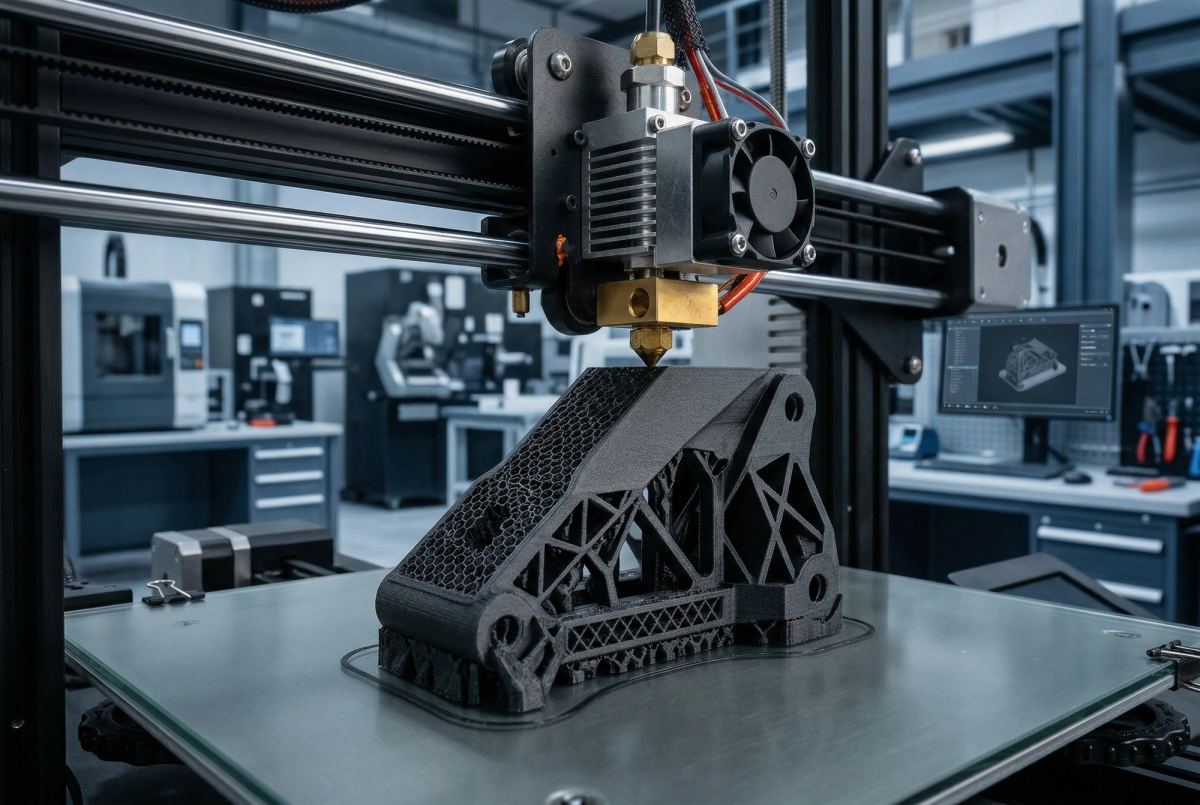
3D printing has grown from a prototyping tool into a serious manufacturing platform for engineering, aerospace, automotive, electronics, medical devices, and custom industrial components. As the technology matures, the material side becomes more important. Printing hardware matters, but material performance is often what determines whether a printed part is just a demonstration model or something that can survive real-world use. That is where graphene enters the picture. Graphene is a form of carbon made of a single layer of atoms arranged in a hexagonal lattice. It is known for its mechanical strength, electrical conductivity, thermal conductivity, and high surface area. Those properties make it attractive as an additive in polymers, coatings, composites, and now increasingly in 3D printing filaments. When graphene is incorporated into thermoplastic filaments, it does not turn every print into a miracle material. That would be a marketing fantasy. What it can do, when used properly, is improve targeted properties in a way that makes printed parts more useful, more durable, or more functional. In additive manufacturing, those incremental gains matter a great deal. This fundamental shift from mere prototyping to creating end-use components demands materials that transcend the limitations of conventional plastics, pushing the boundaries of what is achievable with extrusion-based additive manufacturing.
The Material Imperative in Additive Manufacturing
Why graphene is added to 3D printing filaments: Standard 3D printing materials such as PLA, PETG, ABS, nylon, TPU, and polycarbonate all come with strengths and weaknesses. Some are easy to print but brittle. Some are tough but difficult to process. Some have good temperature resistance but poor dimensional stability. Material engineers are constantly trying to push those tradeoffs in better directions. Graphene can help because it acts as a nanoscale reinforcement and performance modifier. Even at relatively low loading levels, a graphene additive may improve stiffness, tensile behavior, thermal conduction, wear resistance, or electrical conductivity, depending on the base polymer and how the formulation is engineered. This is especially important in 3D printing because layer-by-layer manufacturing introduces inherent challenges that traditional manufacturing processes do not face.
The very nature of fused deposition modeling (FDM) or fused filament fabrication (FFF) creates anisotropic properties, meaning a printed part's strength can vary significantly depending on the direction of applied force. Weak layer adhesion, susceptibility to warping due to differential cooling, and a general lack of robustness compared to injection-molded parts are common hurdles. These limitations often relegate 3D printed objects to non-critical applications, or require extensive post-processing to achieve acceptable performance. The material imperative in additive manufacturing is thus to develop filaments that not only print reliably but also imbue the final part with the mechanical, thermal, and electrical properties necessary for demanding applications, directly addressing these inherent architectural weaknesses. Graphene offers a strategic pathway to overcome many of these constraints by augmenting the base polymer's capabilities at a molecular level.
Graphene's Unique Toolbox for Filaments
Graphene's exceptional properties make it an ideal candidate for enhancing 3D printing filaments. Its atomic structure, a single layer of carbon atoms in a hexagonal lattice, confers an unparalleled combination of characteristics. Mechanically, graphene is the strongest material known, exhibiting immense tensile strength and stiffness, which it can impart to polymer matrices even at low concentrations. This nanoscale reinforcement mechanism significantly improves the composite material's load-bearing capabilities and structural integrity.
Beyond its mechanical prowess, graphene possesses extraordinary thermal conductivity, superior to almost any other known material. This property is crucial in 3D printing, as it can help dissipate heat more efficiently during the printing process, reducing thermal stresses and improving dimensional accuracy. It also allows for the creation of printed parts that can act as functional heat sinks or improve the overall thermal management of electronic components. Furthermore, graphene is an excellent electrical conductor, opening doors for creating conductive filaments suitable for electrostatic discharge (ESD) protection, embedded circuitry, or sensor applications directly within printed objects. Its high surface area also contributes to improved interfacial bonding within the composite, ensuring that these beneficial properties are effectively transferred from the graphene to the polymer matrix and ultimately to the final printed part.
Enhancing Mechanical Performance and Durability
The primary goal for many graphene-enhanced filaments is to boost the mechanical performance and durability of printed parts, transforming them from mere prototypes into functional components. By incorporating graphene, manufacturers can significantly improve tensile strength, impact resistance, and stiffness. Graphene acts as a reinforcing filler, distributing stress more effectively throughout the material and inhibiting crack propagation, which is a common failure mode in traditional 3D printed plastics. This leads to parts that can withstand higher loads and endure more rigorous use environments.
The addition of graphene also plays a critical role in addressing common 3D printing issues like warpage and poor dimensional stability. Graphene's high thermal conductivity helps to homogenize temperature distribution within the part during printing, reducing localized stresses that cause warping as the material cools. This results in more accurate prints with tighter tolerances, essential for parts requiring precise fitting or assembly. Moreover, graphene can improve the wear resistance of printed components, extending their lifespan in applications involving friction or abrasion. By enhancing these fundamental mechanical characteristics, graphene allows for the creation of robust, long-lasting parts that were previously unattainable with standard thermoplastic filaments, making 3D printing viable for more demanding industrial and consumer applications.
Unleashing New Functionalities: Electrical and Thermal Properties
Beyond mechanical enhancements, graphene uniquely enables new functionalities in 3D printed parts through its exceptional electrical and thermal properties. The ability to produce electrically conductive filaments opens up a vast array of applications previously limited to traditional circuit boards or complex multi-material assemblies. Graphene-infused filaments can be used to print custom enclosures with integrated ESD protection, preventing damage to sensitive electronics by safely dissipating static charges. They also facilitate the creation of custom sensors, flexible electronics, or even complex wiring harnesses directly within a printed structure, streamlining design and manufacturing processes.
Similarly, graphene's superior thermal conductivity is revolutionizing thermal management in additive manufacturing. Filaments enhanced with graphene can be used to print highly efficient heat sinks that dissipate heat from electronic components or other critical areas, improving device performance and longevity. This also impacts the printing process itself, as better heat transfer within the extruded material can lead to more consistent layer adhesion and reduced internal stresses, contributing to overall part quality. The strategic incorporation of graphene allows engineers to design and print parts with integrated thermal pathways, enabling entirely new approaches to cooling and temperature regulation in diverse applications from aerospace to consumer electronics. This functional augmentation moves 3D printing beyond simple form creation into complex, performance-driven engineering.
The Science of Integration: Formulating Graphene-Enhanced Filaments
The successful integration of graphene into thermoplastic filaments is a sophisticated scientific and engineering challenge, requiring meticulous formulation and processing. It is not merely a matter of mixing graphene powder into a polymer melt; rather, it involves achieving uniform dispersion of graphene at the nanoscale within the polymer matrix. Poor dispersion can lead to aggregation, diminishing graphene's beneficial properties and potentially weakening the final material. Researchers and manufacturers employ advanced compounding techniques, often involving shear mixing or solvent-assisted methods, to exfoliate graphene layers and distribute them homogeneously throughout the polymer.
Furthermore, the type of graphene material used – whether it's graphene nanoplatelets (GNPs), few-layer graphene, or reduced graphene oxide – plays a critical role in determining the final properties and printability. Each form has distinct characteristics regarding aspect ratio, surface area, and functional groups, which influence its interaction with specific polymers. Surface modification of graphene can also be employed to improve its compatibility and interfacial bonding with various polymer matrices, enhancing the transfer of mechanical and electrical properties. This precise control over graphene morphology, loading levels, and dispersion ensures that the resulting filament maintains excellent printability, while simultaneously delivering the targeted performance enhancements without compromising the base material's inherent processability. The science behind these formulations is what truly unlocks the potential of graphene in additive manufacturing.
Real-World Applications and Future Outlook
Graphene-enhanced 3D printing filaments are already making tangible impacts across a multitude of industries, with their potential continuing to expand rapidly. In the aerospace sector, these materials are enabling the creation of lighter, stronger components with integrated sensor capabilities, reducing fuel consumption and enhancing structural integrity. Automotive manufacturers are exploring graphene filaments for custom tooling, lightweight interior parts, and even functional prototypes that can withstand more rigorous testing conditions. The electronics industry benefits from conductive graphene filaments for rapid prototyping of circuits, ESD-safe enclosures, and smart devices with embedded functionalities.
In the medical field, graphene’s biocompatibility and mechanical strength are paving the way for advanced prosthetic components, custom surgical guides, and even scaffolds for tissue engineering. The future outlook for graphene in 3D printing is incredibly promising, with ongoing research focused on developing multi-functional materials that combine several properties simultaneously. Imagine filaments that are not only strong and conductive but also self-healing or responsive to environmental stimuli. As material science continues to advance and graphene production scales efficiently, these advanced carbon additives will become standard components in the next generation of additive manufacturing, enabling truly revolutionary products and manufacturing paradigms across every conceivable sector. The integration of graphene is fundamentally transforming what is possible with 3D printing.
Frequently Asked Questions
What are the primary benefits of using graphene in 3D printing filaments?
Graphene significantly improves several key properties of 3D printing filaments. It enhances mechanical strength, stiffness, and impact resistance, making parts more durable. It also boosts thermal conductivity, which aids in heat dissipation and reduces warping, while its electrical conductivity enables the printing of functional electronic components and ESD-safe parts. These enhancements collectively elevate the performance and utility of printed objects.
Is graphene safe for use in 3D printing filaments and printed parts?
When properly encapsulated within a polymer matrix, graphene is generally considered safe for use in 3D printing filaments. Extensive research is ongoing, but current understanding suggests that graphene embedded in a polymer does not pose the same risks as airborne nanoparticles. Manufacturers adhere to strict safety guidelines in production, and end-users should follow standard safety protocols for 3D printing, including proper ventilation.
Does adding graphene make 3D printing filaments significantly more expensive?
While graphene is an advanced material, the cost impact on filaments can vary. Due to graphene's high efficiency, only small loading levels are often needed to achieve significant property improvements, which helps manage costs. While graphene-enhanced filaments are typically priced higher than basic commodity plastics, the added performance and functionality they provide can result in substantial cost savings in overall product development and application.
Can I print graphene-enhanced filaments on any standard 3D printer?
Most graphene-enhanced filaments are designed to be compatible with standard FDM/FFF 3D printers, using common nozzle sizes and extrusion temperatures. However, specific formulations might have optimized printing parameters, such as slightly higher nozzle temperatures or adjusted print speeds, to achieve the best results. Always consult the filament manufacturer's recommendations for optimal printing settings to fully leverage the material's potential.
How much graphene is typically added to a 3D printing filament?
The amount of graphene added to a 3D printing filament is typically very low, often ranging from 0.1% to 5% by weight. This relatively small loading is sufficient due to graphene's exceptional properties and high aspect ratio. The precise concentration depends on the desired property enhancement, the type of base polymer, and the specific form of graphene used in the composite.
The integration of graphene into 3D printing filaments represents a pivotal advancement in additive manufacturing. It directly addresses the long-standing challenges of material performance, transforming 3D printed parts from simple prototypes into high-performance, functional components capable of meeting stringent industrial demands. From enhanced mechanical strength and thermal management to groundbreaking electrical conductivity, graphene unlocks capabilities that were once beyond the reach of conventional thermoplastics. This innovative material is not merely an additive; it is a catalyst for innovation, enabling engineers and designers to push the boundaries of what is possible in design, production, and application. As usa-graphene.com continues to drive the development of advanced carbon additives, the future of 3D printing promises to be stronger, smarter, and infinitely more capable.