Graphene Applications, 3D printing
Graphene Usage in 3D Printing Filaments: Why Advanced Carbon Additives Matter
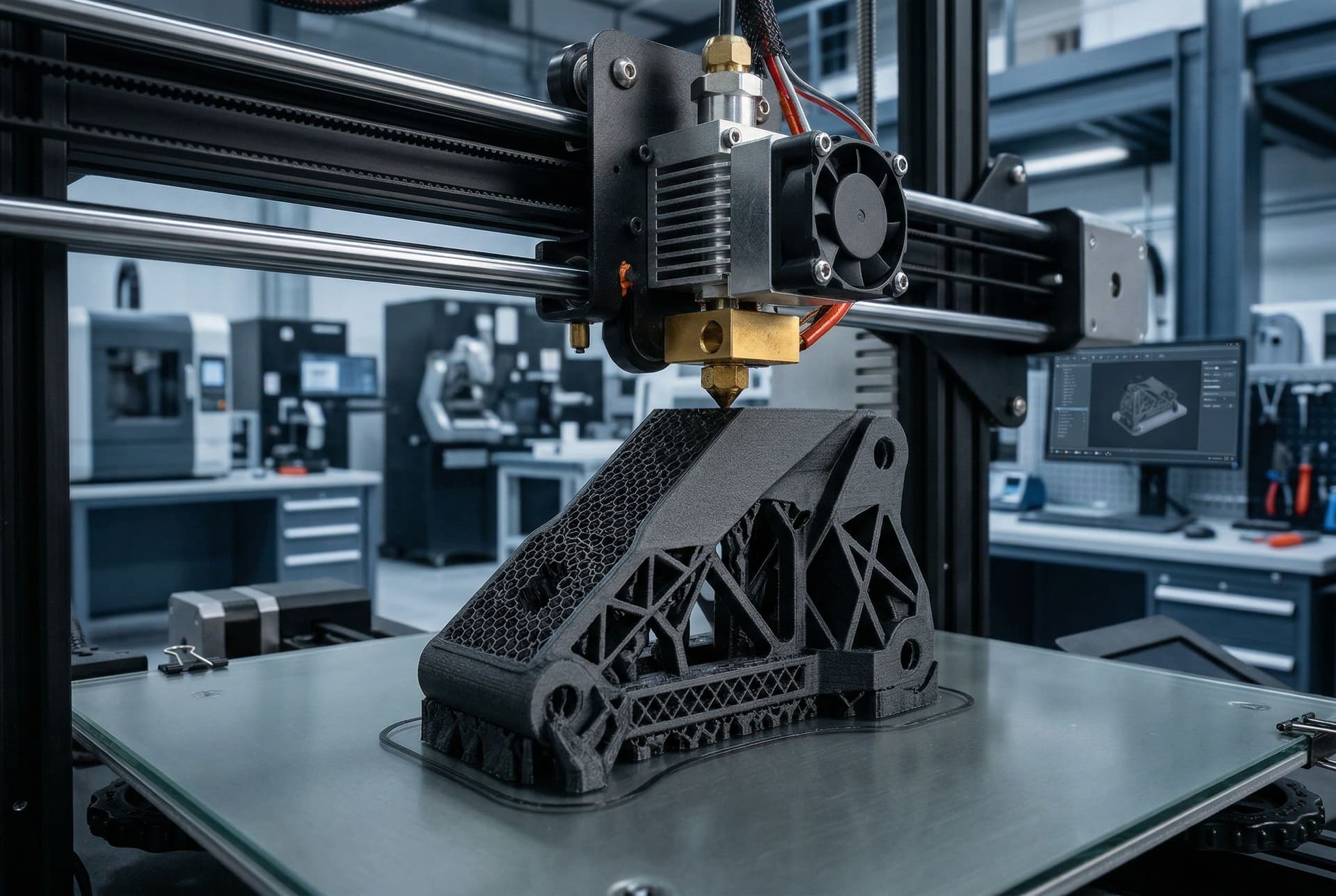
3D printing has grown from a prototyping tool into a serious manufacturing platform for engineering, aerospace, automotive, electronics, medical devices, and custom industrial components. As the technology matures, the material side becomes more important. Printing hardware matters, but material performance is often what determines whether a printed part is just a demonstration model or something that can survive real-world use.
That is where graphene enters the picture. Graphene is a form of carbon made of a single layer of atoms arranged in a hexagonal lattice. It is known for its mechanical strength, electrical conductivity, thermal conductivity, and high surface area. Those properties make it attractive as an additive in polymers, coatings, composites, and now increasingly in 3D printing filaments.
When graphene is incorporated into thermoplastic filaments, it does not turn every print into a miracle material. That would be a marketing fantasy. What it can do, when used properly, is improve targeted properties in a way that makes printed parts more useful, more durable, or more functional. In additive manufacturing, those incremental gains matter a great deal.
Why graphene is added to 3D printing filaments
Standard 3D printing materials such as PLA, PETG, ABS, nylon, TPU, and polycarbonate all come with strengths and weaknesses. Some are easy to print but brittle. Some are tough but difficult to process. Some have good temperature resistance but poor dimensional stability. Material engineers are constantly trying to push those tradeoffs in better directions.
Graphene can help because it acts as a nanoscale reinforcement and performance modifier. Even at relatively low loading levels, a graphene additive may improve stiffness, tensile behavior, thermal conduction, wear resistance, or electrical conductivity, depending on the base polymer and how the formulation is engineered.
This is especially important in 3D printing because layer-by-layer manufacturing introduces weaknesses that bulk molded plastics do not always have to the same degree. Filaments that improve interlayer adhesion, reduce cracking, or add functionality can expand what printed parts are actually good for.
1. Mechanical reinforcement and stiffness
One of the first reasons people look at graphene-filled filaments is strength. In many cases, the more accurate word is reinforcement. Graphene does not automatically make every printed part stronger in every direction, but it can increase stiffness, modulus, and mechanical integrity when dispersed effectively.
Graphene sheets interact with the polymer matrix and can help transfer stress more efficiently through the material. That matters in printed parts because cracks often begin at weak interfaces, voids, or poorly bonded layers. A properly formulated graphene composite filament may help reduce some of those weaknesses and make the part feel more rigid and engineered.
This is useful in structural prototypes, lightweight brackets, housings, jigs, fixtures, and load-bearing demonstration parts. Designers who need printed parts to behave more like functional engineering components, rather than simple visual models, often see value in graphene-enhanced formulations.
That said, reinforcement depends strongly on dispersion and formulation quality. If the graphene is poorly distributed or overloaded into the polymer, the result can actually become more brittle or inconsistent. Good composite design matters more than marketing claims.
2. Improving electrical conductivity
Another major use case is conductivity. Most common 3D printing polymers are electrical insulators. That is fine for general objects, but it limits their use in electronics, sensing, shielding, and functional devices. Graphene can help create conductive pathways within the filament, especially when combined with other conductive fillers or optimized at the right concentration.
Conductive graphene filaments can be useful for:
- low-current circuits and experimental electronic structures
- sensors and touch-sensitive components
- electromagnetic interference shielding
- antistatic housings or trays
- wearable or embedded prototyping
This does not mean every graphene filament becomes a copper replacement. The conductivity of graphene-filled thermoplastics is usually far below that of metals. But it may be high enough for many specialized applications where lightweight, printable, integrated functionality matters more than maximum conductivity.
This is one reason graphene has attracted attention in printed electronics and rapid prototyping. Instead of assembling multiple material systems after printing, engineers can sometimes build more function directly into the printed component.
3. Thermal conductivity and heat management
Heat management is another area where graphene can add value. Polymers generally have poor thermal conductivity, which can be a limitation in enclosures, heat-spreading components, battery mounts, LED housings, or electronics-related parts. Graphene has very high intrinsic thermal conductivity, so when it is incorporated into a filament, it may improve heat dissipation compared with the neat polymer.
Again, this does not turn a plastic into aluminum, but it can push a printed material in a more useful direction. A graphene-filled filament may help reduce hotspots, spread heat more evenly, or improve performance in parts that operate near warm electronics or mechanical friction points.
For advanced users, thermal improvement can also matter during printing itself. Fillers sometimes change how a filament melts, cools, or crystallizes. That can influence dimensional control, warping behavior, and interlayer bonding. In some formulations, graphene may contribute to more stable processing, while in others it may require tighter print settings. Material-specific tuning is essential.
4. Wear resistance and durability
Many printed parts fail not because they snap immediately, but because they wear out over time. Sliding interfaces, repeated contact points, abrasive exposure, and cyclic mechanical loading can all degrade polymer parts. Graphene may help improve wear resistance and durability by reinforcing the matrix and altering the friction behavior of the finished composite.
This is attractive for printed gears, guides, bushings, housings, clips, and custom replacement parts where repeated use matters. In industrial settings, the ability to print a part quickly is useful, but the ability to print a part that actually lasts is much more valuable.
Graphene can also contribute to surface hardness and scratch resistance in some systems. That may improve the feel and longevity of consumer-facing parts, tools, or custom enclosures.
5. Lightweight functional composites
One of the most compelling reasons to use graphene in 3D printing is that it can add multiple improvements without adding much weight. Metals improve conductivity and strength, but they are heavy. Glass fibers and carbon fibers can reinforce polymers, but they change print behavior and may reduce fine-detail printability. Graphene offers a path toward multifunctional enhancement at relatively low filler loadings.
That makes it attractive in lightweight design. Engineers often want printed parts that do not just hold shape, but also resist heat, manage static, carry low-level signals, or survive handling in the field. A graphene-filled filament can sometimes deliver several of those gains at once.
This is why graphene filaments are interesting not only for hobby printing, but for drone components, robotics, field tools, research devices, and specialized industrial development.
6. Better prototyping for real products
A large percentage of 3D printed parts are prototypes, but not all prototypes are equal. Some are appearance models. Others are fit-test models. The most useful ones are functionally honest prototypes that behave more like the final product.
Graphene-enhanced filaments can help make prototypes more meaningful. If a part needs to withstand moderate stress, dissipate some heat, or simulate conductive behavior, a graphene composite may provide a better development material than standard PLA or PETG.
This shortens the gap between concept and deployment. Instead of printing a cosmetic stand-in and later discovering major performance differences in the final material, engineers can test a more realistic printed part earlier in the development cycle.
That does not replace final validation in production materials, but it does improve the quality of iteration.
7. Common base polymers for graphene filament development
Graphene can be blended into a variety of base polymers, and each brings a different balance of printability and performance.
PLA-based graphene filaments are often marketed for ease of printing and improved stiffness. These are useful for general prototyping and entry-level functional printing, though they still inherit PLA’s limitations in heat resistance and brittleness.
PETG-based graphene filaments may offer a better balance of toughness, printability, and chemical resistance. These can be attractive for practical engineering parts that need more resilience.
ABS and ASA systems are interesting when thermal performance and durability matter more, though print conditions become more demanding.
Nylon-graphene composites can be especially promising because nylon is already a serious engineering polymer. With graphene, such materials may offer improved wear, stiffness, and function, though moisture control and print tuning become more important.
Flexible systems like TPU can also benefit from conductive or sensing behavior when modified correctly, opening the door for smart wearables, pressure-sensitive parts, or soft functional components.
8. Challenges and limitations
Graphene in filament is promising, but it is not automatically easy. One challenge is dispersion. If graphene agglomerates inside the polymer, the filament may show inconsistent print quality, rough extrusion behavior, or uneven performance. The quality of the compound and extrusion process matters enormously.
Another issue is nozzle wear and printer compatibility. Depending on the overall filler system, some advanced composite filaments may be more abrasive than standard materials. Users may need hardened nozzles or more careful maintenance.
Print settings can also shift. Composite filaments often require tuning of extrusion temperature, cooling, speed, and retraction to achieve their best results. A good graphene filament should still be usable in conventional printing workflows, but it may not behave exactly like plain PLA or PETG.
There is also the issue of expectations. Some products are marketed aggressively, and not all graphene-labeled filaments contain enough well-dispersed graphene to make a meaningful difference. Engineers should evaluate supplier quality, testing data, and intended use rather than relying on branding alone.
Cost is another factor. Graphene additives can increase filament price, which means the value proposition must be tied to actual performance gains. For hobby use, the improvement may not always justify the cost. For industrial or technical applications, however, even modest performance gains may easily justify a premium filament.
9. Where graphene filaments are most useful today
Graphene-enhanced 3D printing filaments are most useful in applications where a standard polymer almost works but not quite. They are especially attractive when users need one or more of the following:
- improved stiffness or mechanical integrity
- antistatic or conductive performance
- better heat spreading
- improved wear resistance
- lightweight multifunctional behavior
- more realistic engineering prototypes
That makes them well suited for industrial prototyping, robotics, electronics housings, custom tools, sensor platforms, aerospace development parts, and research hardware.
In these areas, the question is not whether graphene is magical. The question is whether it gives enough extra performance to make a printed part more useful. Often, that answer is yes.
10. The future of graphene in additive manufacturing
As additive manufacturing matures, materials will become more specialized. The market is moving away from one-size-fits-all filaments and toward application-specific compounds. Graphene fits that trend well because it can serve as a platform additive for tuning multiple properties at once.
Future graphene filaments may become more consistent, more affordable, and more tailored to exact functions such as EMI shielding, printed sensors, thermal control, or durable lightweight structures. We may also see graphene used in pellet extrusion, large-format additive systems, and higher-temperature engineering polymers beyond consumer desktop printing.
The long-term opportunity is not just prettier prints or slightly stiffer hobby parts. It is the expansion of additive manufacturing into more demanding real-world functions where material performance decides whether printing is actually useful.
Conclusion
Graphene usage in 3D printing filaments matters because additive manufacturing increasingly needs materials that do more than simply print cleanly. Engineers want parts that are stronger, more durable, more thermally stable, and sometimes electrically functional. Graphene offers a way to push thermoplastic filaments in that direction.
It is not a universal fix, and it does not remove the need for good formulation, sound print settings, or realistic expectations. But as a reinforcement and functional additive, graphene has real value in advanced filaments. For companies and developers trying to get more out of 3D printing, that makes graphene one of the most interesting material tools in the space today.
---
Author: Raimundas Juodvalkis