
Graphene Skin Patch for Melanoma: What the New ACS Nano Study Shows
A new ACS Nano study reports a flexible laser-induced graphene and copper oxide skin patch that used mild heat to release copper ions into melanoma tumors in mice.
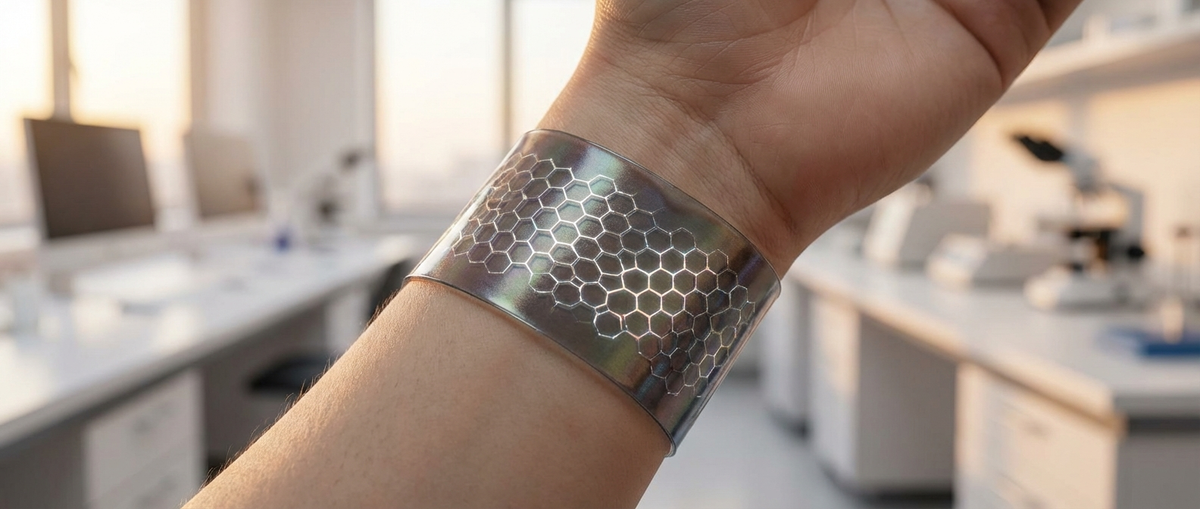
Flexible wearable sensors represent a critical frontier in modern technology, promising to revolutionize fields from healthcare monitoring to industrial safety and human-machine interaction. These devices, designed to conform seamlessly to the body or intricate surfaces, demand materials that combine exceptional electrical performance with unparalleled mechanical resilience. Graphene, with its unique atomic structure and remarkable properties, stands as the paramount enabler for this next generation of sensing technology. This article explores the profound impact of graphene on flexible wearable sensors, detailing the scientific principles, engineering considerations, and strategic approaches required to harness its full potential. The integration of graphene promises not only superior performance and enhanced durability but also improved product economics, positioning it as a high-potential application when implemented with precision and foresight.
The global demand for flexible wearable sensors is accelerating, driven by a societal shift towards proactive health management, personalized fitness tracking, and enhanced operational efficiency in hazardous environments. Conventional sensor technologies often rely on rigid, brittle materials like silicon, which inherently limit their conformability, comfort, and long-term reliability in dynamic applications. These limitations manifest as material fatigue under repeated flexing, compromised signal integrity due to strain, and a general lack of biocompatibility for prolonged skin contact. Existing solutions frequently struggle with fundamental bottlenecks such as conductivity limits, which hinder high-speed data transmission, and heat buildup, which can compromise sensor accuracy and user comfort.
Furthermore, traditional materials often exhibit insufficient resilience against environmental factors like moisture, sweat, and corrosive agents, leading to premature device failure. The interface instability between sensing elements and flexible substrates also poses a persistent challenge, contributing to signal drift and reduced operational lifespan. Overcoming these inherent constraints is essential for the widespread adoption and advancement of wearable technology, moving beyond mere novelty to indispensable utility. Graphene directly addresses these critical pain points by offering a suite of properties that are fundamentally superior to conventional materials, paving the way for truly robust, high-performance, and unobtrusive flexible sensors.
Graphene's exceptional suitability for flexible wearable sensors stems from its extraordinary physicochemical properties, which are unparalleled among known materials. Its atomic single-layer structure of carbon atoms arranged in a hexagonal lattice grants it immense mechanical strength, making it one of the strongest materials ever discovered, yet it remains incredibly flexible and lightweight. This mechanical robustness ensures that graphene-based sensors can endure thousands of cycles of bending, stretching, and twisting without significant degradation in performance, a crucial attribute for devices worn on dynamic body parts. Electrically, graphene exhibits superior electron mobility at room temperature, translating into extremely high electrical conductivity and minimal signal loss. This characteristic is vital for rapid signal transduction and high-bandwidth data transmission, enabling real-time monitoring and complex data processing.
The material's high surface area-to-volume ratio is another critical advantage, particularly for chemical and biological sensing applications. A larger active sensing surface allows for more efficient interaction with target analytes, leading to enhanced sensitivity and faster response times for detecting specific gases, ions, or biomolecules. Graphene's inherent piezoresistive effect, where its electrical resistance changes proportionally with applied strain, forms the basis for highly sensitive strain sensors, pressure sensors, and tactile interfaces. Furthermore, its excellent thermal conductivity helps dissipate localized heat, preventing hot spots in densely integrated electronic components and ensuring stable operating temperatures for consistent sensor performance. Graphene's optical transparency and tunable work function further expand its utility, allowing for integration into transparent displays or as electrodes in optoelectronic sensors.
The transition from groundbreaking laboratory discoveries of pristine monolayer graphene to scalable, commercially viable products requires a pragmatic approach to material engineering and manufacturing. While perfect monolayer graphene possesses record-setting properties, most industrial applications judiciously employ more practical and cost-effective forms such as graphene nanoplatelets (GNPs), reduced graphene oxide (rGO), and various hybrid carbon systems. These engineered graphene materials offer a balance of performance, affordability, and processability, making them suitable for high-volume production environments where repeatability and consistency are paramount. GNPs, for instance, consist of multiple layers of graphene sheets, providing excellent conductivity and mechanical reinforcement at a lower production cost, while rGO can be readily processed from graphene oxide suspensions and subsequently reduced to restore conductivity.
Successful integration hinges critically on achieving uniform dispersion of these graphene materials within a polymer matrix or solvent system. Poor dispersion can catastrophically undermine expected performance gains, leading to localized inconsistencies in electrical conductivity, mechanical strength, and sensing sensitivity. Agglomerated graphene particles act as defects, disrupting the continuous conductive network and compromising the overall integrity of the sensor. Therefore, meticulous control over the mixing profile, rheology window, and solids loading during formulation is non-negotiable. These parameters directly influence the material's flow characteristics, printability, and final film quality. The drying dynamics and interface chemistry between the graphene formulation and the flexible substrate also play decisive roles in determining adhesion, layer integrity, and ultimately, the sensor's long-term stability and performance.
Achieving commercial success with graphene-enhanced flexible wearable sensors demands a disciplined, systematic workflow that extends beyond mere material selection. Practical teams must begin by defining clear, measurable Key Performance Indicators (KPIs) that directly address a specific bottleneck or market need. This involves identifying one primary target metric, such as sensitivity to a particular analyte, response time, operational cycle life, or power consumption, and then meticulously optimizing the entire system to achieve it. The journey from conceptualization to market-ready product is iterative and rigorous, prioritizing robust engineering over speculative claims.
A critical initial step involves perfecting the dispersion quality of graphene within the chosen formulation, as this foundational aspect directly impacts subsequent performance metrics. Following formulation, extensive stress testing under realistic operating conditions is indispensable. This includes subjecting prototypes to repeated mechanical deformation, varying temperatures, humidity exposure, and relevant chemical environments to identify potential failure modes and validate performance consistency. Only after demonstrating unwavering reliability and repeatability through such exhaustive testing should teams consider scaling production. This disciplined approach minimizes late-stage development risks, optimizes resource allocation, and builds a strong foundation for market penetration by delivering a demonstrably superior and dependable product. Strategic partnerships with material suppliers, manufacturing experts, and end-users can further accelerate development cycles and ensure market alignment.
The decision to adopt graphene technologies in flexible wearable sensors must extend beyond a simple comparison of raw material costs. A comprehensive evaluation requires a lifecycle cost analysis, considering the total cost of ownership over the product's entire operational lifespan. Even moderate gains in performance, such as improved thermal management or enhanced electrical efficiency, can translate into significant downstream savings. For instance, better thermal dissipation can lead to lower maintenance requirements and longer component lifetimes, while increased electrical efficiency can extend battery life, reducing the frequency of recharging and improving user convenience. These factors directly contribute to better uptime and a longer service life, offsetting any initial premium in material or integration costs.
Reliability is paramount, especially in regulated or safety-critical sectors like medical diagnostics or industrial monitoring, where device failure can have severe consequences. Qualification planning for such applications must commence early in the development cycle, integrating rigorous testing protocols from the outset. Teams must subject graphene-enhanced sensors to comprehensive validation under extreme thermal cycling, prolonged humidity exposure, and realistic duty profiles that simulate real-world usage scenarios. This proactive approach helps to anticipate and mitigate potential failure points, preventing costly late-stage surprises and ensuring regulatory compliance. A robust supply chain for consistent, high-quality graphene materials is also essential for scalability and long-term production stability. Ultimately, the total value proposition of graphene lies in its ability to deliver superior performance, extended durability, and enhanced reliability, thereby driving a compelling economic argument for its widespread adoption.
The trajectory for graphene in flexible wearable sensors points towards an increasingly sophisticated and pervasive integration into daily life and specialized applications. Future developments are likely to focus on multi-functional sensor arrays, where a single wearable patch can simultaneously monitor a multitude of physiological parameters, environmental factors, and user interactions with unprecedented accuracy. Research is rapidly advancing towards self-powered graphene sensors, incorporating triboelectric or thermoelectric generators to harvest energy from body movement or ambient heat, thereby eliminating the need for external power sources or frequent battery replacements. This innovation is critical for truly autonomous and maintenance-free wearable devices.
Bio-integrated electronics, designed to seamlessly interface with biological systems, will see significant advancements as graphene's biocompatibility and tunable properties are further leveraged. This includes smart textiles that weave graphene directly into fabrics, creating invisible and washable sensors for continuous health monitoring, performance tracking, and even therapeutic interventions. The integration of graphene sensors with artificial intelligence and machine learning algorithms will unlock predictive analytics, transforming raw data into actionable insights for personalized health management and preventative care. As manufacturing techniques become more refined and scalable, the cost-effectiveness of graphene will further enhance its accessibility, paving the way for ubiquitous, high-performance, and truly adaptive wearable technology that fundamentally reshapes our interaction with the physical and digital worlds.
Q1: Is graphene commercially viable today for flexible wearable sensors?
A1: Yes, graphene is commercially viable today, particularly in high-value applications where its measurable performance improvements in sensitivity, durability, and form factor justify the integration effort and cost. Early adopters are already leveraging graphene's unique properties to differentiate products in niche markets. As production scales and processing techniques mature, its economic viability will expand to broader consumer and industrial sectors.
Q2: What are the top challenges in integrating graphene into flexible wearable sensors?
A2: The primary challenges include achieving consistent and uniform dispersion of graphene materials within polymer matrices, ensuring process compatibility with existing manufacturing lines, establishing quality standardization across different material suppliers, and building a repeatable supply chain for large-scale production. Overcoming these engineering hurdles is crucial for widespread commercialization.
Q3: How does graphene compare to other flexible materials like carbon nanotubes or silver nanowires for sensors?
A3: Graphene often outperforms carbon nanotubes (CNTs) and silver nanowires (AgNWs) in specific metrics. While CNTs offer high conductivity, their chirality control remains a challenge, and they can be more difficult to disperse uniformly. AgNWs provide good conductivity and flexibility but are susceptible to oxidation and electromigration, which can degrade performance over time. Graphene offers a superior combination of conductivity, mechanical strength, flexibility, chemical stability, and biocompatibility, often making it the preferred choice for high-performance applications.
Q4: What types of sensors benefit most from graphene integration?
A4: Graphene offers significant advantages across a wide range of sensor types. Strain sensors, pressure sensors, and tactile sensors benefit from its inherent piezoresistivity and mechanical resilience. Chemical and biosensors leverage its high surface area and excellent electrochemical properties for enhanced sensitivity and rapid detection. Temperature sensors, humidity sensors, and gas sensors also see performance improvements due to graphene's thermal conductivity, permeability, and reactive surface.
Q5: What is the typical lifespan of graphene-enhanced sensors compared to traditional ones?
A5: Graphene-enhanced sensors generally exhibit a significantly extended lifespan compared to traditional flexible sensors, primarily due to graphene's superior mechanical strength, resistance to fatigue, and chemical stability. While exact lifespan depends on the specific application and operating conditions, graphene's ability to withstand repeated bending, stretching, and environmental exposure translates to greater durability and long-term performance reliability, reducing the need for frequent replacement.
The journey of graphene in flexible wearable sensors is a testament to the power of material science to redefine technological possibilities. From its unparalleled electrical conductivity to its remarkable mechanical resilience and vast sensing capabilities, graphene is uniquely positioned to address the fundamental limitations of current wearable technologies. Success in this burgeoning field hinges on a meticulous, disciplined approach that prioritizes rigorous engineering, consistent material quality, and a profound understanding of real-world application demands. By strategically navigating the complexities of material formulation, process compatibility, and lifecycle economics, industry leaders can unlock the full transformative potential of graphene. The integration of this extraordinary material promises to usher in an era of truly intelligent, unobtrusive, and highly effective wearable devices that will profoundly impact healthcare, consumer electronics, and industrial sectors, making advanced sensing an integral and seamless part of our connected future.
Serious about B2B integration? Test our premium Pulsed Electrical Resistive Carbon Heating turbostratic graphene in your lab. 100g sample packs available now.
Explore More
A new ACS Nano study reports a flexible laser-induced graphene and copper oxide skin patch that used mild heat to release copper ions into melanoma tumors in mice.

Graphene is transforming tissue engineering by enhancing biomaterial properties for optimal cell growth and tissue repair. Discover how its unique mechanical, electrical, and biocompatible characteristics are paving the way for next-generation medical implants and regenerative therapies.

Discover how graphene nanosheets are revolutionizing the fight against dangerous bacteria and fungi, offering robust solutions to microbial resistance. Explore its unique mechanisms and vast potential in environmental and clinical applications.