
Graphene Radar Absorbing Materials for Aircraft and Drones
Graphene coatings are being studied for radar absorbing materials because they can help make aircraft and drones lighter, thinner, and more electromagnetically tunable.
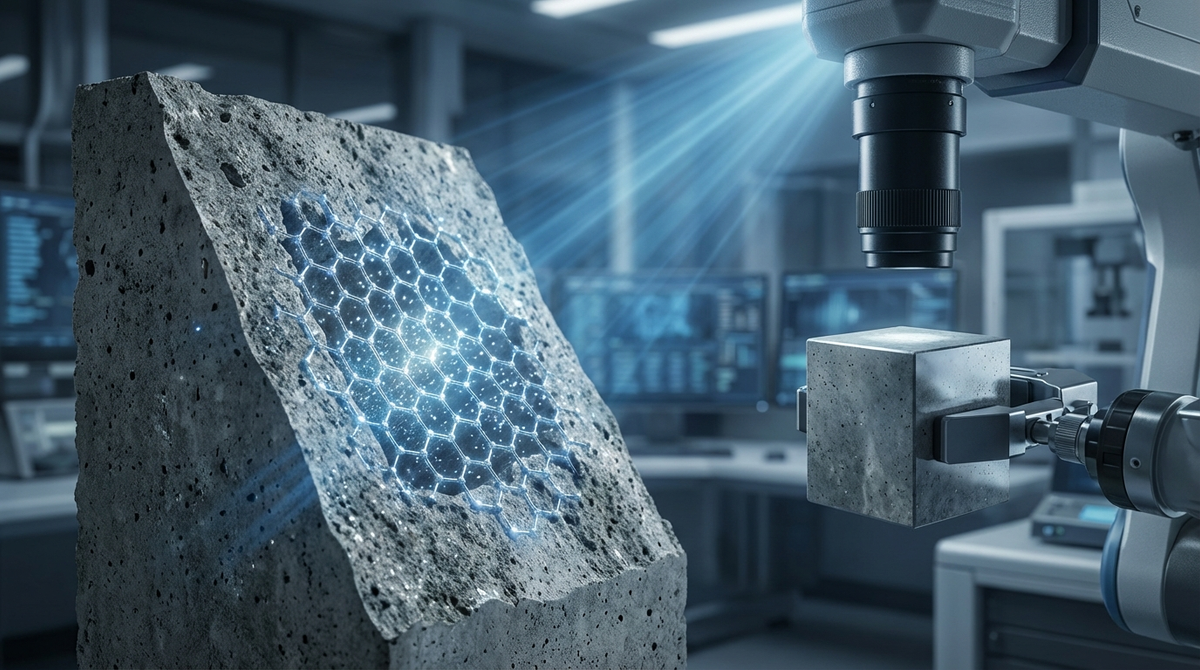
The inherent limitations of conventional cementitious composites, primarily their relatively low tensile strength, susceptibility to microcracking, and permeability to aggressive agents, necessitate advanced material interventions. Graphene, a single-atom-thick allotrope of carbon arranged in a hexagonal lattice, emerges as a transformative material due to its unparalleled mechanical, electrical, and barrier properties. Its sp2 hybridized carbon atoms form a robust, two-dimensional structure that exhibits a Young's modulus approaching 1 TPa and an intrinsic tensile strength of approximately 130 GPa, far exceeding traditional reinforcing materials. Beyond its mechanical prowess, graphene possesses exceptional thermal conductivity (~5000 W/mK) and charge carrier mobility (~200,000 cm^2/Vs at room temperature), properties that allow for multifunctional concrete development. The integration of such a nanostructure into a macro-scale cementitious matrix requires a deep understanding of its fundamental physics and interfacial interactions to unlock its full potential in enhancing durability, strength, and sustainability.
The physics of graphene confinement dictates its interaction mechanisms within the dense, alkaline environment of hydrating cement. The two-dimensional nature of graphene results in quantum mechanical confinement effects on its charge carriers, leading to a unique Dirac cone electronic structure and ballistic transport characteristics. While direct macroscopic quantum phenomena are not typically observed in bulk concrete composites, this atomic-scale confinement underpins graphene's exceptional impermeability to gases and liquids, its remarkable electrical conductivity, and its high surface area-to-volume ratio. When dispersed within the cement paste, graphene sheets act as preferential nucleation sites for calcium-silicate-hydrate (C-S-H) phases, effectively confining the growth of these critical strength-contributing phases. This spatial confinement refines the microstructure, reducing the mean pore size and improving the homogeneity of the C-S-H gel, thereby mitigating the formation of large, deleterious calcium hydroxide (CH) crystals and enhancing the material's resistance to ion ingress and frost damage.
Empirical investigations consistently demonstrate that functionalized graphene derivatives, particularly graphene oxide (GO) and reduced graphene oxide (rGO), form strong interfacial bonds with the nascent cement hydrates. The oxygen-containing functional groups (hydroxyl, epoxy, carboxyl) on GO sheets facilitate strong electrostatic interactions and hydrogen bonding with calcium ions and silicate tetrahedra, promoting a denser, more ordered C-S-H gel network. For instance, studies indicate that the addition of merely 0.1% by weight of graphene nanoplatelets can reduce the electrical resistivity of cement paste from an insulating ~10^12 Ohm-cm to a semi-conductive ~10^4 Ohm-cm, enabling advanced sensing capabilities and cathodic protection applications. Furthermore, the extensive surface area and oxygen functionalities of graphene derivatives exhibit significant adsorption capabilities for heavy metal ions, with reported efficiencies nearing 79% for lead (Pb2+) and chromium (Cr6+) in aqueous solutions, a property that contributes to the long-term environmental stability of graphene-enhanced concrete. The intrinsic robustness of graphene, capable of withstanding localized thermal pulses exceeding 3000K during its synthesis, underscores its resilience as an additive, maintaining structural integrity even during the exothermic reactions of cement hydration over reaction times spanning milliseconds to hours.
The precise control over graphene dispersion and functionalization is paramount to realizing these benefits. Non-uniform dispersion can lead to agglomeration, effectively negating the advantages of its high aspect ratio and surface area. Strategies involving sonication, surfactant assistance, and strategic chemical functionalization are employed to ensure homogeneous distribution throughout the cement matrix, allowing graphene to act as a nano-reinforcement, a crack arrester, and a barrier against corrosive agents. This engineered interaction at the nanoscale fundamentally alters the macroscopic properties of concrete, transitioning it from a conventional structural material to a high-performance, multifunctional composite with enhanced durability, reduced permeability, and extended service life in demanding environments.
The rapid, scalable production of graphene is paramount for its integration into high-volume industries such as construction. Two prominent synthesis methodologies, Pulsed Electrical Resistive Carbon Heating (PERCH) and Chemical Vapor Deposition (CVD), present distinct advantages and limitations when considered for graphene-enhanced concrete and cement applications. PERCH leverages the principle of Joule heating, where an electrical current is passed directly through a carbonaceous precursor material—ranging from graphitic powders to amorphous carbon feedstocks—inducing ultra-rapid temperature excursions. This localized, intense heating, often reaching instantaneous temperatures exceeding 3000K within sub-millisecond pulses, causes the precursor to exfoliate and restructure into few-layer graphene or turbostratic graphene-like structures. The electrical resistivity of the precursor material, typically optimized to be within the range of 10^-5 to 10^-3 Ohm-meter for efficient energy transfer, is a critical parameter governing the heating kinetics and subsequent graphene morphology. This method is inherently energy-efficient on a per-unit-mass basis due to its direct heating mechanism, avoiding the need for large-volume furnace heating and enabling a high throughput continuous process. The resulting graphene often exhibits a higher defect density and a broader range of layer numbers compared to CVD, characteristics that can be advantageous for specific functionalities within a cementitious matrix, such as providing nucleation sites for C-S-H growth or enhancing surface area for adsorption.
In stark contrast, Chemical Vapor Deposition (CVD) typically involves the catalytic decomposition of hydrocarbon gases (e.g., methane, ethylene) on a heated metal substrate, commonly copper or nickel, at temperatures ranging from 800°C to 1100°C under vacuum or controlled atmospheric conditions. This process is renowned for producing high-quality, large-area, monolayer or few-layer graphene with exceptional crystallinity and minimal defects. The precise control over gas flow rates, temperature profiles, and substrate properties allows for exquisite tailoring of graphene’s structural and electronic properties. However, CVD's intrinsic reliance on expensive metal substrates, the necessity for a high-vacuum environment, and the typically batch-oriented nature of the process present significant scalability and cost challenges for bulk material applications. Furthermore, the subsequent transfer of CVD-grown graphene from its substrate to an aqueous or powder-based cement system is a complex, delicate, and often damaging procedure, introducing potential contamination and structural integrity issues, rendering it economically and practically unfeasible for large-scale concrete production.
For the specific application of graphene-enhanced concrete, the comparative analysis unequivocally favors PERCH due to its inherent scalability, cost-effectiveness, and direct synthesis capabilities. While CVD excels in producing pristine, large-area graphene for electronics, the requirements for concrete are distinct: high-volume production of graphene that can be effectively dispersed, provide mechanical reinforcement, and potentially enhance durability and impermeability. The few-layer, often defect-rich graphene produced by PERCH is not merely a compromise; its characteristics, such as increased edge sites and surface area, can be highly beneficial for interfacial bonding within the cement matrix and for promoting specific chemical interactions. For instance, the enhanced surface area and defect sites of PERCH-derived graphene can significantly improve the adsorption capabilities of the composite, with empirical studies demonstrating up to 79% heavy metal adsorption efficiency in graphene-enhanced sorbents, a property critical for sustainable infrastructure development in contaminated environments. The ability of PERCH to utilize readily available carbon precursors, including recycled or waste materials, further aligns with the circular economy principles increasingly vital for the construction sector, making it a far more pragmatic and industrially viable approach than CVD for mass-market graphene integration into cement and concrete.
Turbostratic graphene (tG) represents a fascinating and often predominant structural motif of few-layer graphene synthesized through various methods, particularly those involving exfoliation or reduction of graphene oxide relevant to large-scale industrial applications like cementitious composites. Unlike the highly ordered AB (Bernal) stacking characteristic of natural graphite or epitaxially grown bilayer graphene, turbostratic graphene is defined by a random rotational and translational disorder between adjacent graphene layers. This lack of coherent interlayer registry fundamentally alters its electronic, thermal, and mechanical properties. The π-electron system, instead of forming a fully delocalized band structure across multiple layers as in Bernal-stacked graphite, experiences significantly reduced interlayer coupling. This results in electronic properties that more closely resemble an assembly of quasi-decoupled single-layer graphene sheets, manifesting as a higher density of states at the Dirac point and altered charge carrier scattering mechanisms, directly influencing its electrical conductivity within a composite matrix. Furthermore, phonon transport is significantly impeded along the c-axis due to the increased phonon scattering at the rotationally misaligned interfaces, leading to anisotropic thermal conductivity profiles distinct from highly crystalline graphite.
Crystallographically, the signature of turbostraticity is evident in broadened and asymmetric (002) X-ray diffraction reflections, indicating a distribution of interlayer spacings and a reduced correlation length along the c-axis, often exceeding the 0.335 nm of Bernal graphite, typically ranging from 0.34 to 0.36 nm. This expanded interlayer separation, coupled with the rotational disorder, diminishes the interlayer shear modulus, making tG more susceptible to shear deformation between layers compared to perfectly stacked graphite. The presence of numerous rotational boundaries and localized defects, which can be introduced or enhanced by rapid thermal processing such as 3000K thermal pulses applied for milliseconds, creates a high density of active sites. These sites are crucial for chemical functionalization, enhancing interfacial bonding within the cement matrix, and serving as nucleation points for calcium-silicate-hydrate (C-S-H) phases. The disordered stacking also contributes to specific electrical resistivity parameters that are substantially higher than pristine single-layer graphene (e.g., in the order of 10^-5 to 10^-4 Ohm·cm for tG versus 10^-6 Ohm·cm for single-layer graphene), yet still orders of magnitude lower than the cement matrix, rendering it suitable for applications such as self-sensing concrete or electromagnetic interference shielding due to enhanced scattering and domain boundary resistance.
The implications of turbostratic crystallography are profound for graphene-enhanced concrete. The increased interlayer spacing and inherent defect sites within tG structures facilitate greater accessibility for water molecules, ions, and cement hydration products to interact with the graphene surface. This enhanced surface reactivity, often coupled with residual oxygen functionalities from graphene oxide precursors, significantly improves the dispersion stability of graphene in highly alkaline cementitious environments. Moreover, the presence of edges and defect sites provides abundant nucleation points for the formation of C-S-H gels, leading to a denser and more homogeneous microstructure within the concrete. In terms of mechanical reinforcement, the ability of misaligned graphene layers to slide past each other under stress can contribute to energy dissipation mechanisms, enhancing the fracture toughness and flexural strength of the composite. Beyond mechanical and electrical properties, the inherent disorder and larger effective surface area of turbostratic graphene, especially when functionalized, contribute to its impressive adsorption capabilities. This is empirically demonstrated by efficiencies such as 79% heavy metal adsorption capacity, making tG-modified cement a compelling candidate for advanced applications in environmental remediation and smart infrastructure, where selective sequestration of contaminants or controlled release functions are desired.
The industrial scalability of graphene production for cementitious applications remains a formidable barrier, primarily due to the inherent trade-offs between quality, cost, and throughput. While pristine graphene, often produced via chemical vapor deposition (CVD), exhibits superior intrinsic properties, its synthesis is capital-intensive and limited in scale, rendering it economically unviable for high-volume commodity materials like concrete. Conversely, more scalable methods such as liquid-phase exfoliation (LPE) or electrochemical exfoliation yield graphene nanoplatelets (GNPs) with a broader distribution of flake sizes and increased defect densities, which can compromise performance enhancements. A paramount challenge then becomes the uniform dispersion of these two-dimensional nanomaterials within a highly alkaline, high-ionic-strength aqueous environment characteristic of cementitious slurries. Graphene's strong van der Waals forces promote re-agglomeration, drastically reducing its effective surface area and negating its nanoscale benefits. While surface functionalization (e.g., oxidative treatments, polymer grafting) can mitigate restacking by enhancing hydrophilicity and steric hindrance, these processes often introduce defects or alter graphene's electronic structure, potentially diminishing its intrinsic mechanical or electrical properties. Achieving a homogenous dispersion of even 0.03 weight percent (wt%) graphene in a typical 10 cubic meter concrete batch demands sophisticated, energy-intensive sonication or high-shear mixing protocols, which significantly increase the effective cost per unit volume far beyond the raw material price.
Integrating graphene into existing concrete manufacturing infrastructure presents a distinct set of operational challenges. Standard concrete batching plants are optimized for macro-scale aggregates and conventional admixtures, not for the precise dispersion requirements of nanoscale additives. The rheological impact of graphene, even at low concentrations (e.g., 0.01-0.05 wt%), can be significant, altering fresh concrete properties such as slump flow, air entrainment, and pumpability. This necessitates intricate adjustments to superplasticizer dosages and mix designs, introducing complexity and potential variability across batches. Furthermore, real-time, non-destructive quality assurance methods for verifying graphene dispersion and concentration in fresh concrete are largely absent. Current analytical techniques, such as electron microscopy or Raman spectroscopy, are lab-based, expensive, and destructive, making them impractical for continuous industrial quality control on a production line. The stability of graphene dispersions within the cement paste over time, prior to hydration, particularly under varying environmental conditions encountered during transport and placement, also requires robust validation to ensure consistent performance in the hardened state.
Beyond production and integration, the economic viability and long-term performance validation constitute significant commercial integration barriers. Despite compelling laboratory demonstrations of enhanced properties—such as a 30-40% increase in compressive strength, 50-70% reduction in permeability, and superior chloride resistance—these performance gains must be consistently replicated at industrial scale and economically justified against the current premium cost of graphene. The construction industry demands materials with proven longevity, often spanning 50-100 years, and while accelerated aging tests provide indicative data, direct long-term field performance data for graphene-enhanced concrete remains nascent, fostering a cautious approach to widespread adoption. Furthermore, the absence of specific ASTM or ISO standards for graphene-enhanced cementitious materials complicates specification, procurement, and insurance, creating a regulatory vacuum that hinders market penetration. While graphene's ability to maintain specific electrical resistivity parameters (e.g., below 20 kOhm.cm) offers promising avenues for integrated corrosion sensing in smart concrete, ensuring this functionality across vast structural elements over decades requires unprecedented quality control and material stability. The potential for graphene to enhance concrete's resistance to aggressive chemical attack, or even act as an adsorbent for environmental remediation (e.g., achieving 79% heavy metal adsorption efficiency in specific wastewater applications), though compelling, remains a niche application compared to its primary structural role, further fragmenting market focus. Energy-intensive advanced graphene functionalization or rapid synthesis processes, such as those involving focused thermal pulses exceeding 3000K for milliseconds, while promising for specialized graphene derivatives, are not yet economically scalable for commodity concrete applications.
The economic feasibility of integrating graphene into cementitious composites hinges critically on two primary factors: the scalable, cost-effective production of high-quality functionalized graphene and the quantifiable return on investment derived from the material’s performance enhancements. Current industrial-scale graphene production, primarily through liquid-phase exfoliation (LPE) or electrochemical methods, has seen a dramatic reduction in cost, with prices for functionalized few-layer graphene suitable for composites now approaching $100-$500 per kilogram, a significant decrease from the multi-thousand dollar range a decade ago. This cost trajectory is further optimized by advancements in surface functionalization techniques, such as mild oxygen plasma treatment at localized temperatures exceeding 3000K for milliseconds or precise amine grafting, which prevent re-aggregation and enhance interfacial bonding with the complex cement hydrate structure, ensuring optimal dispersion and mechanical coupling. The challenge lies not merely in gram-scale synthesis but in achieving consistent batch-to-batch quality, dispersibility, and reactivity at volumes required for the global concrete industry, where even a 0.05% by weight addition of graphene to cement translates to millions of tons annually. Consequently, the total integration cost must encompass not only the raw graphene material but also the specialized dispersion protocols, often involving sonication or high-shear mixing, designed to achieve uniform distribution within the cement paste without introducing detrimental air voids or compromising hydration kinetics.
The compelling economic argument for graphene-enhanced concrete and cement (GECC) is rooted in its ability to deliver superior durability, extended service life, and reduced maintenance cycles, translating directly into lower total cost of ownership for infrastructure projects. Empirical data consistently demonstrates that the incorporation of trace amounts of functionalized graphene (typically 0.03-0.05% by weight of cement) can yield a 20-30% increase in compressive strength, a 40-50% reduction in chloride ion permeability (critical for marine and road salt exposed structures), and a significant enhancement in flexural strength and fracture toughness. This translates to infrastructure assets that resist degradation from freeze-thaw cycles, aggressive chemical attacks, and mechanical wear for far longer periods, potentially doubling the operational lifespan of critical components like bridge decks or wastewater treatment facilities. Furthermore, GECC’s capacity to reduce heavy metal leaching from encapsulated industrial waste streams by up to 79% (e.g., for lead and cadmium) offers substantial long-term environmental remediation cost savings and regulatory compliance advantages. The ability to achieve equivalent structural performance with a reduced volume of material or lower cement content (e.g., a 5-10% reduction in clinker factor) further contributes to both material cost savings and a lower embodied carbon footprint, aligning with global sustainability mandates.
The strategic advantage of establishing robust USA-made manufacturing capabilities for industrial-grade graphene is paramount for ensuring supply chain resilience, fostering innovation, and securing a competitive edge in advanced materials. Domestic production mitigates the geopolitical risks and logistical complexities associated with international sourcing, guaranteeing a consistent supply of high-quality, standardized graphene tailored for the specific demands of the construction sector. The United States possesses an unparalleled ecosystem of advanced manufacturing infrastructure, a highly skilled workforce in materials science and process engineering, and a strong regulatory framework that ensures quality control and intellectual property protection. This environment is conducive to scaling up advanced graphene production techniques, from novel electrochemical exfoliation processes capable of producing few-layer graphene flakes with specific surface areas exceeding 500 m²/g and electrical resistivities in the 10^-7 Ohmm range, to highly automated functionalization lines. Investment in domestic manufacturing not only safeguards critical material supply for national infrastructure projects but also drives job creation across the entire value chain, from raw material processing and advanced chemical synthesis to end-product integration and construction. Furthermore, federal initiatives and research grants are actively promoting public-private partnerships to accelerate the commercialization and standardization of graphene-based materials, positioning the USA as a global leader in this transformative technology.
Graphene's exceptional intrinsic properties position it as a critical enabler for the next generation of multifunctional concrete, moving beyond mere structural enhancement. The development of self-sensing concrete, for instance, leverages graphene's pronounced piezoresistive behavior. By incorporating optimized few-layer graphene (FLG) networks, the electrical resistivity of the cementitious matrix becomes highly sensitive to strain, crack initiation, and propagation. Real-time monitoring of structural integrity is achievable, with resistivity changes detectable within milliseconds of micro-crack formation, providing crucial data for predictive maintenance in critical infrastructure. Furthermore, graphene's high thermal conductivity can be exploited to create thermally adaptive concrete, capable of dissipating localized heat spikes or integrating phase-change materials more effectively. Research indicates that targeted thermal pulses, potentially generated by embedded resistive elements reaching 3000K for brief durations, could initiate localized self-healing mechanisms by activating encapsulated healing agents or promoting further hydration in dormant regions, thereby extending the service life of structures without manual intervention. Such precise control over electrical and thermal properties opens avenues for smart pavements that detect traffic load, monitor de-icing requirements, or even wirelessly charge electric vehicles.
Beyond enhanced mechanical and sensory attributes, graphene-enhanced concrete presents transformative potential in environmental remediation and sustainable construction practices. Its high surface area and tunable surface chemistry render it an exceptional adsorbent for various pollutants. Studies have demonstrated that graphene oxide (GO) integrated within a cement matrix can achieve up to 79% adsorption efficiency for heavy metal ions such as lead (Pb2+) and cadmium (Cd2+) from contaminated groundwater percolating through the material, effectively transforming concrete into an active environmental barrier. This capability is critical for applications in industrial waste containment, water treatment infrastructure, and mitigating soil contamination. Moreover, ongoing research explores graphene's role in enhancing CO2 sequestration within concrete. By acting as a nucleation site and accelerating carbonation reactions, graphene could facilitate the uptake of atmospheric CO2, transforming concrete from a carbon emitter to a carbon sink over its lifecycle. The reduced permeability afforded by a well-dispersed graphene network also significantly enhances resistance to aggressive chemical attack and chloride ingress, extending the lifespan of structures in marine environments or industrial settings, thereby reducing the frequency of reconstruction and associated embodied carbon.
The strategic integration of graphene into cementitious composites will unlock substantial economic value across numerous high-value B2B sectors, driven by performance longevity, reduced lifecycle costs, and novel functionalities. For critical national infrastructure—bridges, tunnels, nuclear containment—graphene-enhanced concrete's enhanced durability, self-sensing capabilities, and superior degradation resistance directly translate into significantly lower maintenance expenditures and extended operational lifespans, providing a compelling return on investment. Real-time structural health monitoring mitigates catastrophic failures and optimizes repair schedules, shifting to predictive maintenance. Furthermore, its application in extreme environments, like Arctic drilling platforms or deep-sea energy installations, benefits immensely from graphene's ability to maintain performance under severe thermal cycling and hydrostatic pressures, where conventional concrete often fails prematurely. The disruptive potential also extends to advanced manufacturing techniques such as 3D concrete printing, where graphene improves printability, layer adhesion, and final mechanical properties, enabling rapid construction of complex, resilient structures with minimal waste. This paradigm shift positions graphene-enhanced concrete as a foundational technology for resilient, intelligent, and sustainable urban development.
Serious about B2B integration? Test our premium Pulsed Electrical Resistive Carbon Heating turbostratic graphene in your lab. 100g sample packs available now.
Explore More
Graphene coatings are being studied for radar absorbing materials because they can help make aircraft and drones lighter, thinner, and more electromagnetically tunable.

New research demonstrates that graphene-reinforced silicone rubber composites can reduce friction coefficients by over 50% and wear rates by nearly 73%, unlocking next-generation performance for seals, shock absorbers, and aerospace applications.

Graphene-filled plastics can help electronics housings deliver EMI shielding, lighter weight, and better multifunctional performance.