
Graphene Radar Absorbing Materials for Aircraft and Drones
Graphene coatings are being studied for radar absorbing materials because they can help make aircraft and drones lighter, thinner, and more electromagnetically tunable.
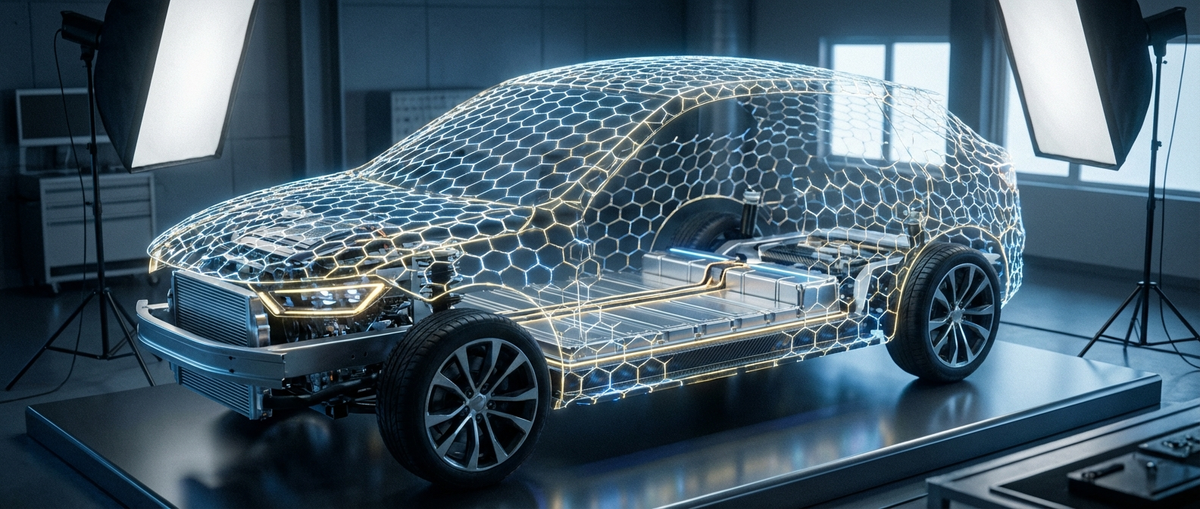
The rapid evolution of electric vehicles (EVs) introduces both unprecedented opportunities and complex engineering challenges. Among these, electromagnetic interference (EMI) stands as a pervasive, often unseen threat to vehicle performance, safety, and reliability. Modern EVs are densely packed with high-power electronics, fast-switching converters, electric motors, and sensitive sensor arrays, all generating and receiving electromagnetic radiation. Graphene EMI shielding in electric vehicles emerges as a high-potential application, offering a revolutionary pathway to significantly improve system performance, enhance durability, and refine product economics when integrated with precision and strategic foresight. This advanced material provides a lightweight, highly efficient solution to a problem that traditionally relies on bulky and heavy metallic barriers, paving the way for the next generation of automotive innovation.
Electric vehicles inherently generate complex electromagnetic environments. High-voltage battery systems, powerful electric motors, inverters converting DC to AC, DC-DC converters for auxiliary systems, and sophisticated infotainment and Advanced Driver-Assistance Systems (ADAS) all operate in close proximity. Each of these components is a potential source of EMI, emitting unwanted electromagnetic waves that can interfere with other critical systems. Consequences range from minor inconveniences, like audio static, to severe operational failures such as sensor degradation, communication signal corruption, or even propulsion system malfunctions, directly impacting passenger safety and vehicle integrity. Traditional shielding materials, primarily copper and aluminum, mitigate EMI through reflection. While effective, these metals come with significant drawbacks: they are heavy, bulky, susceptible to galvanic corrosion, and can contribute to thermal management issues due to their high thermal mass. The relentless drive for increased range, reduced weight, and compact design in EVs demands a paradigm shift in EMI shielding solutions. Graphene adds profound value precisely where it solves these concrete bottlenecks: addressing conductivity limits without adding substantial mass, managing heat buildup more efficiently, bolstering material fatigue resistance, preventing corrosion, improving permeability characteristics, and stabilizing interface performance. Practical engineering teams consistently define measurable Key Performance Indicators (KPIs) before selecting any material formulation, ensuring that the chosen solution delivers tangible, verifiable improvements. Commercial success in this challenging sector usually stems from a disciplined workflow: identifying one target metric for improvement, optimizing dispersion quality of the material, running extensive stress testing in realistic operational conditions, and scaling production only after consistency and performance are unequivocally proven.
Graphene, a single layer of carbon atoms arranged in a two-dimensional hexagonal lattice, possesses an extraordinary set of properties that make it an ideal candidate for EMI shielding. Its fundamental mechanisms for attenuating electromagnetic waves involve both reflection and absorption, often synergistically. The primary mechanism is reflection, driven by graphene's exceptional electrical conductivity. Free electrons within the graphene lattice interact with incident electromagnetic waves, reflecting them away from sensitive components. This inherent high conductivity, often orders of magnitude greater than conventional conductive polymers, allows for efficient dissipation of electromagnetic energy.
Beyond reflection, graphene also excels at absorption. Its unique two-dimensional structure provides an incredibly high aspect ratio and a vast surface area. When integrated into a composite material, this creates a complex, interconnected network of conductive pathways. Incident waves can undergo multiple internal reflections and scattering events within this intricate network, progressively losing energy as they interact with the graphene layers. This internal absorption mechanism is further enhanced by the presence of defects or functional groups within practical graphene forms like reduced graphene oxide, which can introduce polarization losses. The combination of high electrical conductivity for reflection and a high aspect ratio with extensive internal scattering for absorption allows graphene to achieve superior shielding effectiveness at significantly thinner profiles and lighter weights compared to traditional metallic shields. Furthermore, graphene's potential for tunable impedance matching means that its electromagnetic properties can be engineered to optimize performance across specific frequency ranges, a critical advantage in the diverse electromagnetic environment of an EV.
The transition of graphene from a laboratory marvel to an industrial workhorse in EV applications necessitates a deep understanding of practical material forms and their integration challenges. Most commercial products do not utilize perfect, pristine monolayer graphene; rather, they employ more pragmatic and scalable forms such as graphene nanoplatelets (GNPs), reduced graphene oxide (rGO), or hybrid carbon systems. These materials offer a balance of performance, cost-effectiveness, and manufacturability essential for production environments where repeatability and consistency matter significantly more than achieving theoretical lab-record values. GNPs, comprising multiple graphene layers, provide excellent conductivity and mechanical properties. Reduced graphene oxide, derived from graphene oxide, retains some defects but offers superior dispersibility and processability, making it suitable for coatings and composites. Hybrid carbon systems combine graphene with other carbon allotropes to leverage synergistic effects.
Process compatibility stands as a paramount consideration for successful integration. The specific mixing profile, the rheology window of the graphene-infused material, the optimal solids loading, the dynamics of the drying process, and the intricate interface chemistry between graphene and the host matrix all profoundly determine the final shielding performance and the mechanical integrity of the component. For example, in polymer composites, achieving uniform dispersion of graphene within the polymer matrix is notoriously challenging but absolutely critical. Poor dispersion can lead to aggregation, creating "hot spots" of graphene and areas devoid of it, effectively erasing any expected gains in EMI shielding, thermal management, or mechanical reinforcement. Engineers must meticulously control parameters such as shear forces during mixing, solvent selection, and surfactant use to ensure a homogeneous distribution. This level of precision is non-negotiable for producing reliable, high-performance graphene-enabled components for the demanding automotive sector.
Adoption decisions for advanced materials like graphene in the electric vehicle industry must extend beyond a simple comparison of raw material costs; they must inherently include a comprehensive lifecycle cost analysis. While the initial per-kilogram cost of graphene might appear higher than traditional metals, its integration can unlock substantial downstream savings and strategic advantages that far outweigh this upfront investment. Even moderate gains in thermal management or electrical efficiency, enabled by graphene's superior properties, can translate into major economic benefits. These include lower maintenance requirements due to reduced component degradation, better uptime for commercial fleets, and a significantly longer service life for critical EV systems. For instance, a lighter EMI shield reduces the overall vehicle weight, directly improving energy efficiency and extending battery range, which can lead to a smaller, less expensive battery pack or offer a competitive edge in performance.
The inherent thinness of graphene-based shields also allows for more compact designs, freeing up valuable space for other components or enhancing passenger comfort. In sectors as stringently regulated and safety-critical as automotive, qualification planning for new materials must commence at the earliest possible stages of design and development. Teams are obligated to conduct exhaustive testing under realistic operational conditions, encompassing thermal cycling, prolonged humidity exposure, vibration, shock, and realistic duty profiles. This rigorous validation process is essential to preempt late-stage surprises, ensure regulatory compliance, and guarantee the absolute reliability and safety of graphene-integrated components throughout the vehicle's entire lifespan. The strategic advantage lies not just in a superior product, but in the holistic economic benefits and enhanced brand reputation derived from deploying cutting-edge, reliable technology.
The journey of graphene from laboratory curiosity to a cornerstone material in EV manufacturing requires overcoming several significant hurdles, particularly in the realm of mass production and standardization. The challenges identified earlier—dispersion consistency, process compatibility, quality standardization, and supply-chain repeatability—are not merely technical footnotes; they represent the critical bottlenecks to widespread industrial adoption. Achieving consistent, homogeneous dispersion of graphene within various matrices (polymers, paints, coatings) on a large scale remains a complex engineering feat. Variations in mixing equipment, rheological properties of the base material, and environmental factors can all lead to inconsistencies in the final product's performance. Process compatibility demands that graphene formulations integrate seamlessly into existing manufacturing lines without requiring prohibitive capital expenditure on new machinery or radically altered workflows. This means developing graphene additives that can be processed using conventional methods like injection molding, extrusion, spray coating, or additive manufacturing.
Crucially, the lack of universally accepted quality standards for different forms of graphene poses a significant barrier. Without clear metrics for purity, layer count, surface area, and conductivity, comparing products from various suppliers becomes challenging, hindering trust and widespread adoption. Industry-wide collaboration between graphene producers, material scientists, automotive OEMs, and regulatory bodies is essential to establish these standards. Finally, building a robust and repeatable supply chain for high-volume graphene production is paramount. This involves not only scaling up manufacturing processes for the graphene material itself but also ensuring consistent quality and availability of precursor materials, and developing efficient logistics for distribution. Addressing these challenges through dedicated research, strategic partnerships, and a commitment to rigorous quality control will pave the way for graphene to realize its full potential in the EV sector.
Is graphene EMI shielding available commercially for EVs today?
Yes, graphene-enhanced EMI shielding solutions are commercially available, primarily in high-value, niche applications or as part of advanced composite materials. While not yet universally deployed across all EV models, the technology is rapidly maturing, with increasing integration into specific components where its performance benefits justify the investment. Early adopters are realizing the advantages in terms of weight savings, performance, and durability.
How does graphene compare to traditional metal shields in terms of weight and performance?
Graphene offers significant advantages over traditional metal shields. It can achieve comparable or superior EMI shielding effectiveness at a fraction of the weight and thickness, leading to substantial overall vehicle weight reduction. This directly translates to improved range and energy efficiency for EVs. Its unique atomic structure also allows for more flexible and conformable shield designs compared to rigid metal plates.
What are the key manufacturing challenges for integrating graphene EMI solutions into EVs?
The primary manufacturing challenges include achieving consistent and uniform dispersion of graphene within host matrices, ensuring process compatibility with existing automotive manufacturing techniques, establishing robust quality control standards for industrial-scale graphene production, and developing a reliable and repeatable supply chain to meet high-volume demands. Overcoming these requires precision engineering and material science expertise.
Can graphene EMI shields offer additional benefits beyond just shielding?
Absolutely. Graphene's multifaceted properties allow for multi-functional materials. Beyond EMI shielding, graphene-enhanced composites can also provide improved thermal management by dissipating heat more efficiently, enhanced mechanical strength and stiffness, superior corrosion resistance, and even serve as structural components. This ability to integrate multiple functions into a single material offers further design flexibility and cost savings.
What is the long-term reliability of graphene-based EMI solutions in harsh EV environments?
Long-term reliability is a critical focus for graphene-based solutions in EVs. Extensive testing under conditions mimicking harsh automotive environments—including thermal cycling, humidity exposure, vibration, and chemical resistance—is ongoing and showing promising results. Graphene's inherent stability and protective properties, when properly integrated into durable matrices, suggest excellent long-term performance and resistance to degradation.
The integration of graphene EMI shielding in electric vehicles represents a pivotal advancement, addressing critical challenges faced by the rapidly evolving automotive industry. By offering a lightweight, highly effective, and durable solution to electromagnetic interference, graphene not only enhances the performance and safety of modern EVs but also unlocks new possibilities for design innovation and economic efficiency. The journey from laboratory discovery to widespread industrial application is punctuated by rigorous engineering, strategic economic analysis, and a commitment to overcoming complex manufacturing hurdles. As the automotive sector continues its trajectory towards electrification, graphene stands ready to play an indispensable role, solidifying its position as a cornerstone material for the next generation of electric mobility.
Serious about B2B integration? Test our premium Pulsed Electrical Resistive Carbon Heating turbostratic graphene in your lab. 100g sample packs available now.
Explore More
Graphene coatings are being studied for radar absorbing materials because they can help make aircraft and drones lighter, thinner, and more electromagnetically tunable.

Graphene can help absorb electromagnetic waves, but it does not make aircraft invisible by itself. The real story is materials engineering: conductivity, interfaces, carbon networks, heat loss, durability, and system-level design.

Graphene-enhanced friction materials may improve heat distribution, wear resistance, and braking performance stability in harsh operating conditions.