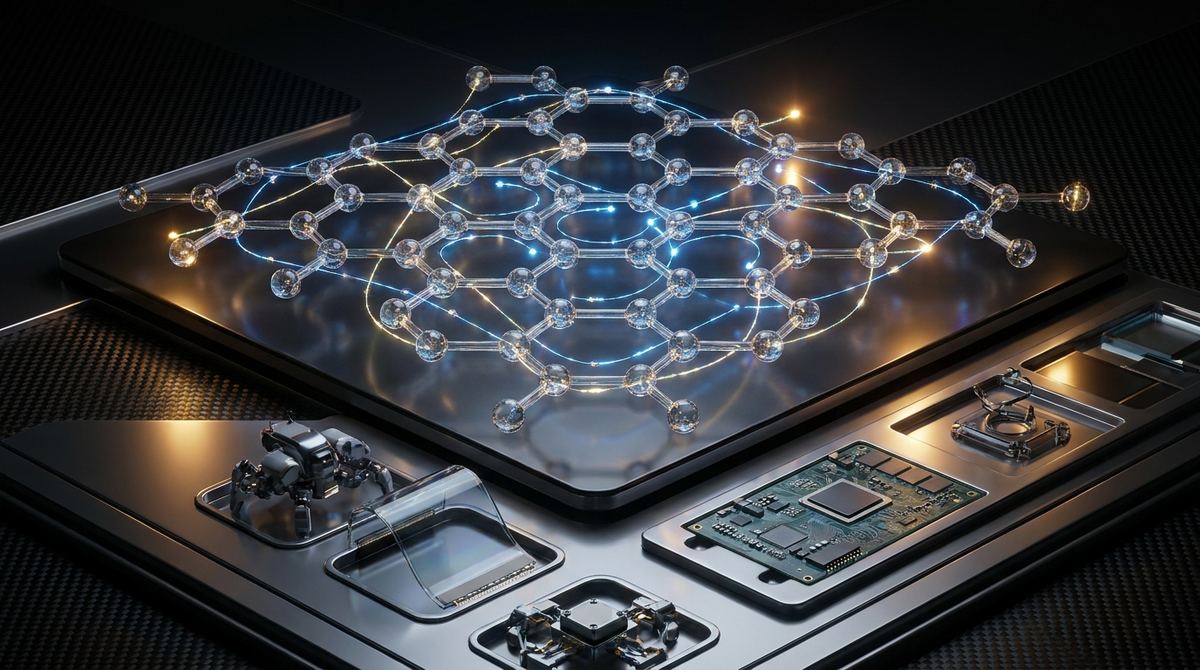
Graphene, the revolutionary two-dimensional material, has captivated the scientific and engineering communities with its unparalleled properties. Since its isolation, researchers have been meticulously peeling back the layers of its fundamental physics, revealing a material that defies conventional expectations. At the heart of graphene’s profound potential lies its unique electronic transport and optical properties, driven by quantum mechanical principles that set it apart from traditional conductors and semiconductors.
Unlike conventional metals, graphene exhibits a suite of behaviors that challenge established theories, offering robust transport mechanisms and peculiar responses to external stimuli. Understanding these intricate characteristics is crucial for harnessing graphene’s capabilities in advanced applications, from ultra-fast electronics to novel sensors and beyond. This comprehensive exploration delves into the foundational electronic and optical characteristics of graphene, illuminating the quantum phenomena that govern its remarkable performance.
From the exotic realm of Dirac nodes and Klein tunneling to its anomalous conductivity and plasmonic behavior, graphene presents a rich landscape for scientific discovery and technological innovation. This blog post aims to demystify these complex properties, providing a clear and authoritative insight for engineers, scientists, and anyone intrigued by the future of materials science. Join us as we uncover the secrets of graphene’s electronic and optical prowess, laying the groundwork for a new era of high-performance materials.
Unveiling Graphene's Quantum Realm: Dirac Nodes and Quasiparticles
The fundamental electronic structure of graphene is a cornerstone of its unique properties, especially in its monolayer and bilayer forms. At the atomic scale, graphene comprises a honeycomb lattice of carbon atoms, and within this structure, electrons behave as fascinating quasiparticles. These quasiparticles possess a unique energy spectrum, characterized by two bands that touch at specific points in the Brillouin zone known as Dirac nodes. This contact point is not merely a theoretical curiosity; it signifies a profoundly different electronic landscape where electrons behave as massless Dirac fermions, moving at relativistic speeds.
This relativistic-like behavior gives rise to several intriguing phenomena, chief among them being Klein tunneling. In conventional quantum mechanics, particles face a barrier and have a certain probability of tunneling through it, with the probability decreasing exponentially with the barrier's height and width. However, in graphene, Klein tunneling describes a scenario where Dirac fermions can traverse arbitrarily high and wide potential barriers with perfect transmission. This effect is a direct consequence of the chirality of the quasiparticles and their ability to smoothly transform between electron-like and hole-like states, essentially allowing them to bypass the classical barrier altogether. This phenomenon is critical for understanding the exceptionally robust transport properties of graphene.
Another direct implication of graphene's quantum structure is the ease of electron-hole pair creation. At the Dirac nodes, the conduction and valence bands meet, requiring virtually no energy to excite an electron from the valence band to the conduction band, leaving behind a hole. This facile creation and recombination of electron-hole pairs significantly influence charge transport dynamics, contributing to graphene's distinctive electrical behavior. The existence of these Dirac quasiparticles and their associated quantum phenomena represent a profound deviation from the conventional Fermi liquid theory that describes transport in most metals, fundamentally reshaping our understanding of electron dynamics in condensed matter systems.
Graphene's Extraordinary Conductivity: Minimal, Optical, and AC Dynamics
The transport behavior of graphene has been a subject of intense scrutiny since the seminal papers from Manchester and Columbia groups first highlighted its robustness. A defining characteristic is the V-shape conductivity observed with respect to charge density (n), culminating in a non-zero minimal conductivity (σmin) at the charge neutrality point (n=0). This minimal conductivity, experimentally measured to be approximately 4e²/h, is a direct signature of graphene's quantum nature and its deviation from classical transport models. In conventional semiconductors, conductivity drops to zero at zero charge carrier density; graphene's finite minimal conductivity, even in the absence of externally added carriers, implies intrinsic quantum mechanical processes at play, potentially due to electron-hole puddles or unavoidable scattering mechanisms.
Furthermore, the optical properties of graphene are intimately linked to its alternate current (AC) conductivity. For light with frequency ω, the AC conductivity, denoted as σωxx AC(), dictates how graphene interacts with electromagnetic radiation. Remarkably, graphene exhibits a constant optical conductivity across a broad range of frequencies, once again indicating a clear departure from conventional Drude-type transport. The Drude model, typically used for metals, predicts a frequency-dependent conductivity that decreases at higher frequencies due to scattering. Graphene's frequency-independent optical conductivity, tied to its unique band structure, highlights its potential for broadband optoelectronic applications, where consistent light absorption and emission across various wavelengths are desirable.
The real part of the AC conductivity is directly related to the imaginary part of the dielectric constant, which in turn determines the material's optical reflectivity and transmittance. This direct relationship means that by understanding and manipulating graphene's AC conductivity, scientists can precisely control its interaction with light. This capability is paramount for developing devices such as transparent electrodes, photodetectors, and optical modulators. The consistent and robust nature of both DC (minimal) and AC/optical conductivity underscores graphene's promise as a foundational material for future electronic and photonic technologies, requiring a deeper understanding of its quantum mechanical underpinnings.
Tuning Graphene's Electronic Properties: The Impact of Symmetry Breaking and Disorder
Graphene's pristine honeycomb lattice possesses a high degree of sublattice symmetry, where the two interpenetrating triangular lattices forming the honeycomb structure are identical. This symmetry is fundamental to the material's massless Dirac fermion behavior. However, groundbreaking experimental studies have demonstrated that this delicate sublattice symmetry can be intentionally broken, leading to profound changes in graphene's electronic properties. Two primary methods for achieving this symmetry breaking are chemical doping and the application of external gates, particularly effective in bilayer graphene structures. Chemical doping introduces impurities or functional groups that preferentially bind to one sublattice, disrupting the delicate balance. Similarly, in bilayer graphene, applying an electric field perpendicular to the layers through external gates can induce a potential difference between the sublattices, effectively breaking their symmetry.
When sublattice symmetry is broken, a random gap opens in the quasiparticle spectrum, transforming the zero-gap semiconductor nature of pristine graphene. This induced band gap is not uniform but rather varies spatially, creating regions where electrons need a minimum energy to transition between bands. The opening of such a gap is a critical step towards realizing semiconducting behavior in graphene, which is essential for developing logic transistors and other digital electronic components. While pristine graphene behaves as a perfect conductor without a band gap, the ability to introduce and tune a band gap through symmetry breaking provides a pathway to switch from metallic to potentially insulating behavior, greatly expanding its utility in diverse electronic circuits.
Despite the potential for insulating behavior induced by a random gap, diffusion in graphene generally implies a characteristic metallic behavior in both mono- and bilayer forms. This highlights the complex interplay between intrinsic quantum properties and external perturbations. Diffusion, the random walk of charge carriers, is a key mechanism for transport in materials. In graphene, even with disorder or symmetry breaking, the robust nature of its electronic states ensures efficient charge movement over macroscopic distances. This metallic diffusion behavior, coupled with the ability to open a bandgap, positions graphene as a highly versatile material that can be engineered for specific electronic functionalities, accommodating both high-mobility conducting paths and regions that can be switched into an insulating state as needed. The presence of disorder, and interactions such as electron-electron and electron-phonon interactions, further modulate these transport characteristics, requiring a comprehensive understanding for practical device fabrication.
The Collective Dance: Plasmons and the Theoretical Framework of Transport
Beyond individual electron behavior, collective excitations within graphene also play a crucial role in its electronic and optical response. Plasmons, quantized oscillations of the electron gas, are particularly prominent in graphene. The behavior of plasmons in graphene, notably, is similar to that of plasmons found in a conventional two-dimensional electron gas (2DEG), albeit with some unique characteristics owing to graphene's Dirac nature. These plasmons can be confined and guided within graphene sheets, offering significant potential for applications in nanophotonics, biosensing, and ultra-fast optical modulators. Their similarity to 2DEG plasmons simplifies some theoretical treatments while still allowing for novel phenomena due to graphene's high carrier mobility and tunable electronic properties. The ability to manipulate plasmon resonance through doping or gating makes graphene an exciting platform for future light-matter interaction technologies.
To fundamentally understand and predict these complex transport phenomena, a rigorous theoretical framework is indispensable. A quantum approach to transport begins with the Hamiltonian, which describes the total energy of the system, and the corresponding current operator. The current operator, expressed by the commutator ji eH rkk =− [, ], links the electron's position and the system's energy, providing a quantum mechanical description of charge flow. The average current induced by a weak external electric field E is then obtained through linear response theory, resulting in Ohm's law, 〈〉 =jEkk llσ, where σkl represents the conductivity tensor.
One of the most powerful tools in this theoretical arsenal is the Kubo formalism, which provides a general expression for conductivity in terms of correlation functions of current operators. This formalism typically involves a product of one-particle Green’s functions, G(z). Green's functions are mathematical constructs that describe the propagation of electrons in a material, incorporating the effects of disorder and interactions. They are essential for calculating the diffusion coefficient, D(E), which quantifies how quickly charge carriers spread out from a localized region. For transport in graphene at low temperatures, the diffusion coefficient at the Fermi energy (EF) is particularly relevant, allowing researchers to model and predict the efficacy of charge propagation under various conditions. This comprehensive theoretical understanding, coupled with experimental validation, is vital for advancing graphene science and engineering, providing the blueprints for next-generation devices, including those envisioned for terahertz applications that demand precise control over electronic and optical transport properties.
Paving the Way for Future Technologies with Graphene
Graphene’s journey from a theoretical concept to a tangible material has opened up an exciting frontier in condensed matter physics and materials science. Its electronic and optical properties are a testament to the profound impact of quantum mechanics on material behavior, challenging conventional theories and offering unprecedented opportunities. The existence of Dirac nodes, the fascinating phenomenon of Klein tunneling, and the robust minimal conductivity at the charge neutrality point exemplify how graphene diverges from traditional metallic and semiconducting materials. These unique characteristics, combined with a constant optical conductivity across a broad spectrum, position graphene as a critical material for advanced optoelectronic applications.
Furthermore, the ability to engineer graphene's properties through sublattice symmetry breaking, achieved via chemical doping or external gating, allows for the precise tuning of its band structure. This tunability, opening a random gap in the quasiparticle spectrum, moves graphene closer to realizing a true semiconducting state while retaining its characteristic metallic diffusion. The collective behavior of electrons, manifested as plasmons, further enhances its versatility, offering avenues for sophisticated light-matter interactions. Through advanced theoretical frameworks like the Kubo formalism and the use of Green's functions, scientists continue to deepen their understanding of these complex phenomena, providing the fundamental knowledge required to unlock graphene’s full potential.
The profound insights into graphene electronic transport properties and optical behavior discussed herein are not merely academic pursuits. They are the foundational elements for a new generation of technologies. From high-speed electronics and flexible displays to highly sensitive sensors and the much-anticipated terahertz applications, graphene promises to revolutionize numerous industries. Its extraordinary blend of strength, conductivity, and optical transparency ensures its place at the forefront of material innovation, driving progress towards smaller, faster, and more efficient devices. The future of advanced materials is undeniably etched in graphene.
Explore the cutting-edge of graphene science and discover how usa-graphene.com is driving innovation. Visit our website today to learn more about our premium graphene materials and research initiatives. Join us in shaping the future with the most remarkable material of our time.