
A New Era of Graphene Engineering: Pre-Designing Twist Angles on Demand
Researchers have developed a breakthrough method for growing twisted bilayer graphene with pre-designed angles, a key step toward manufacturable quantum...
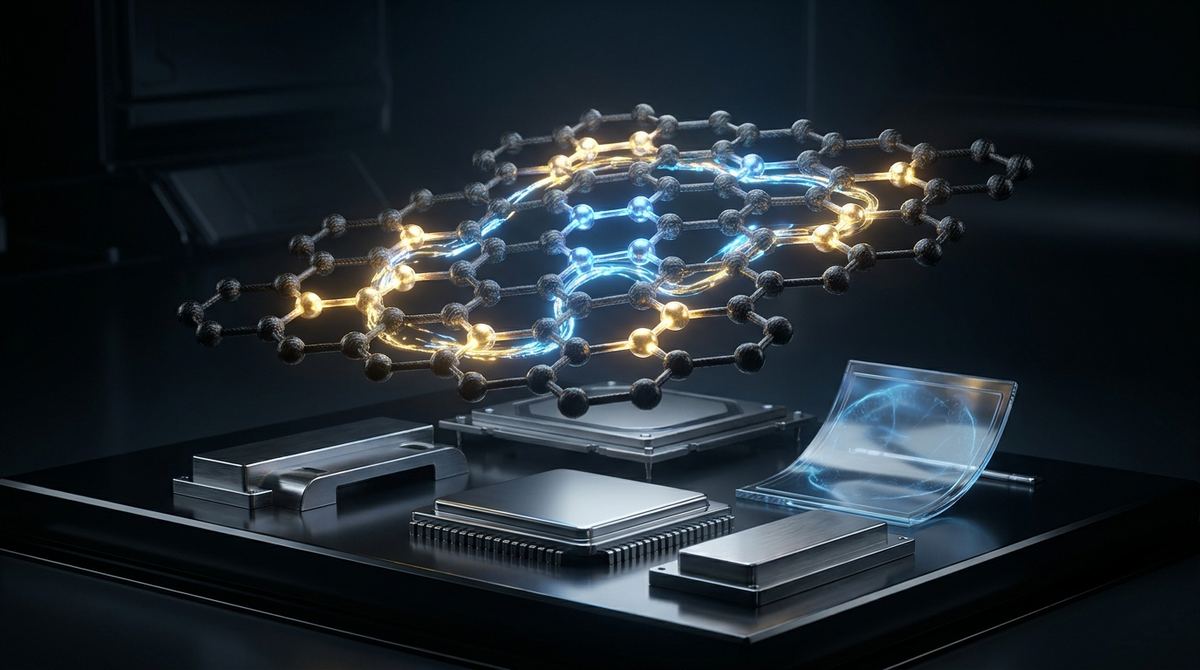
The advent of graphene has ushered in a new era for materials science and engineering, promising advancements that were once relegated to the realm of science fiction. As a single layer of carbon atoms arranged in a honeycomb lattice, this two-dimensional (2D) material possesses an array of extraordinary properties, particularly in its electronic behavior. However, to fully harness graphene's potential for diverse applications, from high-speed electronics to quantum computing, its intrinsic electronic characteristics often require precise tuning and modification. This is where the strategic interaction with transition metals emerges as a pivotal and highly effective approach. Graphene, since its experimental isolation in 2004, has captivated researchers due to phenomena like massless Dirac electrons, exceptionally high carrier mobility, and the anomalous quantum Hall effect. These features stem directly from its unique atomic structure, where two π bands intersect linearly at what are known as Dirac points. The ability to coherently propagate large currents over significant distances, coupled with the ease of controlling carrier density—either electron or hole—via simple gating structures, hints at an endless spectrum of possibilities. Yet, the pristine form of graphene, while remarkable, lacks the application-specific tunability needed for complex devices. Consequently, scientists are intensively exploring methods to modify and optimize graphene’s electronic properties, with doping, adsorption, and termination using transition metals standing out as particularly promising avenues.
At its core, graphene's allure lies in its unparalleled electronic characteristics, which are fundamentally different from traditional semiconductors. Being a single atomic layer, it represents the basic building block for a myriad of carbon nanostructures, including carbon nanotubes and fullerenes. The electrons within graphene behave as massless Dirac fermions, meaning they travel at incredibly high speeds without scattering, mimicking relativistic particles. This unique behavior arises from the linear dispersion relation of its energy bands at specific points in the Brillouin zone, known as Dirac points. These Dirac points are where the valence and conduction bands meet, forming a zero-bandgap semiconductor.
The exceptionally high carrier mobility in graphene, often exceeding 100,000 cm²/Vs at room temperature, allows for ballistic transport over micrometers, making it an ideal candidate for ultra-fast electronic devices. This mobility, combined with its robust mechanical strength and thermal conductivity, positions graphene as a transformative material for next-generation technologies. Furthermore, graphene exhibits a fascinating anomalous quantum Hall effect, observable even at room temperature, which is a direct consequence of its unique electron energy spectrum and spin-valley coupling. The ability to control its carrier density through external electric fields, a process known as gating, further enhances its versatility for electronic modulation. These intrinsic properties establish graphene as a cornerstone for both fundamental scientific exploration and groundbreaking technological innovation.
While the intrinsic properties of pristine graphene are undeniably remarkable, its direct application in many advanced electronic and spintronic devices faces significant limitations. The primary hurdle is its zero bandgap, meaning there is no energy difference between its valence and conduction bands. This characteristic prevents graphene from effectively switching current on and off, a fundamental requirement for transistors in digital logic circuits where a high on/off ratio is crucial. Without a tunable bandgap, graphene struggles to compete with conventional semiconductors like silicon in device architectures that rely on precise current control.
Beyond the bandgap issue, pristine graphene also lacks intrinsic magnetism, a property vital for spintronic devices that leverage electron spin in addition to charge. Its spin-orbit coupling, which describes the interaction between an electron's spin and its motion, is naturally weak, limiting its utility in advanced quantum computing and spin-based memory applications. Furthermore, while highly conductive, the chemical inertness of pristine graphene can be a disadvantage for certain applications, such as catalysis or sensing, where specific surface interactions are desired. Therefore, to unlock graphene's full potential and tailor it for specific functionalities, controlled modification of its electronic structure becomes not just beneficial, but absolutely essential. This necessity drives intensive research into methods for post-synthesis functionalization and doping.
The strategic integration of transition metals offers a powerful and versatile approach to precisely engineer graphene's electronic properties. Transition metals possess unique electronic configurations, particularly their partially filled d-orbitals, which enable strong and varied interactions with graphene's carbon p-orbitals. These interactions can significantly alter graphene's band structure, carrier concentration, and spin characteristics. Several key mechanisms facilitate this tailoring, each offering distinct advantages for specific applications.
One prominent method is doping, where transition metal atoms are incorporated directly into the graphene lattice, replacing carbon atoms. This substitutional doping can introduce localized electronic states, alter the local charge density, and even induce magnetic moments depending on the metal used. For instance, substituting carbon with a transition metal can create electron or hole doping, shifting the Fermi level and effectively tuning the carrier concentration. Another critical mechanism is adsorption, where transition metal atoms or clusters are deposited onto the graphene surface. The adsorbed metal atoms interact with graphene through charge transfer and orbital hybridization, leading to modifications in the Dirac cone, opening a bandgap, or inducing magnetism via proximity effects.
Intercalation represents another powerful technique, particularly relevant for multi-layer graphene or graphene grown on a substrate. Here, transition metal atoms are inserted between graphene layers or between graphene and its underlying substrate. This process can significantly alter the interlayer coupling and the electronic interaction between graphene and the substrate, leading to phenomena like superconductivity or enhanced spin-orbit coupling. Surface functionalization, involving the covalent attachment of transition metal-containing molecules to graphene, provides a robust way to introduce specific chemical functionalities and localized electronic perturbations. These diverse interaction mechanisms, ranging from direct atomic substitution to non-covalent adsorption, provide a rich toolkit for fine-tuning graphene's electronic landscape for a vast array of high-performance applications.
The precise control offered by transition metals allows for a profound impact on graphene's properties, unlocking capabilities previously unattainable in its pristine form. One of the most critical breakthroughs involves the opening of a band gap, essential for developing functional graphene transistors. By placing specific transition metals like nickel (Ni), cobalt (Co), or iron (Fe) onto graphene, or by forming specific interfaces, researchers can induce a finite band gap through strong hybridization between the metal's d-orbitals and graphene's p-orbitals. This allows for controlled switching of current, paving the way for high-performance field-effect transistors with excellent on/off ratios, a direct competitive advantage against silicon.
Beyond band gap engineering, transition metals are instrumental in introducing and controlling magnetism in graphene, a prerequisite for spintronic applications. Adsorbing magnetic transition metal atoms such as iron, cobalt, or nickel can induce magnetic moments in graphene, creating a magnetically ordered state. This allows for the manipulation of electron spins, promising advancements in spin-based memory, logic devices, and quantum computing. The proximity of magnetic metals can also enhance spin injection and spin lifetimes within graphene, crucial for efficient spintronic device operation.
Furthermore, the catalytic capabilities of transition metals are profoundly enhanced when integrated with graphene. Graphene acts as an ideal support material, modifying the electronic structure of the adsorbed metal nanoparticles and optimizing their catalytic activity for various chemical reactions. For example, graphene-supported platinum (Pt) or palladium (Pd) catalysts show superior performance in fuel cells and hydrogen evolution reactions, benefiting from increased surface area, enhanced electron transfer, and altered reaction pathways. This synergistic effect positions graphene-transition metal composites at the forefront of sustainable energy technologies.
Heavy transition metals, such as platinum (Pt), gold (Au), or iridium (Ir), can significantly enhance spin-orbit coupling (SOC) in graphene through proximity effects. Increased SOC is vital for realizing topological insulators and for developing advanced spintronic devices that utilize spin Hall effects. This enhanced interaction allows for novel pathways to manipulate spin currents, opening new avenues for ultra-low-power electronics and quantum information processing. The strategic choice of transition metal and the precise engineering of its interaction with graphene thus enable a tailored approach to addressing specific technological demands, pushing the boundaries of what is possible with this extraordinary material.
Despite the immense promise and ongoing advancements, the field of tailoring graphene's electronic properties with transition metals faces several significant challenges that require concerted research efforts. Achieving precise and uniform control over the doping or adsorption of transition metal atoms at a large scale remains a primary hurdle. Many experimental methods still yield heterogeneous distributions, leading to inconsistent electronic properties across the graphene sheet, which is detrimental for device reproducibility and industrial scalability. Developing synthetic techniques that allow for atomic-level precision and homogeneity over large areas is crucial for real-world applications.
Another critical challenge lies in the long-term stability of these modified graphene systems. Transition metal atoms or clusters can be prone to oxidation, migration, or aggregation over time, especially under ambient conditions or during device operation. This degradation can alter the carefully engineered electronic properties, affecting device longevity and reliability. Researchers are actively exploring protective encapsulation layers and more robust chemical bonding strategies to mitigate these stability issues. Understanding the intricate quantum mechanical interactions between various transition metals and graphene is also complex, often requiring sophisticated theoretical modeling and high-resolution experimental characterization to fully unravel the underlying physics.
Looking ahead, the future of graphene-transition metal hybrid systems is incredibly bright and multifaceted. The integration of machine learning and artificial intelligence is poised to accelerate the discovery of novel transition metal combinations and configurations that yield desired electronic properties, optimizing materials design at an unprecedented pace. Exploration of new heterostructures, where graphene is combined not only with transition metals but also with other 2D materials, promises to unlock entirely new functionalities through engineered interfaces. Furthermore, integrating these advanced materials into existing semiconductor fabrication processes will be key to transitioning from laboratory demonstrations to commercial products. The ongoing pursuit of precise, stable, and scalable methods for tailoring graphene with transition metals will undoubtedly lead to transformative advancements in electronics, spintronics, catalysis, and quantum technologies.
What is the primary motivation for modifying graphene's electronic properties?
The main motivation is to overcome the limitations of pristine graphene, particularly its zero bandgap, which prevents its use in traditional transistor applications requiring a high on/off current ratio. Modification also allows for the introduction of new functionalities like magnetism or enhanced catalytic activity, tailoring graphene for specific advanced technologies.
How do transition metals typically interact with graphene to alter its properties?
Transition metals interact with graphene through several mechanisms: doping, where metal atoms substitute carbon atoms in the lattice; adsorption, where metal atoms or clusters sit on the graphene surface; and intercalation, where metal atoms are inserted between graphene layers or between graphene and a substrate. These interactions lead to charge transfer, orbital hybridization, and changes in the electronic band structure.
Can transition metals make graphene magnetic?
Yes, transition metals can induce magnetism in graphene. By adsorbing magnetic transition metals like iron, cobalt, or nickel onto the graphene surface, or by incorporating them into the lattice, their magnetic moments can be transferred to or interact with graphene's electrons, leading to the creation of magnetic graphene. This is crucial for developing spintronic devices.
What are some key applications enabled by tailoring graphene with transition metals?
Tailoring graphene with transition metals enables a range of applications. These include high-performance transistors with tunable bandgaps, advanced spintronic devices that manipulate electron spin, highly efficient catalysts for energy conversion and chemical synthesis, and next-generation sensors. The ability to control properties like magnetism and spin-orbit coupling also opens doors for quantum computing.
What are the main challenges in developing graphene-transition metal hybrid systems?
Key challenges include achieving precise and uniform control over the placement and concentration of transition metals across large graphene areas, ensuring the long-term stability of these hybrid systems against oxidation and degradation, and fully understanding the complex quantum mechanical interactions at play. Scalability from laboratory research to industrial production also remains a significant hurdle.
The journey to unlock graphene's full potential is fundamentally intertwined with our ability to precisely tailor its electronic properties, and transition metals stand as an indispensable toolkit in this endeavor. From overcoming the intrinsic zero bandgap to introducing magnetism, enhancing catalytic activity, and boosting spin-orbit coupling, the strategic interaction with transition metals transforms graphene from a remarkable material into a versatile platform for innovation. The diverse mechanisms of doping, adsorption, and intercalation provide scientists with an unparalleled level of control, enabling the design of materials specifically engineered for high-speed electronics, advanced spintronics, efficient energy solutions, and quantum technologies. While challenges in precise control and long-term stability persist, ongoing research and the integration of advanced computational methods are rapidly paving the way for scalable and robust graphene-transition metal hybrid systems. The promise of these engineered materials is immense, poised to drive the next generation of technological breakthroughs and redefine the landscape of modern science and engineering.
Serious about B2B integration? Test our premium Pulsed Electrical Resistive Carbon Heating turbostratic graphene in your lab. 100g sample packs available now.
Explore More
Researchers have developed a breakthrough method for growing twisted bilayer graphene with pre-designed angles, a key step toward manufacturable quantum...

Learn how deep learning is revolutionizing the structural characterization of twisted bilayer materials, accelerating the development of next-generation...

Learn to build a prototype graphene FET biosensor for sensitive DNA detection. This guide covers materials, fabrication, and testing for point-of-care...