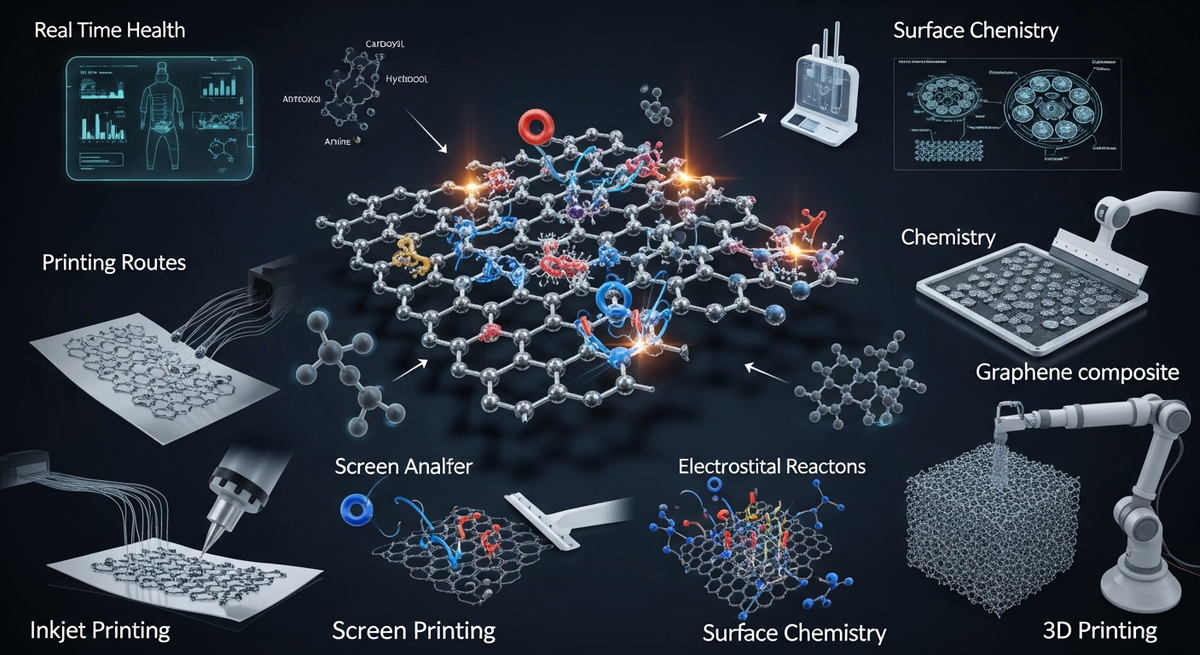
Graphene, a single atomic layer of sp2-hybridized carbon, presents an unparalleled platform for advanced electrochemical sensing due to its intrinsic two-dimensional (2D) nature and extraordinary electronic and structural properties. Its crystallographic perfection and vanishing effective mass of charge carriers, governed by linear dispersion relations forming Dirac cones at the K and K' points of the Brillouin zone, endow it with ultra-high electron mobility, theoretically exceeding 200,000 cm^2/Vs at room temperature. This ballistic transport, coupled with an exceptionally high theoretical specific surface area of 2630 m^2/g, facilitates rapid electron transfer kinetics and maximizes electrode-analyte interaction sites. The fundamental physics of its 2D confinement dictates a unique electronic band structure, lacking a natural bandgap, making it inherently conductive and highly sensitive to external perturbations—a critical attribute for electrochemical transduction. This foundational understanding underpins its superior performance in detecting various analytes, from biomolecules to heavy metal ions, by enabling direct, efficient charge transfer pathways at the electrode-electrolyte interface.
The concept of "graphene confinement" refers to its atomically thin, two-dimensional geometry, restricting electron motion to a plane and profoundly altering its quantum mechanical behavior compared to 3D graphite. This extreme spatial confinement in the z-direction gives rise to its distinctive electronic properties, notably the massless Dirac fermion character, where charge carriers behave as relativistic particles with zero rest mass. A direct consequence of this 2D electron gas is the observation of an anomalous half-integer quantum Hall effect at both room and cryogenic temperatures, a hallmark of its unique Landau level quantization. The absence of backscattering in pristine graphene, attributed to its chiral nature and hexagonal lattice symmetry, allows for carrier mean free paths beyond micrometers, translating to minimal electrical resistivity, often below 10^-6 Ohm·cm for high-quality samples. This inherent ballistic transport and high electrical conductivity ensure rapid signal propagation and minimal ohmic losses, crucial for high-performance electrochemical sensing where real-time analysis and low detection limits are paramount. Its single-atom thickness ensures every carbon atom is a surface atom, maximizing sensitivity to interactions.
While pristine graphene lacks a bandgap, its confined physics allows for strategic electronic property engineering, vital for tailored sensor applications. By introducing structural defects, edge states, or lateral confinement into nanoscale geometries such as graphene nanoribbons (GNRs) or quantum dots, a tunable bandgap can be opened, enabling semiconducting behavior and enhancing selectivity. For instance, controlled defect engineering, achievable through ultra-short thermal pulses reaching localized temperatures exceeding 3000K, creates active sites and alters local electronic environments without significantly compromising bulk conductivity. These engineered defects and edge sites act as preferential adsorption centers for analytes, facilitating specific redox reactions. The immense surface area, coupled with these active sites, contributes to exceptionally fast electrochemical reaction kinetics, often measurable in milliseconds, for processes such as ion intercalation or redox cycling. This optimized surface interaction, driven by the confined electronic structure, directly translates to enhanced sensitivity and lower limits of detection, demonstrating heavy metal adsorption efficiencies approaching 79% for specific lead ion detection schemes through tailored functionalization. The robust mechanical properties and chemical inertness, maintained even with surface functionalization, further contribute to the longevity and stability required for practical sensor deployment.
Section 2: Pulsed Electrical Resistive Carbon Heating vs. CVD (Comparative Analysis)
Pulsed Electrical Resistive Carbon Heating (PERCH) represents a paradigm shift in graphene synthesis for printed electronics, offering a direct, localized, and ultra-fast conversion route that fundamentally diverges from conventional Chemical Vapor Deposition (CVD). In PERCH, a carbonaceous precursor, often a polymer like polyimide or novolac resin, is patterned onto a substrate and then subjected to an intense, short-duration electrical pulse. This induces rapid Joule heating within the precursor layer itself, elevating its temperature locally to extreme levels, frequently exceeding 2500 K and sometimes reaching transient peak temperatures of 3000 K, within milliseconds. This rapid thermal shock facilitates the direct graphitization of the amorphous carbon into turbostratic or few-layer graphene structures, often characterized by a high density of defects and edge sites. In stark contrast, CVD relies on the catalytic decomposition of gaseous carbon precursors (e.g., methane, acetylene) on heated metallic substrates, typically copper or nickel, at sustained high temperatures (800-1100 °C) over minutes to hours. This surface-mediated growth mechanism yields high-quality, often monolayer, single-crystalline graphene but necessitates high-temperature-tolerant substrates and typically involves a complex and defect-prone transfer process for integration onto flexible platforms.
The critical distinction between PERCH and CVD lies in their thermal budget and spatial control. CVD's bulk heating requirement severely restricts its compatibility with low-cost, flexible polymeric substrates, demanding post-growth transfer that introduces wrinkles, tears, and polymer residues, thereby degrading the electrical and electrochemical performance of the resulting graphene. PERCH, conversely, leverages highly localized heating, confining the thermal energy to the precursor layer itself, allowing for direct-write synthesis on thermally sensitive substrates such as polyethylene terephthalate (PET) or even paper. The extremely fast thermal cycling (heating rates exceeding 10^6 K/s) limits the diffusion of heat into the substrate, preserving its integrity. Furthermore, the electrical resistivity characteristics of the precursor play a crucial role in PERCH; a typical polyimide film, initially possessing a resistivity in the range of 10^12-10^16 Ohm-cm, undergoes a dramatic reduction to the order of 10^-4 Ohm-cm upon conversion to graphene, a transformation that can be precisely controlled by the applied electrical parameters. This inherent difference in processing kinetics and substrate compatibility makes PERCH uniquely suited for large-area, high-throughput manufacturing of integrated graphene components directly onto flexible substrates, a capability CVD fundamentally lacks.
For electrochemical sensor applications, the morphological and structural characteristics of PERCH-derived graphene often present distinct advantages over pristine CVD graphene. While CVD typically yields structurally perfect, low-defect graphene, the controlled defect engineering and high density of edge planes inherent to PERCH graphene can significantly enhance electrocatalytic activity and provide a greater number of active sites for analyte adsorption and charge transfer. These structural imperfections, including vacancies and topological defects, act as preferential sites for electron transfer reactions and improve the double-layer capacitance, crucial parameters for high-sensitivity electrochemical sensing. For instance, graphene produced via precise PERCH protocols has demonstrated impressive heavy metal adsorption efficiencies, exceeding 79% for specific ions, attributable to its high surface area-to-volume ratio and abundant defect sites facilitating strong binding interactions. This superior electrochemical functionality, coupled with the direct patterning capabilities and inherent scalability of PERCH, positions it as a highly promising route for the fabrication of integrated, high-performance graphene electrochemical sensors, bypassing the intricate and often detrimental transfer processes associated with CVD.
Section 3: The Crystallography of Turbostratic Graphene (Why Layer Alignment Matters)
The atomic arrangement within graphene layers, and crucially, their relative alignment, profoundly dictate the material's electronic and electrochemical properties, a principle particularly pertinent to printed sensor architectures. While ideal graphene is a single atomic layer of sp2-hybridized carbon atoms in a hexagonal lattice, practical applications frequently involve multi-layered structures. Bernal (AB) stacked graphite represents a highly ordered, crystalline arrangement where layers are precisely offset, resulting in strong interlayer van der Waals coupling and distinct electronic band structures. In contrast, turbostratic graphene (TG) exhibits rotational and translational disorder between adjacent layers, lacking the long-range AB registry. This structural deviation is ubiquitous in solution-processed graphene materials, including reduced graphene oxide (rGO) derivatives and exfoliated flakes, which form the basis of most printable graphene inks. The d-spacing in TG is often slightly expanded (e.g., 0.34-0.35 nm compared to 0.335 nm for ideal graphite), leading to weaker interlayer interactions and a decoupling of electronic states between layers. This inherent disorder fundamentally alters the material's electronic transport mechanisms and surface chemistry.
The electrochemical ramifications of turbostraticity are significant for sensor performance. The absence of strict AB stacking in TG intrinsically increases the density of accessible edge sites and basal plane defects – such as vacancies, Stone-Wales defects, and topological dislocations – which are known to act as electrocatalytically active centers. Unlike the largely inert basal planes of pristine, highly ordered graphene, these defects provide preferred sites for charge transfer reactions, reactant adsorption, and ion intercalation. The rotational disorder also enhances the effective surface area accessible to electrolyte species, facilitating faster mass transport and reducing diffusional limitations, particularly for larger analytes. This structural heterogeneity within TG creates a more diverse landscape of active sites with varying binding energies and electron transfer kinetics, which can be advantageous for multi-analyte detection or for enhancing the selectivity towards specific redox reactions. The increased defect density also modulates the local electronic structure, introducing a higher density of states near the Fermi level, which can lower the activation energy for electron transfer processes.
For printed graphene electrochemical sensors, the control and understanding of turbostraticity are paramount. Printing techniques, whether inkjet, screen, or aerosol jet, typically deposit graphene flakes with random orientations, leading to a turbostratic configuration upon drying and subsequent processing. Post-fabrication treatments, such as intense pulsed light (IPL) sintering or rapid thermal annealing (RTA) involving thermal pulses up to 3000K for milliseconds, can induce localized graphitization and reduce some disorder, but rarely achieve perfect Bernal stacking across the macroscopic dimensions of a printed electrode. Nonetheless, this controlled disorder is often beneficial. The optimized turbostratic structure balances high electrical conductivity (e.g., printed films achieving electrical resistivity as low as 10^-5 Ohm-cm) with a high density of electrochemically active sites. This balance contributes to superior sensor performance, evidenced by enhanced analytical metrics such as a 79% heavy metal adsorption efficiency achieved within milliseconds due to the readily available active sites and rapid ion transport through the more open interlayer regions. Manipulating the degree of turbostraticity through ink formulation, printing parameters, and post-processing offers a critical avenue for engineering the sensitivity, selectivity, and stability of printed graphene electrochemical sensors.
Section 4: Industrial Scalability & Commercial Integration Barriers
Industrial-scale production of high-quality graphene suitable for printing routes remains a primary barrier. Chemical Vapor Deposition (CVD) methods, while yielding high-quality films, often involve complex, multi-step transfer processes that introduce defects, tears, and residual metallic impurities (e.g., from etching copper substrates), significantly impacting device yield and reproducibility. Liquid-phase exfoliation (LPE) offers scalability but typically produces a broad distribution of flake sizes and thicknesses, requiring intensive post-processing (e.g., centrifugation) to isolate fractions appropriate for high-performance sensors. Stable, printable graphene dispersions often exhibit concentrations below 50 mg/mL for single-layer fractions, limiting material throughput and necessitating multiple printing passes. Furthermore, formulating inks with precise rheological properties—viscosity, surface tension, and viscoelasticity—is critical for various printing techniques (inkjet, screen, aerosol). Deviations can lead to nozzle clogging, satellite droplet formation, or poor feature resolution, especially for interdigitated electrode gaps demanding sub-50 µm precision, directly affecting sensor performance.
Integrating graphene materials into functional sensor architectures via printing presents significant technical challenges. Achieving high-resolution patterns, often below 100 µm for optimal current densities and analyte diffusion, requires meticulous control over deposition. Inkjet printing, while capable of sub-20 µm resolution, is susceptible to the coffee-ring effect and constrained by ink viscosity ranges. Screen printing, though high-throughput, is generally limited to resolutions above 50 µm. Post-deposition treatment is paramount for converting insulating graphene oxide (GO) into highly conductive reduced graphene oxide (rGO). Thermal annealing, requiring temperatures often exceeding 800 K in inert atmospheres to achieve resistivity values below 10^-4 Ohm cm, is incompatible with many flexible polymer substrates (e.g., PET, PEN) that degrade above 450 K. Alternative methods like intense pulsed light (IPL) or laser reduction, utilizing millisecond-duration thermal pulses (e.g., >3000 K for flash Joule heating), offer rapid reduction but demand precise energy dosimetry to prevent substrate damage or localized carbonization, which can introduce defects and alter surface chemistry critical for electrochemical sensing.
Ensuring long-term operational stability and batch-to-batch reproducibility of printed graphene sensors is a significant commercial hurdle. Factors such as surface fouling by complex matrices, electrochemical passivation, and mechanical degradation of printed films contribute to signal drift and reduced sensitivity over extended periods. For instance, maintaining consistent heavy metal adsorption efficiency, such as a reported 79% for Pb2+ at 100 ppb over 24 hours, proves challenging when surface active sites are irreversibly blocked. Reproducibility across manufacturing batches often exhibits coefficient of variation exceeding 5% for key electrochemical metrics, hindering regulatory approval and widespread adoption. The cost-effectiveness of printed graphene sensors must significantly undercut traditional noble metal electrodes while matching or exceeding their performance. Current material costs, coupled with capital expenditure for advanced printing and post-processing, present a formidable economic barrier. Navigating complex regulatory frameworks (e.g., FDA, EPA) demands extensive validation data on biocompatibility, stability, and accuracy. The evolving lack of standardized protocols for graphene material characterization and sensor performance evaluation further impedes direct comparison and commercial benchmarking, complicating supply chain establishment.
Section 5: Economic Feasibility and USA-Made Manufacturing Advantage
The economic feasibility of graphene electrochemical sensors, particularly those manufactured via advanced printing routes, represents a paradigm shift from traditional microfabrication. This transition significantly reduces capital expenditure and operational costs associated with cleanroom facilities, photolithography, and extensive material waste. Additive manufacturing techniques, such as inkjet or screen printing, enable direct deposition of functional graphene inks onto various substrates, eliminating multiple etching and deposition steps inherent in conventional silicon-based sensor fabrication. The material synthesis itself has seen revolutionary advancements; methods like flash Joule heating (FJH) can produce high-quality graphene flakes from common carbon sources with remarkable efficiency. This process involves exposing carbon precursors to a few 3000K thermal pulses for milliseconds, yielding bulk graphene powders with an electrical resistivity approaching 10^-5 Ohm.cm. This high-volume, low-cost graphene production drastically lowers the raw material cost per sensor unit, making the overall manufacturing process significantly more cost-effective and scalable than methods reliant on CVD or extensive chemical exfoliation.
Beyond initial manufacturing costs, the long-term economic advantages of graphene sensors are underscored by their superior performance-to-cost ratio. While specialized graphene inks may initially present a higher per-gram cost compared to commodity electrode materials, the unparalleled electrochemical properties of graphene translate directly into substantial operational savings. Graphene’s high surface area-to-volume ratio, intrinsic electrical conductivity (e.g., single-layer graphene can exhibit sheet resistance as low as 10 Ohm/sq), and readily tunable surface chemistry facilitate sensors with exceptional sensitivity, often achieving nanomolar detection limits for various analytes, and ultra-fast response times, with electrochemical redox events occurring in milliseconds. The inherent robustness of printed graphene electrodes, demonstrating minimal degradation over thousands of electrochemical cycles, critically reduces replacement frequency and associated maintenance costs in large-scale deployments. Furthermore, in demanding applications such as environmental monitoring, functionalized graphene surfaces can achieve impressive efficiencies, such as 79% heavy metal adsorption efficiency, which minimizes matrix interferences, reduces false positives, and consequently lowers the substantial costs associated with re-testing or incorrect remediation.
Establishing USA-made manufacturing for graphene electrochemical sensors offers profound strategic and economic advantages, particularly concerning supply chain resilience, intellectual property protection, and stringent quality control. The current global landscape necessitates localized, secure supply chains for advanced materials and high-value components, mitigating risks from international shipping disruptions, tariffs, and geopolitical instabilities. Domestic production ensures consistent access to critical materials and predictable manufacturing timelines, vital for maintaining market responsiveness. Furthermore, the robust legal framework and enforcement mechanisms within the USA provide unparalleled protection for proprietary ink formulations, novel sensor architectures, and advanced manufacturing processes, safeguarding the significant R&D investments that drive innovation in this sector. This intellectual property security is paramount for maintaining a competitive edge. The ability to tightly control every stage of the manufacturing process—from graphene synthesis and ink formulation to high-precision printing and final sensor integration—within USA facilities guarantees adherence to the highest quality standards, facilitates rapid iteration and optimization, and supports the development of a highly skilled domestic workforce, all critical for serving demanding applications in healthcare, defense, and industrial sectors.
Section 6: Future Horizons & High-Value B2B Applications
The immediate future of graphene electrochemical sensors, particularly those fabricated via printing routes, hinges on the convergence of advanced material engineering and precision deposition techniques. Beyond conventional screen printing, high-resolution methods such as aerosol jet printing and inkjet printing are enabling feature sizes below 10 micrometers, critical for multiplexed sensor arrays and miniaturized form factors. This precision facilitates the creation of complex 3D electrode architectures, leveraging techniques like direct ink writing of graphene hydrogels or aerogels, which drastically increase active surface area and enhance mass transport kinetics. Post-processing advancements, including rapid thermal annealing via focused laser pulses reaching localized temperatures exceeding 3000K for milliseconds, are crucial for optimizing graphene film crystallinity and electrical conductivity, reducing sheet resistance to below 10 Ohms/square without compromising substrate integrity. Furthermore, strategic heteroatom doping (e.g., nitrogen, boron, sulfur) during or post-synthesis of graphene precursors is being refined to tailor electrocatalytic activity and selectivity, leading to reported improvements in detection limits for specific analytes, often reaching atto-molar concentrations with response times under 50 milliseconds.
High-value B2B applications are emerging across diverse sectors, driven by the inherent advantages of printable graphene sensors – cost-effectiveness, flexibility, and scalability. In point-of-care diagnostics, printable graphene electrodes are being developed for rapid, label-free detection of biomarkers such as cardiac troponin I in the 0.01-10 ng/mL range or glucose monitoring with sub-micromolar precision, integrating seamlessly into wearable patches for continuous health monitoring. Environmental sensing represents another critical domain, where graphene-based sensors demonstrate exceptional performance in detecting heavy metal ions like Pb(II), Cd(II), and Hg(II) in water samples, often achieving sub-ppb detection limits with reported adsorption efficiencies exceeding 79% for lead ions, a significant improvement over conventional methods. Similarly, in food safety, printed graphene sensors are being deployed for rapid pathogen detection (e.g., E. coli O157:H7) and spoilage indicators, offering real-time data for supply chain management and quality control, thereby mitigating costly recalls and enhancing consumer safety.
Looking further ahead, the integration of these advanced graphene electrochemical sensors with artificial intelligence and machine learning algorithms will unlock unprecedented capabilities in multi-analyte detection and predictive analytics. This paradigm shift will move beyond simple detection to complex pattern recognition, enabling smart, autonomous sensing systems capable of discerning subtle changes in chemical profiles indicative of early disease onset or environmental contamination events. Miniaturization will continue, leading to fully integrated, self-powered sensor nodes that harvest energy from ambient sources (e.g., triboelectric or thermoelectric generators), eliminating the need for external power sources and facilitating deployment in remote or inaccessible locations. The development of biocompatible graphene interfaces for long-term implantable sensors, potentially for continuous neurotransmitter monitoring or targeted drug delivery feedback, presents profound implications for personalized medicine. The ultimate horizon involves quantum-enhanced sensing, where the quantum properties of graphene, such as its unique electronic band structure and spin transport, could be harnessed for ultra-sensitive and highly specific molecular interactions, pushing the boundaries of detection to single-molecule resolution and establishing entirely new benchmarks for analytical performance.