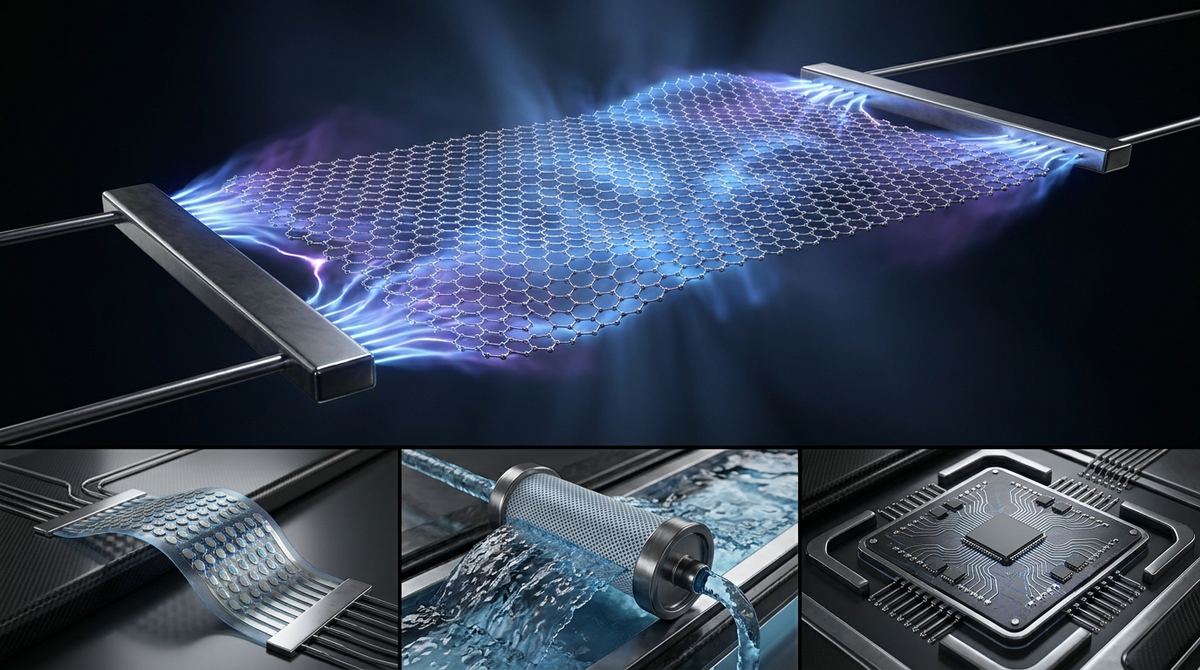
Graphene, the two-dimensional wonder material, has captivated the scientific and industrial worlds with its extraordinary properties. Renowned for its exceptional strength, unparalleled electrical conductivity, and vast surface area, graphene has already shown immense promise across a multitude of applications, including ultrasensitive gas sensors, highly efficient transparent electrodes in liquid crystal displays, and large-capacity electrodes in next-generation batteries. Yet, the journey to fully harness its potential is an ongoing scientific endeavor, continuously pushing the boundaries of material science.
At the forefront of this evolution is a fascinating area of research: understanding and leveraging the effect of external electric fields on graphene. These fields, commonly encountered in various practical applications, possess the remarkable ability to fundamentally alter graphene-based materials. They can induce significant changes in the material's geometry, modify binding energies, shift vibrational spectra, tune chemical activities, and profoundly impact electronic properties. Such induced alterations are not merely academic curiosities but represent a powerful pathway to further widen graphene's already impressive application landscape, transforming its inherent capabilities into truly multifunctional solutions. This exploration delves into how precisely external electric fields can act as catalysts and tuners, opening new frontiers for graphene technology and solidifying its role as a cornerstone of future innovation.
The Fundamental Influence of Electric Fields on Graphene's Intrinsic Properties
The interaction of graphene with external electric fields is a powerful phenomenon that goes far beyond simple charge conduction. These fields act as sophisticated control mechanisms, capable of precisely altering the very fabric and behavior of graphene at an atomic level. Scientists have meticulously investigated how electric fields induce substantial changes in graphene's geometry, leading to subtle yet critical structural reconfigurations that can influence its overall performance. These geometric shifts are often accompanied by significant alternations in binding energies, which dictate how other molecules or atoms interact with the graphene surface, profoundly affecting its adhesive and reactive characteristics.
Moreover, the vibrational spectra of graphene are highly sensitive to external electric fields. Changes in these spectra provide critical insights into the strength and nature of atomic bonds within the material and how they respond to external stimuli. Such modifications are not just observable; they are actionable, directly influencing graphene's chemical activities. This means that reactions that were once energetically unfavorable on pristine graphene can be accelerated or even enabled by the judicious application of an electric field, effectively making the material a more versatile chemical platform.
The electronic properties of graphene are perhaps the most widely studied aspect influenced by electric fields. Early experimental results, such as those from angle-resolved photoemission, have demonstrated that an electric field can induce charge transfer from dopants to carbon atoms in a K-doped graphene bilayer, altering its electronic landscape. More recently, newly developed graphene layers have shown a pronounced response to perpendicular electric fields, highlighting their potential for advanced electronic devices. For instance, the band structure of a bilayer graphene, a crucial determinant of its electrical conductivity and optical properties, can be precisely controlled and tuned by an applied electric field, enabling functionalities previously difficult to achieve.
Theoretical approaches, particularly density functional theory (DFT) methods, have been instrumental in unraveling these complex interactions. Researchers utilize DFT, often employing generalized gradient approximation (GGA) functionals, to computationally model and predict how electric fields enhance various phenomena. For example, studies have shown a dramatic decrease in hydrogen adsorption energy on nanoscale BN sheets—from −0.07 to −0.48 eV/H2—in the presence of a modest 0.050-au field. This theoretical predictive power allows for the rational design of graphene-based materials with tailored properties, accelerating the development cycle for new applications. From influencing the energetically preferred binding sites of CO and NO on metal surfaces to polarizing quaterthiophene molecules and thereby changing HOMO/LUMO levels, electric fields represent a fundamental and versatile tool for advanced material engineering.
Graphene and Electric Fields for Advanced Hydrogen Storage Solutions
The quest for efficient and safe hydrogen storage remains a critical challenge for the widespread adoption of hydrogen as a clean energy carrier. Graphene, with its exceptionally large surface-to-volume ratio, has long been recognized as a highly promising candidate for this application. However, unlocking its full potential for hydrogen storage requires overcoming significant inherent hurdles, particularly concerning the stable and reversible capture of hydrogen. Most early research focused on storing molecular hydrogen, but the future of high-density storage often points towards atomic hydrogen, where individual H atoms are directly and robustly bonded to the carbon framework.
One of the primary difficulties in utilizing pristine graphene for atomic hydrogen storage lies in its strong chemical bonding. The robust sp2 bonding between carbon atoms and the inherent π bonding between pz orbitals create a formidable energy barrier for hydrogen dissociation. This reaction barrier, typically ranging between 3.3 and 6.1 eV depending on the specific adsorption site, makes it energetically unfavorable for molecular hydrogen (H2) to spontaneously break apart and bond with the carbon atoms. Consequently, while graphene offers an ideal structural scaffold, its intrinsic chemical inertness towards hydrogen dissociation limits its direct application.
To overcome this limitation, researchers have explored various functionalization strategies, with doping emerging as a highly effective approach. Introducing foreign atoms into the graphene lattice can significantly modify its electronic structure and chemical reactivity. For instance, theoretical studies have shown that Al-doped graphene can significantly enhance CO adsorption, demonstrating the power of tailored doping. Similarly, systematic DFT calculations have investigated the gas adsorption properties of graphene doped with elements like Nitrogen (N), Boron (B), and Sulfur (S). Notably, an ab initio study revealed that N-doped carbon nanotubes (CNTs) could reduce the hydrogen dissociation energy barrier from 1.3 eV to a more manageable 0.9 eV, making hydrogen adsorption more feasible. N-doped graphene itself can be synthesized through various methods, including arc discharge in the presence of H2 and pyridine or ammonia, transformation of nanodiamonds, chemical vapor deposition, and electrothermal reactions.
This is where the transformative power of external electric fields comes into play, working synergistically with doping strategies. While doping makes the graphene surface more amenable to hydrogen interaction, electric fields provide an additional catalytic push. Theoretical investigations, particularly through DFT calculations, have extensively explored how electric fields can effectively modify the chemical reaction pathway of H2 molecular dissociative adsorption on graphene. On pristine graphene, H2 molecules are only weakly adsorbed, typically settling at the hollow site of the carbon hexagon at a distance of approximately 2.612 Å, with minimal adsorption energy. This weak interaction necessitates further intervention.
However, by strategically applying an electric field, the energy barrier for H2 dissociation can be dramatically lowered, or even completely removed, effectively turning the field into a catalyst. This facilitation by electric fields is critical for achieving efficient atomic hydrogen storage, potentially leading to the formation of stable graphane—a fully hydrogenated graphene where each carbon atom adsorbs one hydrogen atom, forming an sp3-hybridized carbon frame. This transformation, confirmed experimentally through transmission electron microscopy, could enable high-density, reversible hydrogen storage crucial for fuel cells and clean energy vehicles. The combined approach of tailored doping and precisely applied electric fields represents a cutting-edge strategy to unlock graphene's full potential for safe, high-capacity atomic hydrogen storage, moving us closer to a hydrogen-based economy.
Revolutionizing Surface Chemistry: Electric Field-Induced Reversible Wettability Tuning of Graphene
Beyond energy storage, the capacity to precisely control the surface properties of materials holds immense value across a spectrum of industrial applications. Wettability, the ability of a liquid to maintain contact with a solid surface, is a critical parameter influencing everything from self-cleaning coatings and anti-icing technologies to microfluidic devices and advanced biomedical sensors. Graphene, in its pristine state, exhibits inherent hydrophobicity, meaning it repels water. While this property is advantageous in certain contexts, the ability to reversibly switch its wettability between hydrophobic (water-repelling) and hydrophilic (water-attracting) states offers an unprecedented level of material control and adaptability.
The profound impact of external electric fields on graphene’s chemical activities and binding energies is precisely what enables this remarkable transformation. By carefully applying an electric field, researchers can induce changes in the electronic structure of the graphene surface, altering its interaction potential with water molecules. This electronic modification can effectively turn the graphene surface from being non-polar and water-repelling into a more polar and water-attracting entity. The strength and direction of the electric field become the dial that dictates this reversible transition, providing a dynamic control mechanism that is both elegant and efficient.
Imagine surfaces that can instantly adapt their water interaction based on environmental needs. In microfluidics, tunable wettability could allow for precise droplet manipulation and flow control within miniaturized lab-on-a-chip devices, revolutionizing medical diagnostics and chemical synthesis. For biomedical applications, graphene with switchable wettability could be used for on-demand drug delivery systems, smart biocompatible implants, or even advanced cell culture platforms where surface interactions are critical for cell adhesion and differentiation. The ability to switch between hydrophobic and hydrophilic states on demand offers a pathway to truly intelligent materials.
Furthermore, this electric field-induced wettability tuning has significant implications for anti-fouling and self-cleaning surfaces. Coatings that can actively shed contaminants or attract specific liquids offer a distinct advantage over passive surfaces. By making a graphene-based surface temporarily hydrophilic, it could be easily rinsed clean, and then reverted to a hydrophobic state to repel water and prevent adhesion. This level of dynamic control over surface energy presents a paradigm shift in material design, promising highly adaptive and responsive systems that can interact with their environment in previously unimaginable ways, all thanks to the precise influence of external electric fields on the fundamental properties of graphene.
Catalytic Power: External Electric Field-Catalyzed N2O Decomposition on Mn-Embedded Graphene
Beyond hydrogen storage and wettability, external electric fields are proving to be powerful tools for enhancing the catalytic capabilities of graphene, particularly in crucial environmental applications. Nitrous oxide (N2O), often referred to as laughing gas, is a potent greenhouse gas with a global warming potential significantly higher than carbon dioxide (CO2). It also contributes to stratospheric ozone depletion and is a byproduct of various industrial and agricultural processes. Efficiently decomposing N2O into benign nitrogen (N2) and oxygen (O2) is therefore a critical goal for mitigating environmental pollution and achieving sustainable industrial practices.
Traditional N2O decomposition catalysts often require high temperatures and expensive noble metals, which limits their widespread applicability. The emergence of graphene as a catalytic support material, especially when functionalized, opens new avenues for developing more efficient and cost-effective catalysts. In this context, researchers have explored Mn-embedded graphene as a promising platform for N2O decomposition. Manganese (Mn) is a relatively abundant and inexpensive transition metal, and embedding it within the graphene lattice can create highly active catalytic sites.
The remarkable insight from recent studies, grounded in density functional calculations, is that external electric fields can act as powerful catalysts themselves, significantly facilitating the N2O decomposition reaction on Mn-embedded graphene. While the Mn active sites initiate the catalytic process, the applied electric field provides the necessary energy and alters the electronic environment to lower activation barriers and accelerate reaction kinetics. This means that the reaction can proceed more efficiently, potentially at lower temperatures or with reduced energy input, making the catalytic process more sustainable and economically viable.
The mechanism involves the electric field influencing the binding energies and electronic states of the N2O molecule as it interacts with the Mn-graphene surface. The field can stabilize transition states, promote charge transfer, or reorient reactive species, all contributing to a more favorable reaction pathway. By acting as an “electronic lever,” the electric field fine-tunes the chemical environment at the active site, thereby boosting the catalytic efficiency of the Mn-embedded graphene. This synergistic effect between the catalyst material and the external electric field represents a significant advancement in catalytic science.
The implications of electric field-catalyzed N2O decomposition are far-reaching. Industries that produce N2O as a byproduct, such as nitric acid production, adipic acid production, and semiconductor manufacturing, could benefit immensely from this technology. Implementing highly efficient, graphene-based catalysts capable of operating under milder conditions, enhanced by electric fields, would significantly reduce greenhouse gas emissions and operational costs. This innovative approach not only highlights the multifunctional nature of graphene but also showcases how intelligent material design combined with external stimuli can provide elegant solutions to pressing global environmental challenges, moving us closer to a cleaner and more sustainable future.
Broader Horizons: Graphene in Gas Sensing, Transparent Electrodes, and Beyond
While hydrogen storage, wettability tuning, and N2O decomposition represent compelling applications, the principles derived from studying electric field interactions extend across graphene’s already established utility. Graphene's use as an ultrasensitive gas sensor, for instance, relies heavily on its ability to change electronic properties upon adsorption of gas molecules. External electric fields can precisely enhance this sensitivity by fine-tuning the electronic structure of graphene, making it more reactive or selective towards specific analytes. This could lead to even more accurate and rapid detection of hazardous gases or environmental pollutants, safeguarding public health and improving industrial process control.
Similarly, in applications such as transparent electrodes for liquid crystal display (LCD) devices, the electronic properties are paramount. The ability to control the band structure of graphene with an applied electric field, as theoretical and experimental results have shown, opens doors for dynamic control over transparency, conductivity, and work function. This offers the potential for faster, more efficient, and perhaps even tunable transparent electronics, pushing the boundaries of display technology and optoelectronics. Imagine displays with dynamically adjustable optical properties or smart windows that can alter their tint based on external electric signals.
Even in large-capacity battery electrodes, where graphene offers advantages in terms of surface area and conductivity, external electric fields can play a subtle yet significant role. By influencing charge transfer mechanisms, ion diffusion, and electrode-electrolyte interfaces, electric fields can potentially optimize battery charging/discharging rates, enhance capacity retention, and improve overall cycle life. While direct experimental validation in commercial batteries may be complex, the foundational understanding gleaned from electric field studies provides crucial insights for material design and performance optimization in electrochemical energy storage.
These diverse applications underscore the true multifunctional nature of graphene when synergistically combined with external electric fields. The fields don't merely provide an external perturbation; they become an integral part of the material's functionality, acting as an active control element. This paradigm shift from passive material to active, responsive system is what positions graphene at the forefront of advanced materials innovation, promising a new generation of technologies that are more efficient, adaptable, and intelligent across various sectors.
Conclusion: The Electrifying Future of Graphene with External Fields
The exploration into the effects of external electric fields on graphene’s properties reveals a profound and transformative landscape for advanced material science. From precisely tailoring its geometry and binding energies to fundamentally altering its chemical activities and electronic characteristics, electric fields are proving to be an indispensable tool for unlocking graphene's full, multifunctional potential. This strategic manipulation is not merely a theoretical curiosity; it directly translates into tangible advancements across critical applications.
We have seen how electric fields act as potent catalysts, drastically reducing the energy barriers for crucial reactions such as hydrogen dissociation, paving the way for efficient atomic hydrogen storage—a cornerstone of a clean energy future. The ability to reversibly tune graphene’s wettability between hydrophobic and hydrophilic states, controlled by an electric field, promises revolutionary applications in smart surfaces, microfluidics, and biomedical devices. Furthermore, the catalytic enhancement of N2O decomposition on Mn-embedded graphene by external fields offers an innovative and sustainable solution to pressing environmental challenges.
The overarching theme is clear: graphene, when intelligently integrated with external electric fields, transcends its already impressive capabilities to become a truly dynamic and highly adaptable material. These advancements are not just incremental; they represent a fundamental shift in how we can design, control, and deploy advanced nanomaterials for high-impact applications in energy, environmental remediation, electronics, and beyond. As research continues to deepen our understanding of these intricate interactions, the future promises even more extraordinary innovations.
At usa-graphene.com, we are committed to being at the forefront of this graphene revolution, providing high-quality graphene materials that enable researchers and industries to explore these cutting-edge applications. Discover how our premium graphene solutions can power your next breakthrough. Explore our products and connect with our experts today to leverage the electrifying potential of graphene for your innovative projects. Your future in advanced materials starts here.