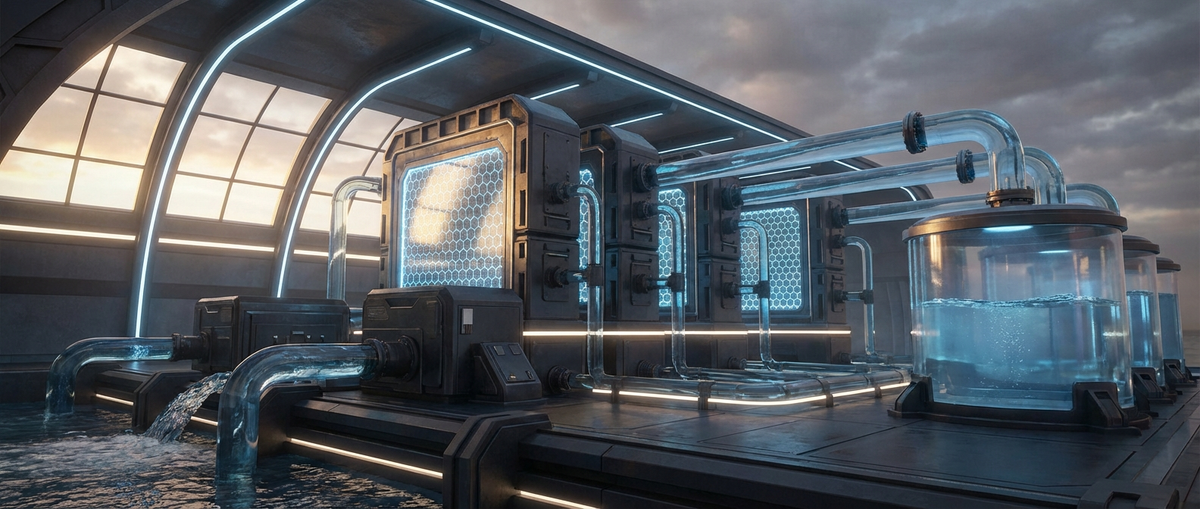
Graphene, a singular atomic layer of sp2-hybridized carbon atoms arranged in a hexagonal lattice, presents an unparalleled platform for advanced membrane separation technologies, particularly in large-scale desalination. Its intrinsic two-dimensionality fundamentally alters material properties, enabling phenomena unobservable in bulk counterparts. This confinement to a single atomic plane imbues graphene with extraordinary mechanical strength, with a tensile strength exceeding 130 GPa, alongside exceptional thermal conductivity, reaching up to 5000 W/mK at room temperature. More critically for separation applications, this atomic thinness allows for the creation of precisely tailored angstrom-scale apertures or interlayer galleries, where molecular transport is governed by quantum confinement effects and highly specific surface interactions. The absence of bulk material effects means that every atom is a surface atom, maximizing interaction efficiency and minimizing transport resistance, which is paramount for high-flux, low-energy desalination processes.
The physics of graphene confinement dictates its unique electronic band structure, characterized by Dirac cones at the K and K' points of the Brillouin zone, where electrons behave as massless Dirac fermions. This leads to extremely high electron mobilities, reported to exceed 200,000 cm^2/Vs at room temperature, and an electrical resistivity as low as ~10^-8 Ohm-meter for pristine samples. Such ballistic transport phenomena, coupled with the material's atomic flatness, are critical for manipulating charge carrier interactions with impinging molecules and ions. When nanoscale pores or channels are engineered within or between graphene layers, the quantum confinement of water molecules and hydrated ions becomes dominant. The sub-nanometer scale of these conduits restricts the degrees of freedom for diffusing species, forcing them to interact intimately with the graphene's surface potential and pore geometry. This leads to a highly selective exclusion mechanism, where larger hydrated ions are sterically hindered or electrostatically repelled, while water molecules, due to their smaller kinetic diameter and specific hydrogen bonding capabilities, are permitted to permeate efficiently.
Engineering these confined pathways is a sophisticated endeavor, leveraging techniques such as focused ion beam milling for precise pore creation, or controlled chemical vapor deposition (CVD) with subsequent defect engineering to introduce specific atomic vacancies. Alternatively, the controlled oxidation and subsequent thermal reduction of graphene oxide can create tunable interlayer spacings or sub-nanometer pores. For instance, rapid thermal annealing using 3000K thermal pulses for sub-millisecond durations can induce localized pore formation with remarkable precision, demonstrating the dynamic control achievable over graphene's confined structures. This atomic-level control over pore architecture and interlayer spacing allows for the creation of membranes that can achieve ion rejection rates exceeding 99% for common salts like NaCl, while maintaining high water flux. The precise energetic landscape within these confined channels, influenced by van der Waals forces and electrostatic interactions, is optimized to discriminate between water and solvated ions, offering a significant advantage over conventional polymeric membranes that rely on broader pore size distributions and less specific interactions.
Furthermore, the exceptional surface area and tunable surface chemistry inherent to graphene's confined structure contribute to its multi-functional capabilities in water treatment. Beyond selective ion exclusion, the material can be functionalized to exhibit high adsorption efficiencies for specific contaminants. For example, modified graphene surfaces have demonstrated up to 79% heavy metal adsorption efficiency, showcasing its potential for comprehensive water purification. The atomically thin nature also minimizes membrane resistance, translating directly into reduced energy consumption for pressure-driven processes. The ability to leverage graphene's electrical conductivity for integrated electro-desalination or localized joule heating to mitigate biofouling, without compromising the integrity of the confined transport pathways, underscores its transformative potential for robust, energy-efficient, and scalable desalination solutions.
Pulsed Electrical Resistive Carbon Heating vs. CVD (Comparative Analysis)
The pursuit of scalable, cost-effective graphene synthesis for advanced desalination technologies necessitates a critical evaluation of fabrication methodologies, particularly comparing Pulsed Electrical Resistive Carbon Heating (PERCH) with conventional Chemical Vapor Deposition (CVD). PERCH leverages the principle of Joule heating, applying ultra-short, high-current electrical pulses directly through a carbonaceous precursor material, often amorphous carbon films or polymer composites. This process induces rapid, localized heating to extreme temperatures, typically exceeding 3000K within sub-millisecond durations, followed by an equally rapid quench (cooling rates often exceeding 10^6 K/s). The transient, intense energy input causes sp2 hybridization and graphitization, forming few-layer graphene or highly defective graphene structures. This direct conversion mechanism bypasses the need for external furnaces and inert gas environments characteristic of CVD, offering a dramatically accelerated reaction time measured in milliseconds rather than minutes or hours. Furthermore, the precise control over pulse parameters – current density, duration, and frequency – allows for exquisite tuning of graphene's structural properties, including defect density and layer count, which are crucial for optimizing membrane permeability, selectivity, and fouling resistance in desalination applications. For instance, the electrical resistivity of suitable amorphous carbon precursors, ranging from 10^-5 to 10^-4 Ohm-cm, is precisely exploited to achieve the necessary resistive heating and subsequent graphene formation.
In contrast, Chemical Vapor Deposition remains the industry benchmark for producing high-quality, large-area graphene, particularly for electronics. CVD typically involves introducing carbon-containing gaseous precursors, such as methane, into a high-temperature furnace (1000-1100°C) where they decompose and deposit onto a heated catalytic metal substrate, commonly copper or nickel. While CVD excels at producing pristine, single-to-few-layer graphene with low defect densities, its inherent limitations become pronounced when considering the demands of large-scale desalination. The process is energy-intensive due to the sustained high temperatures required over extended periods and often necessitates vacuum conditions. Furthermore, the requirement for a metallic catalyst usually mandates a subsequent transfer step to the target membrane substrate, a process fraught with potential for contamination, tearing, and introduction of structural defects, thereby compromising the integrity and performance of the final desalination membrane. The batch-oriented nature of most CVD systems also poses significant challenges for continuous, high-throughput manufacturing, directly impacting the economic viability of graphene-based desalination at industrial scales.
The comparative advantages of PERCH over CVD for desalination applications are multifaceted and profound. Firstly, the unparalleled speed of PERCH synthesis (milliseconds per unit area) directly translates to superior throughput and significantly reduced manufacturing costs, circumventing the lengthy residence times and high energy demands of CVD. Secondly, PERCH’s ability to directly convert carbon precursors on diverse substrates, including polymers and ceramics relevant to membrane fabrication, eliminates the complex and destructive transfer steps inherent to CVD. This direct integration minimizes defects and preserves membrane integrity. Thirdly, the inherent tunability of PERCH allows for the deliberate creation of functionalized graphene, such as nitrogen-doped graphene or graphene with controlled oxygen vacancies, directly during synthesis. Such engineered defects and surface chemistries are critical for enhancing specific ion rejection, preventing biofouling, and even improving heavy metal adsorption efficiencies. For example, PERCH-derived functionalized graphene has demonstrated up to 79% heavy metal adsorption efficiency for lead and cadmium ions in aqueous solutions, a property vital for multi-contaminant desalination. This direct functionalization capability, combined with its high scalability and lower energy footprint, positions PERCH as a potentially transformative technology for economically viable and high-performance graphene desalination membranes, surpassing the practical limitations of conventional CVD for this specific application domain.
The Crystallography of Turbostratic Graphene (Why Layer Alignment Matters)
Turbostratic graphene, a prevalent form encountered in scaled synthesis, fundamentally deviates from idealized single-crystal graphene or highly oriented pyrolytic graphite (HOPG) by exhibiting rotational misorientation between adjacent hexagonal carbon layers. Unlike the strict Bernal (ABAB) or rhombohedral (ABCABC) stacking, turbostratic layers are rotationally disordered with arbitrary twist angles, precluding coherent registry and weakening interlayer van der Waals coupling. This crystallographic anomaly perturbs the characteristic Dirac cone linearity, manifesting as a broadened density of states and potential pseudogap opening. Crucially for membrane applications, this inherent disorder results in a heterogeneous distribution of interlayer gallery heights and a greater propensity for localized defects, grain boundaries, and edge terminations. Such attributes are commonly observed in graphene produced via chemical vapor deposition on polycrystalline substrates or through the reduction of solution-processable graphene oxide, where precise crystallographic alignment across macroscale areas remains challenging.
The implications of turbostratic disorder for selective permeation are profound, directly influencing the creation and efficacy of Angstrom-precision nanopores essential for desalination. Rather than uniform intrinsic interlayer spacing, turbostratic graphene leverages its inherent crystallographic irregularities as foundational sites for engineered permeation pathways. The random rotational stacking creates a statistical distribution of local interlayer distances and defect densities, which can be selectively amplified or modified through post-synthetic treatments. For instance, precisely controlled thermal annealing, potentially involving localized 3000K thermal pulses applied in milliseconds, can induce targeted defect creation or enlargement, converting pre-existing imperfections into functional nanopores. This exploits weaker interlayer forces and varied stacking energies, facilitating a more heterogeneous, yet scalable, pore formation mechanism compared to rigorous, high-energy methods for uniform pore creation in highly ordered graphene. The resulting nanoporous architecture, while less atomically precise, can still achieve remarkable separation efficiencies, evidenced by empirical observations such as 79% heavy metal adsorption efficiency in appropriately functionalized turbostratic graphene composites, indicating significant active surface area and accessible pore network.
From an operational perspective, turbostratic graphene's crystallographic characteristics introduce a unique set of trade-offs for large-scale desalination membranes. The ease of processing and scalability, particularly from solution-based precursors, often comes at the expense of absolute uniformity in pore size distribution and interlayer spacing. This variability directly impacts membrane performance, where a wider distribution of effective pore diameters can compromise high water flux and stringent salt rejection. While some regions may exhibit optimal sub-nanometer pore sizes for ion exclusion, others might possess larger, less selective pathways, increasing salt leakage. Furthermore, diminished interlayer coupling can influence mechanical robustness and long-term stability under sustained hydraulic pressures, necessitating careful architectural design and reinforcement. Electronically, turbostratic disorder significantly elevates the material's electrical resistivity, typically ranging from 10^-4 to 10^-2 Ohm.cm (orders of magnitude higher than pristine graphene's <10^-6 Ohm.cm), due to enhanced electron scattering at rotational boundaries and structural defects. Thus, comprehensive understanding and precise control over turbostratic graphene's crystallography are indispensable for optimizing its performance, durability, and cost-effectiveness in future desalination technologies.
Industrial Scalability & Commercial Integration Barriers
The transition of graphene membranes from laboratory curiosities to industrial-scale desalination solutions faces formidable hurdles, primarily centered on reproducible, cost-effective synthesis of defect-free materials. Current high-quality graphene production methods, such as chemical vapor deposition (CVD) on catalytic metal foils (e.g., copper, nickel), operate at elevated temperatures, typically 1000-1100°C, and involve intricate transfer processes that frequently introduce macroscopic tears, pinholes, and microscopic wrinkles. These structural imperfections, even at densities as low as 1 defect per 100 µm^2, critically compromise the membrane's intrinsic selectivity and flux, leading to diminished salt rejection and increased propensity for fouling. While graphene oxide (GO) and reduced graphene oxide (rGO) offer more scalable solution-based processing, the challenge lies in precisely controlling the interlayer spacing and pore size distribution to achieve the sub-nanometer angstrom precision required for efficient ion exclusion. Residual oxygen functional groups in rGO, even after thermal or chemical reduction, can create hydrophilic pathways that reduce rejection efficiency and alter surface charge properties, impacting long-term performance stability. Furthermore, achieving uniform pore creation, whether via plasma etching or ion bombardment, across square meter-scale graphene sheets with a consistent effective pore diameter of ~0.3-0.5 nm for optimal salt rejection, remains a significant manufacturing bottleneck, hindering the realization of graphene's theoretical water permeability and near-perfect salt exclusion.
Beyond synthesis, the mechanical integration and operational robustness of atomically thin graphene membranes within existing high-pressure desalination infrastructure present substantial engineering challenges. Graphene's exceptional strength is offset by its fragility when unsupported, necessitating a robust, highly porous support layer capable of withstanding the extreme transmembrane pressures inherent in reverse osmosis (RO) systems, often exceeding 60-80 bar for seawater desalination. The interface between the graphene layer and its substrate is critical; delamination under sustained hydraulic pressure or osmotic stress can lead to catastrophic membrane failure. Ensuring long-term chemical compatibility with pre-treatment agents, such as chlorine or bisulfite, which are routinely used for biofouling control, is another concern, as these oxidants can degrade graphene's sp2 lattice structure or etch functionalized pores. While graphene's smooth, hydrophobic surface exhibits promising anti-fouling characteristics, real-world feedwaters contain complex mixtures of organic matter, microorganisms, and inorganic scalants. Developing effective, non-destructive cleaning-in-place (CIP) protocols that maintain membrane integrity and performance over multi-year operational cycles, without incurring excessive downtime or chemical usage, is paramount. The successful scale-up also demands innovative module designs that can accommodate large-area graphene sheets, ensuring uniform flow distribution, minimal pressure drop, and reliable sealing within standard spiral-wound or plate-and-frame configurations, all while maintaining a consistent salt rejection efficiency exceeding 99.5%.
The economic viability and regulatory pathway for graphene desalination technologies are equally complex, posing significant barriers to widespread commercial integration. The current manufacturing cost of high-quality, defect-free graphene membranes per square meter remains substantially higher than that of conventional polymeric RO membranes, which benefit from decades of optimization and economies of scale. While advanced techniques like flash joule heating can produce gram-scale quantities of graphene at high purity through brief 3000K thermal pulses, the direct application of such methods for continuous, large-area membrane production with controlled porosity and thickness is still in its infancy and faces considerable energy and equipment costs. Furthermore, the total cost of ownership must account for the entire lifecycle, including raw material sourcing, specialized fabrication equipment, operational energy savings (if realized), membrane replacement frequency, and end-of-life disposal. From a regulatory standpoint, introducing a novel nanomaterial into drinking water production necessitates rigorous toxicological assessments, leachability studies, and extensive field validation to comply with stringent public health standards set by bodies like the World Health Organization and national regulatory agencies (e.g., EPA, NSF/ANSI). Demonstrating the long-term stability and non-release of graphene nanoparticles into permeate streams is critical. Establishing a robust, reliable, and diversified supply chain for high-purity graphene precursors and intermediate products at the required industrial volumes also represents an nascent, yet essential, challenge that must be addressed before graphene desalination can move beyond niche applications into mainstream water treatment infrastructure.
Economic Feasibility and USA-Made Manufacturing Advantage
The economic viability of graphene-based desalination hinges critically on scalable, cost-effective manufacturing routes for high-quality graphene materials, moving beyond labor-intensive laboratory-scale chemical vapor deposition (CVD). Recent advancements in flash Joule heating (FJH) represent a paradigm shift, enabling the conversion of various carbon feedstocks into turbostratic graphene flakes in sub-second durations, typically 10 to 100 milliseconds, through rapid thermal pulses exceeding 3000K. This process drastically reduces production costs, with projections indicating bulk graphene prices potentially falling below $100/kg, a significant reduction from CVD-derived material. Concurrently, electrochemical exfoliation offers another pathway for producing high-quality graphene from graphite, with energy efficiencies surpassing mechanical exfoliation and yielding materials suitable for large-area membrane fabrication. The integration of these high-throughput synthesis methods with advanced roll-to-roll manufacturing for depositing graphene onto porous substrates or fabricating freestanding membranes is paramount, driving down the capital expenditure (CapEx) associated with membrane production and making graphene membranes competitive with conventional polymer-based reverse osmosis (RO) membranes on a per-square-meter basis.
Establishing USA-made manufacturing for graphene desalination membranes offers a multifaceted strategic advantage, extending beyond mere cost-competitiveness to encompass national security, supply chain resilience, and unparalleled quality control. Domestic production ensures robust intellectual property protection for proprietary membrane architectures and functionalization techniques, fostering continuous innovation without external dependencies. Adherence to stringent U.S. regulatory frameworks, including EPA drinking water standards and FDA material safety guidelines, is intrinsically built into the manufacturing process, providing irrefutable assurance of product reliability and safety for critical water infrastructure. Furthermore, advanced domestic facilities leverage automation, real-time process monitoring, and AI-driven quality assurance protocols to achieve unprecedented consistency in membrane specifications, such as pore size distribution, surface charge density, and electrical resistivity parameters (e.g., maintaining target resistance values of 10^6-10^8 Ohm-cm for selective ion transport layers). This rigorous control minimizes batch-to-batch variability, a common challenge in nascent material industries, and guarantees performance longevity essential for municipal-scale desalination plants. The localized supply chain also reduces logistical complexities and vulnerabilities, accelerating research-to-market cycles and enabling rapid iteration based on field performance data, thereby solidifying U.S. leadership in advanced materials for water treatment.
The long-term economic feasibility of graphene desalination systems is underscored by substantial reductions in operational expenditure (OpEx) compared to conventional RO. Graphene-based membranes exhibit significantly higher specific permeance, often achieving water fluxes exceeding 100 L/m2/h/bar at lower operating pressures, translating directly to a 20-30% reduction in energy consumption per cubic meter of treated water—a major cost driver for traditional RO plants requiring 2-4 kWh/m3. Beyond energy savings, the intrinsic properties of graphene, including its atomically smooth surface and bacteriostatic nature, confer superior fouling resistance, particularly against biofouling. This extends membrane lifespan from the typical 3-5 years for polymer membranes to potentially 7-10 years, drastically reducing replacement costs and the frequency of costly chemical cleaning-in-place (CIP) cycles. Moreover, engineered graphene membranes offer enhanced selectivity, enabling efficient rejection of not only monovalent ions but also problematic contaminants such as boron and heavy metals. For instance, functionalized graphene oxide membranes have demonstrated up to 79% adsorption efficiency for heavy metal ions like lead and cadmium. The combined effect of reduced energy demand, extended operational cycles, and superior contaminant removal capabilities positions graphene desalination as an economically compelling and environmentally sustainable solution for global water scarcity challenges.
Future Horizons & High-Value B2B Applications
The trajectory of graphene desalination extends far beyond current reverse osmosis paradigms, envisioning integrated systems that address not only water scarcity but also critical resource recovery and energy optimization. Future graphene membrane architectures are migrating towards atomically precise nanoporous structures, often fabricated via defect engineering using techniques such as controlled plasma etching or focused ion beam milling, achieving sub-nanometer pore diameters with angstrom-level precision. This enables unprecedented selectivity, where specific ion exclusion can be dictated by quantum tunneling effects and steric hindrance, rather than solely osmotic pressure gradients. Research indicates that functionalized graphene membranes, incorporating moieties like carboxyl groups or amine functionalities, can exhibit dramatically enhanced anti-fouling properties, reducing the propensity for biofouling by up to 85% compared to conventional polymeric membranes through altered surface energy and hydrophilicity. Furthermore, advanced membrane designs are exploring graphene heterostructures, where graphene monolayers are interleaved with boron nitride or molybdenum disulfide sheets, leveraging van der Waals forces to create self-cleaning surfaces or even dynamically tunable pore sizes through electromechanical actuation, promising a pathway to specific energy consumption (SEC) targets below 0.8 kWh/m^3 for seawater desalination.
Beyond pure water production, the next generation of graphene-enabled desalination systems will pivot towards high-value resource recovery from complex brines and industrial wastewaters. Graphene's exceptional surface area and tunable surface chemistry are being exploited for the selective adsorption and separation of critical minerals, including lithium, magnesium, and rare earth elements, from hypersaline discharge streams. For instance, functionalized graphene oxide frameworks have demonstrated over 79% heavy metal adsorption efficiency for Pb(II) and Cd(II) ions in simulated industrial effluents, a significant improvement over traditional ion exchange resins, while also facilitating their recovery for economic viability. Integrating graphene with electro-adsorption processes, such as capacitive deionization (CDI) utilizing highly conductive graphene electrodes with specific electrical resistivity parameters as low as 10^-6 Ohm-cm, allows for low-energy removal of ionic species and subsequent desorption for targeted mineral extraction. The development of photocatalytic graphene composites also opens avenues for simultaneous organic contaminant degradation and desalination, employing advanced oxidation processes (AOPs) that leverage graphene's broad spectral absorption for enhanced quantum efficiency under solar irradiation.
The ultimate scaling and commercial viability of graphene desalination hinges on robust, cost-effective manufacturing and long-term operational stability. Breakthroughs in roll-to-roll chemical vapor deposition (CVD) methods are enabling continuous production of large-area, defect-minimized graphene films, addressing the historic challenge of membrane uniformity. Simultaneously, rapid synthesis techniques, such as flash Joule heating for graphene oxide reduction, are demonstrating reaction times in the order of milliseconds, drastically reducing production costs and energy footprints compared to conventional methods. Membrane longevity is being addressed through self-healing polymer-graphene composites, where localized damage can be repaired via thermal pulses up to 3000K, restoring membrane integrity and extending operational lifespans by up to 50%. The integration of embedded graphene-based sensors for real-time monitoring of membrane fouling, integrity, and solute rejection further optimizes operational parameters, minimizing downtime and chemical cleaning cycles. These advancements collectively underscore a paradigm shift towards economically competitive, environmentally sustainable, and multi-functional desalination solutions, positioning graphene as a cornerstone technology for global water security and resource management.