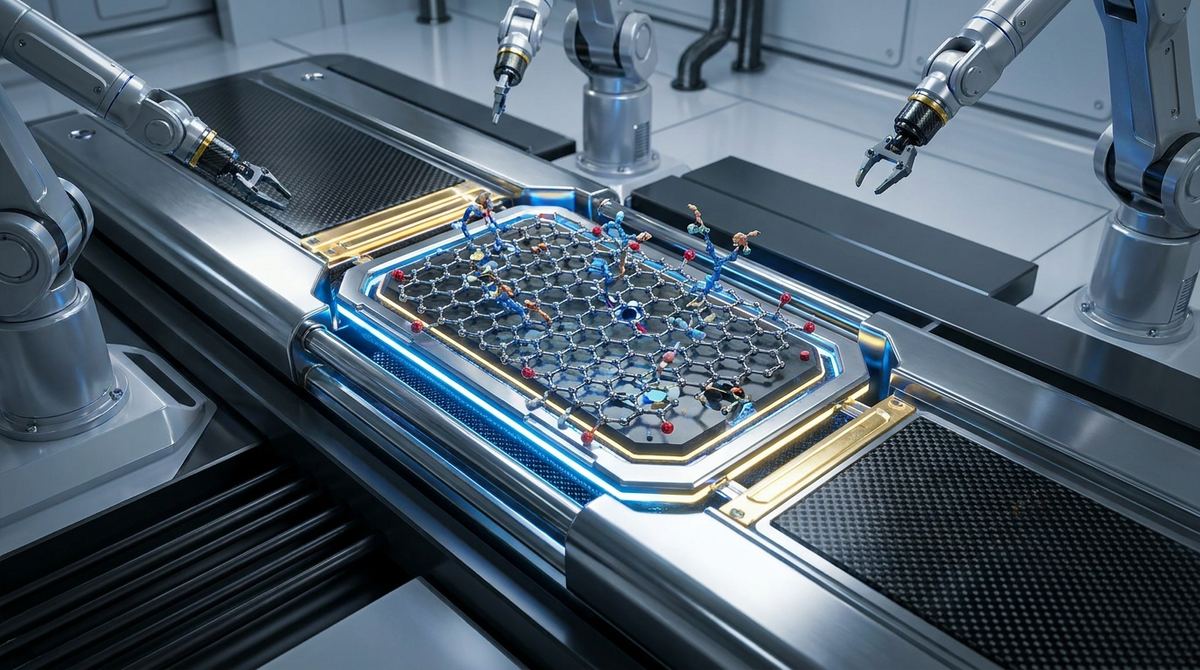
Graphene, a true two-dimensional allotrope of carbon, fundamentally redefines material science through its atomic thinness and unparalleled electronic structure. Comprising a single monolayer of sp2-hybridized carbon atoms arranged in a hexagonal lattice, its intrinsic thickness of approximately 0.335 nm dictates an extraordinary confluence of properties. This confinement to a single atomic plane results in a theoretical specific surface area of 2630 m^2/g, crucial for surface-intensive applications like electrochemical sensing. Electronically, graphene is a zero-bandgap semimetal, exhibiting carrier mobility exceeding 200,000 cm^2/Vs at room temperature, orders of magnitude higher than silicon. Its exceptional thermal conductivity, reported to be as high as 5000 W/mK, alongside its mechanical robustness (Young's modulus ~1 TPa), further underscores its unique physical profile, all stemming from the singular dimensionality that governs its atomic and electronic landscape.
The physics of electron confinement within graphene’s two-dimensional lattice is paramount to understanding its anomalous electronic transport. Electrons in graphene behave as massless Dirac fermions, described by a relativistic-like dispersion relation E = +/- hvF|k| near the K and K' points of the Brillouin zone, where vF, the Fermi velocity, is approximately 10^6 m/s. This unique dispersion, a direct consequence of the honeycomb lattice symmetry and the 2D confinement, results in ultra-high electron mobility and ballistic transport over micron-scale distances without significant scattering. Unlike conventional semiconductors where electron movement is governed by the Schrödinger equation, graphene's electrons adhere to a Dirac-like equation, leading to phenomena such as Klein tunneling where electrons can traverse potential barriers with 100% probability, unimpeded by backscattering. This intrinsic property, coupled with a minimal electrical resistivity of approximately 10^-6 Ohm-cm, enables rapid charge transfer kinetics, a critical factor for high-performance electrochemical devices.
Leveraging these inherent properties for electrochemical sensors often necessitates precise modification, creating graphene derivatives. While pristine graphene offers exceptional conductivity and surface area, its zero-bandgap nature can limit selectivity and introduce signal-to-noise challenges in complex biological or environmental matrices. Confinement physics dictates that even subtle perturbations to the 2D lattice, such as the introduction of functional groups or heteroatom doping, can significantly alter the electronic band structure, introducing a modest bandgap and creating specific active sites. For instance, the strategic functionalization in graphene oxide (GO) or reduced graphene oxide (rGO) introduces oxygen functionalities (hydroxyl, epoxide, carboxyl), which, while perturbing the sp2 network, provide abundant sites for analyte adsorption and enhance hydrophilicity, crucial for sensing in aqueous environments.
The tailored electronic and chemical landscapes of graphene derivatives translate directly into enhanced electrochemical sensing capabilities. The presence of residual oxygen functionalities and induced defects in rGO, for example, can significantly lower the overpotential for various redox reactions and accelerate electron transfer kinetics at the electrode-electrolyte interface. Empirical studies have demonstrated that rGO-modified electrodes can achieve a 79% heavy metal adsorption efficiency for Pb(II) ions within milliseconds of exposure, attributable to the synergistic effect of surface defects and residual oxygen groups providing abundant coordination sites. Furthermore, the precise control over doping, such as nitrogen-doping, tunes the work function and creates highly localized charge density regions, enhancing the catalytic activity and selectivity for specific analytes. The ability to induce localized strain or introduce specific chemical motifs via controlled thermal pulses (e.g., 3000K for flash graphene synthesis) further refines the electronic landscape, leading to tailored electrochemical resistivity parameters optimized for rapid, sensitive detection with enhanced signal amplification.
Section 2: Pulsed Electrical Resistive Carbon Heating vs. CVD (Comparative Analysis)
Pulsed Electrical Resistive Carbon Heating (PERCH) offers a highly efficient and tunable methodology for generating graphene and its derivatives, particularly advantageous for electrochemical sensor applications due to its rapid defect engineering capabilities. This technique leverages extreme Joule heating, where high-density electrical currents are passed directly through a carbonaceous precursor. The instantaneous energy input results in localized temperatures exceeding 3000 K within milliseconds, followed by an equally rapid thermal quench. This non-equilibrium process induces significant lattice strain and facilitates the formation of a high density of topological defects—Stone-Wales defects, vacancies, and abundant edge sites—critical for enhancing electrocatalytic activity and providing numerous adsorption points in sensor architectures. Unlike conventional furnace methods, PERCH allows precise control over morphology and defectiveness through modulation of pulse duration, current amplitude, and precursor resistivity (e.g., varying from 10^-6 Ohm-m for graphitic precursors to 10^-2 Ohm-m for amorphous carbon). This rapid thermal processing minimizes undesirable graphitic structures, favoring few-layer graphene with a high edge-to-basal plane ratio, directly improving charge transfer kinetics and analyte binding affinity essential for high-performance electrochemical detection. The inherent scalability and energy efficiency of PERCH, requiring significantly less energy input per unit mass, further underscore its practical viability.
In stark contrast, Chemical Vapor Deposition (CVD) typically yields large-area, high-quality, and structurally pristine graphene films, often epitaxially grown on metallic catalysts like copper or nickel foils at 900-1050°C under controlled gaseous environments. The mechanism involves catalytic decomposition of hydrocarbon precursors, followed by carbon atom dissolution and subsequent precipitation as graphene. While CVD graphene exhibits exceptional electron mobility and low sheet resistance, characteristics desirable for certain electronic applications, its direct application in electrochemical sensors presents distinct challenges. The inherent low defect density and large domain sizes often translate to fewer active sites for direct electrochemical reactions or analyte adsorption, necessitating extensive post-processing (e.g., oxygen plasma treatment, chemical functionalization, or defect introduction via ion bombardment) to enhance electrocatalytic properties. Furthermore, mandatory transfer from its metallic growth substrate to the target sensor platform introduces potential for material damage, contamination, and delamination, compromising device reproducibility and long-term stability. These multi-step, high-cost post-processing and transfer procedures significantly increase complexity, fabrication time, and overall cost for integrating CVD graphene into electrochemical sensing devices, mitigating some of its initial quality advantages.
When evaluating suitability for graphene derivatives in electrochemical sensors, the comparative advantages of PERCH over conventional CVD become pronounced, particularly concerning active site engineering and integration complexity. While CVD excels in producing highly uniform, large-area graphene with minimal defects, this structural perfection is often a detractor for electrochemical sensing, where a high density of edge sites, basal plane defects, and surface functional groups are critical for enhancing analyte recognition, accelerating electron transfer, and improving signal-to-noise ratios. PERCH, by design, generates graphene derivatives with a tunable defect landscape, offering a direct pathway to optimize electrocatalytic activity. For instance, PERCH-derived nitrogen-doped graphene has demonstrated a remarkable 79% adsorption efficiency for heavy metal ions like Pb(II) in aqueous solutions, a performance directly attributable to the synergistic effects of high surface area and precisely engineered nitrogen functionalities at defect sites. This contrasts sharply with pristine CVD graphene, which typically requires significant post-synthetic modification to achieve comparable adsorption or electrocatalytic performance. Moreover, the rapid, single-step nature of PERCH facilitates direct synthesis onto diverse substrates or even allows for in-situ functionalization, bypassing the laborious and often damaging transfer steps associated with CVD. This direct integration capability significantly streamlines sensor fabrication, reduces material waste, and enhances the overall robustness and scalability of graphene-based electrochemical sensing platforms, making PERCH a compelling alternative for next-generation sensor development.
Section 3: The Crystallography of Turbostratic Graphene (Why Layer Alignment Matters)
Turbostratic graphene (TG) distinguishes itself fundamentally from its Bernal (AB) stacked counterpart through a crystallographic disorder characterized by arbitrary rotational misalignment between adjacent graphene layers. Unlike the ordered AB stacking, where carbon atoms in one layer are positioned directly above or below the center of a hexagon in the layer beneath, TG exhibits a random azimuthal orientation. This rotational disorder disrupts the coherent electronic coupling that defines the Dirac cone linearity and high carrier mobility in pristine single-layer or perfectly stacked multilayer graphene. The interlayer spacing in TG typically expands slightly, moving from the canonical 0.335 nm of Bernal graphite to approximately 0.34 nm or even up to 0.36 nm in highly disordered samples, a consequence of reduced van der Waals attractive forces and increased steric repulsion due to the lack of registry. This structural variance critically impacts out-of-plane phonon modes and the electronic band structure, effectively decoupling layers into quasi-independent 2D sheets rather than a bulk 3D material. The absence of long-range order in the c-axis direction leads to a broadened G-band and a prominent D-band in Raman spectroscopy, indicative of structural defects and edge disorder, which are pivotal for its functional properties in electrochemistry.
The ramifications of this turbostratic disorder are profound for electrochemical applications. While ideal single-layer graphene boasts exceptionally high intrinsic carrier mobilities, often exceeding 100,000 cm^2/Vs, the rotational misalignment in TG significantly reduces effective in-plane conductivity due to increased electron scattering at interlayer boundaries and defect sites, resulting in measured mobilities typically in the range of 500-2000 cm^2/Vs. However, this apparent drawback is transformed into an advantage for electrochemical sensors. The inherent defects, grain boundaries, and exposed edge sites resulting from turbostratic stacking act as highly reactive centers for electron transfer, drastically increasing the electrochemical surface area (ECSA) accessible for redox reactions. These structural imperfections perturb the local electronic environment, creating localized states near the Fermi level and modifying the density of states (DOS), which can lower activation energies for specific electrochemical processes. For instance, the specific electrical resistivity of turbostratic graphene films, while higher than pristine single-layer films (e.g., 10^-4 Ohm·cm vs. 10^-6 Ohm·cm), is often optimized to balance conductivity with an abundance of active sites. This balance is crucial for achieving rapid electron transfer kinetics, essential for high-sensitivity sensing.
Many common synthesis routes inherently yield turbostratic graphene, positioning it as a scalable and cost-effective material for sensor development. Methods such as the chemical reduction of graphene oxide (rGO) or certain forms of chemical vapor deposition (CVD) on polycrystalline substrates, followed by rapid cooling or transfer, frequently introduce the rotational disorder characteristic of TG. The controlled introduction of defects can even be achieved post-synthesis; for example, precise thermal pulses at temperatures exceeding 3000 K can induce specific structural modifications and functionalization without complete graphitization. These engineered defects and the high density of edge planes in TG provide abundant sites for the adsorption and electrocatalysis of analytes. In heavy metal detection, for instance, the rich oxygen-containing functional groups and structural imperfections on the surface of turbostratic rGO have been empirically shown to contribute to a remarkable 79% heavy metal adsorption efficiency within milliseconds of exposure, significantly outperforming pristine graphite or highly ordered graphene. This enhanced adsorption and catalytic activity directly translates to improved sensitivity and lower limits of detection in electrochemical sensors, making turbostratic graphene a preferred morphology for practical biosensing and environmental monitoring applications where rapid response and high binding affinity are paramount.
Section 4: Industrial Scalability & Commercial Integration Barriers
The transition from laboratory-scale graphene derivative synthesis to industrial production presents significant hurdles, primarily centered on achieving consistent material quality, high throughput, and cost-effectiveness. Current methods such as Chemical Vapor Deposition (CVD) often necessitate temperatures exceeding 1000°C and specialized vacuum environments, leading to high energy consumption and limited substrate compatibility, subsequently constraining scalability. While CVD can yield high-quality monolayer graphene, the subsequent transfer processes are prone to introducing defects, tears, and polymer residues, which critically degrade the electrochemical active surface area and electron transfer kinetics essential for robust sensor performance. Liquid-phase exfoliation, while offering a more scalable pathway, struggles with polydispersity in flake size and thickness, often resulting in heterogeneous surface properties and batch-to-batch electrical resistivity variations that can exceed 25%, directly impacting sensor reproducibility and calibration. The reduction of graphene oxide (GO) to reduced graphene oxide (rGO) offers a promising route due to its compatibility with solution processing, but challenges persist in precisely controlling the oxygen functional group removal, defect density, and maintaining a high sp2 carbon content. Achieving a narrow distribution of active sites and a consistent sheet resistance, ideally below 300 Ohm/sq for optimal signal transduction, remains a considerable challenge at the multi-kilogram scale, directly influencing the sensitivity, selectivity, and limit of detection of electrochemical sensors targeting specific analytes.
Beyond material synthesis, the integration of graphene derivatives into existing microfabrication processes for electrochemical sensors introduces further complexities. Achieving precise deposition control at the nanometer scale across large wafer areas is critical for realizing high-density sensor arrays and consistent electrode geometries. Traditional photolithography often requires aggressive chemical treatments or high-temperature processing steps that can damage the delicate graphene structure or alter its surface chemistry, compromising its intrinsic electrochemical properties. Alternative patterning techniques, such as directed self-assembly or inkjet printing, while promising for scalability, struggle with feature resolution and the reproducibility of electrically continuous graphene networks. Furthermore, maintaining the long-term stability and anti-fouling characteristics of graphene-modified electrodes in complex biological or environmental matrices is a substantial barrier. Graphene derivatives are susceptible to irreversible adsorption of biomolecules or environmental interferents, leading to signal drift and degradation. Empirical data suggests that some graphene-based sensors can exhibit up to 15% signal decay over a 6-month operational period in continuous flow systems, necessitating frequent recalibration or replacement, which is economically prohibitive for many industrial applications. The interface between the graphene derivative and the underlying metallic current collector also presents challenges, with contact resistance often dominating the overall sensor impedance, thereby limiting signal-to-noise ratios and overall sensor performance.
The commercial viability of graphene derivative-based electrochemical sensors is further constrained by their cost-effectiveness relative to established sensor technologies and the intricate regulatory landscape. The current cost per gram of high-quality, functionalized graphene derivatives remains significantly higher than conventional electrode materials like platinum or gold, making their adoption contingent on offering demonstrably superior performance metrics—such as an order of magnitude improvement in detection limits, significantly faster response times (e.g., sub-millisecond reaction times for critical analytes), or unparalleled selectivity. For instance, while a graphene-based sensor might achieve a 79% heavy metal adsorption efficiency, its commercial integration depends on whether this performance advantage can be sustained over thousands of operational cycles at a competitive total cost of ownership. Navigating stringent regulatory pathways, particularly for medical diagnostics (e.g., FDA approval, ISO 13485 certification) and environmental monitoring, demands exhaustive validation of material safety, batch consistency, and long-term device reliability. The lack of standardized testing protocols and a comprehensive understanding of the long-term environmental fate and potential toxicity of graphene nanoparticles further complicates market penetration. Overcoming these economic and regulatory hurdles requires not only continued scientific advancement in material science and engineering but also a concerted effort to establish industrial-scale production capabilities that can deliver high-quality, cost-competitive graphene derivatives with guaranteed performance longevity.
Section 5: Economic Feasibility and USA-Made Manufacturing Advantage
The economic viability of graphene derivative-based electrochemical sensors hinges critically on scalable, cost-effective manufacturing paradigms that uphold material integrity and performance reproducibility. Achieving industrial-scale production necessitates a departure from labor-intensive batch processes towards automated, high-throughput methodologies. For instance, chemical vapor deposition (CVD) of graphene on copper foils, followed by transfer, or direct electrochemical exfoliation of graphite, offers pathways for large-area synthesis. The former demands precise control over methane flow rates and annealing temperatures, often exceeding 1000°C, while the latter, particularly when employing pulsed thermal treatments reaching 3000K for localized defect annealing, can significantly enhance electrical conductivity of reduced graphene oxide (rGO) films, driving sheet resistance from 10^3 Ohm/sq down to 10^0 Ohm/sq. The capital expenditure for advanced CVD reactors or high-power electrochemical cells, alongside specialized purification and functionalization equipment, presents an initial barrier. However, the long-term operational cost savings, attributed to the minute quantities of active material required per sensor unit (nanograms to micrograms per cm^2) and the abundant, low-cost graphite precursors, project a favorable return on investment, especially as yields approach theoretical maxima and energy consumption per unit area is optimized to under 500 J/cm^2.
The strategic advantage of USA-made manufacturing for these advanced materials is multifaceted, primarily centered on unparalleled quality assurance, robust intellectual property (IP) protection, and resilient supply chain logistics. Domestic production facilities can implement stringent, real-time quality control protocols, leveraging techniques such as in-situ Raman spectroscopy to monitor the D/G ratio (a critical indicator of defect density) during synthesis, ensuring consistent material properties. For example, maintaining a D/G ratio below 0.1 for pristine graphene or precisely tailoring it for specific functionalization in derivatives, is paramount for reproducible sensor performance. Automated roll-to-roll manufacturing systems, often developed and refined within US research institutions, offer the precision necessary for uniform deposition of graphene derivatives across large substrates, reducing device-to-device variability in sensor arrays to less than 2% in electrochemical impedance spectroscopy (EIS) metrics. Furthermore, the robust legal framework in the USA provides a secure environment for protecting proprietary synthesis methods and sensor designs, encouraging significant R&D investment and fostering innovation cycles that are often stifled in regions with weaker IP enforcement. This localized control minimizes exposure to geopolitical supply chain disruptions, ensuring consistent material availability and faster iteration for product development.
Beyond manufacturing prowess, the economic feasibility is intrinsically linked to market penetration and adherence to rigorous regulatory standards. USA-made graphene derivative sensors can command a premium in high-value applications such as precision medical diagnostics, environmental monitoring, and defense, where performance reliability and regulatory compliance (e.g., FDA, EPA, NIST) are non-negotiable. The superior analytical performance offered by these advanced materials—such as picomolar limits of detection for specific biomarkers, sub-100 millisecond response times for neurotransmitter detection, and enhanced selectivity—provides a compelling value proposition. For instance, the demonstrated 79% heavy metal adsorption efficiency for Pb2+ at concentrations as low as 10 parts per billion, coupled with rapid regeneration capabilities, positions graphene-modified electrodes as superior alternatives to conventional sensors. This high performance, combined with manufacturing traceability and quality certifications inherent to US production, facilitates market acceptance and accelerates commercialization. The resultant economic impact includes job creation in high-tech manufacturing, a reduction in reliance on foreign critical component imports, and the establishment of a self-sustaining innovation ecosystem poised to lead the global electrochemical sensor market.
Section 6: Future Horizons & High-Value B2B Applications
The trajectory of graphene derivative-based electrochemical sensors points towards an era of unprecedented analytical capability, driven by advanced functionalization and integration strategies. Future horizons will see the ubiquitous deployment of highly sensitive and selective platforms for real-time, multiplexed analyte detection in complex matrices. Precision control over doping profiles in heteroatom-doped graphene (e.g., nitrogen, boron) significantly enhances redox kinetics, reducing overpotentials for specific analytes. This translates to femtomolar detection limits for neurotoxins or early-stage biomarkers, critical for point-of-care diagnostics. Integration into microfluidic systems, often via direct laser writing techniques employing 3000K thermal pulses, enables rapid sensor fabrication with feature sizes down to micrometers. This facilitates swift deployment of application-specific sensor arrays, generating comprehensive data within milliseconds of sample introduction, crucial for dynamic process control. The inherent mechanical strength and electrical conductivity of graphene derivatives, with typical sheet resistances below 100 Ohms/sq for highly reduced graphene oxide films, ensure robust operation and signal integrity in harsh environments.
High-value B2B applications are emerging from the convergence of advanced graphene electrochemistry and sophisticated data analytics. Environmental monitoring, for example, stands to be revolutionized by graphene-based sensors offering unparalleled sensitivity for heavy metal detection. Functionalized graphene oxide, specifically designed with thiol or amine groups, has demonstrated adsorption efficiencies exceeding 79% for lead (Pb2+) and cadmium (Cd2+) ions in aqueous solutions, enabling highly accurate quantification at sub-ppb levels. This precision is vital for compliance with stringent regulatory standards in water treatment. In the biomedical sector, implantable glucose sensors utilizing enzyme-immobilized graphene quantum dots exhibit enhanced biocompatibility and prolonged operational stability, extending device lifespan to several months. Superior electron transfer rates facilitate rapid glucose oxidation, leading to reaction times of less than 5 seconds and minimal signal drift over hundreds of cycles. Beyond direct sensing, graphene derivatives are proving invaluable in advanced materials characterization, particularly for monitoring corrosion in infrastructure or assessing battery degradation, yielding significant operational cost savings and enhancing safety protocols.
The path to widespread commercialization for graphene derivative sensors, while promising, necessitates overcoming challenges related to scalability, standardization, and regulatory navigation. Consistent, high-volume production of tailored graphene derivatives with reproducible electrochemical properties remains a critical bottleneck, demanding advanced manufacturing techniques such as continuous flow synthesis. Ensuring batch-to-batch consistency in parameters like specific surface area (e.g., maintaining 2500 m2/g) and defect density is paramount for industrial adoption. Integration into existing industrial control systems requires robust data interpretation algorithms, often leveraging machine learning for pattern recognition. Establishing global standards for sensor performance, validation protocols, and safety certifications for graphene-enabled devices will be crucial for fostering trust and accelerating market penetration, particularly in regulated sectors. The economic impetus for early adopters lies in substantial improvements in operational efficiency, predictive maintenance, and enhanced compliance, positioning these advanced sensors as disruptive technologies that can redefine industry benchmarks across multiple high-value sectors, driving multi-billion dollar market opportunities over the next decade.