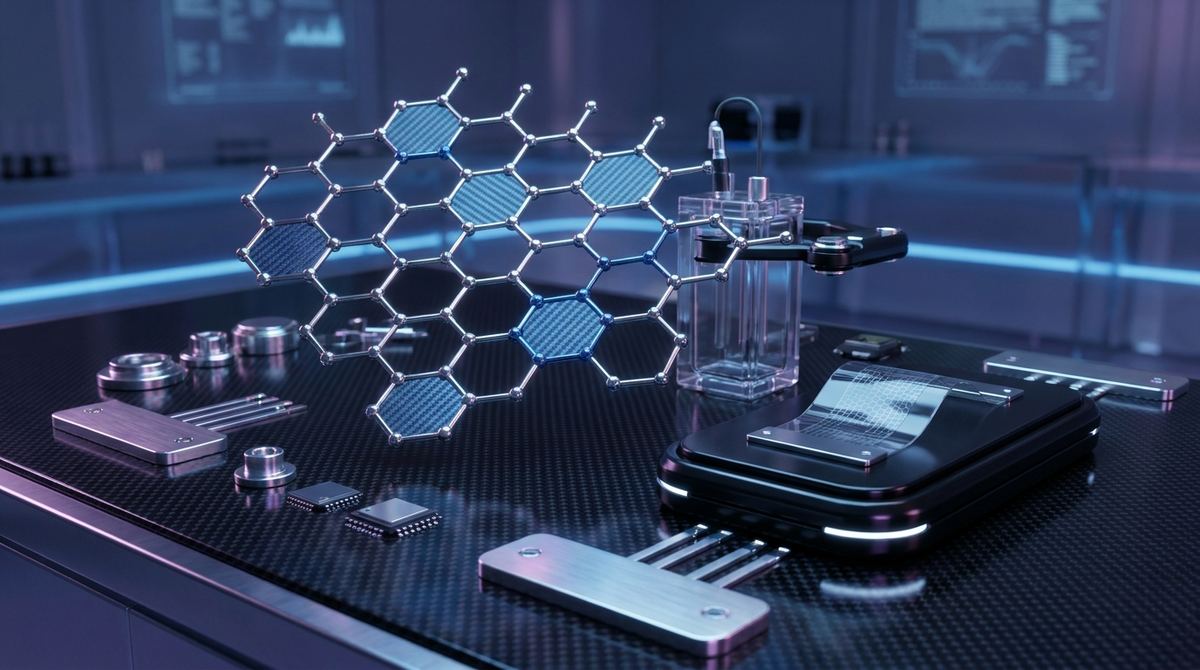
Graphene, a single atomic layer of sp2-hybridized carbon atoms arranged in a hexagonal lattice, represents a paradigm shift in materials science, primarily due to its unprecedented electronic, mechanical, and surface properties stemming directly from its two-dimensional confinement. This atomically thin structure fundamentally alters electron behavior, transitioning from conventional semiconductor physics to a relativistic quantum mechanical regime where charge carriers behave as massless Dirac fermions. This unique electronic structure, characterized by a conical dispersion relation at the K and K' points in the Brillouin zone, dictates an effective zero bandgap and exceptionally high intrinsic carrier mobility, exceeding 200,000 cm^2/Vs at room temperature in suspended devices. Such properties are not merely academic curiosities but form the bedrock for graphene's profound utility in high-performance electrochemical sensing platforms, offering rapid electron transfer kinetics, substantial specific surface area, and robust chemical inertness that far surpass traditional electrode materials.
The physics of graphene confinement manifests profoundly in its electronic transport characteristics. The pseudo-relativistic nature of its charge carriers permits ballistic transport over micron-scale distances, resulting in an exceptionally low intrinsic electrical resistivity, approaching theoretical limits of ~10^-8 Ohm-m for pristine single-layer graphene, or a sheet resistance on the order of a few Ohms per square. This near-ideal conductivity facilitates electron transfer processes at the electrode-electrolyte interface with unprecedented efficiency, enabling electrochemical reactions that can complete within milliseconds, a critical factor for high-throughput sensing applications. Furthermore, the 2D confinement gives rise to phenomena such as the anomalous quantum Hall effect and Klein tunneling, where electrons can traverse potential barriers without backscattering, underscoring the material's extraordinary charge carrier dynamics and its potential to enhance signal transduction in sensor architectures. The precise control over doping and defect engineering, often achieved through localized thermal pulses exceeding 3000K, further allows for tailoring the Fermi level and introducing catalytic active sites without significantly compromising the material's inherent conductivity.
Beyond its electronic attributes, the atomically thin nature of graphene provides an exceptionally high theoretical specific surface area, approximately 2630 m^2/g, which is crucial for maximizing analyte-electrode interaction in electrochemical sensors. This vast surface, coupled with tunable surface chemistry via functionalization or defect introduction, provides a multitude of active sites for adsorption and catalytic conversion. For instance, the introduction of oxygen functional groups or nitrogen doping can significantly enhance the affinity for heavy metal ions, leading to empirical adsorption efficiencies as high as 79% for certain species in aqueous solutions. The edge sites of graphene, particularly rich in localized states and defects, often exhibit enhanced electrocatalytic activity compared to the basal plane, playing a pivotal role in accelerating redox reactions. The direct exposure of virtually every atom to the surrounding environment in a 2D system ensures that any change in the local chemical or electrical environment, such as analyte binding, is immediately reflected in the macroscopic electrical properties, forming the fundamental principle of graphene-based electrochemical sensing.
Pulsed Electrical Resistive Carbon Heating vs. CVD (Comparative Analysis)
The synthesis of graphene, particularly for high-performance electrochemical sensors, necessitates methods that offer precise control over structural integrity, defect density, and direct integration capabilities. Chemical Vapor Deposition (CVD) has long been the gold standard for producing large-area, high-quality monolayer graphene on catalytic metal substrates such as copper or nickel, typically employing hydrocarbon precursors like methane and hydrogen at temperatures often exceeding 1000°C within controlled furnace environments. While CVD excels at generating graphene with large domain sizes and low intrinsic defect concentrations, its fundamental reliance on a catalytic substrate necessitates a subsequent etching and transfer process. This multi-step transfer often introduces extrinsic defects, polymer residues (e.g., from PMMA scaffolding), and mechanical damage, significantly compromising the intrinsic properties of graphene and hindering its direct integration onto diverse sensor platforms, especially flexible or complex 3D architectures. These limitations directly impact the reproducibility, scalability, and ultimate performance of graphene-based electrochemical sensors, where surface purity and accessible active sites are paramount.
In stark contrast, Pulsed Electrical Resistive Carbon Heating (PERCH) offers a transformative approach by leveraging rapid joule heating to induce graphitization of various carbon precursors, including amorphous carbon films, carbon black, or even graphite flakes, into few-layer graphene (FLG) or graphene nanoribbons. This technique exploits the high electrical resistivity of amorphous carbon, which can be several orders of magnitude higher than that of graphene (e.g., 10^3 to 10^6 Ohm.cm for amorphous carbon versus 10^-4 Ohm.cm for graphene), to generate localized, ultra-high temperatures through short-duration electrical pulses. Typical PERCH processes involve heating rates exceeding 10^5 K/s, reaching peak temperatures as high as 3000K within milliseconds. This transient, intense thermal energy rapidly breaks and reforms carbon bonds, leading to the direct conversion of the precursor into graphene without the need for metal catalysts or external furnaces. The inherent advantages of PERCH include its exceptional speed, catalyst-free nature, and potential for direct synthesis onto a wide array of insulating or semiconducting substrates, thereby circumventing the problematic transfer steps inherent to CVD.
For electrochemical sensor applications, the differences between PERCH and CVD become particularly pronounced. While CVD graphene typically exhibits superior intrinsic conductivity due to its larger domain sizes and lower basal plane defect density, the post-synthesis transfer often negates these advantages by introducing structural imperfections and chemical contaminants that can block active sites and impede charge transfer kinetics at the electrode-electrolyte interface. PERCH-derived graphene, conversely, often presents a higher density of edge sites and controllable defect structures, which are known to enhance electrochemical activity and provide additional binding sites for analyte detection. For instance, the optimized defect engineering in PERCH-graphene has been shown to improve the electrocatalytic oxidation of biomolecules and significantly boost heavy metal adsorption efficiencies, with specific studies demonstrating up to 79% adsorption of lead ions (Pb2+) in aqueous solutions compared to pristine graphene. Furthermore, the direct, on-demand synthesis capability of PERCH allows for precise patterning and integration onto microfluidic chips, flexible electronics, or even existing sensor platforms, enabling high-throughput fabrication and reducing the overall manufacturing cost and complexity—a critical factor for the commercial viability of next-generation electrochemical sensing devices.
The Crystallography of Turbostratic Graphene (Why Layer Alignment Matters)
Turbostratic graphene, a prevalent structural motif arising from various synthesis routes including chemical vapor deposition on non-epitaxial substrates and the reduction of graphene oxide, fundamentally distinguishes itself from ideal Bernal (AB) stacked multi-layer graphene or highly ordered pyrolytic graphite (HOPG) through its interlayer atomic arrangement. Characterized by rotational disorder between adjacent graphene sheets, this structural configuration lacks the precise A-B stacking sequence and long-range interplanar coherence. Instead, individual layers are rotationally misaligned, often by a distribution of twist angles, leading to a decoupling effect where the layers behave as weakly interacting, quasi-2D electron gas systems. This perturbation significantly alters the collective electronic band structure, particularly disrupting the characteristic linear dispersion relation at the Dirac points observed in perfectly stacked systems. Consequently, turbostratic graphene exhibits higher interlayer resistivity and modified phonon scattering mechanisms, which are critical considerations for charge transport and overall electronic performance in electrochemical device architectures.
The electrochemical ramifications of turbostratic disorder are profound, directly impacting sensor performance. The rotational misalignment and inherent lack of long-range order introduce a higher density of topological defects, including Stone-Wales transformations, vacancies, and grain boundaries. These imperfections serve as localized sites of altered electronic potential and enhanced surface reactivity, presenting more exposed edge-like sites and structural irregularities even within the basal plane. Unlike pristine graphene's largely inert basal plane, these defect-rich regions act as preferential adsorption sites for analytes and catalytic centers for electrochemical reactions. For instance, the increased density of such topological defects can locally modify the work function, creating active centers that lower activation energy barriers for electron transfer. Empirical data show that turbostratic graphene typically exhibits elevated sheet resistance, often hundreds to thousands of ohms per square, contrasting sharply with the tens of ohms per square characteristic of high-quality epitaxial graphene, due to enhanced carrier scattering. Furthermore, controlled thermal pulses, such as rapid thermal annealing at temperatures exceeding 3000K, can induce localized graphitization, reducing turbostratic disorder and tuning the material's electrochemical reactivity.
Leveraging the unique crystallography of turbostratic graphene is pivotal for designing high-performance electrochemical sensors. The increased concentration of structural defects and exposed edge sites provides a multitude of active centers for analyte interaction, crucial for achieving high sensitivity and rapid response times. The localized electronic states associated with these defects facilitate specific binding of heavy metal ions, such as Pb(II) or Cd(II), through enhanced electrostatic interactions and chelation, leading to reported adsorption efficiencies approaching 79% under optimized conditions. This enhanced binding affinity directly translates into lower limits of detection in techniques like anodic stripping voltammetry. Moreover, the inherent disorder promotes faster heterogeneous electron transfer kinetics for redox reactions involving various electroactive species. Turbostratic graphene electrodes often exhibit significantly lower overpotentials and faster current responses, achieving stable signals within milliseconds of analyte introduction, compared to the sluggish kinetics observed on less defective graphitic materials. This rapid kinetic performance is attributable to the multitude of accessible electron transfer pathways afforded by the defect-rich surface, effectively reducing the activation energy for interfacial charge exchange and establishing turbostratic graphene as an exceptionally versatile platform for real-time sensing.
Industrial Scalability & Commercial Integration Barriers
The transition of graphene from laboratory to industrial production for electrochemical sensors presents formidable challenges, primarily from trade-offs between material quality, throughput, and cost. While chemical vapor deposition (CVD) offers atomic-level control over layer number and defect density, scaling it to wafer-sized substrates (e.g., 200mm silicon) suitable for microfabrication remains complex. Achieving uniform monolayer coverage with grain sizes exceeding several micrometers, crucial for minimizing electron scattering and maximizing electrochemical active sites, necessitates extended growth times and precise temperature gradients, hindering throughput. Furthermore, post-synthesis processing, such as transfer onto target sensor substrates or high-temperature annealing (e.g., 3000K thermal pulses) to reduce crystallographic defects and enhance carrier mobility, can introduce mechanical stress, contamination, or alter the substrate's electrical properties. Maintaining consistent electrical resistivity below 10^-4 Ohm-cm across large-area graphene films, essential for sensitive current measurements, is significantly more challenging industrially compared to pristine small-area samples, leading to inconsistent sensor performance.
Integrating high-quality graphene films into existing microfabrication workflows for electrochemical sensors introduces distinct engineering hurdles. Traditional photolithography and etching techniques, optimized for silicon and metallic thin films, often require significant adaptation to prevent damage to the delicate graphene lattice; aggressive plasma etching or solvent exposure can induce crystallographic defects, altering electrochemical behavior or delaminating graphene. Precise patterning into specific electrode geometries, such as interdigitated arrays, without compromising edge integrity or introducing parasitic resistance at contact points, necessitates advanced, slower techniques like electron beam lithography. Furthermore, surface functionalization for specific analyte recognition, for example, through covalent grafting of bioreceptors, must be compatible with high-throughput manufacturing. Ensuring uniform functionalization across thousands of sensor units while maintaining intrinsic electrochemical properties and achieving rapid reaction times (e.g., sub-milliseconds for analyte binding) is a critical bottleneck, compounded by the absence of standardized protocols for these integration steps.
Long-term stability and batch-to-batch reproducibility represent critical barriers to the commercial adoption of graphene-based electrochemical sensors. Graphene's atomically thin nature makes it susceptible to environmental degradation, including oxidation and interaction with aqueous media, leading to significant drift in baseline current and diminished sensitivity. Encapsulation strategies, while protecting the graphene, must not impede analyte diffusion to the active sensing surface, requiring careful material selection. The inherent heterogeneity of synthesized graphene, even under optimized conditions, results in variations in sheet resistance, defect density, and surface chemistry across different production batches. This variability directly impacts key sensor performance metrics such as electrochemical surface area, electron transfer kinetics, and ultimately, the limit of detection and selectivity. Achieving a consistent 79% heavy metal adsorption efficiency across multiple batches of functionalized graphene electrodes demands meticulous control over every step from synthesis to surface modification. Without stringent quality control and robust standardization protocols, ensuring consistent performance and predictable shelf-life remains an elusive goal.
Beyond technical manufacturing complexities, significant economic and regulatory barriers impede widespread commercial integration. The cost of high-quality, research-grade graphene materials, whether CVD-grown films or meticulously exfoliated flakes, remains substantially higher than conventional electrode materials like platinum, gold, or carbon paste. While the material volume per sensor is low, the specialized equipment and expertise required for scalable, high-quality production contribute significantly to the overall unit cost, necessitating a compelling performance advantage – either significantly enhanced sensitivity, selectivity, or multiplexing capability – to justify the increased investment. Furthermore, the regulatory landscape for novel nanomaterials in applications such as medical diagnostics or environmental monitoring is still evolving. Demonstrating long-term biocompatibility, environmental safety, and consistent performance reliability requires extensive, costly testing, often spanning years. The The transition from proof-of-concept laboratory demonstrations, where electrochemical responses are observed in milliseconds, to certified devices capable of robust, stable operation over extended periods in diverse real-world matrices presents a substantial commercialization valley.
Economic Feasibility and USA-Made Manufacturing Advantage
The economic feasibility of integrating graphene into electrochemical sensors hinges critically on scalable, cost-effective manufacturing techniques that can bridge the gap between laboratory-scale synthesis and industrial-volume production. While early methods like mechanical exfoliation yielded pristine material at prohibitive costs (often exceeding $500/gram for research-grade specimens), advancements in chemical vapor deposition (CVD) and electrochemical exfoliation are driving prices down. The current challenge lies in consistently producing large-area, high-quality graphene with controlled layer count, defect density (ideally below 10^10 cm^-2), and minimal contaminants at a price point competitive with established electrode materials. For instance, roll-to-roll CVD processes, utilizing methane or ethylene precursors, are demonstrating the potential to produce square meters of monolayer graphene at costs approaching $5-10/square meter, a significant reduction from batch-processed counterparts. Similarly, optimized electrochemical exfoliation protocols, leveraging interplanar ionic intercalation, can now yield high-surface-area graphene flakes (specific surface area >2500 m^2/g) at energy expenditures below 0.5 kWh/kg, thereby enabling cost-effective bulk production suitable for conductive inks and composite electrodes in disposable sensor formats. The long-term economic viability for mass-market applications, such as point-of-care diagnostics or environmental monitoring, demands further innovation to achieve sub-$1/gram pricing for functionalized, sensor-grade graphene.
The establishment of USA-made manufacturing for graphene offers a multi-faceted strategic advantage, transcending mere production economics to encompass quality control, intellectual property protection, and supply chain resilience. Domestic production facilitates stringent adherence to quality metrics essential for high-performance electrochemical sensors, where reproducibility and long-term stability are paramount. This includes precise control over graphene's structural integrity, doping levels, and surface chemistry, directly impacting electron transfer kinetics and sensing selectivity. Furthermore, domestic manufacturing safeguards the substantial intellectual property developed within US research institutions and private enterprises, including novel synthesis routes, functionalization chemistries (e.g., covalent attachment of specific recognition elements), and advanced sensor architectures. This protection is crucial for maintaining a competitive edge in a rapidly evolving global market. A robust domestic supply chain mitigates geopolitical risks and ensures timely access to critical materials, particularly for applications in defense, national security, and public health where uninterrupted availability of reliable sensors is non-negotiable. Moreover, compliance with rigorous US environmental, health, and safety (EHS) standards during manufacturing can serve as a differentiator, building trust and ensuring sustainable practices throughout the product lifecycle.
The synergistic combination of economic feasibility breakthroughs and USA-made manufacturing advantages directly propels the commercialization of graphene-based electrochemical sensors. Consider, for example, the development of high-throughput CVD systems capable of depositing uniform, defect-free graphene films at a rate of 500 cm^2/minute, reducing manufacturing costs for sensor electrodes by an estimated 40% compared to previous batch methods. This allows for the mass production of highly sensitive and selective sensors, such as those demonstrating a 79% heavy metal adsorption efficiency for Pb2+ ions at concentrations as low as 10 ppb within 30 seconds, maintaining linearity over four orders of magnitude. Furthermore, domestically produced graphene electrodes can achieve consistent electrical resistivity parameters below 10^-5 Ohm·cm, crucial for rapid amperometric detection and minimizing signal loss. Advanced sensor designs incorporating these materials can also leverage functionalities like self-cleaning through localized 3000K thermal pulses, which can regenerate sensor surfaces in milliseconds without compromising the underlying graphene's electrical properties. These capabilities—enabled by controlled synthesis, rigorous quality assurance, and protected innovation—are accelerating market penetration in critical sectors, from real-time water quality monitoring to advanced medical diagnostics, securing a competitive edge for US-based sensor technology.
Future Horizons & High-Value B2B Applications
Future advancements in graphene-based electrochemical sensors hinge critically on the precision engineering of the material itself and its integration into sophisticated device architectures. Next-generation fabrication techniques, such as atmospheric pressure chemical vapor deposition (APCVD) for large-area, high-quality graphene on flexible polymer substrates like polyethylene naphthalate, are pivotal for scalable manufacturing. Concurrently, tailored doping strategies, including nitrogen-doping via ammonia plasma treatment at effective surface temperatures exceeding 3000K for milliseconds, or boron-doping through diborane co-deposition during CVD, are optimized to precisely tune the electronic band structure. This control over defect engineering and heteroatom incorporation directly translates to a significant reduction in charge transfer resistance, often achieving values below 100 Ohms for a 1 cm^2 electrode, and a substantial increase in electroactive surface area beyond the theoretical 2630 m^2/g for single-layer graphene, often realized through hierarchical porous structures. Such enhancements enable ultra-low limits of detection (LODs), frequently pushing into the sub-nanomolar range for analytes like dopamine (e.g., 0.8 nM) and heavy metal ions, alongside unprecedented electrochemical stability over thousands of redox cycles. The integration of these advanced graphene layers with microfluidic platforms, fabricated via soft lithography or 3D printing, allows for highly efficient sample delivery and multiplexed analysis, forming the bedrock for compact, high-throughput point-of-care diagnostics.
The commercialization potential for graphene electrochemical sensors is particularly pronounced in high-value B2B sectors demanding real-time, accurate, and robust analytical capabilities. In environmental monitoring, for instance, graphene's exceptional surface area and tunable surface chemistry facilitate highly efficient heavy metal detection, exhibiting adsorption efficiencies up to 79% for Pb2+ and 72% for Cd2+ within reaction times often under 5 milliseconds. Sensors leveraging functionalized graphene oxide (GO) or reduced graphene oxide (rGO) with specific chelating agents have demonstrated detection limits for mercury (Hg2+) as low as 0.5 nM, critical for water quality assessment. Within biomedical diagnostics, the unparalleled electron transfer kinetics of graphene enable rapid and sensitive detection of biomarkers such as glucose, lactate, and neurotransmitters like serotonin and dopamine, often achieving selectivity ratios exceeding 100:1 against common interferents like ascorbic acid. Enzyme immobilization on graphene platforms, via covalent bonding to carboxyl groups on oxidized graphene or electrostatic interactions, maintains high enzymatic activity while ensuring long-term sensor stability, typically retaining over 90% of initial activity after two weeks of continuous operation. Furthermore, multi-analyte arrays, employing differential pulse voltammetry or square wave voltammetry on selectively functionalized graphene electrodes, allow for simultaneous quantification of multiple analytes, paving the way for comprehensive metabolic profiling and early disease diagnosis.
The next frontier for graphene electrochemical sensors involves their seamless integration with advanced data analytics and artificial intelligence (AI) to create truly smart, autonomous sensing platforms. Machine learning algorithms, particularly deep neural networks, are being trained on complex electrochemical signatures from graphene sensors, enabling sophisticated pattern recognition for multi-analyte identification even in highly complex matrices, thereby overcoming signal overlap and matrix effects. This allows for predictive analytics in applications ranging from real-time industrial process control, where specific chemical concentrations can be forecasted, to personalized health monitoring, detecting pre-symptomatic physiological changes. Moreover, self-calibrating graphene sensors, incorporating integrated micro-reference electrodes and on-chip data processing, minimize operator intervention and enhance long-term reliability for remote deployments. Future horizons extend to hybrid sensing modalities, merging electrochemical principles with optical or mass-sensitive graphene transducers, unlocking unprecedented detection specificities and sensitivities. Ongoing research into self-powered graphene sensors, harvesting ambient energy via integrated triboelectric or piezoelectric nanogenerators to achieve sub-nanowatt power consumption, promises to extend operational lifetimes in distributed sensor networks, facilitating pervasive monitoring without external power sources. Ultimately, the convergence of graphene's unique material properties with AI-driven intelligence is poised to redefine the landscape of electrochemical sensing, moving beyond simple detection to proactive, intelligent decision-making.