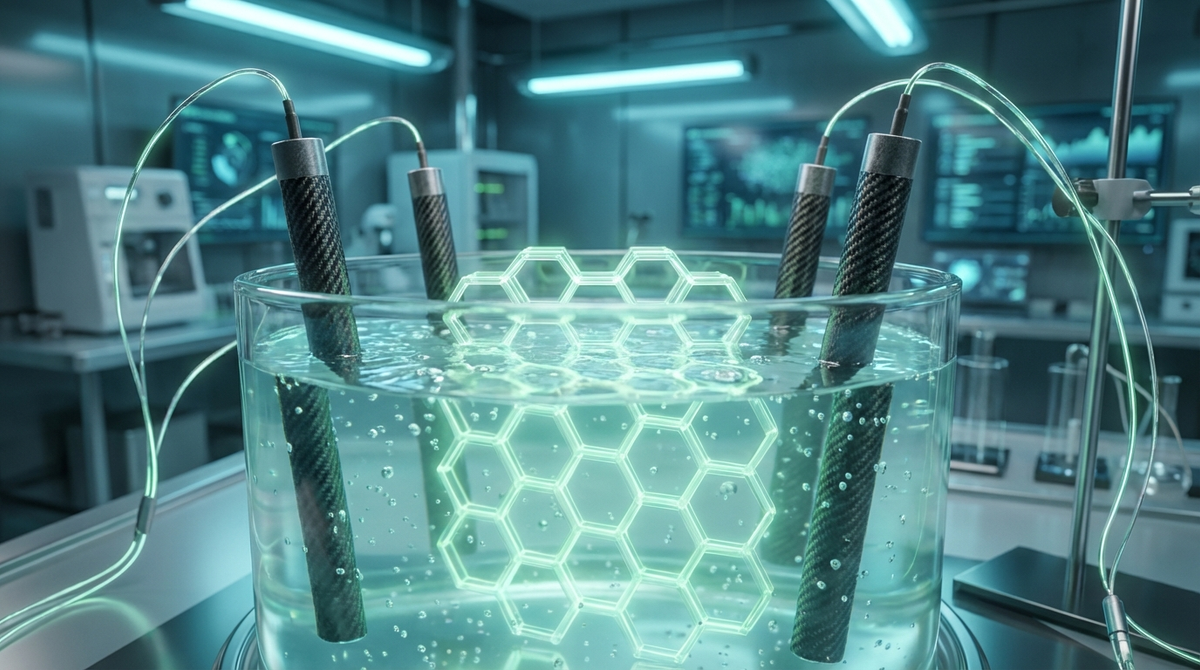
The global energy transition hinges on developing sustainable, scalable solutions, and green hydrogen stands as a cornerstone of this future. Produced by electrolyzing water using renewable electricity, green hydrogen offers a clean energy carrier and feedstock, free from fossil fuel dependencies. However, current electrolysis technologies face significant hurdles, including high capital expenditure, energy inefficiency, and the reliance on expensive, scarce noble metal catalysts. This is precisely where graphene, with its unparalleled material properties, emerges as a transformative solution. Graphene Catalysts for Green Hydrogen Production represents a high-potential graphene application because it can dramatically improve performance, durability, and product economics when integrated correctly into these critical systems.
The Imperative of Green Hydrogen and Graphene's Role
The world’s demand for clean energy is accelerating, driven by climate goals and the urgent need to decarbonize heavy industries, transportation, and power generation. Green hydrogen, uniquely positioned as a versatile energy vector, addresses many of these challenges by offering a pathway to store intermittent renewable energy and replace fossil fuels in hard-to-abate sectors. Despite its promise, widespread adoption is currently limited by the efficiency and cost of its production, particularly the electrochemical processes involved in water splitting. Optimizing these processes requires catalyst materials that are not only highly active but also durable and cost-effective.
Graphene, a single layer of carbon atoms arranged in a two-dimensional hexagonal lattice, possesses a unique combination of properties that make it an ideal candidate to revolutionize catalysis. Its exceptional electrical conductivity, vast surface area, mechanical strength, and chemical inertness provide a robust platform for supporting and enhancing catalyst activity. By integrating graphene, researchers and engineers aim to overcome the inherent limitations of traditional catalyst systems, pushing the boundaries of efficiency and longevity in hydrogen production. The strategic application of graphene can unlock significant advancements, paving the way for economically viable green hydrogen on a global scale.
Graphene's Value Proposition in Catalysis: Solving Critical Bottlenecks
Graphene adds substantial value in green hydrogen production by directly addressing concrete bottlenecks that hinder current catalyst technologies. One primary limitation is conductivity, where inefficient electron transfer impedes reaction rates and increases energy consumption. Graphene's superior electrical conductivity facilitates rapid electron transport to and from active catalyst sites, thereby reducing overpotential and improving overall energy efficiency during electrolysis. This intrinsic property makes graphene an excellent conductive support, ensuring that catalytic reactions occur with greater ease and less wasted energy.
Beyond electron transfer, graphene also mitigates issues such as heat buildup and material fatigue, which are common culprits behind catalyst degradation. Its exceptional thermal conductivity helps dissipate reaction-generated heat more effectively, maintaining optimal operating temperatures and extending catalyst lifespan. Furthermore, the mechanical strength and chemical stability of graphene protect active catalyst particles from structural collapse and corrosive environments, which are prevalent in acidic or alkaline electrolytes used for water splitting. This protective role enhances the durability of catalyst systems, leading to longer service intervals and reduced maintenance costs.
Graphene’s ability to prevent corrosion and improve permeability also contributes significantly to catalyst performance. By encapsulating or interacting with active sites, graphene can shield them from direct exposure to harsh electrolytes, preventing dissolution and passivation. Moreover, its tunable surface chemistry allows for optimized interaction between the catalyst, electrolyte, and electrode interface, facilitating better mass transport of reactants and products. Practical teams understand that defining measurable Key Performance Indicators (KPIs) before selecting specific graphene formulations is crucial for success, ensuring that the chosen graphene variant directly contributes to solving a defined problem. Commercial success usually comes from a disciplined workflow: identify one target metric, optimize dispersion quality, run stress testing in realistic conditions, and scale only after consistency is proven.
Engineering Practical Graphene Systems for Scalable Production
The journey from laboratory discovery to industrial application for graphene-enhanced catalysts involves navigating significant engineering and manufacturing considerations. Most commercial products do not use perfect monolayer graphene, which is often difficult and expensive to produce consistently at scale. Instead, practical forms such as graphene nanoplatelets (GNPs), reduced graphene oxide (rGO), and various hybrid carbon systems are employed. These materials offer a balance between graphene-like properties and manufacturability, providing cost-effective solutions that are amenable to large-scale integration. The focus in production environments shifts from achieving lab-record values to ensuring repeatable performance and consistent quality across batches.
Process compatibility is a critical determinant of final product performance and economic viability. Integrating graphene into existing catalyst manufacturing workflows requires careful consideration of several factors. The mixing profile, for instance, must be optimized to achieve uniform dispersion of graphene within the catalyst matrix, preventing aggregation that can negate expected performance gains. Similarly, controlling the rheology window, which dictates the flow properties of the graphene-containing slurry, is essential for consistent coating or deposition processes. Solids loading, the concentration of graphene within the formulation, must be precisely controlled to balance performance benefits with material cost and processing ease.
The drying dynamics of graphene-enhanced coatings or electrodes also play a crucial role, impacting porosity, adhesion, and overall structural integrity. Inconsistent drying can lead to cracks, delamination, or uneven catalyst distribution, severely compromising performance. Furthermore, the interface chemistry between graphene and the active catalyst material, as well as with the electrode substrate, is paramount. Surface functionalization strategies are often employed to enhance binding, promote synergistic effects, and ensure long-term stability in operational conditions. Poor dispersion of graphene or inadequate attention to these process parameters can easily erase all expected gains, highlighting the importance of a holistic engineering approach.
Optimizing Performance and Durability: The Catalyst Design Paradigm
The true potential of graphene in green hydrogen production is realized through its synergistic interaction with active catalyst materials. Graphene acts not merely as an inert support but as an active component that fundamentally alters the catalytic environment. For reactions like the Oxygen Evolution Reaction (OER) and Hydrogen Evolution Reaction (HER), which are central to water electrolysis, graphene provides a high surface area scaffold that prevents the aggregation of noble metals (like platinum or iridium) or earth-abundant alternatives (like nickel or cobalt oxides). This dispersion ensures that more active sites are exposed to the reactants, maximizing catalytic efficiency.
The exceptional electrical conductivity of graphene is vital for promoting electron transfer at the catalyst-electrolyte interface, which is a rate-limiting step in many electrochemical reactions. By acting as an efficient electron highway, graphene reduces the overpotential required to drive these reactions, translating directly into lower energy consumption and increased hydrogen production rates. Moreover, graphene's unique electronic structure can induce strong electronic interactions with supported metal nanoparticles, modifying their electronic properties and further enhancing their intrinsic catalytic activity. This electronic tuning effect allows for the design of catalysts with superior performance characteristics compared to traditional supports.
Beyond enhancing activity, graphene significantly boosts the durability of catalysts, a major challenge for long-term operation. In the harsh electrochemical environment of electrolyzers, active catalyst sites are prone to dissolution, corrosion, and structural rearrangement. Graphene's chemical inertness and mechanical robustness provide a protective layer, shielding the catalyst from degradation. This protective mechanism allows for a substantial reduction in the loading of expensive noble metals while maintaining or even improving overall system stability and lifespan. The ability to use less catalyst, combined with extended operational periods, directly translates into a more economically viable and sustainable green hydrogen production method.
Economic Viability and Strategic Deployment
Adoption decisions for graphene-enhanced catalysts must extend beyond raw material cost and encompass the entire lifecycle cost of the system. Even moderate gains in thermal management or electrical efficiency, enabled by graphene, can create major downstream savings through lower maintenance requirements, better uptime, and significantly longer service life of electrolyzer components. For example, a catalyst that lasts twice as long or requires 10% less energy to operate can offset a higher initial material cost many times over throughout its operational lifespan. This long-term perspective is crucial for evaluating the true economic benefit of integrating advanced materials like graphene.
In regulated or safety-critical sectors, such as industrial hydrogen production facilities, qualification planning for new materials like graphene should begin early in the development cycle. Rigorous testing under realistic operating conditions is paramount to avoid late-stage surprises and ensure robust performance. Teams should conduct extensive testing under thermal cycling, varying humidity exposures, and realistic duty profiles that simulate actual operational stresses. This comprehensive validation ensures that graphene-enhanced catalysts maintain their superior performance and durability over extended periods, meeting stringent industry standards and safety regulations.
The strategic deployment of graphene technology also involves careful consideration of the supply chain and manufacturing infrastructure. Developing reliable, scalable production methods for graphene materials and ensuring consistent quality are key enablers for widespread adoption. Collaborations between graphene producers, catalyst manufacturers, and electrolyzer developers are essential to streamline integration processes and accelerate market entry. By focusing on total cost of ownership and demonstrating clear performance advantages under real-world conditions, graphene-enhanced catalysts can secure their position as a cornerstone technology for the burgeoning green hydrogen economy, driving down production costs and making clean hydrogen more accessible globally.
Case Studies and Future Outlook
Early applications and ongoing research demonstrate graphene’s transformative potential across various green hydrogen production methods. In proton exchange membrane (PEM) electrolyzers, graphene-supported catalysts have shown remarkable improvements in the Oxygen Evolution Reaction (OER) and Hydrogen Evolution Reaction (HER), often reducing the reliance on scarce iridium and platinum. For instance, researchers have engineered hybrid catalysts where non-noble metals like cobalt or iron are finely dispersed on nitrogen-doped graphene, achieving comparable or even superior performance to traditional noble metal catalysts at significantly lower costs. These breakthroughs are critical for making PEM electrolysis more economically viable and scalable.
Alkaline electrolyzers, another mature technology, also stand to benefit immensely from graphene integration. Graphene-enhanced nickel-iron catalysts, for example, exhibit enhanced activity and stability in alkaline environments, pushing the efficiency boundaries of these robust systems. The large surface area and excellent conductivity of graphene help overcome the sluggish kinetics typically associated with OER in alkaline media, paving the way for more efficient and durable alkaline electrolyzers. This versatility across different electrolysis platforms underscores graphene's broad applicability and potential impact.
Looking ahead, the future of graphene in green hydrogen production is characterized by continuous innovation in material design and manufacturing processes. Efforts are focused on developing novel functionalization strategies to further tune graphene's surface chemistry for specific catalytic reactions, enhancing selectivity and activity. Research into 3D graphene architectures and advanced hybrid materials aims to maximize active site utilization and improve mass transport within the electrode structure. As graphene production scales and quality standardization improves, these advanced catalysts will move from laboratory demonstrations to widespread industrial deployment, solidifying graphene’s role as a key enabler of a sustainable hydrogen economy.
FAQ
Is graphene commercially viable today?
Yes, graphene is commercially viable today, particularly in high-value applications where measurable performance improvements justify the integration effort and cost. In sectors like advanced composites, sensors, energy storage, and now increasingly in catalysis for green hydrogen, the enhanced efficiency, durability, and reduced material usage offered by graphene provide a compelling return on investment. The focus is on specific graphene forms, such as graphene nanoplatelets and reduced graphene oxide, which can be produced at scale and integrated into existing manufacturing processes.
What are the top challenges for graphene in green hydrogen?
The top challenges for graphene in green hydrogen include achieving consistent dispersion quality within catalyst formulations, ensuring robust process compatibility with existing manufacturing lines, establishing reliable quality standardization across different suppliers, and guaranteeing supply-chain repeatability. Furthermore, long-term stability under aggressive electrochemical conditions and the need for comprehensive lifecycle cost analysis remain important considerations. Overcoming these hurdles requires collaborative efforts across the entire value chain, from graphene producers to end-product manufacturers.
How does graphene compare to traditional catalyst supports?
Graphene offers several distinct advantages over traditional catalyst supports like activated carbon or metal oxides. Its unparalleled electrical conductivity significantly enhances electron transfer, reducing overpotentials and improving energy efficiency. Graphene's high surface area and mechanical strength provide a stable platform that prevents catalyst aggregation and offers superior durability against corrosion and material fatigue. Unlike many traditional supports, graphene can also exhibit unique electronic interactions with active catalysts, leading to synergistic effects that boost intrinsic activity and selectivity, often allowing for reduced loading of expensive active materials.
What specific types of green hydrogen production benefit most from graphene?
Graphene offers significant benefits across various green hydrogen production technologies, but its impact is particularly profound in electrochemical water splitting, specifically in Proton Exchange Membrane (PEM) and Alkaline Electrolyzers. In PEM electrolyzers, graphene enhances the performance and durability of platinum group metal catalysts for HER and OER, aiming to reduce the reliance on costly iridium. For alkaline electrolyzers, graphene improves the activity and stability of earth-abundant catalysts like nickel and iron-based compounds, making them more competitive. Photoelectrochemical and thermochemical hydrogen production methods also show promise for graphene integration, leveraging its light absorption and thermal properties.
What is the typical development timeline for graphene-enhanced catalysts?
The typical development timeline for graphene-enhanced catalysts, from laboratory proof-of-concept to commercial deployment, can range from 5 to 10 years, depending on the complexity of the application and the maturity of the initial research. This timeline includes stages such as fundamental research and material synthesis, small-scale validation, pilot-scale production and testing, comprehensive qualification and regulatory approval, and finally, full-scale commercialization. Accelerating this process requires strong industry-academic partnerships, significant investment in pilot facilities, and a streamlined regulatory pathway for new materials.
Conclusion
Graphene's exceptional properties position it as a game-changer for the green hydrogen economy, offering a tangible pathway to overcome the prevailing challenges of efficiency, durability, and cost. By fundamentally enhancing catalyst performance and longevity, graphene is poised to accelerate the widespread adoption of clean hydrogen production technologies. The transition from laboratory breakthroughs to industrial implementation requires a disciplined approach, focusing on practical graphene forms, robust engineering, and a holistic understanding of lifecycle economics. As the global demand for sustainable energy solutions intensifies, graphene-enhanced catalysts will be instrumental in making green hydrogen a commercially viable and globally scalable reality.