
Graphene Skin Patch for Melanoma: What the New ACS Nano Study Shows
A new ACS Nano study reports a flexible laser-induced graphene and copper oxide skin patch that used mild heat to release copper ions into melanoma tumors in mice.
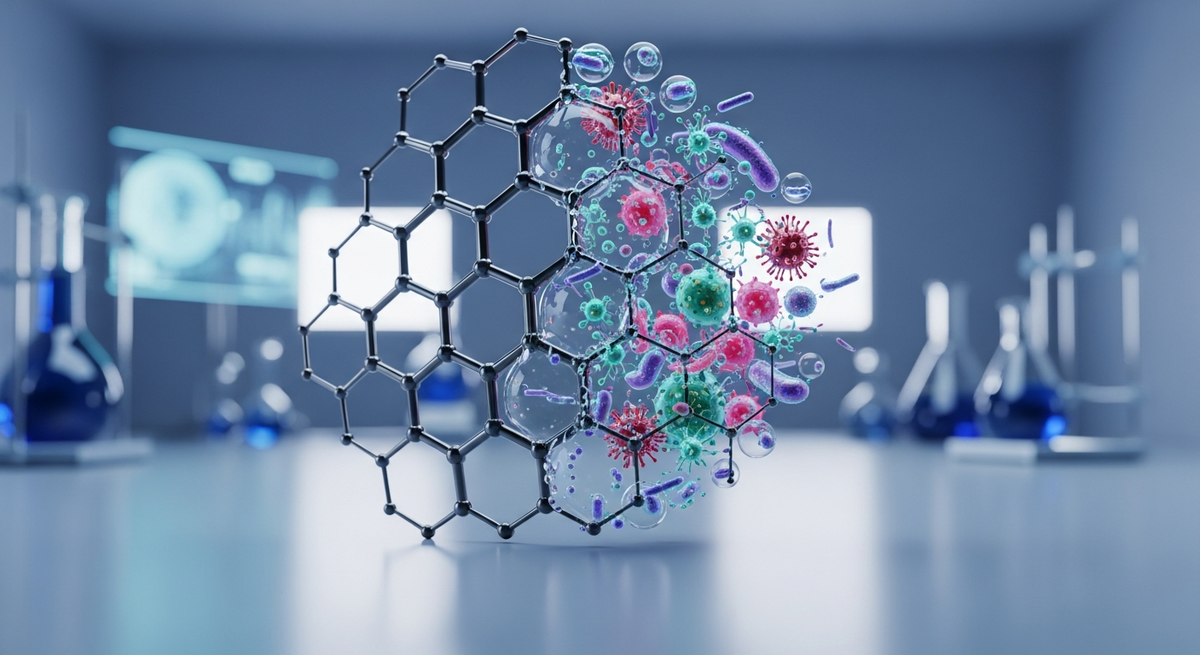
In an era where public health challenges are increasingly dominated by persistent microbial threats and the looming crisis of antibiotic resistance, the scientific community is fervently seeking innovative solutions. Traditional antibacterial and antifungal agents, while historically effective, are facing a significant hurdle as microorganisms rapidly evolve resistance mechanisms, rendering many conventional treatments obsolete. This pressing need for novel antimicrobial strategies has propelled cutting-edge research into advanced materials, with graphene emerging as a particularly promising candidate.
Graphene, a remarkable material comprising a single atomic layer of sp2-bonded carbon atoms, stands at the forefront of this revolution. Its extraordinary physical and chemical properties make it an ideal platform for a myriad of applications, extending far beyond its well-known roles in electronics and energy storage. With an exceptionally high surface area of approximately 2630 m² g⁻¹, superior electrical conductivity reaching around 2000 S cm⁻¹, impressive thermal conductivity spanning 4840–5300 W m⁻¹ K⁻¹, remarkable electronic carrier mobility of 200,000 cm² V⁻¹ s⁻¹, and an astonishing Young’s modulus of about 10 TPa, graphene offers an unparalleled combination of characteristics. These properties not only underpin its potential in advanced materials but also provide the foundation for its potent antimicrobial activities, positioning graphene nanosheets as a formidable weapon against pathogenic bacteria and fungi.
The global health community is grappling with an escalating crisis: antimicrobial resistance (AMR). This phenomenon, where microorganisms develop the ability to withstand the effects of drugs designed to kill or inhibit their growth, poses a severe threat to public health, leading to prolonged illnesses, increased mortality rates, and substantial economic burdens. Conventional antibiotics and antifungal drugs, which typically rely on specific biochemical interactions to disrupt microbial processes, have inadvertently driven the evolution of resistance, creating a vicious cycle of drug development and resistance emergence. The limitations of these traditional agents underscore the critical demand for entirely new approaches.
Nanomaterials, with their unique scale-dependent properties, have ushered in a new era of antimicrobial research, presenting alternatives that often operate through mechanisms less susceptible to microbial adaptation. Among this diverse class of materials—including 0D nanoparticles, 1D nanotubes and nanowires, and 3D nanofilms—two-dimensional (2D) nanosheets, particularly those derived from graphene, have demonstrated exceptional promise. Graphene's antimicrobial efficacy stems from its distinct physical and chemical attributes, which enable it to combat pathogens through pathways fundamentally different from those targeted by traditional pharmaceuticals. This difference is crucial, as it suggests that graphene-based materials may not encounter the same concerns regarding antibiotic resistance that plague existing treatments. By offering a novel mode of action, graphene provides a robust and enduring solution in the ongoing battle against infectious diseases, safeguarding public health against evolving microbial threats.
Graphene nanosheets exhibit remarkable efficacy against a broad spectrum of microorganisms, including common bacterial strains like Escherichia coli and Staphylococcus aureus, as well as prevalent fungi such as Aspergillus niger, Aspergillus oryzae, and Fusarium oxysporum. The multifaceted antimicrobial action of graphene is primarily attributed to two distinct yet synergistic mechanisms: direct physical damage to microbial cell membranes and the induction of oxidative stress. These dual pathways ensure comprehensive pathogen elimination, making graphene a potent broad-spectrum antimicrobial agent.
1. Physical Disruption of Microbial Cell Membranes
One of the most compelling aspects of graphene's antimicrobial activity lies in its ability to physically compromise the structural integrity of microbial cells. Graphene nanosheets, characterized by their atomically thin, two-dimensional structure and remarkably sharp edges, act as molecular ‘nanoknives’ that directly interact with and damage the delicate cell membranes of bacteria and fungi. When these sharp edges come into contact with the cell wall and membrane, they can puncture and tear the lipid bilayer, leading to the rapid leakage of intracellular components, including vital cytoplasmic contents, ions, and metabolic molecules. This physical puncturing results in an immediate loss of membrane potential, disrupting essential cellular functions such as ATP synthesis, nutrient uptake, and waste expulsion. The irreversible damage to the cell membrane prevents the cell from maintaining its internal environment, ultimately leading to metabolic failure and cell death. This purely physical mechanism is particularly significant because it is inherently difficult for microorganisms to develop resistance against mechanical disruption, unlike their ability to modify biochemical pathways targeted by conventional antibiotics. The direct interaction of graphene’s sharp edges with the microbial surface, as observed in studies on Escherichia coli and Staphylococcus aureus, provides a robust and non-evolutionary pathway to antimicrobial action.
2. Oxidative Stress Induced by Reduced Graphene Oxide (rGO)
Beyond direct physical damage, graphene, particularly in its reduced graphene oxide (rGO) form, also employs a potent chemical mechanism involving oxidative stress. Reduced graphene oxide, which retains some diluted oxygen-containing functional groups, possesses the ability to interact with crucial biological molecules within microbial cells. A key target for rGO's oxidative action is glutathione, a vital redox state mediator present in most bacteria and fungi. Glutathione plays a critical role in maintaining cellular redox balance, protecting cells from oxidative damage by scavenging reactive oxygen species (ROS) and regenerating antioxidants. When rGO encounters microbial cells, it can oxidize glutathione, disrupting this delicate redox equilibrium. The oxidation of glutathione leads to a cascade of detrimental effects within the cell. Without sufficient reduced glutathione, the cell's antioxidant defenses are compromised, resulting in an accumulation of reactive oxygen species. These ROS, including superoxide radicals and hydrogen peroxide, are highly reactive molecules that can indiscriminately damage essential cellular components such as proteins, lipids, and DNA. The widespread oxidative damage inhibits critical enzyme functions, impairs DNA replication and repair mechanisms, and compromises membrane integrity, collectively leading to the inhibition of bacterial and fungal growth. This chemical mechanism complements the physical damage, offering a dual-pronged attack that enhances the overall antimicrobial effectiveness of graphene-based materials, as evidenced by its actions against various fungal species.
The efficacy of any antimicrobial agent is paramount to its practical utility. For graphene-based materials, quantitative studies have provided valuable insights into their potency, particularly against fungal pathogens. One standard measure of antimicrobial effectiveness is the Inhibitory Concentration 50% (IC50), which represents the concentration of an agent required to inhibit 50% of the growth of a microorganism under specific experimental conditions. A lower IC50 value indicates a more potent antimicrobial agent, as a smaller concentration is needed to achieve a significant inhibitory effect.
Research has meticulously quantified the antifungal activity of reduced graphene oxide (rGO) against several notable fungal species. For Fusarium oxysporum, a widespread plant pathogen capable of causing devastating crop diseases, the IC50 of rGO was determined to be a remarkably low 50 µg mL⁻¹. This figure suggests that F. oxysporum is particularly susceptible to rGO's antifungal properties, requiring only a modest concentration to significantly impede its growth. Against Aspergillus niger and Aspergillus oryzae, both industrially important fungi, but also opportunistic pathogens, the IC50 values for rGO were found to be 100 µg mL⁻¹. These values, while higher than for F. oxysporum, still demonstrate significant inhibitory activity at relatively low concentrations, showcasing rGO’s broad-spectrum antifungal potential. Such quantifiable data are critical for engineers and business professionals considering the integration of graphene into products, providing tangible evidence of its effectiveness and guiding optimal application dosages.
Beyond these specific IC50 values, graphene’s inherent material properties further contribute to its overall antimicrobial efficacy. Its exceptionally high surface area of approximately 2630 m² g⁻¹ ensures maximum contact between the graphene nanosheets and microbial cells, facilitating efficient physical damage and oxidative interactions. Furthermore, the material’s robust mechanical properties, including its high Young's modulus of ~10 TPa, contribute to the structural integrity and sharp-edge characteristics crucial for its physical antimicrobial mechanism. The combination of these intrinsic properties with the demonstrated inhibitory concentrations positions graphene as a highly effective and versatile antimicrobial agent, capable of addressing a wide range of microbial challenges across diverse environments.
The compelling antimicrobial properties of graphene nanosheets unlock a vast array of potential applications, addressing critical needs in both environmental protection and clinical health. The ability of graphene to inhibit the growth of bacteria and fungi without inducing conventional resistance mechanisms makes it an invaluable material for future innovations. These applications leverage not only graphene's antimicrobial prowess but also its other exceptional characteristics, such as high electrical and thermal conductivity, and robust mechanical strength.
In environmental applications, graphene can revolutionize purification and preservation technologies. For instance, in water treatment systems, graphene-based filters and membranes can effectively remove pathogenic bacteria and fungi from contaminated water sources, providing safer drinking water and preventing the spread of waterborne diseases. Its high surface area and physical disruption mechanism make it highly efficient at trapping and inactivating microbes. In the agricultural sector, antifungal graphene coatings could protect crops from devastating fungal infections like those caused by Fusarium oxysporum, reducing crop losses and the reliance on chemical fungicides that can harm ecosystems. Furthermore, graphene could be integrated into food packaging materials to extend shelf life and prevent spoilage caused by microbial contamination, ensuring food safety and reducing waste. The development of antimicrobial surfaces for public spaces, such as hospitals, schools, and transportation hubs, represents another critical environmental application. Graphene-coated surfaces could dramatically reduce the transmission of infectious agents, creating healthier and safer communal environments.
In clinical applications, graphene's unique properties offer transformative solutions for healthcare. Its potential to overcome antibiotic resistance makes it ideal for developing advanced biomedical implants, such as orthopedic devices, catheters, and prosthetics. Coating these devices with graphene could significantly reduce the incidence of implant-related infections, a major complication that often necessitates costly and invasive follow-up surgeries. In wound care, graphene-integrated dressings could provide a dual benefit: actively preventing infection while also potentially accelerating tissue regeneration due to graphene's biocompatibility and electrical properties. The development of novel drug delivery systems that utilize graphene as a carrier could enable targeted delivery of antimicrobial agents directly to infection sites, minimizing systemic side effects and improving therapeutic outcomes. Moreover, graphene's incorporation into antimicrobial textiles for hospital linens, surgical gowns, and other medical apparel could create a new standard of hygiene in healthcare settings, further curbing the spread of hospital-acquired infections. The synergy of graphene's physical and chemical antimicrobial mechanisms, combined with its high surface area and mechanical strength, positions it as a cornerstone material for addressing some of the most persistent environmental and clinical health challenges of our time.
The profound challenges posed by evolving microbial resistance demand groundbreaking solutions, and graphene nanosheets have unequivocally emerged as a frontrunner in this critical endeavor. As a material defined by its monolayer of sp2-bonded carbon atoms, graphene boasts an extraordinary suite of properties—from its unparalleled surface area and conductivity to its exceptional mechanical strength. These attributes not only enable a diverse range of technological advancements but also underpin its potent and multifaceted antimicrobial capabilities against formidable pathogens like Escherichia coli, Staphylococcus aureus, Aspergillus niger, Aspergillus oryzae, and Fusarium oxysporum.
At the heart of graphene's effectiveness are its unique antimicrobial mechanisms: the physical disruption of microbial cell membranes through its extremely sharp edges, and for reduced graphene oxide (rGO), the induction of oxidative stress via the oxidation of critical redox mediators like glutathione. These dual actions circumvent the limitations of conventional antibiotics, offering a pathway to combat infections that is less susceptible to microbial resistance. The quantifiable efficacy, such as the impressive IC50 values observed for rGO against various fungi, underscores its potential as a highly effective agent in environmental and clinical settings.
The implications of graphene's antimicrobial prowess are far-reaching, promising transformative applications in water purification, food safety, agricultural protection, and advanced medical devices. For engineers and business professionals seeking to integrate the most advanced materials into their products and processes, graphene represents not just an innovation, but a strategic advantage. It offers a robust, sustainable, and powerful solution to some of the most pressing health and environmental challenges of our age. Explore the unparalleled capabilities of this revolutionary material and discover how high-quality graphene can elevate your solutions. Learn more about premium graphene materials and their applications by visiting usa-graphene.com today.
Serious about B2B integration? Test our premium Pulsed Electrical Resistive Carbon Heating turbostratic graphene in your lab. 100g sample packs available now.
Explore More
A new ACS Nano study reports a flexible laser-induced graphene and copper oxide skin patch that used mild heat to release copper ions into melanoma tumors in mice.

Graphene is transforming tissue engineering by enhancing biomaterial properties for optimal cell growth and tissue repair. Discover how its unique mechanical, electrical, and biocompatible characteristics are paving the way for next-generation medical implants and regenerative therapies.

Graphene's extraordinary properties are unlocking new frontiers in medical diagnostics, paving the way for ultra-sensitive and selective biosensors. Discover how this revolutionary material is transforming healthcare and life sciences.