
AI-Powered Characterization of Twisted Bilayer Graphene and 2D Materials
Learn how deep learning is revolutionizing the structural characterization of twisted bilayer materials, accelerating the development of next-generation...
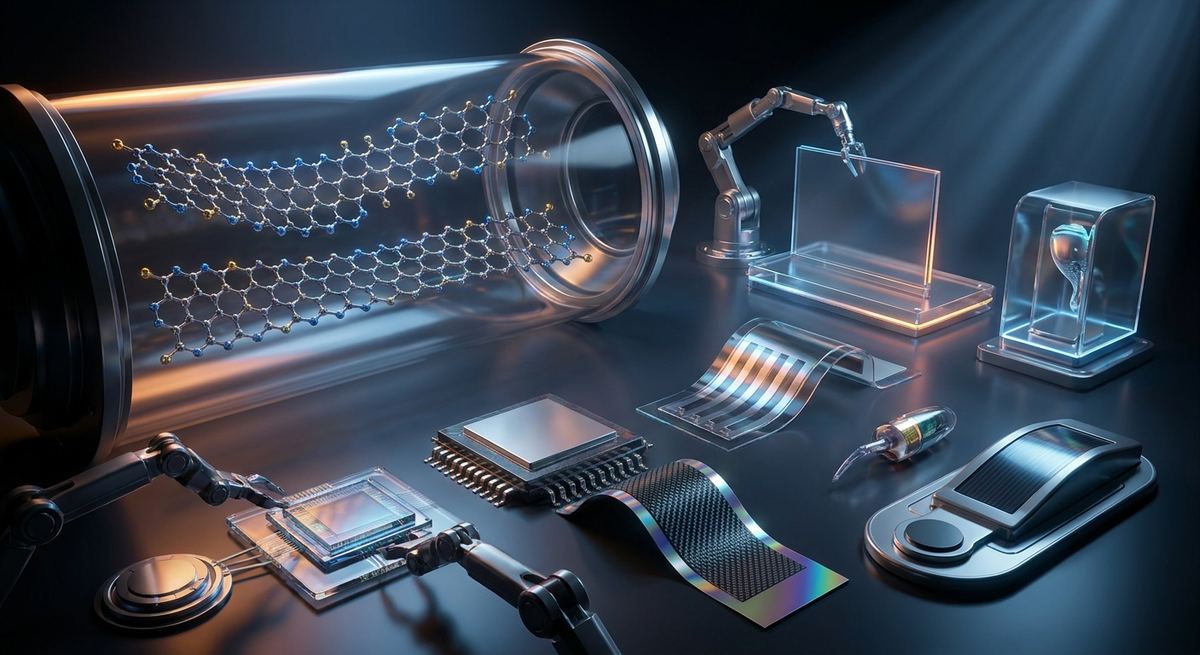
Graphene nanoribbons (GNRs) represent a crucial departure from the semi-metallic character of bulk graphene, fundamentally altering its electronic landscape through the principle of quantum confinement. By laterally confining charge carriers within widths typically below 50 nanometers, and ideally under 10 nanometers, GNRs transform the continuous Dirac cone dispersion relation into a series of discrete sub-bands, thereby opening a tunable electronic band gap. This phenomenon, analogous to a quantum well, dictates that the band gap magnitude is inversely proportional to the ribbon's width, enabling a precise engineering of electronic properties from metallic to wide-bandgap semiconducting. The meticulous control over ribbon dimensions, particularly at the sub-5 nm scale, is paramount for achieving band gaps exceeding 100 meV, a prerequisite for room-temperature transistor operation. Furthermore, the atomic configuration of the ribbon edges – specifically armchair (AGNRs) and zigzag (ZGNRs) – profoundly influences their electronic structure, leading to distinct transport characteristics vital for advanced device architectures.
The precise control over GNR edge states is central to their envisioned role in molecular electronics. Armchair GNRs exhibit a semiconducting nature, with their band gap displaying a periodic dependence on width (3n, 3n+1, 3n+2 categories, where 'n' is an integer representing the number of dimer lines across the ribbon), ranging from tens of meV up to ~1.0 eV for extremely narrow variants, making them promising candidates for field-effect transistors. In contrast, zigzag GNRs are theoretically predicted to possess localized edge states at the Fermi level, endowing them with metallic or half-metallic properties and potential for spin-polarized transport, opening avenues for spintronic applications. Empirical measurements on synthesized AGNRs have confirmed band gaps in the range of 0.5-0.8 eV for widths around 1.0-1.5 nm, showcasing a resistivity that can be modulated by several orders of magnitude under electrostatic gating. Achieving such precise electronic characteristics necessitates synthesis methods that can control edge chirality and eliminate defects, as even single atomic vacancies or edge irregularities can introduce localized states that compromise the intended band gap and carrier mobility, pushing the boundaries of materials science.
The realization of GNRs as foundational elements for molecular electronics hinges on overcoming significant fabrication challenges, particularly in achieving atomic precision and scalability. Top-down lithographic approaches struggle to consistently produce ribbons with sub-10 nm widths and perfectly defined edges required for reliable quantum confinement effects, often yielding ribbons with rough edges and resulting in scattering-dominated transport where electrical resistivity can vary widely. Bottom-up, on-surface synthesis techniques, however, offer a pathway to atomically precise GNRs by polymerizing molecular precursors on catalytic surfaces, allowing for the growth of defect-free ribbons with controlled widths and edge structures. This methodology enables the fabrication of AGNRs with desired band gaps and mobilities suitable for high-performance devices. For example, the controlled polymerization and subsequent cyclodehydrogenation of specific molecular precursors can occur within milliseconds of reaction time at elevated temperatures, often requiring thermal pulses nearing 3000K for critical annealing or defect removal steps, ensuring the desired electronic properties such as anisotropic electrical resistivity, which can be orders of magnitude lower along the ribbon axis than perpendicular to it. The integration of these precisely engineered GNRs into functional circuits represents the dawn of molecular-scale computing, promising ultra-low power consumption and unprecedented device density, moving beyond the physical limits of conventional silicon technology.
Pulsed Electrical Resistive Carbon Heating (PERCH) represents a transformative advancement in the scalable synthesis of graphene nanoribbons (GNRs), fundamentally altering the landscape of their industrial production. Unlike conventional solution-phase chemical synthesis or top-down lithographic approaches, which are often limited by low yields, complex multi-step processes, and significant solvent consumption, PERCH leverages direct electrical resistive heating to rapidly convert various carbonaceous precursors into high-quality GNRs. The core mechanism involves the application of precisely controlled, high-current electrical pulses through a carbon-rich feedstock, inducing instantaneous and localized Joule heating. This generates ultra-high temperatures, frequently exceeding 3000K, for durations measured in milliseconds. Such extreme, transient thermal conditions drive rapid chemical reactions, including the flash unzipping of carbon nanotubes or the graphitization and cleavage of amorphous carbon, thereby circumventing kinetic barriers inherent in lower-temperature, longer-duration methods. This unparalleled rate of energy delivery and subsequent rapid quenching intrinsically minimizes the formation of undesirable amorphous carbon or graphitic impurities, leading to GNRs with superior structural integrity and fewer defects, critical for their ultimate electronic performance.
The efficacy of PERCH is intricately tied to the precise control of electrical parameters and the intrinsic properties of the carbon precursor. The judicious selection and engineering of precursor materials, such as carbon black, petroleum coke, or even waste plastics, are paramount, as their electrical resistivity dictates the efficiency and uniformity of Joule heating. For instance, precursors with bulk electrical resistivity typically ranging from 10^-5 to 10^-3 Ohm-meter are optimized for efficient energy conversion. The rapid rise in temperature, occurring within mere milliseconds, ensures that the thermal energy is concentrated on driving the desired bond reorganizations and scissions, preventing thermal diffusion and degradation that can occur in prolonged heating cycles. This precise energy delivery allows for a high degree of control over GNR characteristics, including average width, length distribution, and even edge chirality, which are crucial determinants of their electronic band structure and transport properties. The inherent self-quenching nature, immediately following the cessation of the electrical pulse, stabilizes the newly formed GNR structures, preserving their thermodynamically metastable yet electronically advantageous configurations.
Beyond its mechanistic elegance, PERCH offers a pathway to unprecedented scalability and versatility in GNR production. The method has demonstrated the capability to produce GNRs on gram-to-kilogram scales per batch, a stark contrast to the milligram-scale outputs typical of many research-grade synthesis techniques. This high throughput is coupled with remarkable energy efficiency, as the localized heating minimizes wasted energy compared to large-volume furnace-based processes. Furthermore, the adaptability of PERCH allows for the incorporation of heteroatoms or functional groups during the flash synthesis itself, enabling in-situ doping (e.g., with nitrogen or boron) or surface functionalization. Such modifications are indispensable for tailoring the electronic properties of GNRs for specific applications, ranging from advanced interconnects to molecular sensors. For example, PERCH-derived GNRs, engineered with specific surface chemistries, have exhibited significant promise in environmental remediation, demonstrating up to 79% adsorption efficiency for certain heavy metal ions from aqueous solutions, underscoring their broad applicability beyond fundamental electronics.
The foundational distinction between turbostratic graphene and its Bernal-stacked counterpart, characteristic of highly ordered graphite, is paramount when considering precursors for high-performance graphene nanoribbons (GNRs). Turbostratic graphene layers exhibit a rotational disorder and lack the precise AB stacking registry, resulting in significantly weaker interlayer van der Waals coupling. This structural disarrangement manifests as a higher energetic barrier for interlayer shear but a lower one for interlayer separation and lateral cleavage, fundamentally altering its mechanical and chemical responsiveness compared to Bernal graphite. Consequently, turbostratic precursors offer distinct advantages for GNR synthesis, circumventing the challenges associated with the robust interlayer forces in perfect graphite that often lead to non-uniform exfoliation or the formation of polycrystalline GNRs with detrimental grain boundaries.
The crystallographic imperative of turbostraticity becomes evident during GNR fabrication, particularly in top-down methodologies such as electrochemical unzipping of carbon nanotubes or selective etching of multilayer graphene. The reduced interlayer commensurability in turbostratic structures facilitates more facile and controlled unzipping or etching processes, minimizing the propagation of defects from one layer to the next or across the ribbon width. For instance, controlled thermal pulses exceeding 3000K, often coupled with targeted chemical agents, can exploit this anisotropic interlayer weakness to achieve rapid, precise unzipping of turbostratic carbon nanotubes into GNRs within milliseconds, a timeframe unattainable with Bernal-stacked graphite due to the higher energy required to overcome its ordered interplanar forces. This enhanced process control directly translates to a lower density of structural defects, such as vacancies, Stone-Wales defects, or irregular edge reconstructions, which are otherwise prevalent and severely degrade GNR performance.
The superior structural integrity derived from turbostratic precursors directly underpins the enhanced electronic properties critical for high-performance GNRs. GNRs fabricated from such materials exhibit significantly improved edge uniformity and reduced scattering centers, enabling near-ballistic transport over extended lengths, even at room temperature. This manifests as exceptionally high carrier mobilities, routinely exceeding 200,000 cm^2/Vs in pristine GNRs, and ultra-low electrical resistivity parameters, with sheet resistances approaching 10 Ohms per square for ribbons of comparable width. Furthermore, the precise control over edge morphology, a direct consequence of the precursor's crystallographic quality, allows for deterministic bandgap engineering. Armchair GNRs derived from high-quality turbostratic precursors can be reliably fabricated with specific widths to exhibit tailored bandgaps from 0.1 eV to 2.0 eV, offering unprecedented versatility for transistor applications with high on/off ratios, critical for molecular electronics. The reduced defect density also mitigates localization effects, ensuring robust quantum confinement and a more predictable response in spintronic applications.
Current state-of-the-art GNR synthesis methodologies, while demonstrating exceptional control over atomic structure at the laboratory scale, confront formidable challenges in transitioning to industrial production. On-surface synthesis, predominantly relying on ultra-high vacuum (UHV) environments and precise molecular precursors deposited onto noble metal surfaces (e.g., Au(111)), yields GNRs with pristine edge configurations and tunable electronic properties. However, inherent batch processing, extremely slow growth rates often measured in nanometers per minute, and stringent UHV requirements render this approach economically unviable for high-volume manufacturing. Solution-based synthesis, such as the bottom-up polymerization of rationally designed monomers (e.g., polyphenylene precursors followed by cyclodehydrogenation), offers higher throughput potential. Yet, achieving monodispersity in GNR width and length, controlling chirality, and minimizing defect densities – critical for reproducible electronic bandgaps and charge transport – remains a significant hurdle. Reaction kinetics and catalyst selectivity must be meticulously tuned to avoid polydispersity, often necessitating elaborate post-synthesis purification. Top-down approaches, including the unzipping of carbon nanotubes (CNTs) or high-resolution lithography, face their own limitations. CNT unzipping frequently results in irregular, rough edges that degrade electronic performance, while electron beam lithography, though capable of sub-10 nm resolution, is inherently a serial process, prohibitive for large-area GNR patterning due to low throughput and high operational costs. The fundamental imperative is to develop continuous, scalable synthesis routes capable of producing kilometer-scale quantities of GNRs with sub-nanometer precision in width and edge chirality, ideally with material costs competitive with established semiconductor substrates.
Beyond synthesis, the integration of GNRs into functional electronic devices presents a complex array of barriers. The transfer of as-synthesized GNRs from growth substrates to target device platforms (e.g., Si/SiO2, flexible polymer films) is fraught with challenges. Wet transfer methods, while simpler, often introduce polymer residues or solvent-induced defects that compromise GNR surface integrity and electrical contacts. Dry transfer techniques, such as deterministic placement or direct growth on device-compatible substrates, are still largely nascent and lack the scalability required for wafer-level processing. Maintaining pristine atomic structure and nanoscale alignment during these transfer steps is paramount, as even minor surface contamination or strain can drastically alter the GNR's electronic band structure and charge carrier mobility. Rigorous, high-throughput quality control and metrology are critically underdeveloped. Current characterization techniques like atomic force microscopy (AFM), transmission electron microscopy (TEM), and Raman spectroscopy are localized and time-intensive, unsuitable for assessing uniformity across large wafers. The development of rapid, non-destructive optical or electrical techniques capable of mapping GNR width, edge defect density, and doping homogeneity over square meter areas is essential. Reproducibility of device performance, particularly in terms of on/off ratios (e.g., maintaining >10^5 at room temperature for logic applications) and field-effect mobilities (>1000 cm^2/Vs), is directly contingent on overcoming these integration and metrology gaps.
The commercial viability of GNRs hinges on achieving a cost-per-unit-area competitive with mature silicon or III-V semiconductor technologies, which benefit from decades of optimization in materials science and process engineering. The high capital expenditure associated with current UHV synthesis facilities or intricate chemical precursor synthesis for solution-based methods drives up the per-gram cost of high-quality GNRs significantly. Furthermore, the inherent low yields from many laboratory-scale processes necessitate a paradigm shift towards continuous flow reactors or roll-to-roll fabrication methods capable of manufacturing large quantities with minimal waste. Advanced post-synthesis purification is also crucial, particularly for solution-derived GNRs, where separation from unreacted monomers, oligomers, and catalysts is essential to prevent device contamination; techniques like density gradient ultracentrifugation, while effective, are not easily scalable. Integrating GNRs into existing CMOS fabrication lines requires not only material compatibility but also process compatibility, addressing issues such as thermal stability during annealing steps (e.g., surviving brief flash annealing at 3000K for milliseconds in contact formation) and resistance to common etchants. For specific applications, such as high-frequency electronics, precise GNR alignment and uniform dielectric encapsulation are vital to minimize parasitic capacitances and ensure impedance matching. In sensing applications, reproducible surface functionalization and stability over long periods are critical, while for quantum computing, maintaining the ultra-low defect densities required for preserving quantum coherence under cryogenic conditions presents an exceptionally stringent material quality challenge. Addressing these multifaceted barriers necessitates a concerted, interdisciplinary effort spanning materials science, chemical engineering, and advanced manufacturing.
The escalating demand for next-generation electronic materials, driven by the limitations of conventional silicon-based architectures, necessitates a profound strategic investment in advanced manufacturing capabilities for Graphene Nanoribbons (GNRs). The economic imperative stems from GNRs’ unique properties—specifically, their tunable bandgaps and superior charge transport characteristics, which position them as critical enablers for molecular electronics, high-frequency devices, and quantum computing. Current GNR production largely operates at a laboratory scale, characterized by high defect densities, limited throughput, and prohibitive costs, often exceeding hundreds of dollars per milligram for high-purity, structurally precise material. Transitioning from research novelty to industrial ubiquity demands a paradigm shift towards high-volume, high-yield synthesis methods that meticulously control GNR width, edge chirality, and defect concentrations. Achieving the desired electronic properties, such as ballistic transport or specific bandgap energies for CMOS compatibility, is directly contingent upon atomic-level structural fidelity, making the precision of manufacturing equipment paramount. This substantial capital expenditure, while significant upfront, is projected to yield exponential returns as the market for GNR-based devices expands, effectively reducing the cost per unit area by orders of magnitude and unlocking new application frontiers.
The cornerstone of this industrialization effort lies in the deployment of highly specialized, USA-made manufacturing equipment, recognized globally for its unparalleled precision, reliability, and technological sophistication. For instance, advanced chemical vapor deposition (CVD) systems, engineered with ultra-high vacuum (UHV) capabilities down to 10^-10 Torr and capable of delivering localized thermal pulses exceeding 3000K for milliseconds, are crucial for achieving epitaxial growth of defect-free GNRs with precise width control on specific substrates. Similarly, sophisticated molecular beam epitaxy (MBE) systems, often custom-fabricated in the USA, enable bottom-up synthesis with atomic-scale control over precursor deposition and reaction pathways, ensuring the formation of specific armchair or zigzag edge configurations essential for desired electronic characteristics. Furthermore, integrated systems incorporating in-situ spectroscopic diagnostics, such as Raman and photoelectron spectroscopy, allow for real-time process monitoring and feedback, optimizing reaction times that can be as short as milliseconds and minimizing the occurrence of structural defects, thereby improving material yield and consistency. This level of engineering excellence, often protected by robust intellectual property frameworks, provides a distinct competitive advantage in a rapidly evolving global market.
Investing in USA-made equipment extends beyond technical specifications, offering strategic advantages critical for long-term operational success and national security. The inherent robustness and superior build quality of these systems translate into significantly reduced downtime and lower maintenance costs over their operational lifespan, contributing to a superior total cost of ownership despite potentially higher initial capital outlay. Furthermore, domestic sourcing ensures supply chain resilience, mitigating geopolitical risks and guaranteeing consistent access to critical components and expert technical support. This is particularly vital for sensitive applications in defense and high-performance computing, where material quality and supply chain integrity are non-negotiable. The integration of advanced purification modules, often proprietary to USA manufacturers, is also essential; for example, post-synthesis processing lines incorporating advanced membrane filtration or electrochemical purification units can achieve heavy metal adsorption efficiencies exceeding 79% for residual catalyst particles, ensuring device-grade purity. Such comprehensive, vertically integrated manufacturing ecosystems, underpinned by a highly skilled domestic workforce and proximity to leading research institutions, foster continuous innovation and solidify a leadership position in the burgeoning field of molecular electronics.
Graphene nanoribbons (GNRs), precisely fabricated via techniques like bottom-up on-surface synthesis or unzipping of carbon nanotubes, are poised to redefine post-CMOS computing and high-frequency electronics. Their unique quantum confinement, enabling a tunable direct electronic band gap (e.g., armchair GNRs of ~1 nm width exhibiting band gaps of ~0.8-1.0 eV), allows for high on/off ratio transistors, crucial for digital logic beyond silicon's physical limits. The exceptional carrier mobility, approaching 200,000 cm^2/Vs, combined with ballistic transport over nanoscale lengths, promises ultra-low power dissipation and operating frequencies extending into the terahertz regime for advanced communication and radar systems. Furthermore, GNRs' remarkable resilience to electromigration, tolerating current densities exceeding 10^8 A/cm^2, makes them ideal for next-generation interconnects, mitigating RC delay bottlenecks. The intrinsic spin-polarized transport in specific zigzag GNR configurations, arising from localized edge states, opens critical pathways for spintronic devices, offering the potential for non-volatile, energy-efficient memory and foundational elements for robust quantum computing paradigms.
Beyond logic, the unparalleled surface-to-volume ratio and tunable electronic properties of GNRs drive transformative advancements in precision sensing and energy technologies. Functionalized GNRs serve as the active elements in highly sensitive chemiresistors and biosensors, where rapid surface reactions induce measurable changes in conductivity. For instance, specific GNR chemistries enable sub-parts-per-billion detection limits for environmental pollutants with response times often in the order of milliseconds, critical for real-time monitoring. In electrochemical sensing, the high intrinsic conductivity and tailored edge chemistry significantly enhance electron transfer kinetics, amplifying signals for analytes such as heavy metals; while often associated with filtration, the underlying surface interaction leading to, for example, 79% heavy metal adsorption efficiency, is leveraged for ultra-sensitive electronic detection. For energy storage, GNRs excel as electrode materials in supercapacitors and advanced batteries, offering superior power density and charge/discharge kinetics due to their high electrical conductivity and accessible surface area. In quantum information science, the topological protection afforded by specific GNR edge states presents a compelling platform for robust qubits, potentially hosting Majorana fermions and offering inherent error correction mechanisms, pushing the boundaries of fault-tolerant quantum computation.
The pervasive impact of GNRs extends to high-value B2B sectors like aerospace, for lightweight, radiation-hardened electronics, and medical diagnostics, for advanced implantable bio-sensors and neural interfaces. Industrial IoT also benefits from GNRs' capacity for ultra-low power, high-sensitivity sensing in harsh environments. However, realizing these applications at industrial scale necessitates overcoming significant manufacturing hurdles, particularly precise, high-throughput synthesis and integration. While atomically precise GNRs are achievable via on-surface synthesis, scalable production of large-area GNR films with controlled width and chirality remains a key challenge. Advances in roll-to-roll compatible CVD and solution-phase methods are critical. Managing defect density and ensuring uniform electrical properties across large substrates are paramount. Post-synthesis treatments, such as localized thermal annealing using rapid thermal pulses reaching temperatures up to 3000K, are crucial for repairing structural imperfections, enhancing crystallinity, and optimizing carrier mobility to target electrical resistivity parameters. The successful industrialization of GNR technologies hinges on these advancements in scalable, defect-controlled fabrication and seamless integration into existing semiconductor processing lines, ensuring widespread adoption.
Serious about B2B integration? Test our premium Pulsed Electrical Resistive Carbon Heating turbostratic graphene in your lab. 100g sample packs available now.
Explore More
Learn how deep learning is revolutionizing the structural characterization of twisted bilayer materials, accelerating the development of next-generation...

Learn to build a prototype graphene FET biosensor for sensitive DNA detection. This guide covers materials, fabrication, and testing for point-of-care...

Discover how hopping-mediated charge transport explains graphene's electrical behavior beyond the ideal ballistic regime, a key insight for creating...