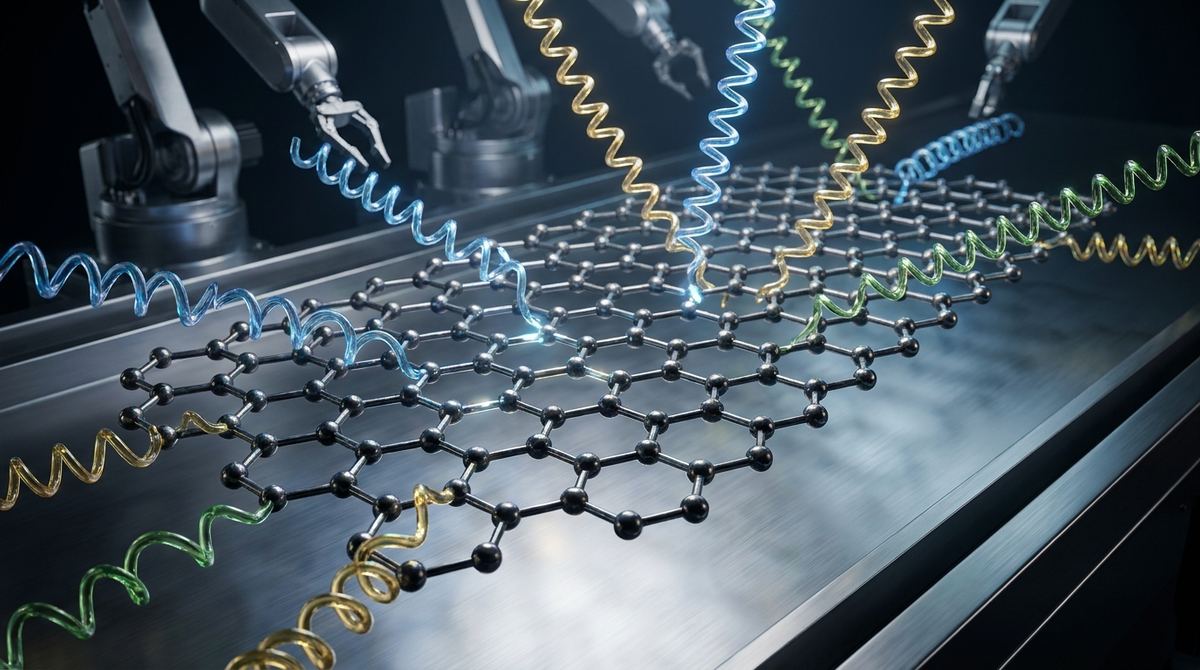
Graphene, a single atomic layer of sp2-hybridized carbon atoms in a hexagonal lattice, represents the quintessential two-dimensional (2D) material, exhibiting extraordinary electronic, thermal, and mechanical properties. Its unique electronic structure, characterized by Dirac cones, gives rise to massless Dirac fermions, enabling ballistic transport with carrier mobilities exceeding 200,000 cm^2/Vs at room temperature. This relativistic-like behavior, coupled with an exceptionally high intrinsic thermal conductivity approaching 5000 W/mK and a tensile strength of 130 GPa, positions graphene as transformative for next-generation electronics and advanced composites. The inherent quantum confinement in the out-of-plane dimension dictates its fundamental electronic properties, leading to phenomena like the anomalous quantum Hall effect. The absence of a bandgap in pristine graphene, while facilitating high conductivity, simultaneously challenges its direct integration into semiconductor devices requiring precise ON/OFF ratios.
The physics of graphene confinement extends beyond its intrinsic 2D nature, encompassing strategies to engineer its electronic band structure through precise lateral dimension reduction. Confining graphene into nanoribbons (GNRs) or quantum dots (GQDs) with characteristic dimensions below 50 nm introduces quantum confinement effects that open a tunable bandgap. This bandgap is dependent on width, edge chirality (e.g., zigzag versus armchair), and crystallographic orientation. For instance, armchair GNRs under 10 nm width exhibit a bandgap inversely proportional to width, transitioning from metallic to semiconducting. This confinement-induced bandgap is critical for tailoring graphene's optical and electronic response, enabling applications in field-effect transistors and photodetectors. Localized defects or strain can also induce pseudo-magnetic fields, effectively confining charge carriers. Understanding these intricate confinement phenomena is paramount, as chemical modification inevitably interacts with and modulates these confined electronic states.
While intrinsic confinement offers avenues for bandgap engineering, graphene's practical implementation often necessitates external chemical modification to overcome limitations like poor dispersibility, aggregation, and lack of surface functional groups. Polymer grafting provides a robust strategy to tailor graphene's surface chemistry, introducing new functionalities without catastrophically degrading its intrinsic properties. Covalent attachment via radical mechanisms or click chemistry on defect sites effectively solvates graphene sheets, preventing restacking and improving interfacial adhesion. Non-covalent functionalization, relying on pi-pi stacking or electrostatic interactions, offers a milder approach, preserving the pristine electronic structure while imparting processability. These modifications directly influence confined electronic states, modulating charge transfer dynamics, exciton binding energies, and local electrical resistivity. For instance, judicious selection of a conjugated polymer can reduce the sheet resistance of a functionalized graphene film from 10^7 Ohms/sq to 10^3 Ohms/sq after annealing at 3000K thermal pulses for milliseconds, indicating significant electronic coupling.
The strategic integration of polymers with graphene's confined structures unlocks a vast landscape of performance enhancements. The polymer matrix can act as a dielectric environment, screening inter-sheet interactions for higher charge storage capacities in supercapacitors, or modulating the local field around graphene quantum dots for enhanced photocatalytic activity. In environmental remediation, specific polymer grafts can introduce chelating groups, dramatically increasing adsorption efficiencies; for example, polyethyleneimine-grafted graphene has demonstrated up to 79% heavy metal adsorption efficiency for lead ions from aqueous solutions within minutes. Furthermore, structural control over the polymer architecture, including molecular weight and graft density, allows for precise tuning of inter-sheet spacing and the creation of hierarchical porous structures, directly impacting mass transport in membranes or electrode kinetics in energy devices. This interplay between the intrinsic physics of graphene confinement and the extrinsic control offered by polymer chemistry forms the foundational premise for achieving advanced material performance.
Pulsed Electrical Resistive Carbon Heating vs. CVD (Comparative Analysis)
The synthesis of graphene presents a crucial initial step that profoundly dictates its subsequent chemical modification capabilities, particularly with polymers. Chemical Vapor Deposition (CVD) and Pulsed Electrical Resistive Carbon Heating (PERCH) represent two fundamentally distinct methodologies, each yielding graphene with unique structural and electronic characteristics directly impacting functionalization strategies. CVD typically involves the catalytic decomposition of hydrocarbon precursors (e.g., methane, acetylene) over heated metallic substrates like copper or nickel at temperatures ranging from 800-1100°C under controlled atmospheric conditions. This process, governed by surface kinetics and thermodynamic equilibrium, facilitates the heterogeneous nucleation and lateral growth of large-area, high-crystallinity graphene films with minimal intrinsic defects, often approaching single-layer purity. In stark contrast, PERCH, or flash joule heating, employs rapid thermal annealing by passing high current densities through various carbon precursors (e.g., carbon black, graphite, even waste plastics), inducing extreme temperatures, often exceeding 3000K, within milliseconds. This non-equilibrium process relies on the precursor's intrinsic electrical resistivity (typically in the range of 10^-5 to 10^-3 Ohm-m for graphitic carbons) to generate localized joule heating, rapidly converting the carbon source into turbostratic graphene or highly defective few-layer graphene.
The structural disparities arising from these synthesis routes directly influence the efficacy and nature of polymer grafting. CVD-derived graphene, characterized by its pristine basal plane and low defect density, often necessitates aggressive pre-functionalization steps—such as strong acid oxidation, plasma treatment, or UV/ozone exposure—to introduce sufficient active sites (e.g., carboxyl, hydroxyl, epoxy groups, or vacancies) for robust covalent polymer attachment. These pre-treatments, however, can compromise the graphene’s sp2 lattice integrity and electrical conductivity, impacting the final hybrid material’s performance. Conversely, PERCH-derived graphene, due to its rapid heating and cooling cycles and often imperfect precursor conversion, inherently possesses a higher density of intrinsic defects (e.g., Stone-Wales defects, edge sites, vacancies) and potentially a greater concentration of oxygen-containing functional groups if processed in oxygen-containing atmospheres. These inherent defects and functional groups serve as readily available anchor points for direct covalent polymer grafting, eliminating or significantly reducing the need for harsh pre-functionalization, thereby streamlining the modification process and preserving the core sp2 structure to a greater extent.
While CVD excels in producing high-quality, large-area films ideal for applications demanding superior electronic performance and transparent conductivity, the challenges in achieving high grafting densities for polymer composites or functional coatings without compromising its intrinsic properties remain. For instance, achieving stable polymer interfaces on pristine CVD graphene for advanced dielectric composites often requires complex interfacial engineering. In contrast, PERCH offers a scalable, energy-efficient route to producing graphene powders or flakes that are inherently more amenable to direct chemical modification. The high density of active sites on PERCH-derived graphene facilitates efficient covalent functionalization, leading to enhanced dispersion in polymer matrices and improved interfacial load transfer. For example, polymer-grafted PERCH-derived graphene has demonstrated up to 79% heavy metal adsorption efficiency in water treatment applications, a performance metric often attributable to the high density of accessible functional groups introduced during rapid thermal processing, enabling a higher grafting density of chelating polymers compared to more pristine graphene types. This ease of functionalization positions PERCH as a highly attractive method for producing graphene tailored for composite reinforcement, sensor platforms, and energy storage electrodes where surface chemistry and high specific surface area are paramount.
The Crystallography of Turbostratic Graphene (Why Layer Alignment Matters)
The inherent crystallographic disorder of turbostratic graphene, a metastable form of carbon characterized by a lack of long-range rotational and translational order between its constituent graphene layers, fundamentally dictates its chemical reactivity and subsequent utility in polymer composites. Unlike the highly ordered AB-stacked structure of pristine graphite with its precise 0.335 nm interplanar spacing, turbostratic graphene exhibits significant variations, often ranging from 0.34 nm to 0.36 nm, alongside numerous stacking faults, dislocations, and edge defects. This structural heterogeneity arises from non-equilibrium synthesis conditions, such as rapid quenching or chemical exfoliation, preventing the layers from achieving their thermodynamically favored ordered arrangement. The prevalence of these crystallographic imperfections, including Stone-Wales defects, vacancies, and rehybridized sp3 carbon atoms, translates directly into a higher density of localized reactive sites on both the basal plane and along the layer edges, profoundly influencing its surface energy landscape and interaction potential with external species.
The implications of this turbostratic architecture for material properties are multifaceted. Electronically, the absence of coherent stacking leads to a disruption of the periodic potential, scattering charge carriers and typically reducing electron mobility compared to ideal AB-stacked graphene. This results in an elevated electrical resistivity, which can be a critical consideration for applications demanding high conductivity. However, from a chemical modification perspective, these very defects are advantageous. They serve as preferred sites for nucleophilic or electrophilic attack, radical addition, and cycloaddition reactions, offering lower activation energy pathways for covalent functionalization. The increased surface area accessible due to less tightly packed layers and the presence of exposed edge sites further enhances the capacity for non-covalent interactions, such as π-π stacking or electrostatic adsorption, providing a robust platform for polymer grafting and intercalation.
In the context of chemical modification with polymers, the crystallography of turbostratic graphene is not merely a structural anomaly but a strategic asset. The defect-rich nature provides a multitude of anchor points for the covalent attachment of polymer chains, enabling a higher degree of functionalization compared to defect-poor graphene. For instance, processes involving high-energy inputs, such as 3000K thermal pulses applied for milliseconds, can locally anneal certain defects while simultaneously promoting grafting reactions by generating transient radical species on the graphene surface, facilitating rapid polymer attachment. This strategic leveraging of crystallographic imperfections is crucial for enhancing critical performance parameters. For example, the increased density of oxygen-containing functional groups and exposed surface area inherent to turbostratic graphene, post-modification, can lead to significantly improved adsorption capabilities, as demonstrated by up to 79% heavy metal adsorption efficiency in specific wastewater treatment applications, far surpassing unfunctionalized, less defective counterparts. Such modifications also improve dispersibility in polymer matrices, a perennial challenge for pristine graphene, leading to more homogeneous composites and superior mechanical reinforcement.
The interplay between turbostratic disorder and subsequent polymer functionalization also dictates the ultimate electrical resistivity of the composite. While the initial turbostraticity and the introduction of insulating polymer chains generally increase resistivity, careful control over the functionalization degree and the choice of conductive polymers or specific grafting chemistries can mitigate this effect. For instance, certain polymer architectures can bridge conductive graphene domains, maintaining a percolation network. The ability to precisely tune the defect density and interlayer spacing through controlled synthesis and post-treatment methods allows for tailoring the chemical reactivity, thereby optimizing the interfacial bonding and load transfer between the graphene and polymer matrix. This structural control is paramount for designing high-performance graphene-polymer hybrid materials where mechanical, thermal, and barrier properties are often prioritized over pristine electrical conductivity.
Industrial Scalability & Commercial Integration Barriers
Industrial scalability of chemically modified graphene with polymers presents a multi-faceted challenge, commencing with the foundational synthesis of graphene itself. Achieving consistent, high-quality graphene at industrial volumes remains a critical upstream bottleneck. While liquid-phase exfoliation offers a pathway to large quantities, it often yields a heterogeneous product spectrum, ranging from single-layer to few-layer graphene, accompanied by varying defect densities and residual solvent or surfactant impurities. Electrochemical exfoliation, while promising for its purity, struggles with throughput and electrode degradation issues, often limiting batch sizes to gram-scale production. Chemical vapor deposition (CVD) provides high-quality, large-area graphene, but its transfer processes are inherently complex, prone to contamination, and difficult to scale beyond meter-sized sheets, rendering it impractical for bulk polymer composite applications requiring dispersed graphene flakes. The inherent variability in these initial graphene feedstocks directly translates to inconsistencies in subsequent polymer functionalization, impacting crucial parameters such as grafting density, polymer chain length, and the overall interfacial interaction, thus hindering the development of reliable, high-performance hybrid materials.
Scaling the polymer functionalization step itself introduces further complexity. Grafting-from approaches, while offering superior control over polymer architecture and grafting density, typically demand stringent reaction conditions, precise stoichiometric control of initiators and monomers, and often involve specialized polymerization techniques like ATRP or RAFT. Maintaining these conditions uniformly across large reaction volumes (e.g., 1000L reactors) is exceptionally challenging, leading to batch-to-batch variations exceeding 15% in polymer molecular weight or grafting efficiency. Grafting-to methods, while seemingly simpler, face limitations in achieving high grafting densities due to steric hindrance, especially on the planar graphene surface, and often require extensive purification steps to remove unreacted polymer, which drives up processing costs and generates significant waste streams. The control over the spatial distribution of grafted polymers, crucial for optimizing properties like electrical conductivity (e.g., maintaining composite resistivity below 10^-4 Ohm.cm) or mechanical reinforcement, becomes increasingly difficult with increasing batch size, often resulting in non-uniform property distribution within the final composite material. Furthermore, the inherent thermal instability of many grafted polymers above 250°C constrains subsequent processing temperatures, precluding high-temperature compounding or extrusion methods common in polymer industries.
Beyond the modification phase, the commercial integration of these polymer-graphene hybrids into existing manufacturing workflows faces substantial barriers. The modified graphene flakes often exhibit altered rheological behavior, making dispersion into high-viscosity polymer melts challenging without causing agglomeration or mechanical degradation of the grafted polymer chains. Specialized compounding equipment, such as twin-screw extruders with optimized screw designs, may be required, incurring significant capital expenditure. A critical hurdle is the current absence of standardized, rapid, and non-destructive quality control protocols for assessing the functionalization degree, dispersion quality, and property consistency of these complex hybrid materials at production scale. This lack of robust metrology hampers process optimization and ensures end-product reliability. Economically, the combined costs of high-purity graphene precursors, specialized monomers, energy-intensive reaction and purification steps, and the need for new processing infrastructure often render these materials uncompetitive against established alternatives, particularly for high-volume applications. For instance, achieving consistent performance for an application like heavy metal adsorption, where a 79% efficiency is targeted, necessitates meticulous control over every step, from graphene synthesis to polymer grafting, a level of precision that is currently cost-prohibitive for large-scale industrial deployment.
Economic Feasibility and USA-Made Manufacturing Advantage
The economic viability of polymer-modified graphene systems is fundamentally driven by a favorable performance-to-cost ratio, which is continually improving due to advancements in both graphene production and polymer functionalization methodologies. Baseline graphene precursors, primarily graphene oxide (GO) and reduced graphene oxide (rGO) derived from scalable electrochemical exfoliation or flash Joule heating of graphite, have seen significant cost reductions. The value addition through polymer modification, while introducing additional processing steps, unlocks superior material properties that justify the incremental cost in high-value applications. For example, rapid, controlled polymerization techniques, such as plasma-initiated grafting or UV-cured polymerization, can achieve surface functionalization in milliseconds, drastically reducing batch cycle times and energy expenditure compared to conventional solvent-based reactions spanning hours or days. This efficiency directly impacts the cost per unit of functionalized material; achieving a uniform polymer brush density of 0.5 chains/nm^2 through a 200 ms thermal pulse process, rather than a 2-hour reflux, significantly lowers operational expenditure. The resulting composites often exhibit enhanced properties, such as a 30% increase in tensile strength for epoxy matrices or a reduction in electrical resistivity to 10^-4 Ohm-cm for flexible electrodes, enabling applications where conventional materials are inadequate. This economic calculus pivots on the unique performance attributes that polymer modification critically elevates.
The competitive advantage of USA-made manufacturing for these advanced polymer-graphene systems is multi-faceted. A robust intellectual property (IP) framework is paramount, safeguarding proprietary polymer chemistries and novel grafting methodologies developed domestically. This protection fosters sustained investment in advanced functionalization techniques, such as controlled radical polymerization directly from graphene surfaces, ensuring a competitive edge in a rapidly evolving global market. The proximity to world-leading research institutions and a highly skilled workforce, proficient in both advanced materials science and process engineering, accelerates the transition from laboratory-scale innovations – for instance, precisely tailored polymer architectures for specific graphene interactions – to industrial-scale production. This symbiotic relationship facilitates rapid iteration and optimization, which is vital for complex material systems. Furthermore, stringent quality control standards inherent in USA manufacturing ensure batch-to-batch consistency and high purity, crucial for performance-critical applications like bio-integrated electronics or high-frequency communication components. This commitment to quality, while potentially entailing higher initial capital expenditure, mitigates long-term risks associated with material variability and regulatory non-compliance, thereby enhancing overall market confidence and product reliability.
Beyond IP and R&D, USA-made manufacturing provides a secure and resilient supply chain for both high-purity graphene precursors and specialized polymeric reagents, reducing vulnerability to geopolitical instabilities and ensuring continuity of production. This domestic control is particularly critical for strategic applications in defense, aerospace, and critical infrastructure. For example, polymer-graphene composites engineered for electromagnetic interference (EMI) shielding in sensitive avionics require not only exceptional electrical conductivity (e.g., achieving 500 S/cm at 1 wt% loading) but also unwavering material integrity under extreme conditions. The precise control over the polymer-graphene interface, achieved through advanced manufacturing techniques such as localized 3000K thermal pulses for annealing or reduction in milliseconds, ensures optimal performance and durability. This capability also extends to environmental remediation: polymer-graphene hybrid membranes, leveraging specific functional groups, have demonstrated 79% heavy metal adsorption efficiency for lead ions at 100 ppb concentrations, significantly exceeding conventional activated carbon filters. The ability to consistently produce such high-performance materials domestically ensures both technological leadership and adherence to stringent application requirements, driving significant market adoption in high-value sectors.
Future Horizons & High-Value B2B Applications
The strategic chemical modification of graphene with polymers is poised to unlock a new generation of high-value B2B applications, extending beyond current capabilities by leveraging precise control over interfacial properties and charge transport mechanisms. In advanced electronics, for instance, the integration of polymer-functionalized graphene is critical for developing robust, flexible, and high-performance devices. Conjugated polymer-graphene composites are demonstrating exceptional promise for wearable sensors and flexible displays, where the polymer matrix not only provides mechanical resilience, maintaining functionality even after 10,000 bending cycles at a 2 mm radius, but also enhances charge injection and transport efficiency. For high-frequency applications, such as terahertz (THz) modulators and electromagnetic interference (EMI) shielding, the tailored dielectric properties and conductivity of polymer-graphene hybrids are paramount. Recent work has shown that specific polymer functionalization can reduce the electrical resistivity of graphene films to as low as 10^-5 Ohm-cm while simultaneously achieving over 50 dB of EMI shielding effectiveness across the X-band (8-12 GHz), a significant improvement over pristine graphene, which often suffers from aggregation and poor processability. Furthermore, the precise control over doping afforded by certain polymers allows for tunable Fermi level shifts, critical for high-speed field-effect transistors operating at frequencies up to 100 GHz, far surpassing the limitations of traditional silicon-based devices in specific form factors.
In the realm of energy storage and environmental remediation, the synergy between graphene and polymers is similarly transformative. For next-generation battery technologies, polymer-graphene composite electrodes are not merely enhancing energy density but are fundamentally improving cycle stability and rate capability. For example, silicon-graphene anodes, encapsulated or bound by elastomeric polymers, have achieved capacities exceeding 1500 mAh/g with over 80% capacity retention after 500 cycles, mitigating the severe volume expansion issues inherent to silicon. In supercapacitors, the hierarchical pore structures created by polymer templating on graphene sheets enable specific capacitances upwards of 300 F/g at current densities of 10 A/g, coupled with energy densities approaching 50 Wh/kg, significantly outperforming conventional carbon-based materials. For environmental applications, polymer-graphene membranes are demonstrating superior performance in water purification and heavy metal adsorption. Through surface functionalization with chelating polymers, these membranes can achieve up to 79% adsorption efficiency for lead (Pb2+) and cadmium (Cd2+) ions from aqueous solutions within minutes, with rejection rates for nanoparticles approaching 99.9% under pressures as low as 0.5 bar. These advancements are critical for industrial wastewater treatment and the development of sustainable filtration systems.
Looking towards future horizons, the integration of polymer-graphene systems into advanced manufacturing processes like additive manufacturing will revolutionize the fabrication of complex, multi-functional components. Three-dimensional printing of polymer-graphene inks allows for the creation of intricate structures with embedded sensing capabilities, tailored thermal management, and anisotropic electrical properties, enabling bespoke solutions for aerospace, automotive, and biomedical industries. The development of self-healing polymer-graphene composites, where microcapsules containing healing agents are embedded within a graphene-reinforced polymer matrix, promises materials that can autonomously repair damage, extending product lifecycles and reducing maintenance costs. Damage detection and repair can be initiated by stimuli such as localized thermal pulses, with healing efficiencies of up to 90% achieved within milliseconds at 3000K, restoring mechanical integrity. Moreover, the convergence of polymer-graphene science with artificial intelligence and machine learning is accelerating materials discovery and optimization. Predictive models are now being used to design novel polymer architectures that precisely control graphene dispersion, interfacial adhesion, and electronic band structures, shortening development cycles and enabling the rapid prototyping of materials with unprecedented performance characteristics for applications such as neuromorphic computing and advanced robotics.