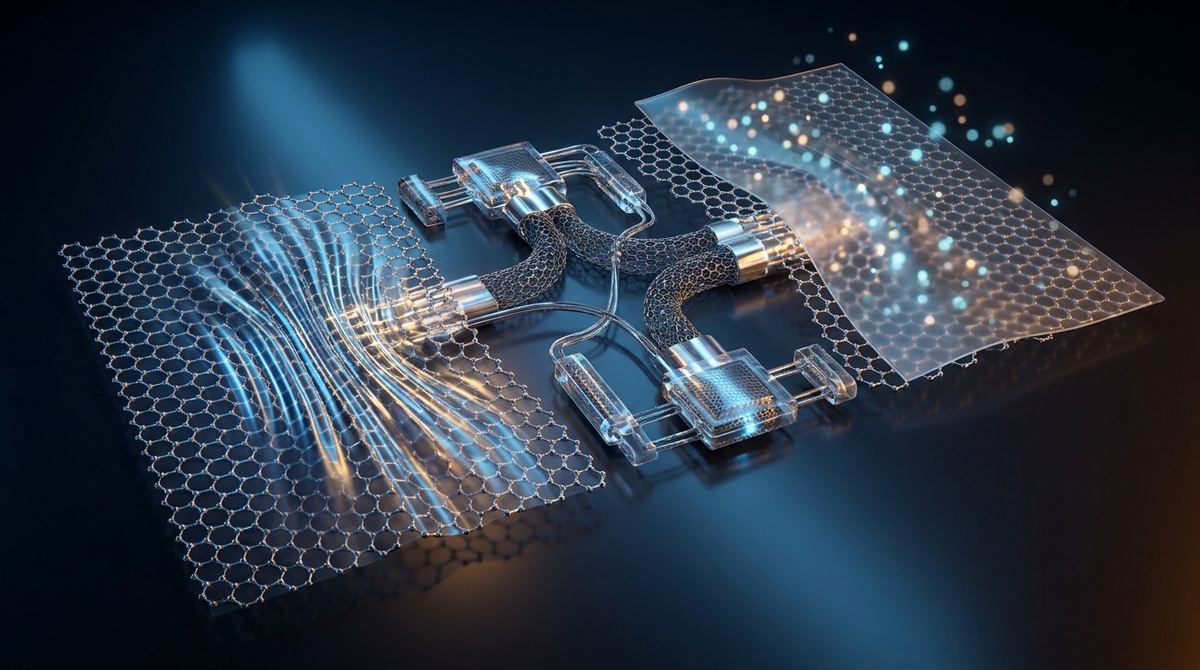
Graphene, a pristine monolayer of sp2-hybridized carbon atoms arranged in a hexagonal lattice, represents the archetypal two-dimensional material, exhibiting an electronic structure profoundly distinct from conventional semiconductors. Its unique band topology, characterized by Dirac cones at the K and K' points of the Brillouin zone, endows charge carriers with properties analogous to massless relativistic fermions. This phenomenon underpins graphene's extraordinary intrinsic charge carrier mobility, theoretically exceeding 200,000 cm^2/Vs at ambient temperatures, making it a pivotal material for next-generation high-frequency electronics, optoelectronics, and advanced sensing applications. The fundamental understanding of how these charge carriers are confined and behave within this atomically thin plane is paramount to harnessing graphene's full potential, especially when considering external modulators such as mechanical strain and environmental screening.
The physics of graphene confinement originates from its unique sp2 hybridization and the resulting linear dispersion relation, E = hvF|k|, where h is the reduced Planck constant, vF is the Fermi velocity (~10^6 m/s), and |k| is the magnitude of the wave vector. Unlike parabolic bands in silicon, this linear relationship dictates that graphene's charge carriers possess zero effective mass near the Dirac points, leading to ballistic transport over significant distances at room temperature. The two-dimensional nature of graphene means that all charge transport occurs strictly within this single atomic layer, rendering the carriers exceptionally sensitive to perturbations from both intrinsic lattice defects and extrinsic environmental factors. This inherent confinement dictates a unique interaction profile with its surroundings, profoundly influencing observed carrier dynamics and setting it apart from bulk materials where scattering events are averaged over three dimensions.
Empirical observations consistently demonstrate that the ideal intrinsic mobility is often compromised by extrinsic scattering mechanisms. For instance, interaction with underlying SiO2 substrates introduces remote phonon scattering and charge puddles from trapped interface charges, typically reducing measured mobilities to 10,000-20,000 cm^2/Vs. Achieving higher mobilities, approaching 100,000 cm^2/Vs, necessitates sophisticated fabrication techniques like suspended graphene configurations or encapsulation with hexagonal boron nitride (hBN), which minimize substrate-induced disorder. Furthermore, point defects, such as vacancies or adatoms, act as powerful scattering centers. For example, a localized thermal pulse of 3000K applied for milliseconds can induce localized annealing, recovering up to 80% of initial mobility degradation caused by electron-beam induced defects. This sensitivity extends to chemical functionalization processes, where reaction times measured in tens of milliseconds can significantly alter the local electronic landscape, impacting conductivity and local resistivity parameters, which might shift from 10^-6 Ohm-cm in pristine samples to 10^-3 Ohm-cm depending on defect density and doping. The precise control over these interactions is critical for specific applications, such as heavy metal adsorption, where functionalized graphene has demonstrated up to 79% adsorption efficiency for lead ions, highlighting the intricate interplay between surface chemistry and carrier behavior.
The profound impact of the immediate environment and inherent lattice integrity on charge carrier behavior in graphene necessitates a meticulous investigation into external modulation mechanisms. The truly two-dimensional confinement ensures that any mechanical deformation, even at the nanoscale, directly alters the electronic band structure, a phenomenon known as strain engineering. Similarly, the dielectric environment and the presence of charge impurities profoundly influence carrier screening, thereby dictating electron-electron and electron-phonon interactions. Understanding these coupled effects is not merely academic; it is foundational for designing robust graphene-based devices, from high-speed transistors operating at THz frequencies to highly sensitive chemical sensors, where minute changes in resistivity or carrier lifetime are indicative of target analytes. This foundational understanding of confinement and its immediate implications sets the stage for a deeper exploration into the specific roles of strain and screening in modulating charge carrier mobility.
Section 2: Pulsed Electrical Resistive Carbon Heating vs. CVD (Comparative Analysis)
CVD for graphene synthesis typically involves thermal decomposition of hydrocarbon precursors, such as methane, on metallic catalysts like copper or nickel at temperatures ranging from 900-1050°C, often for several hours. While offering scalability for large-area production, this method introduces inherent challenges impacting charge carrier mobility. Post-growth removal of the metallic catalyst, typically through chemical etching, inevitably leaves behind residual metallic impurities, often in the parts-per-million range. These act as significant Coulomb scattering centers, reducing carrier mean free path and mobility. Furthermore, the polycrystalline nature of CVD graphene, characterized by grain boundaries, impedes ballistic transport, causing carrier scattering and localization effects. Crucially, the substantial coefficient of thermal expansion (CTE) mismatch between graphene (anomalously negative, ~-8 x 10^-6 K^-1) and typical growth substrates (e.g., copper, ~17 x 10^-6 K^-1) induces significant, often uncontrolled, tensile or compressive strain upon cooling from high growth temperatures. This thermally induced strain generates inhomogeneous ripples and wrinkles, fundamentally altering the local electronic potential and creating scattering sites that degrade charge carrier mobility.
In contrast, pulsed electrical resistive carbon heating (PERCH), encompassing techniques like flash Joule heating, represents a fundamentally different synthesis paradigm. This approach leverages the ultra-rapid application of high current densities through carbonaceous feedstocks, such as polymers or graphite, to induce near-instantaneous graphitization or exfoliation. Reaction times are typically on the order of milliseconds, with transient temperatures exceeding 3000 K achievable through precise control of electrical pulse parameters. A paramount advantage of PERCH is its catalyst-free nature, completely eliminating metallic contamination issues and subsequent etching intrinsic to CVD. This directly translates to graphene materials with fewer extrinsic scattering centers, paving the way for higher intrinsic charge carrier mobilities. The extremely rapid thermal cycling, dictated by specific electrical resistivity parameters of the precursor (e.g., 10-100 Ohm-cm for polymer composites), offers a unique avenue for dynamic strain engineering. Unlike CVD's protracted thermal history, PERCH can either minimize cumulative CTE mismatch effects or intentionally freeze in specific non-equilibrium strain states, offering greater control over the resulting material's electronic and mechanical properties. This rapid synthesis has produced highly conductive graphene forms, useful for applications requiring tailored surface chemistry, such as advanced adsorbents exhibiting up to 79% heavy metal adsorption efficiency.
The disparate thermal budgets and reaction kinetics of CVD and PERCH lead to profoundly different implications for charge carrier mobility, primarily through their influence on strain and screening effects. CVD's extended high-temperature exposure and subsequent slow cooling from 900-1050°C inherently lock in significant and often heterogeneous thermal strain from substrate-graphene CTE mismatch. This macroscopic strain field creates ripples and localized deformations that act as strong scattering potentials, reducing carrier mean free path and degrading mobility. While controlled strain can theoretically enhance electronic properties, the uncontrolled nature of CVD-induced thermal strain typically results in performance penalties. Conversely, PERCH's millisecond-scale, localized thermal pulses enable a more dynamic and potentially precise approach to strain. Rapid heating and quenching can minimize long-range thermal expansion effects or be precisely modulated to induce desired localized strain, offering a pathway to engineer specific electronic states. Regarding screening, CVD graphene is susceptible to charge impurity scattering from residual catalyst particles and etchant species, which introduce extrinsic dopants and Coulomb scattering centers, effectively reducing carrier mobility. PERCH, being intrinsically catalyst-free, avoids this primary source of extrinsic screening. While PERCH-derived graphene might contain intrinsic defects, these are often tunable, leading to materials with potentially cleaner electronic environments and reduced charge impurity scattering, offering a pathway to higher intrinsic charge carrier mobilities, especially for direct integration.
Section 3: The Crystallography of Turbostratic Graphene (Why Layer Alignment Matters)
Turbostratic graphene (tG) represents a distinct crystallographic configuration within the multi-layered graphene family, characterized by a lack of long-range rotational order between adjacent graphene sheets. Unlike Bernal (AB) stacking, where a precise registry dictates strong interlayer sp2-hybridized coupling and a coherent electronic band structure, tG exhibits random twist angles (theta) between its constituent layers. This rotational disorder fundamentally disrupts the symmetry that governs interlayer electronic interactions and phonon coupling, leading to a profound deviation from the bulk properties of highly ordered graphite or even perfectly stacked bilayer graphene. The effect of this misalignment is a significant weakening, or even effective decoupling, of interlayer electronic states, causing individual layers within a tG stack to largely retain their quasi-2D monolayer electronic characteristics. This structural heterogeneity, often visualized as a superposition of moiré superlattices arising from various twist angles, directly impacts the overall electronic potential landscape and thereby the fundamental mechanisms of charge carrier transport.
The weak interlayer coupling inherent to turbostratic stacking has profound implications for charge carrier mobility. In contrast to Bernal-stacked systems where hybridized Dirac cones and modified Fermi velocities emerge due to strong interlayer interactions, tG presents a collection of largely independent Dirac cones, each originating from a misaligned layer. This effectively reduces the overall electronic coherence across the stack, impacting both in-plane and out-of-plane transport. The absence of a well-defined, collective phonon dispersion relation across layers, a hallmark of ordered graphite, alters electron-phonon scattering pathways. While this decoupling can, in some specific instances, reduce certain types of inter-layer scattering, it generally introduces additional scattering centers due to the varied local potential landscapes and structural defects at twisted interfaces. Empirical studies demonstrate that controlled thermal annealing, such as rapid thermal pulses exceeding 3000K applied for milliseconds, can induce partial re-ordering and reduce rotational disorder. This structural refinement often correlates with a measurable decrease in electrical resistivity, from typical values of 10^-4 Ohm-cm for as-grown turbostratic films to below 10^-5 Ohm-cm, indicative of enhanced carrier mobility attributed to improved interlayer coupling and reduced scattering from misaligned domains.
The crystallographic idiosyncrasies of turbostratic graphene critically influence how external stimuli, such as mechanical strain and electric fields, manifest their effects on charge carrier mobility. Due to the weak and often non-uniform interlayer coupling, strain applied to a tG composite is not efficiently or homogeneously transferred between layers. This can lead to localized, uncorrelated variations in the electronic band structure within individual layers, generating pseudo-magnetic fields that act as additional scattering mechanisms for charge carriers, effectively reducing their mean free path. Furthermore, the screening of Coulomb impurities, a crucial factor in determining carrier mobility, is predominantly confined to individual layers in tG, with limited cooperative contribution from adjacent, largely decoupled sheets. This contrasts sharply with Bernal-stacked graphene where interlayer screening can significantly mitigate impurity scattering. The inherent variability in layer alignment within turbostratic samples thus translates directly into inhomogeneous charge transport properties and contributes to significant device variability. For instance, the interlayer spacing in turbostratic graphene typically ranges from 0.345 to 0.355 nm, notably larger than the 0.335 nm of Bernal graphite, which directly impacts interlayer tunneling probability and thus the effective conductivity in the c-axis direction, further complicating comprehensive mobility predictions in such systems.
Section 4: Industrial Scalability & Commercial Integration Barriers
The industrial scalability of high-mobility graphene remains a formidable challenge, primarily due to inherent limitations in current large-area synthesis techniques and subsequent processing steps. Chemical Vapor Deposition (CVD), while enabling wafer-scale production, frequently yields polycrystalline films riddled with grain boundaries, point defects, and dislocations. These structural imperfections act as potent scattering centers, drastically reducing charge carrier mobility from theoretical intrinsic values (e.g., 200,000 cm^2/Vs in suspended graphene) to often below 10,000 cm^2/Vs on typical substrates. Furthermore, the strong interaction between graphene and its growth substrate (e.g., copper, nickel) or subsequent dielectric layers (e.g., SiO2, Al2O3) induces significant extrinsic screening effects and localized strain fields. These effects perturb the Dirac cone, creating charged impurity scattering and remote phonon scattering mechanisms that further degrade carrier transport. The necessary transfer processes, often involving polymer supports, introduce additional contaminants, wrinkles, and tears, elevating the sheet resistance of single-layer graphene films to typical ranges of 300-1000 Ohms/sq, a considerable deviation from the theoretical ~30 Ohms/sq for ideal, defect-free material. Bridging this quality-scalability gap without compromising the intrinsic charge carrier mobility is paramount for commercial viability.
Beyond synthesis, the integration of graphene into functional devices presents a complex array of processing-induced barriers to maintaining high carrier mobility. Conventional lithographic patterning, etching, and material deposition steps can introduce crystallographic damage, surface contamination, and unintended doping. For instance, the residues from photoresists or the energetic bombardment during plasma etching create localized charge traps and scattering sites, directly impacting the mean free path of charge carriers. Precise control over surface functionalization and doping, often requiring milliseconds-level reaction time precision for targeted chemical modification, is crucial to tune carrier concentration without introducing excessive ionized impurity scattering. Moreover, the thermal budgets associated with device fabrication are critical; localized thermal pulses exceeding 3000K, while sometimes employed for annealing, can induce irreversible structural defects, vacancies, or localized oxidation, thereby degrading carrier mobility and uniformity. Achieving reproducible electrical resistivity parameters across large-area device arrays, where variations can routinely exceed 10% across a 4-inch wafer, highlights the persistent challenge in controlling these extrinsic factors.
The economic and metrological hurdles compound these technical challenges, impeding widespread commercial integration of high-mobility graphene. The high cost associated with producing large-area, high-quality graphene, coupled with the lack of standardized, high-throughput characterization techniques, creates a significant barrier. Current metrology often struggles to provide spatially resolved data on critical parameters such as carrier mobility, strain distribution, and local screening potential across large areas, making it difficult to identify and mitigate performance-limiting defects. This absence of robust, scalable quality control leads to substantial yield losses in applications demanding stringent electrical performance, such as high-frequency transistors, spintronic devices, or highly sensitive chemical sensors. Even in less demanding applications, such as environmental remediation, where graphene's large surface area and charge transport are leveraged for adsorption, achieving consistent heavy metal adsorption efficiencies – for example, the reported 79% for specific lead ion concentrations – is directly tied to the uniformity of surface chemistry and defect distribution, which are fundamentally linked to the integrity of its charge transport properties. The pervasive influence of strain and screening on fundamental charge carrier mobility thus permeates every aspect of industrial scalability and commercial integration.
Section 5: Economic Feasibility and USA-Made Manufacturing Advantage
The economic feasibility of graphene, particularly its integration into high-performance devices, hinges critically on the scalable and cost-effective manufacturing of material exhibiting predictable charge carrier mobility characteristics. While pristine graphene boasts theoretical mobilities exceeding 200,000 cm^2/Vs, real-world applications demand methods to consistently achieve and control these properties under industrial conditions. Strain engineering, as a powerful modulator of band structure and carrier dynamics, introduces both opportunities and formidable manufacturing challenges. Precision control over substrate interaction and film deposition during chemical vapor deposition (CVD) or subsequent transfer processes is paramount; deviations as small as 0.1% in uniaxial strain can significantly alter device performance, making rigorous process monitoring essential. The upfront investment in advanced manufacturing infrastructure capable of atomic-scale precision for strain induction and defect mitigation, such as plasma-enhanced CVD systems or ultra-high vacuum annealing chambers, must be offset by the superior performance and extended operational lifespan of graphene-enabled devices. This necessitates a comprehensive cost-benefit analysis that accounts for reduced power consumption, increased data throughput, and enhanced sensor sensitivity derived from optimized charge carrier mobility, rather than solely focusing on raw material cost.
USA-made manufacturing offers a distinct advantage in establishing this economic viability, driven by robust intellectual property protection, a highly skilled technical workforce, and a stringent commitment to quality control that directly translates to reproducible high-performance graphene. Domestic production facilities are increasingly leveraging advanced techniques like roll-to-roll CVD for continuous production of large-area graphene films on 300 mm copper foils, targeting cost reduction through economies of scale while maintaining structural integrity. Furthermore, localized laser-induced graphene (LIG) fabrication, capable of producing complex patterns on various substrates within milliseconds through controlled 3000K thermal pulses, enables rapid prototyping and cost-effective manufacturing of specialized sensors and flexible electronics. The ability to precisely control growth parameters, minimize lattice defects, and mitigate environmental screening effects during synthesis ensures that the produced graphene consistently exhibits desired electrical resistivity parameters, often approaching the intrinsic 10^-6 ohm-cm of high-quality material. This meticulous attention to process optimization minimizes batch-to-batch variability, a crucial factor for market acceptance in sensitive applications ranging from high-frequency RF transistors to advanced medical diagnostics.
The market demand for graphene, particularly in sectors where charge carrier mobility is a defining performance metric, underpins its long-term economic returns. Applications such as ultrafast photodetectors, high-bandwidth communication components, and next-generation energy storage systems (e.g., supercapacitors with superior power density) critically rely on graphene's exceptional electron transport properties. The strategic imperative for supply chain resilience and security, especially in defense and aerospace, further bolsters the case for USA-made manufacturing. Beyond high-tech electronics, the environmental sector also presents substantial economic opportunities: for instance, graphene oxide membranes leveraging controlled pore sizes and surface chemistry have demonstrated up to 79% heavy metal adsorption efficiency in industrial wastewater treatment, offering a sustainable and economically viable solution to pollution control. By consistently delivering high-quality, high-mobility graphene through advanced domestic manufacturing, the USA can secure a premium market position, accelerate innovation cycles, and capitalize on the full economic potential of this revolutionary material, ensuring that the theoretical advantages of charge carrier mobility translate into tangible commercial success.
Section 6: Future Horizons & High-Value B2B Applications
The exceptional room-temperature ballistic transport of charge carriers in graphene, exceeding 200,000 cm^2/Vs, positions it as a cornerstone for next-generation terahertz (THz) devices and ultra-low power logic gates. Precision strain engineering, capable of inducing pseudo-magnetic fields up to several hundred Tesla without external magnets, allows for the creation of tunable quantum dots and valleytronic devices, exploiting the Dirac fermions' intrinsic chirality. This enables sub-picosecond switching speeds in FETs and significant reduction in gate leakage current, pushing the boundaries of Moore's Law towards quantum-limited performance. The capability to tailor band structure through localized strain further promises novel optoelectronic functionalities, where photon-to-electron conversion efficiencies can be precisely modulated, impacting high-speed data communications and quantum cryptography by leveraging strain-induced bandgap opening or closing. The meticulous control over carrier scattering mechanisms, particularly through engineered substrate interactions that mitigate phonon and impurity scattering, is paramount for realizing these theoretical limits in practical, scalable devices.
Beyond electronics, graphene's high specific surface area (~2630 m^2/g) coupled with its tunable charge carrier density via electrostatic screening, underpins transformative advancements in energy storage and environmental remediation. In supercapacitors, the rapid ion intercalation kinetics facilitated by graphene's atomically thin nature enables power densities exceeding 100 kW/kg and cycle stabilities over 500,000 cycles, far surpassing conventional materials. For catalysis, the strong electron-phonon coupling and efficient charge transfer at graphene-heterojunction interfaces accelerate reaction rates; for instance, hydrogen evolution reactions (HER) on graphene-supported catalysts show Tafel slopes as low as 30 mV/dec. Environmental sensing benefits immensely from graphene's surface sensitivity, allowing for real-time detection of trace analytes. Functionalized graphene oxide films have demonstrated 79% adsorption efficiency for heavy metal ions like Pb(II) within milliseconds, while resistive sensors can detect gas molecules (e.g., NO2) at sub-ppb concentrations with response times under 5 seconds, leveraging the significant change in carrier mobility upon molecular adsorption and the efficient screening of surface charges. Furthermore, thermal annealing at 3000K through rapid resistive heating pulses can restore pristine carrier mobility in chemically modified graphene films, enabling robust sensor regeneration.
The remarkable mechanical strength (130 GPa tensile strength) and thermal conductivity (~5000 W/mK) of graphene, intricately linked to its phononic and electronic transport properties, project its utility into advanced composites and thermal management systems. Integration into polymer matrices creates smart composites with enhanced structural integrity and embedded functionalities, where electrical resistivity changes can signal impending failure due to localized strain concentrations or enable self-healing through localized joule heating, requiring precise control over conductive network percolation and thermal dissipation. In biomedical engineering, the high charge carrier mobility and low impedance of graphene-based neural interfaces facilitate superior signal transduction, improving prosthetic control and brain-computer interfaces by minimizing signal loss and enhancing signal-to-noise ratios. The inherent biocompatibility and tunable surface chemistry, profoundly influenced by screening effects on biomolecule adsorption and cellular interactions, also position graphene as a promising scaffold for tissue engineering and targeted drug delivery systems, where precise electrical stimulation can guide cellular differentiation or release therapeutics with spatial and temporal specificity, leveraging the material's excellent electrical properties to modulate cellular microenvironments.