Education, Graphene Applications
Bouncy Graphene Balloons: Super Strong and Super Fun!
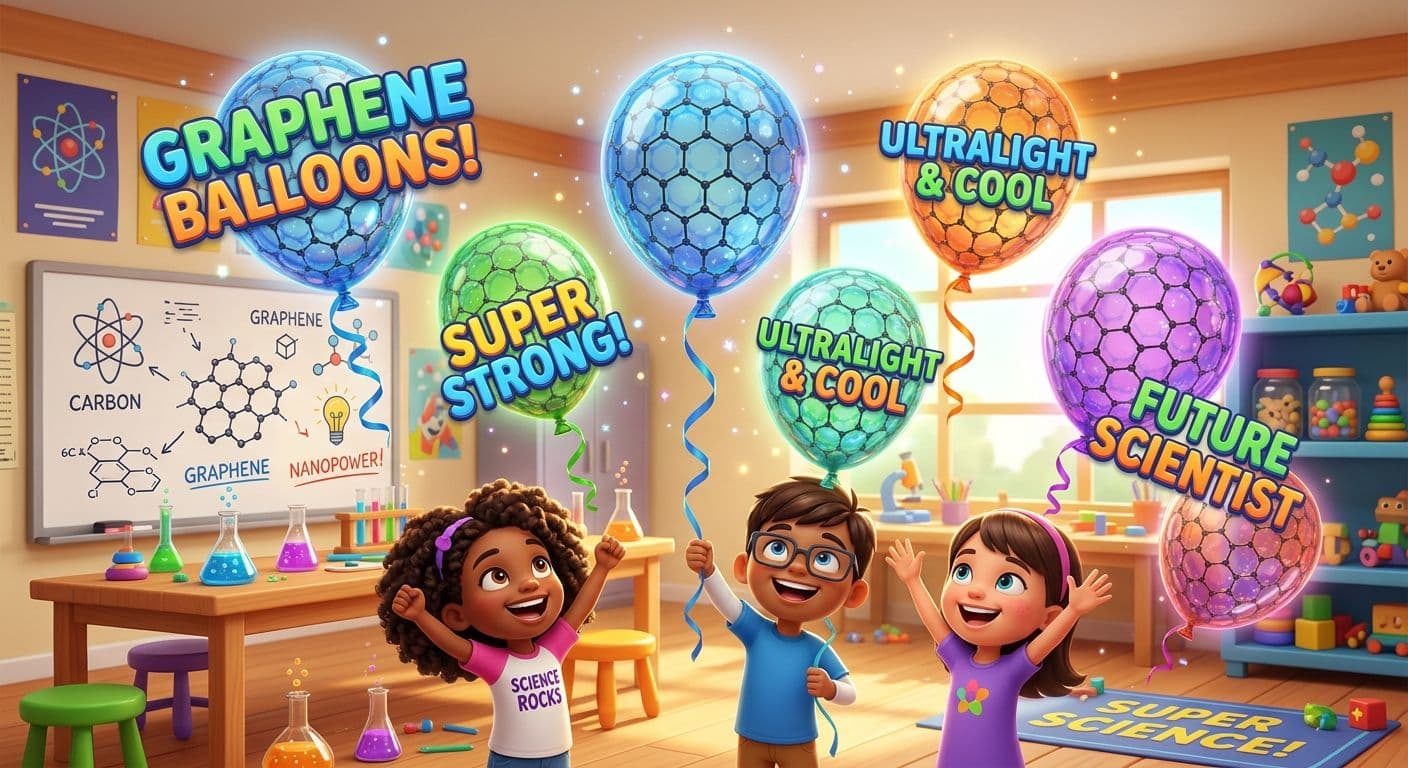
Bouncy Graphene Balloons: The Ultimate Science Experiment
Have you ever blown up a beautifully bright party balloon, watched it bounce across the yard, and then heard the inevitable, tragic *POP* just a few minutes later? We’ve all been there. Traditional rubber and latex balloons are fun, but they are incredibly fragile. A stray blade of grass, a rogue fingernail, or even just sitting out in the hot summer sun is enough to destroy them. But what if we could build a balloon that never pops? What if we could design a bouncy toy so strong that you could squeeze it, sit on it, and toss it around without worrying about it bursting?
Enter the fascinating world of graphene.
Graphene is not science fiction; it is a very real, incredibly powerful material that scientists are studying in laboratories all across the globe right now. Discovered by researchers who used simple scotch tape to peel a single layer of carbon atoms off a block of graphite (the same stuff inside your pencil!), this material is revolutionizing everything from batteries to bulletproof vests. But today, we are going to look at the lighter, more playful side of physics and chemistry. Today, we are exploring how the science of graphene could create the ultimate super-strong bouncy balloon.
What Exactly is Graphene?
To understand how a graphene balloon would work, we have to understand the material itself. Imagine taking a piece of chicken wire, but shrinking it down so small that it is completely invisible to the naked eye. Instead of metal, that hexagonal, honeycomb-shaped chicken wire is made entirely of carbon atoms.
Carbon is one of the most common elements in the universe. It is inside the air we breathe, the plants we eat, and even the cells in our bodies. When carbon atoms link together in a specific, flat, single-layer honeycomb pattern, they form graphene. Because it is only one atom thick, graphene is a two-dimensional material. This makes it incredibly lightweight and nearly transparent. In fact, you would have to stack about 3 million sheets of graphene on top of each other just to equal the thickness of a single sheet of standard printer paper!
But despite being practically invisible, graphene is a heavyweight champion when it comes to strength. It is mathematically calculated to be over 200 times stronger than steel of the same thickness. If you had a sheet of graphene as thick as a plastic wrapper, you could balance a full-sized adult elephant on a pencil with the point resting on the graphene sheet... and the graphene wouldn't rip!
The Trouble with Everyday Latex
Why do regular balloons pop in the first place? Everything comes down to air pressure and structural elasticity. When you blow air into a latex balloon, you are forcing gas molecules into an enclosed space. Those gas molecules are bouncing around excitedly, colliding with the walls of the balloon and pushing outward. This outward push is called air pressure.
Latex is an elastic polymer. Under a microscope, it looks like a tangly bowl of spaghetti strings that stretch out when you pull them. As you inflate the balloon, the pressure forces those polymer strings to stretch thinner and thinner. Eventually, the latex strings become so stretched out that all it takes is a tiny microscopic tear—caused by a piece of dirt, a pinprick, or internal pressure overload—to cause a catastrophic chain reaction. The tension releases instantly, pulling the remaining latex apart at supersonic speeds. That is what causes the loud *POP!*
Furthermore, latex isn't perfectly sealed. Have you ever noticed that a helium balloon floats high on the ceilings on day one, but sags lazily down around your ankles by day three? That is because the latex matrix contains billions of microscopic holes. The helium atoms are tiny enough to slowly wiggle through those gaps and escape into the room.
The Mechanics of a Graphene Balloon
So, how does graphene solve these problems? By acting as an impenetrable, super-strong microscopic armor.
If scientists were to infuse the rubber or latex of a balloon with microscopic flakes of graphene—or build a balloon directly from layers of graphene oxide—the physical properties of the balloon would transform drastically.
1. The Impregnable Shield
Remember the honeycomb structure we talked about? The gap between the carbon atoms in a graphene sheet is extremely small—so small, in fact, that even the tiniest atoms in the universe, like helium and hydrogen, cannot squeeze their way through. A balloon made entirely of or lined with graphene would be completely impermeable. It would hold its air or helium flawlessly. A graphene helium balloon floating in your bedroom today would theoretically still be floating identically at your ceiling thirty years from now, completely unaffected by time.
2. Steel-Piercing Strength
Because of the carbon-carbon covalent bonds, which are among the strongest chemical bonds in known physics, graphene naturally halts tearing propagation. If a balloon reinforced with graphene were to brush up against a sharp pebble, the initial scratch might break the outer polymer layer, but the microscopic graphene lattice beneath would stop the tear dead in its tracks. You would be able to play a vigorous game of "don't let the balloon touch the floor", bounce it off tree branches, and slap it back and forth for hours without any fear of it ripping!
3. Ultimate Flexibility
Usually, when a material is incredibly strong (like steel or ceramic), it is also very stiff and brittle. Try making a balloon out of steel—it wouldn’t expand or bounce very well! The magical aspect of graphene is that it retains the flexibility of carbon. It can stretch, bend, and morph up to 20% of its original length without any of its atomic bonds permanently breaking. It combines the stretchy, bouncy nature of rubber with the resilient tensile strength of heavy metal.
Real World Experiments: Are We There Yet?
If this sounds amazing, you might be asking: *Where can I buy one for my next birthday party?*
Unfortunately, pure graphene balloons are not quite available on store shelves yet. Manufacturing large, continuous sheets of perfect graphene is incredibly difficult and, right now, extremely expensive. Creating a perfectly spherical, seamless sphere of pure graphene is currently beyond our modern mass-production capabilities.
However, engineers and chemists are getting very close by using "graphene composites". Rather than building a pure sheet of carbon, they take liquid polymers (the raw material for rubber) and mix in millions of tiny flakes of *graphene oxide*. When this composite liquid is dried and cured into a balloon, those tiny flakes naturally overlap, creating an armored shell within the rubber.
In actual laboratory tests, scientists have found that blending just a microscopic percentage of graphene into plastics and rubbers can increase their overall strength by more than 50%, while dramatically improving their ability to retain gasses. This means that while we might not have a completely indestructible balloon just yet, we are well on our way to producing super-premium party balloons that last dramatically longer and can take a serious beating out in the backyard.
Bouncing Towards the Future
The potential for graphene balloons goes far beyond backyard games and birthday parties. Think about the massive weather balloons that scientists send high into the Earth's stratosphere. These giant balloons collect vital data on weather patterns, ozone levels, and climate change. Currently, when these balloons get too high, the low atmospheric pressure outside causes the balloon to expand until it inevitably pops, sending thousands of dollars of scientific equipment crashing back to Earth via parachute. A super-resilient, graphene-infused balloon could theoretically ascend much higher, potentially entering the lower ranges of outer space, and stay afloat almost indefinitely, completely avoiding the popping stage!
In conclusion, the science of bouncy graphene balloons teaches us an incredibly valuable lesson: big solutions often come from the smallest places. Something as simple as rearranging the carbon atoms inside a piece of pencil lead can theoretically lead to near-indestructible toys, better spacecraft, and a new frontier of materials engineering. Science is fun, science is playful, and thanks to graphene, the future is looking incredibly strong!