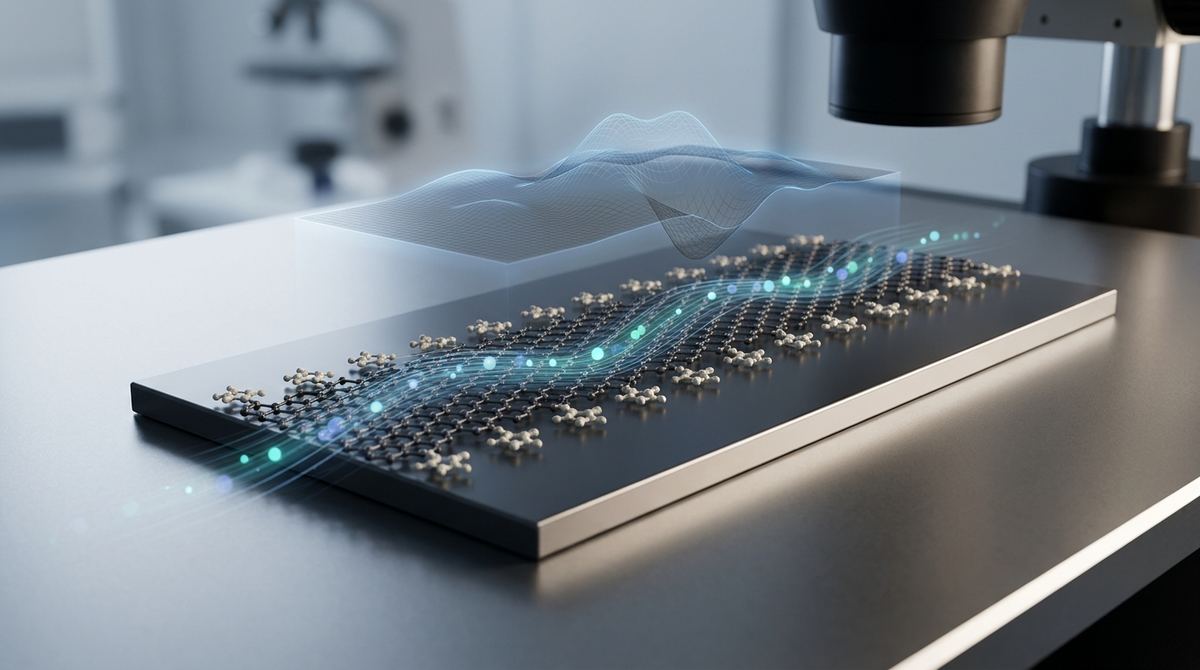
Imagine a world where every single component in your smartphone is so small that it is measured in individual atoms. In this microscopic realm, the rules of physics change, and even a tiny error in how two materials touch can decide whether a device works or fails. As we push toward the limits of how small a transistor can be, we face a massive hurdle: how do we connect these atomic-scale materials to the rest of the world without ruining their unique electrical properties? This is the frontier of nanoelectronics, and it is where the research conducted by Dominik Lüthi, Lin Yang, Xiuling Yu, Ji Ma, Xinliang Feng, Carlo A. Pignedoli, Roman Fasel, and Gabriela Borin Barin becomes vital. Their work tackles the delicate dance between carbon structures and organic molecules, seeking a way to control electricity with unprecedented precision.
The Problem This Research Is Solving
To build a modern computer, we need semiconductors. These are materials that can either allow electricity to flow or block it, acting like a tiny on-off switch. Graphene, a single layer of carbon atoms arranged in a hexagonal lattice, was once thought to be the perfect candidate for this. However, pristine graphene is actually a metal, meaning it always allows electricity to flow. To make it a semiconductor, we must strip it down into extremely narrow strips called graphene nanoribbons.
Once we turn graphene into a nanoribbon, everything changes. The edges of the ribbon become the most important part of the structure. If the edges are irregular or if the ribbon touches a substrate in a messy way, the electronic properties are ruined. Specifically, for 7-atom-wide armchair graphene nanoribbons, the electronic bandgap—the energy required to allow electricity to flow—is highly sensitive to how the ribbon interacts with its environment. If we try to attach traditional metal wires or thick coatings to these ribbons, we often destroy the very electronic properties we are trying to harness. We need a way to create a bridge between the nanoribbon and its environment that is chemically stable, electrically predictable, and structurally precise.
The Key Idea in Plain English
The researchers proposed a clever workaround using a specialized group of molecules called N-heterocyclic carbenes, or NHCs. Think of these molecules as a highly organized, ultra-thin layer of precision-engineered glue. Unlike traditional glues that might coat a surface thickly and unevenly, NHCs can form a single layer, just one molecule thick, on top of the graphene.
What makes this even more interesting is the concept of sparse intercalation. Instead of covering the entire graphene surface like a thick blanket, the NHC molecules can be introduced in a sparse, controlled manner. This allows the molecules to "intercalate," or tuck themselves into the interface between the graphene and the surface beneath it. This creates a bridge that allows electrons to move efficiently between the nanoribbon and the rest of the circuit, without overwhelming the ribbon's unique atomic structure. It is the difference between throwing a bucket of paint at a delicate sculpture and carefully applying a single, microscopic layer of protective lacquer.
How the Graphene-Based System Works
To understand how this works, we have to look at the chemistry of the armchair edge. In an armchair nanoribbon, the carbon atoms at the edge are arranged in a specific "chair-like" pattern. This geometry dictates how the electrons behave. When the NHC molecules are introduced, they don't just sit on top; they engage in interfacial coupling. This means the electronic clouds, or orbitals, of the NHC molecules overlap with the electronic clouds of the graphene.
This overlap is a two-way street of information and charge. The NHC molecules are strong electron donors, meaning they can push or pull electronic density to change how the graphene behaves. Because the molecules are arranged in a monolayer and can be spaced out sparsely, they do not create a chaotic mess of defects. Instead, they create a predictable, engineered interface. This precise coupling allows scientists to tune the electronic bandgap of the 7-atom-wide nanoribbon. By controlling how these molecules interact with the carbon lattice, the researchers can effectively fine-tune the electrical "on-off" switching capability of the ribbon.
What the Researchers Found
The investigation revealed that the interaction between the NHC monolayer and the 7-atom-wide armchair nanoribbons is not just a surface phenomenon, but a deep electronic coupling. The study showed that the NHCs can successfully intercalate at the interface, providing a stable and highly controlled way to modify the electronic landscape of the nanoribbons.
Crucially, the research demonstrated that this method of sparse intercalation avoids the pitfalls of traditional doping. In traditional doping, you might inject foreign atoms into a material to change its conductivity, but those atoms can drift around or create structural defects that slow down electrons. The NHC method, however, provides a structural and electronic stability that is much higher. The researchers observed that the interfacial coupling was robust enough to maintain the specific electronic signatures required for semiconducting behavior, while also providing the necessary connection to the environment. This means they have found a way to "talk" to the nanoribbon electronically without breaking it.
Why the Result Matters
This discovery is significant because it provides a blueprint for the next generation of nanoelectronics. As we approach the physical limits of silicon-based technology, we need new materials that can function at the atomic scale. Graphene nanoribbons are one of the most promising candidates, but they have been notoriously difficult to integrate into actual devices because of the interface problem.
By proving that NHC monolayers can provide stable and tunable interfacial coupling, this research moves us closer to a reality where we can manufacture atomic-scale transistors. The ability to tune the bandgap through molecular engineering rather than crude chemical doping is a game-changer. It suggests that we can build circuits where every single component is tuned with molecular precision, leading to devices that are faster, smaller, and consume significantly less power than current technology.
Limitations and What Still Needs Testing
While this research is a major step forward, it is important to distinguish between a successful laboratory proof-of-concept and a commercially ready product. The study focuses specifically on 7-atom-wide armchair nanoribbons. While these are perfect for fundamental research, the physics of a 10-atom or 20-atom ribbon might be different. We do not yet know if this specific NHC method scales easily to larger, more complex architectures.
Furthermore, there are questions regarding long-term stability. While the coupling is stable in a controlled laboratory environment, we need to know how these organic-inorganic interfaces behave over years of continuous operation in a consumer device, or under different temperature fluctuations. Additionally, the process of "sparse intercalation" must be perfected to ensure that the molecules are placed exactly where they are needed every single time, as even a slight misalignment could disrupt the nanoribbon's electronic performance.
Real-World Applications
The implications of this research reach far beyond the lab. In the near term, this technology could be applied to the development of highly sensitive chemical and biological sensors. Because the electronic properties of the nanoribbon are so sensitive to the molecules at its interface, even a single molecule of a specific toxin or virus could trigger a detectable change in electrical current.
In the long term, this could revolutionize computing. We could see the birth of ultra-low-power processors that require a fraction of the energy currently used by modern silicon chips. This is particularly important for the development of quantum computing components, where maintaining precise electronic states is vital. If we can use molecules to stabilize and tune the electronic properties of nanostructures, we may find new ways to create the stable qubits required for large-scale quantum computation.
If You Remember One Thing
If you take away only one detail from this complex study, let it be this: the future of electronics depends on the interface. We have mastered the ability to make materials, but we are still learning how to make them "talk" to each other at the atomic scale. The use of N-heterocyclic carbene monolayers offers a way to bridge that gap with surgical precision, potentially turning graphene nanoribbons into the building blocks of the next computational revolution.
FAQ
Question: What exactly is an armchair graphene nanoribbon?
Answer: A graphene nanoribbon is a very narrow strip of graphene, which is a single layer of carbon atoms. The term "armchair" refers to the specific way the carbon atoms are arranged along the edges of the strip, resembling the shape of an armchair. This specific geometry is crucial because it determines whether the ribbon acts like a metal or a semiconductor.
Question: Why are N-heterocyclic carbenes (NHCs) being used here?
Answer: NHCs are special organic molecules that can form very strong and stable bonds with surfaces. In this research, they act as a sophisticated interface layer. They allow scientists to connect the carbon nanoribbon to other materials in a way that is much more controlled and stable than traditional methods, allowing for the precise tuning of the ribbon's electronic properties.
Question: What is the difference between "intercalation" and just "coating" a material?
Answer: Coating usually implies covering the entire surface of a material with a layer of something else, which can sometimes block the material's natural properties. Intercalation is the process of inserting molecules into the spaces between layers or within the interface of a material. In this case, the molecules are "tucked" into the interface, allowing for a more delicate and precise interaction.
Question: Why does the width of the nanoribbon matter so much?
Answer: In the world of the very small, size dictates behavior. The width of a graphene nanoribbon determines its electronic bandgap, which is the "energy gap" that controls whether electricity can flow. A 7-atom-wide ribbon has a very specific electronic signature, and changing the width even slightly can completely change how the material behaves in a circuit.
Question: Is this technology going to be in my next phone?
Answer: It is too early to say. While this research is a massive breakthrough for scientific understanding, moving from a controlled laboratory setting to mass-producing billions of identical, atom-perfect devices is a monumental engineering challenge. This research provides the fundamental physics that will eventually lead to such consumer technologies.
Conclusion
The work of Lüthi, Yang, Yu, Ma, Feng, Pignedoli, Fasel, and Barin represents a significant leap in our ability to engineer the interfaces of the future. By using N-heterocyclic carbene monolayers to achieve precise interfacial coupling and sparse intercalation in 7-atom-wide armchair graphene nanoribbons, they have demonstrated a way to control the electronic properties of carbon at the most fundamental level. While challenges in scaling and long-term stability remain, the ability to tune the properties of nanostructures with molecular precision opens a new door for the next generation of ultra-fast, ultra-efficient electronics.