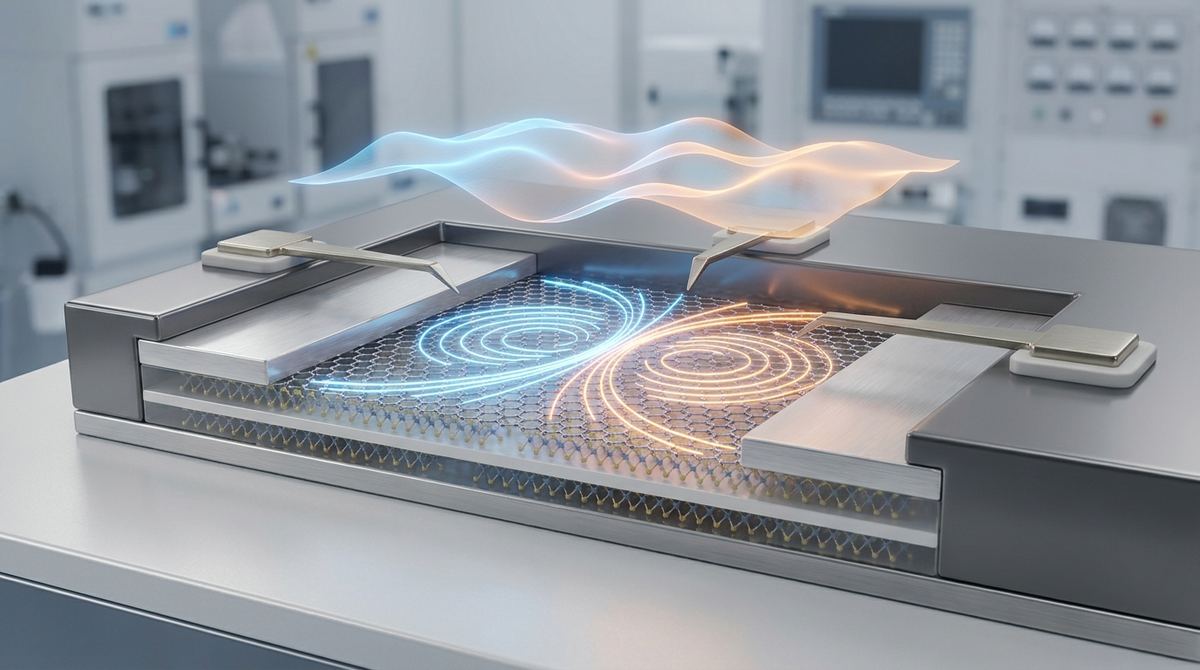
Imagine a computer that does not just use electricity to process information, but uses the intrinsic rotation of electrons to do so. This concept, known as spintronics, promises a future of devices that are faster, smaller, and consume significantly less power than the silicon-based electronics we use today. The challenge has always been how to control this electron spin with extreme precision without needing bulky magnets. Recent theoretical work has uncovered a way to achieve this by sandwiching graphene between specialized layers of matter, allowing us to switch the direction and pattern of electron spins simply by changing how the layers are stacked. This research, led by Juraj Mnich, Marko Milivojević, and Martin Gmitra, suggests a new pathway for designing the fundamental components of quantum information technology.
The Problem This Research Is Solving
Current electronic technology relies on the movement of charge. When we use a computer, we are essentially moving electrons from one point to another through a semiconductor. This movement inevitably generates heat due to electrical resistance, which limits how small and how fast we can make chips. As we approach the physical limits of silicon, the heat generated by these moving charges becomes a barrier to further advancement. Furthermore, charge-based memory is volatile, meaning it requires constant power to maintain its state.
Spintronics offers a solution by using the spin degree of freedom. Since an electron spin can be thought of as a tiny, built-in magnet, we can represent binary data (zeros and ones) by the direction of that spin. If we can control these spins efficiently, we can create memory and logic that are incredibly fast and consume almost no power. However, graphene, the superstar of the materials world, is actually quite poor at this on its own. While graphene has exceptional conductivity, it has very low spin-orbit coupling, which is the physical interaction required to manipulate an electron's spin using an electric field. Without strong spin-orbit coupling, graphene is like a high-speed highway where the drivers have no steering wheels; the electrons move fast, but we cannot direct their spin.
The Key Idea in Plain English
The researchers' solution is to use a technique called proximity-induced spin-orbit coupling. Instead of relying on graphene to do the heavy lifting, they sandwich a single layer of graphene between layers of a material called 1T-TaS2. This material is a transition metal dichalcogenide, which is known for having very strong and complex electronic properties. By placing graphene in such close contact with 1T-TaS2, the electrons in the graphene start to "feel" the intense electronic environment of the surrounding material.
This interaction effectively "borrows" the spin-orbit coupling from the TaS2 and imports it into the graphene. This process breaks the symmetry of the environment surrounding the carbon atoms. In the quantum world, when you break symmetry, you create new possibilities for how particles behave. In this specific setup, the researchers found that by slightly shifting the way the layers are stacked on top of one another, they can fundamentally change the magnetic landscape that the electrons experience. This allows them to switch between a radial field, where spins point outward like spokes on a wheel, and a more stable, persistent texture.
How the Graphene-Based System Works
To understand how this works, we must look at the atomic architecture of the system. Graphene is a two-dimensional lattice of carbon atoms arranged in a hexagonal pattern. On its own, the environment around each carbon atom is highly symmetric, meaning the spin of an electron stays relatively undisturbed as it moves. However, when we introduce the 1T-TaS2 monolayer, we introduce a heavy element—tantalum—into the neighborhood. Tantalum is a much heavier atom than carbon, and in physics, heavier atoms generally produce much stronger spin-orbit coupling.
The interaction occurs at the interface. As the carbon atoms in the graphene lattice sit atop the sulfur atoms of the TaS2, their electron orbitals begin to overlap. This overlap is the engine of the Rashba effect. The Rashba effect is a phenomenon where an electric field perpendicular to the plane of a two-dimensional material creates an effective magnetic field that acts on the electron's spin. Because the 1T-TaS2 layer provides a strong, asymmetrical electric environment, the electrons in the graphene suddenly find themselves moving through a powerful, invisible magnetic field that is tied to their own momentum.
The magic happens when we consider the stacking order. The way the hexagonal lattice of graphene aligns with the lattice of the 1T-TaS2 determines the symmetry of the resulting electric field. If the layers are aligned in one way, the electric field creates a radial Rashba field. This means that as an electron moves through the graphene, its spin is forced to orient itself in a specific direction relative to its direction of travel, creating a pattern that looks like a starburst or a wheel of spokes. If the stacking is changed, the symmetry of the field changes, resulting in persistent spin textures. These textures are special because they are mathematically "protected" by the way the electrons interact with each other, meaning they are less likely to be disrupted by accidents or defects in the material.
What the Researchers Found
The work by Juraj Mnich, Marko Milivojević, and Martin Gmitra reveals that this stacking-induced switching is not just a minor tweak, but a fundamental transformation of the electron's behavior. They discovered that the system can transition between two distinct states. In the first state, the radial Rashba field dominates. Here, the spin direction is strictly coupled to the momentum of the electron. This is useful because it allows for high-speed manipulation of spins using electric gates.
The second state, which they describe as having persistent spin textures, is much more intriguing for long-term stability. In this state, the spin configuration becomes robust against certain types of scattering. In traditional electronics, when an electron hits a defect or an impurity, it scatters, which leads to heat and loss of information. However, when the spin texture is "persistent" and "correlation-protected," the electron can move through the material without its spin information being lost. The term "correlation-protected" refers to the fact that the strong interactions between electrons themselves help stabilize these spin patterns, making them resilient to the chaotic noise of the microscopic world. This ability to switch between a highly controllable state and a highly stable state by simply adjusting the stacking geometry is the core breakthrough of the study.
Why the Result Matters
This research is significant because it solves one of the primary contradictions in spintronics: the trade-off between controllability and stability. In most materials, if you make the spin-orbit coupling very strong to allow for fast control, you also make the spin very unstable because it is easily knocked out of alignment by external noise. Conversely, if you make the system very stable, it becomes difficult to change the spin state, making it useless for active computation.
By using the graphene-TaS2 interface, researchers have found a way to have both. The ability to switch between these states through stacking suggests that we could create "reconfigurable" spintronic components. Instead of having a chip that can only do one thing, we could potentially have a chip where the very nature of the electron's spin behavior can be toggled. This could lead to a new class of logic gates that are much more efficient than current transistors. It also provides a blueprint for how to engineer "topological" protection in two-dimensional materials, which is a cornerstone of the next revolution in physics.
Limitations and What Still Needs Testing
While these findings are theoretically profound, it is important to note that this research is currently in the fundamental physics stage. The study describes a highly controlled, idealized model of how these layers should behave. Translating this from a mathematical model to a physical device is a massive engineering challenge.
One of the primary hurdles is the precision of fabrication. To achieve the specific stacking orders required to switch between these states, engineers must be able to place monolayers of 1T-TaS2 onto graphene with atomic-scale precision. Any misalignment or presence of impurities at the interface could destroy the delicate spin textures the researchers have described. Furthermore, many of these exotic quantum effects are most pronounced at extremely low temperatures, near absolute zero. For these technologies to be useful in your smartphone or laptop, the effects must be made to work at room temperature, which is a hurdle that has not yet been cleared. Finally, the study focuses on a single interface, but a real computer chip requires millions of these interfaces to work in perfect harmony without interference.
Real-World Applications
If the challenges of fabrication and temperature can be overcome, the applications for this technology are vast. The most immediate application would be in non-volatile spintronic memory. Imagine a hard drive that is as fast as your computer's RAM but retains all its data without needing any power, even when the device is turned off. This would lead to "instant-on" computers that consume almost zero power when in standby mode.
Beyond memory, this research paves the way for advanced quantum computing components. The persistent spin textures and correlation-protected states described by Mnich, Milivojević, and Gmitra are essentially the building blocks for qubits—the fundamental units of quantum information. If we can use spin textures to protect quantum information from decoherence (the loss of quantum state due to environmental noise), we move much closer to building large-scale, fault-tolerant quantum computers. Additionally, ultra-low-power logic circuits that use spin switching instead of charge current could revolutionize the energy efficiency of massive data centers, which currently consume a significant portion of the world's electricity.
If You Remember One Thing
If you remember only one thing from this research, let it be this: by sandwiching graphene between other materials, we can transform it from a simple conductor into a sophisticated playground for controlling electron spins, offering a way to switch between high-speed control and high-stability memory through the simple act of changing how the layers are stacked.
FAQ
How does graphene become a spintronic material if it has low spin-orbit coupling?
Graphene is naturally quite "quiet" regarding spin because its carbon atoms are light and its structure is very symmetric. To make it useful for spintronics, we use the "proximity effect." By placing it against a heavier material like 1T-TaS2, the electrons in the graphene start to feel the heavy-atom physics of the neighbor. This effectively "borrows" the necessary forces to control the spin without changing the carbon atoms themselves.
What is the difference between a radial Rashba field and a persistent spin texture?
A radial Rashba field is a specific pattern where the electron's spin direction is tied to its direction of movement, much like the spokes on a bicycle wheel. A persistent spin texture is a more stable, robust arrangement of spins that is protected by the way electrons interact with one another. Essentially, one is a pattern that is easy to manipulate, while the other is a pattern that is hard to break.
Why is "stacking" such an important variable in this research?
In the world of two-dimensional materials, the way one layer sits on top of another determines the symmetry of the electrical environment. Because the spin-orbit coupling is so sensitive to symmetry, even a tiny shift in how the atoms align can completely change whether the electron behaves according to a radial field or a stable, persistent texture.
Does this research mean we will have spin-based computers next year?
No, there is still a significant gap between theoretical physics and commercial engineering. We currently face massive challenges in manufacturing these layers with atomic precision and ensuring they work at room temperature rather than in a specialized laboratory freezer. This is fundamental research that sets the stage for technology that may arrive in a decade or more.
What are the benefits of "correlation-protected" states?
In standard electronics, electrons bump into things and lose their energy and information, creating heat. A correlation-protected state means that the interactions between electrons actually help stabilize the spin pattern. This makes the system much more resistant to errors and noise, which is essential for both reliable computing and quantum information processing.
Conclusion
The work of Juraj Mnich, Marko Milivojević, and Martin Gmitra represents a significant step forward in our ability to engineer the quantum properties of materials. By moving beyond simple conductivity and exploring the complex interplay of spin, symmetry, and stacking, they have identified a way to control the fundamental behavior of electrons with unprecedented precision. While the path from these theoretical breakthroughs to a consumer-ready spintronic chip is long and filled with engineering hurdles, the potential for a new era of low-power, high-speed, and stable quantum-ready electronics is a goal worth pursuing. As we continue to master the art of the atomic sandwich, the boundary between theoretical physics and practical computing continues to blur.