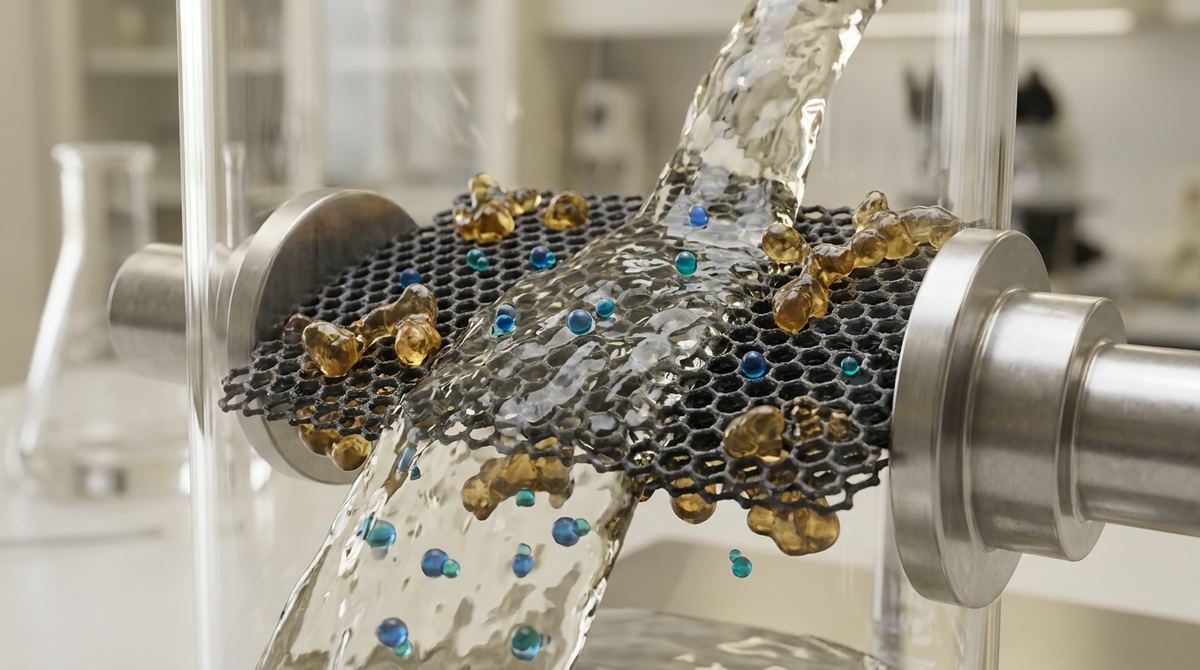
Imagine a straw so thin that it is only a few atoms wide. In our everyday world, pushing liquid through such a tiny opening would be incredibly difficult, requiring massive pressure to overcome the friction of the liquid rubbing against the walls of the straw. However, at the scale of nanotechnology, the rules of physics shift. At this microscopic level, the very chemistry of the straw's surface can determine whether water glides through with almost zero resistance or gets stuck like honey. This phenomenon is the key to a future where we can desalinate ocean water or filter toxins with minimal energy. Recent computational studies are unraveling these mysteries, providing a blueprint for how we might engineer the next generation of ultra-efficient filters. This complex field of study was explored in detail by Elizane E. de Moraes, João Victor Lemos Valle, Bruno H. S. Mendonça, Ernane de Freitas Martins, Hélio Chacham, and Pablo Ordejón, who used advanced simulations to peer into the molecular dance between water and the tiny channels that define modern nanofluidics.
The Problem This Research Is Solving
The world is currently facing a dual crisis: a growing scarcity of fresh water and an increasing demand for energy to process it. Most of the Earth's water is salt water, and current methods of making it drinkable, such as reverse osmosis, are extremely energy-intensive. These systems work by forcing water through semi-permeable membranes under immense pressure. This pressure is required primarily to overcome the resistance created when water molecules interact with the membrane material. If we could design membranes that allow water to pass through much more easily, we could drastically reduce the energy footprint of global water treatment.
The challenge lies in the sheer complexity of the interface between the water and the material. When water encounters a tiny opening, or a nanopore, it is not just a continuous liquid moving through a hole. At that scale, the water behaves as a collection of individual molecules with specific electrical properties. The way these molecules interact with the walls of the pore determines the flow rate. If the walls of the pore are chemically "sticky" to water, the fluid slows down significantly. If the walls are "slippery," the flow can be much faster. Scientists are struggling to predict exactly how different chemical environments—specifically whether a surface is polar or non-polar—will affect this flow across different pore shapes and sizes. Without precise predictions, engineers are essentially guessing when they try to build these materials, which leads to inefficient designs and wasted energy.
The Key Idea in Plain English
To understand this research, you must understand the concept of polarity. Many molecules, including water, have a "dipole moment." This means that even though a water molecule is neutral overall, it has a tiny positive charge on one side and a tiny negative charge on the other. It acts like a microscopic magnet. A "polar" surface is one that also has these electrical charges on its surface, which allows it to create an attraction or a repulsion with the water molecules. A "non-polar" surface is chemically neutral and does not have these electrical charges, meaning it has very little interest in interacting with the water molecules.
Think of a slide at a playground. A non-polar surface is like a slide made of polished ice. When you sit on it, there is very little friction, and you slide down effortlessly. A polar surface, however, is like a slide covered in Velcro. As you try to move, the tiny hooks on the Velcro catch on your clothes, creating friction and slowing you down. In the world of nanopores, if we want water to move through a filter as fast as possible, we want a "slippery" non-polar surface. If we want to control or slow the flow, we might design a polar surface. The research aims to map out exactly how much "stickiness" or "slipperiness" is created by different chemical compositions, allowing us to design the perfect "slide" for water molecules.
How the Graphene-Based System Works
The researchers utilized multiscale simulations to study these interactions, a method that is essential when dealing with things as small as a single atom. At the smallest level, you have molecular dynamics simulations. These simulations track the position and momentum of every single atom and molecule over time using classical physics equations. This allows scientists to see exactly how a water molecule rotates, vibrates, and interacts with the atoms of a nanopore wall. It reveals the "molecular friction" that occurs at the interface.
However, molecular dynamics is computationally expensive and can only simulate very small areas for a very short amount of time. To make these findings useful for real-world engineering, scientists use a multiscale approach. This means they take the data gathered from the atomistic level and use it to inform larger-scale models, such as continuum fluid dynamics. Continuum models treat water as a continuous fluid rather than individual particles, which is much faster to calculate but loses the fine details of molecular behavior. By bridging these two scales, the researchers can predict how the behavior of a single water molecule near a pore wall eventually affects the total flow of a large volume of water through a membrane. The focus on graphene-based systems is particularly important because graphene is a single layer of carbon atoms that is incredibly strong, impermeable to most substances, and highly customizable through chemical modification, making it an ideal candidate for creating these advanced nanoporous structures.
What the Researchers Found
The simulations provided deep insights into how the chemical nature of a nanopore dictates fluid transport. One of the most significant findings involves how the polarity of the pore walls affects the "slip length" of the fluid. In a standard macroscopic pipe, we assume a "no-slip" condition, meaning the layer of water touching the wall moves at the same speed as the wall itself. However, in a nanopore, the water can "slip" along the surface. The research demonstrated that non-polar surfaces significantly enhance this slip effect. Because the non-polar walls do not exert a strong electrostatic pull on the water molecules, the water maintains its momentum, moving through the pore with much less resistance than classical physics would predict.
Conversely, the researchers found that polar surfaces create a much more complex environment. The electrical charges on a polar surface interact with the dipole moment of the water molecules, creating a structured layer of water at the interface. This is often called a hydration shell or a structured hydration layer. Instead of sliding, the water molecules become somewhat ordered or "locked" into position near the walls. This ordering creates a significant amount of internal friction, effectively increasing the viscosity of the fluid within the pore. The study showed that the shape of the pore also plays a critical role; the curvature of the walls and the diameter of the opening change how these electrical forces are distributed, meaning that the interaction between polarity and flow is not just a matter of "sticky vs. slippery," but a complex relationship involving the geometry of the channel itself.
Why the Result Matters
The ability to predict these interactions is a game-changer for materials science and chemical engineering. For the desalination industry, this research suggests a path toward membranes that require a fraction of the current energy to operate. If we can engineer graphene or other two-dimensional materials to have non-polar interiors, we can create high-flux filters that allow water to pass through at incredible speeds while still blocking salt ions.
Furthermore, this research has profound implications for the field of biosensing. In medical diagnostics, scientists often use nanopores to detect the presence of specific DNA sequences or proteins. As a single molecule passes through a nanopore, it creates a tiny change in the electrical current flowing through the pore. If we understand exactly how the surface chemistry of that pore affects the flow and the arrangement of water molecules, we can build much more sensitive sensors. These sensors could potentially detect diseases or genetic markers much earlier and with much higher accuracy than current technologies. The research essentially provides the mathematical and physical framework needed to move from "observing" nanopores to "designing" them with precision.
Limitations and What Still Needs Testing
While these simulation-based insights are incredibly powerful, it is important to recognize that they are models of reality, not reality itself. Simulations are conducted under highly controlled, idealized conditions. In a laboratory or an industrial setting, membranes are rarely perfect. They may have structural defects, uneven surface coatings, or varying pore sizes that a simulation might not fully capture. Additionally, real-world water is not pure; it contains various salts, organic matter, and biological contaminants that can foul the surface of a membrane.
The interaction between these contaminants and the nanopore walls adds another layer of complexity that current simulations struggle to model comprehensively. There is also the challenge of scalability. While it is one thing to simulate a single nanopore in a computer, it is a much larger engineering challenge to manufacture trillions of these pores in a perfectly uniform way across a large membrane area. Future research must bridge the gap between the "perfect" models used in these simulations and the "messy" reality of industrial manufacturing and complex fluid environments.
Real-World Applications
The practical implications of understanding nanopore flow are vast and reach into several critical sectors. In the realm of environmental engineering, the most immediate application is in advanced water purification systems. We are looking at the potential for highly efficient desalination plants that can provide fresh water to arid regions with significantly lower carbon footprints.
In the field of biotechnology, we see the potential for "lab-on-a-chip" devices. These are tiny, portable devices that can perform complex medical tests using just a single drop of blood. By using nanopores designed with specific polarities, these devices could detect individual molecules with extreme precision, enabling rapid, at-home testing for various health conditions.
Furthermore, there is the emerging field of osmotic energy harvesting. As the ocean meets rivers, there is a difference in salt concentration that creates osmotic pressure. If we can use engineered nanoporous membranes to harness this pressure, we could potentially capture clean, renewable energy from the natural movement of water. This research provides the foundational physics required to design the membranes that would make such energy harvesting commercially viable.
If You Remember One Thing
If you take only one concept from this research, let it be this: at the nanoscale, the chemical identity of a surface is just as important as its physical shape. The way a surface interacts with the electrical charges of a molecule determines whether a fluid will glide through with ease or struggle against immense friction.
FAQ
What exactly is a nanopore?
A nanopore is an extremely small opening or channel, often measuring only a few nanometers in diameter. To give you a sense of scale, a nanometer is one-billionth of a meter. These pores are so small that they are roughly the size of individual atoms or small molecules, making them perfect for filtering out specific substances or sensing individual biological molecules.
Why does the polarity of a surface change how water flows?
Water molecules are polar, meaning they have a positive and a negative side. When a surface is also polar, it creates an electrostatic attraction or repulsion with the water. This interaction causes the water molecules to "stick" or arrange themselves in a specific way against the wall, which creates friction and slows down the flow. Non-polar surfaces do not have this charge, so the water does not "stick" and can slide through much more easily.
How do scientists study something so small?
Since nanopores are too small to see with even the most powerful traditional microscopes, scientists use computer simulations. Methods like molecular dynamics allow researchers to simulate the movements and interactions of every single atom. This provides a level of detail that is impossible to capture in a physical laboratory, allowing us to test different chemical scenarios virtually.
Is this research going to result in immediate changes to water filters?
Not immediately. This research is foundational science, meaning it provides the "rules" that engineers will use to design future technology. Moving from a computer simulation to a mass-produced, industrial-scale membrane is a long process involving material science, manufacturing engineering, and rigorous real-world testing to ensure the filters work in messy, non-ideal conditions.
Can this technology be used to generate electricity?
Yes, it is a theoretical possibility. There is a concept called osmotic power, which involves capturing the energy created by the difference in salt concentration between fresh and salt water. By using highly efficient nanoporous membranes, we could potentially capture this energy and convert it into electricity, providing a new source of renewable energy.
Conclusion
The journey from understanding a single water molecule to designing a global desalination solution is a massive one, but it begins with the microscopic details explored by researchers like de Moraes, Valle, Mendonça, Martins, Chacham, and Ordejón. By uncovering the complex relationship between surface polarity and fluid dynamics, these multiscale simulations have provided the roadmap for a new era of nanofluidics. As we learn to master the "stickiness" of the nanoscale, we move closer to a world of limitless clean water and ultra-precise medical diagnostics, turning the challenges of fluid friction into the tools of technological revolution.