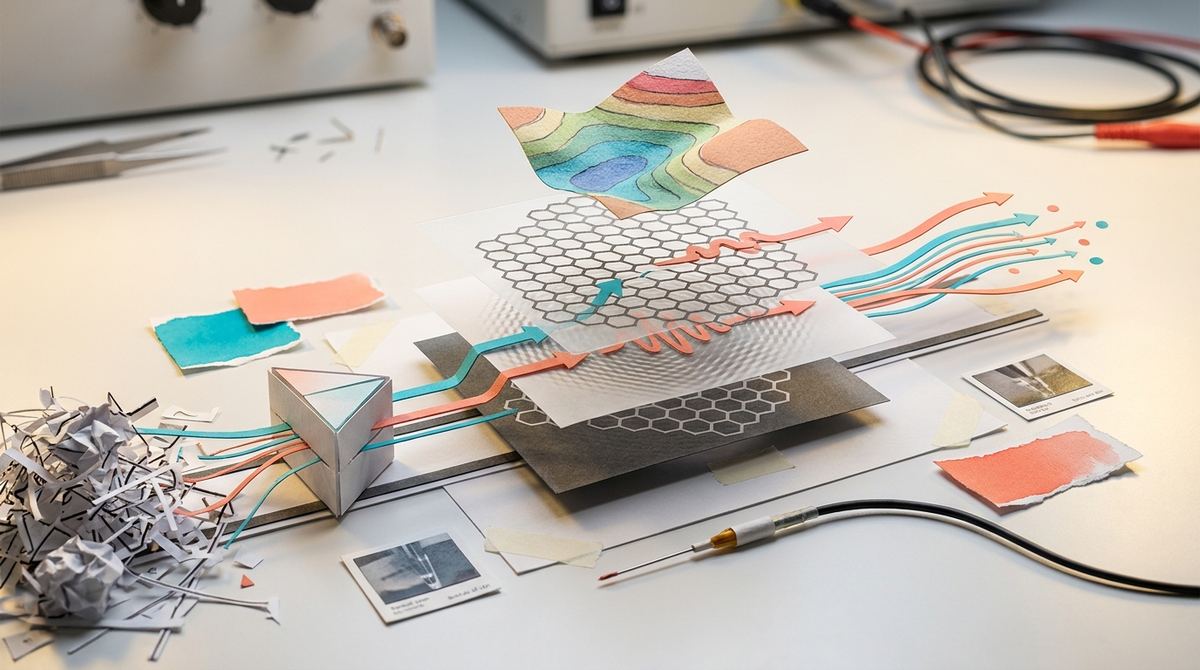
Imagine you are trying to map out the movement of a crowd in a massive stadium, but instead of people walking in straight lines, everyone is moving in swirling, overlapping patterns that never quite repeat. If you tried to track every single person individually to understand the flow of the crowd, you would quickly run out of paper and time. This is precisely the nightmare faced by physicists trying to understand new, ultra-thin materials like trilayer graphene. When layers of carbon are stacked and twisted at specific angles, they create complex interference patterns called moiré patterns. These patterns change how electrons move, potentially leading to revolutionary technologies like super-fast computers or lossless power lines. However, when those layers are twisted in ways that do not align perfectly, the patterns become so chaotic that traditional computer models break down. In a recent study, researchers Ken Beard and Daniel Massatt introduced a new mathematical way to look at these materials, shifting the perspective from tracking individual atoms to analyzing the underlying patterns of energy, a move that could unlock the secrets of the next generation of quantum electronics.
The Problem This Research Is Solving
To understand why this research is necessary, one must understand the concept of periodicity in physics. Most crystals, like the silicon used in your smartphone, are periodic. This means the arrangement of atoms repeats itself perfectly every few angstroms. Because of this repetition, mathematicians can use a shortcut called Bloch's Theorem. This theorem allows them to study a tiny "unit cell" of the crystal and know that the results apply to the entire, infinite material. It makes the math manageable.
However, when we stack layers of graphene—a single layer of carbon atoms—and twist them, we break this perfect repetition. If the twist angle is a simple fraction, we can still find a repeating pattern, though the "unit cell" might become very large. But if the rotation between layers is "incommensurate," meaning the atoms of one layer never align with the atoms of the next in a repeating cycle, the pattern never repeats. It is quasi-periodic. In a trilayer system with "double-incommensurability," you have two different layers that both fail to align with the others in a predictable way.
For a computer, this is a catastrophe. To simulate such a system using standard methods, the computer would have to create a "supercell" so massive that it would exceed the memory of even the most powerful supercomputers. This is the wall that materials scientists have been hitting. Without a way to simulate these double-incommensurate structures, we are essentially flying blind, unable to predict how these materials will behave before we spend millions of dollars trying to manufacture them in a lab.
The Key Idea in Plain English
The breakthrough provided by Ken Beard and Daniel Massatt involves a fundamental shift in how we look at the material. Instead of looking at the "Real Space"—the physical location of every single carbon atom—they turned their attention to "Momentum Space," also known as k-space.
Think of it this way: if you are looking at a chaotic, swirling crowd, "Real Space" is trying to track the exact coordinates of every person at every second. "Momentum Space" is like looking at the crowd through a prism that breaks the movement down into its individual frequencies. Instead of asking where a person is, you ask, "how fast is the crowd moving in this direction?" or "what is the wavelength of this wave of people?"
By moving the problem into momentum space, the researchers can bypass the need to map out an infinite number of atoms. Instead of dealing with the messy, non-repeating physical layout, they can deal with the waves that the electrons make. This mathematical pivot allows them to handle the complexity of incommensurability by focusing on the momentum of the electrons rather than the physical position of the atoms.
How the Graphene-Based System Works
To visualize how this works, we have to look at the structure of trilayer graphene. Graphene is a single sheet of carbon atoms arranged in a hexagonal lattice. When you stack three of these sheets, the electronic properties are determined by how the electrons move between the layers. If the sheets were perfectly aligned, the electrons would move through the stack quite easily.
When you introduce a twist, you create a moiré pattern. This pattern acts like a new landscape for the electrons. The electrons don't just see the carbon atoms; they see the "hills and valleys" created by the overlapping layers. In a double-incommensurate trilayer system, these hills and valleys are incredibly complex and never repeat. This creates a unique electronic environment where electrons can become localized—meaning they get stuck in certain areas—or they can exhibit strange quantum behaviors.
The algorithm works by calculating the electronic structure directly in the momentum space. The researchers use mathematical tools from numerical analysis to solve the equations that describe these electron waves. Because they are working with waves (momentum) rather than discrete points (atoms), they can account for the quasi-periodic nature of the double-incommensurate structure without needing a massive, repeating supercell. This allows for a much more efficient calculation of the energy levels, or the "band structure," which tells us whether the material will behave as a metal, a semiconductor, or a superconductor.
What the Researchers Found
The primary achievement of this work is the development of a robust mathematical framework that can handle the most difficult configurations of trilayer graphene. The researchers demonstrated that their momentum space algorithm can accurately capture the electronic structure of these double-incommensurate systems where traditional methods fail.
Specifically, the algorithm allows for the calculation of the density of states, which is a map of how many electronic states are available at different energy levels. In the context of graphene, the density of states is the "smoking gun" for discovering new physical phenomena. For example, if the density of states shows a sudden spike at zero energy, it is a strong indicator that the material might become a superconductor.
By successfully applying this algorithm to complex trilayer configurations, Beard and Massatt have provided a tool that can explore "twistronics"—the field of controlling electronic properties by twisting layers—at a much higher resolution and with much less computational cost than previously possible. They have essentially built a high-powered microscope made of math, allowing scientists to see the electronic landscape of materials that were previously too complex to model.
Why the Result Matters
The implications of this research are profound for the field of condensed matter physics. The ability to accurately simulate these materials is the bridge between theoretical physics and practical engineering.
First, it enables the discovery of new phases of matter. We know that twisted bilayer graphene can lead to superconductivity, where electricity flows with zero resistance. However, we don't yet know if trilayer or even quadruply-layered systems can produce even more exotic states, such as topological insulators or non-Abelian anyons, which are essential for topological quantum computing. This algorithm allows scientists to "screen" these materials mathematically.
Second, it optimizes material design. Currently, finding the right "magic angle" for a twist requires painstaking experimentation in a laboratory. You might try an angle of 1.1 degrees, then 1.15, then 1.12, hoping to find the sweet spot. With this momentum space algorithm, engineers can simulate a wide range of angles and configurations to find the exact one that produces the desired conductivity or magnetism before a single atom is ever placed in a lab. This significantly accelerates the cycle of material discovery.
Limitations and What Still Needs Testing
While this research represents a significant leap forward, it is important to distinguish between a mathematical tool and a physical product. The work by Beard and Massatt is a methodological advancement in numerical analysis and condensed matter physics. It provides the *means* to study these materials, but it does not automatically mean we can manufacture them.
One major limitation is the complexity of real-world interactions. Most algorithms, including this one, must make certain simplifications to remain computationally efficient. In a real-world laboratory setting, factors like thermal fluctuations, substrate interference, and structural defects (missing atoms or wrinkles in the graphene) can drastically change how the material behaves. While the algorithm is excellent at solving the "ideal" mathematical model, the transition from an ideal model to a messy, real-world device remains a significant hurdle.
Furthermore, while the algorithm handles the complexity of incommensurability, the computational cost still scales with the complexity of the interactions being modeled. As we move toward even more complex systems, such as multi-layer systems with multiple different twist angles, the mathematical intensity will continue to rise, requiring even more sophisticated algorithmic refinements.
Real-World Applications
The long-term engineering relevance of this research is found in the realm of "twistronics" and quantum technologies.
In the field of quantum computing, the goal is to create "qubits" that are highly stable and resistant to error. Certain electronic states in twisted graphene, specifically topological states, are thought to be perfect candidates for qubits because their properties are protected by the geometry of the material itself. By using this momentum space algorithm, researchers can design the exact twist configurations required to create these stable quantum states.
In the realm of traditional electronics, this could lead to the development of new types of transistors. Current silicon-based transistors are reaching their physical limits as they get smaller. Graphene-based electronics, which rely on the movement of electrons through these moiré patterns, offer a way to create devices that are faster and consume significantly less power. If we can use algorithms to predict exactly how to tune the conductivity of a trilayer graphene device, we could create a new class of "tunable" electronics that can be adjusted via an electrical gate, making them incredibly efficient.
If You Remember One Thing
If you take away only one point from this research, let it be this: the ability to accurately simulate complex, non-repeating materials through momentum-space algorithms is the key to unlocking the next generation of quantum and electronic technologies.
FAQ
What is the difference between real space and momentum space?
In real space, we look at the physical location of every atom in a material, which is difficult if the material is very large or never repeats. In momentum space, we look at the waves and frequencies of the electrons moving through the material. This is often a much simpler way to describe how a material behaves if the atoms themselves are arranged in a complex or non-repeating way.
Why does "incommensurability" make things so difficult for computers?
Computers are very good at solving problems that repeat themselves. In a standard crystal, the pattern repeats every few atoms, so the computer only has to solve a tiny piece of the puzzle. In an incommensurate material, the pattern never repeats. This means the computer thinks it has to solve an infinitely large puzzle, which quickly uses up all the computer's memory and processing power.
What is trilayer graphene and why twist it?
Graphene is a single layer of carbon atoms. Trilayer graphene is three of these layers stacked on top of each other. By twisting these layers relative to one another, we create moiré patterns—interference patterns that change how electrons move. This "twisting" allows us to control the electrical properties of the material, which is the core concept of a field called twistronics.
Will this research lead to faster computers immediately?
Not immediately. This research is a mathematical and computational breakthrough. It provides the tools that scientists and engineers need to design new materials. It is like inventing a new type of advanced blueprint; it doesn't build the house, but it makes it possible to design much more complex and efficient houses than we ever could before.
What are the potential benefits of using graphene in electronics?
Graphene is incredibly thin, strong, and has excellent electrical properties. Unlike silicon, which is limited by how small its components can get before they leak electricity, graphene-based systems could potentially operate at much higher speeds and with much lower power consumption. This could lead to everything from faster processors to more efficient sensors and quantum computers.
Conclusion
The work of Ken Beard and Daniel Massatt marks a vital step in our ability to master the complexities of the quantum world. By moving the mathematical focus from the physical location of atoms to the momentum of electron waves, they have provided a way to bypass the computational "wall" created by incommensurate structures. As we move toward a future defined by quantum computing and ultra-efficient electronics, the ability to simulate and predict the behavior of these sophisticated, twisted materials will be the difference between trial-and-error experimentation and precise, efficient engineering.