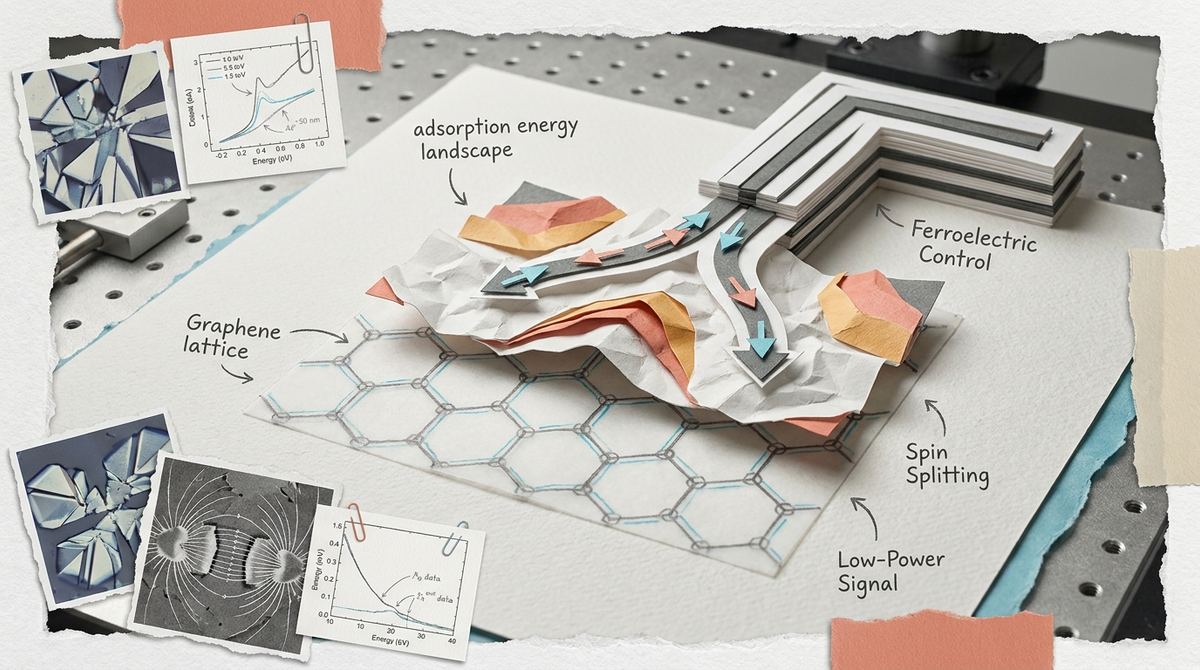
The modern digital revolution is hitting a physical wall. As we attempt to make computers faster and smaller, we are running into a fundamental problem: heat. Every time an electron moves through a traditional silicon chip, it encounters resistance, converting electrical energy into heat. This thermal energy is why your laptop gets hot and why data centers require massive cooling systems. The future of computing lies in a concept called spintronics, which uses the intrinsic spin of an electron rather than its electrical charge to store and process information. By manipulating spin, we could theoretically create devices that generate almost no heat and operate at incredible speeds. However, controlling magnetism usually requires magnetic fields, which are bulky and difficult to scale down to the atomic level. A recent theoretical breakthrough has proposed a way to bypass this by using electricity instead of magnetism. By combining ferroelectricity—the ability of a material to hold an electric charge—with antiferromagnetism, scientists believe they can control the fundamental properties of electron spin using only electric voltages.
The Problem This Research Is Solving
The core challenge in the field of spintronics is the efficiency of control. In traditional magnetic memory, such as the hard drives in current computers, we use magnetic fields to flip the direction of magnetic moments. While effective, magnetic fields are difficult to confine to the tiny spaces required for modern nanotechnology. As transistors and memory cells shrink toward the scale of a few nanometers, the magnetic fields used to control them can interfere with neighboring cells, leading to data corruption and extreme energy inefficiency.
Furthermore, the industry is looking toward antiferromagnets as the ultimate solution for high-speed computing. Unlike ferromagnets, which have a net magnetic moment that creates an external magnetic field, antiferromagnets have magnetic moments that cancel each other out. This makes them "invisible" to outside magnetic interference, allowing for much denser packing of components. However, because they have no net magnetism, antiferromagnets are notoriously difficult to manipulate. They do not respond to standard magnetic control methods in the same way ferromagnets do. This creates a massive engineering gap: we have the ideal magnetic material for the next generation of computers, but we lack an efficient, scalable way to talk to it.
The Key Idea in Plain English
The research addresses this gap by proposing a marriage between two different physical phenomena: ferroelectricity and antiferromagnetism. Ferroelectricity is a property where certain materials maintain an internal electric polarization. This means that if you apply an electric field, you can physically shift the ions within the crystal structure, creating a lasting change in the material's electrical state.
The breakthrough idea proposed by the researchers is that this physical shifting of atoms can be used to manipulate the spin of electrons. When the atoms in an antiferromagnetic material are shifted by an electric field, the symmetry of the crystal is broken. This broken symmetry changes how the electrons move through the lattice, specifically affecting how their spin interacts with their orbital motion. This interaction, known as spin-orbit coupling, can cause the energy levels of the electron spins to split. When these energy levels are split, the material gains a new property that can be toggled on or off with a simple voltage. This would allow us to control the magnetic state of an antiferromagnet using nothing but an electric field, essentially giving us a way to "write" data with electricity rather than magnetism.
How the Graphene-Based System Works
While the specific theoretical framework focuses on antiferromagnetic crystal lattices, the implications for high-performance interfaces—such as those found in graphene-based heterostructures—are profound. To understand the mechanism, we must look at the relationship between crystal symmetry and electron energy.
In a perfectly symmetric crystal, the environment for an electron spinning "up" is identical to the environment for an electron spinning "down." Because the environments are identical, the energy required to exist in either state is the same. This is what we call degenerate energy levels. However, when a material becomes ferroelectric, the ions within the crystal lattice undergo a displacement. This displacement breaks the inversion symmetry of the crystal.
Once inversion symmetry is broken, the electron's orbital motion and its spin become coupled through the spin-orbit interaction. This coupling creates a relativistic effect where the electron feels an effective magnetic field caused by its own movement through the electric field of the atoms. This effective field is not a real magnetic field, but it acts like one on the spin of the electron. Consequently, the energy levels of the spin-up and spin-down electrons are no longer the same. They split. This is the "spin splitting" described in the research. By using an external electric field to control the ferroelectric polarization, we can control the degree and direction of this splitting. This provides a direct, electrical lever to control the spin-based properties of the material.
What the Researchers Found
In their theoretical investigation, Zhihao Dai, Yingwei Chen, Junyi Ji, Chaoyu He, and Hongjun Xiang established a general mathematical framework for this phenomenon. Their work is significant because it is not limited to one specific, rare material. Instead, they have provided a universal theory that applies to a wide class of collinear antiferromagnets.
The researchers demonstrated that the magnitude and nature of the spin splitting are directly tied to the electric polarization of the ferroelectric component. Specifically, they found that the breaking of inversion symmetry through ferroelectric distortion allows for the emergence of spin-orbit coupling effects that are specifically tuned by the electric state of the crystal. This means that the spin-splitting is not just a static property, but a tunable one.
Crucially, the study shows that this control mechanism works even in collinear antiferromagnets—materials where the magnetic moments are aligned along a single axis. This is vital because many of the most stable and predictable antiferromagnetic materials fall into this category. The research provides the mathematical proof that we can achieve precise, predictable control over the spin-polarized electronic structure of these materials using only an electric field, providing a roadmap for the design of new multiferroic spintronic materials.
Why the Result Matters
The implications of this theory are foundational for the future of information technology. If we can successfully implement this theory in real-world materials, we move from the era of charge-based electronics to the era of spin-based electronics.
First, it solves the energy efficiency problem. Controlling spin via electric fields is fundamentally more efficient than using current-driven magnetic fields. This could lead to a massive reduction in the power consumption of data centers and mobile devices. Second, it enables higher density. Because antiferromagnets do not produce stray magnetic fields, devices could be packed much closer together without interference, leading to a significant increase in computational density.
Finally, this research opens the door to "multiferroic spintronics," a field that combines the best properties of electricity and magnetism. By integrating these two phenomena, we can create devices that are not just faster, but more robust. The ability to control spin through electrical symmetry-breaking provides a level of precision that was previously thought to be impossible in antiferromagnetic systems.
Limitations and What Still Needs Testing
While the theoretical foundation laid by Dai and the team is robust, there is a significant gap between a mathematical proof and a commercial microchip. The theory describes what is possible in an ideal crystal lattice, but real-world materials are rarely ideal.
One major challenge is material discovery. While the theory is general, finding a single material that is simultaneously a high-performance antiferromagnet and a high-performance ferroelectric remains a significant hurdle in materials science. Most materials that excel in one property tend to be poor in the other.
Furthermore, the temperature at which these effects occur is a critical factor. For these technologies to be useful in consumer electronics, the ferroelectric and antiferromagnetic properties must remain stable at room temperature or higher. Many of the interesting quantum effects observed in laboratory settings only appear at extremely low, cryogenic temperatures. Finally, the interface between different material layers—such as a ferroelectric layer placed atop an antiferromagnetic layer—must be perfect. Any defects, impurities, or structural mismatches at this interface could destroy the delicate spin-splitting effect the researchers have modeled.
Real-World Applications
The most immediate application for this technology is in the development of next-generation non-volatile memory. Current memory, like DRAM, requires constant power to maintain data. New types of magnetic memory, like Spin-Transfer Torque MRAM, are much better, but they still rely on moving currents. A ferroelectric-controlled antiferromagnetic memory would be non-volatile (retaining data without power) and could be switched almost instantly using an electric voltage, leading to much faster read/write speeds.
Another transformative application lies in neuromorphic computing. This is a type of computing architecture designed to mimic the way the human brain works, using "artificial neurons" and "synapses." Because the spin-splitting effect is tunable and can be modulated by an electric field, it could be used to create highly efficient, hardware-based artificial synapses that are much more compact and energy-efficient than current silicon-based approaches.
Finally, this research could fuel the development of ultra-secure communication devices. Because antiferromagnets do not interact with external magnetic fields, information stored in their spin states is much harder to detect or interfere with, providing a potential layer of hardware-level security for sensitive data.
If You Remember One Thing
If there is one takeaway from this research, it is that the future of computing is not just about moving electrons faster, but about changing the fundamental way we interact with them. By using electricity to manipulate the spin and symmetry of magnetic materials, we are unlocking a pathway to computers that are faster, smaller, and significantly more energy-efficient.
FAQ
Question: What is the main difference between a ferromagnet and an antiferromagnet?
Answer: A ferromagnet, like the iron in a magnet, has all its atomic magnetic moments pointing in the same direction, creating a strong external magnetic field. An antiferromagnet has magnetic moments that point in opposite directions, canceling each other out so that there is no net magnetic field.
Question: Why is it harder to control an antiferromagnet than a ferromagnet?
Answer: Because an antiferromagnet has no net magnetic field, it does not react to external magnetic fields in the same way that a ferromagnet does. This makes it much more stable and resistant to outside interference, but it also makes it much harder to "flip" or control the magnetic state using traditional magnetic methods.
Question: What is "spin splitting" and why is it important?
Answer: Spin splitting occurs when the energy levels of the two spin states of an electron—spin-up and spin-down—are no longer the same. This is important because it allows us to distinguish between the two states, which is the fundamental requirement for using spin to represent binary information (0s and 1s) in a computer.
Question: How does electricity control magnetism in this theory?
Answer: The theory suggests that applying an electric field can shift the positions of atoms within a crystal. This shift breaks the symmetry of the material, which triggers a phenomenon called spin-orbit coupling. This coupling acts as an internal force that splits the spin energy levels, allowing the electrical state to dictate the magnetic state.
Question: Is this technology available in smartphones today?
Answer: No, this is currently a theoretical breakthrough. While the physics is sound, scientists still need to find the perfect materials that can perform these tasks at room temperature and integrate them into reliable, mass-producible microchips.
Conclusion
The theoretical work of Zhihao Dai, Yingwei Chen, Junyi Ji, Chaoyu He, and Hongjun Xiang provides a critical bridge between the fields of ferroelectricity and antiferromagnetism. By proving that symmetry-breaking through electric fields can induce spin splitting, they have provided a blueprint for the next generation of spintronic devices. While the path from mathematical theory to a consumer-ready microchip is filled with material science challenges, the potential rewards—unprecedented energy efficiency and computational speed—make this one of the most exciting frontiers in modern condensed matter physics.