Imagine a material so thin that it is only one single atom thick, yet it possesses the strength of steel and conducts electricity better than copper. This is graphene, the superstar of the nanotechnology world. For over a decade, scientists have been racing to find the perfect way to produce it. The goal is to take bulk graphite—the stuff in your pencil—and peel it apart into individual, pristine sheets. If we can do this efficiently and at scale, we could revolutionize everything from the batteries in your smartphone to the high-speed processors in supercomputers. However, peeling these layers apart is a delicate balancing act. If you use too little force, you are left with thick clumps of graphite. If you use too much force, you shred the precious graphene into useless dust.
The Problem This Research Is Solving
The fundamental challenge in graphene production lies in the nature of the atomic bonds within graphite. Graphite is composed of many layers of carbon atoms arranged in a hexagonal lattice. While the bonds between the carbon atoms within a single layer are incredibly strong covalent bonds, the forces holding one layer to the next are much weaker, known as Van der Waals forces. To create graphene, one must apply enough energy to overcome these inter-planar Van der Waals forces without providing enough energy to disrupt the covalent bonds within the sheets themselves.
Current industrial methods often struggle to find this equilibrium. For example, chemical vapor deposition produces extremely high-quality graphene, but it is an expensive, slow, and complex process that is difficult to scale for bulk material needs. On the other hand, liquid-phase exfoliation, which involves stirring graphite in a solvent, is scalable but often results in a mixture of thick flakes and tiny, broken fragments rather than the highly desired monolayer sheets. The industry lacks a method that combines the high quality of chemical methods with the high throughput and simplicity of mechanical methods. This research seeks to bridge that gap by using the physics of fluid motion to perform the heavy lifting.
The Key Idea in Plain English
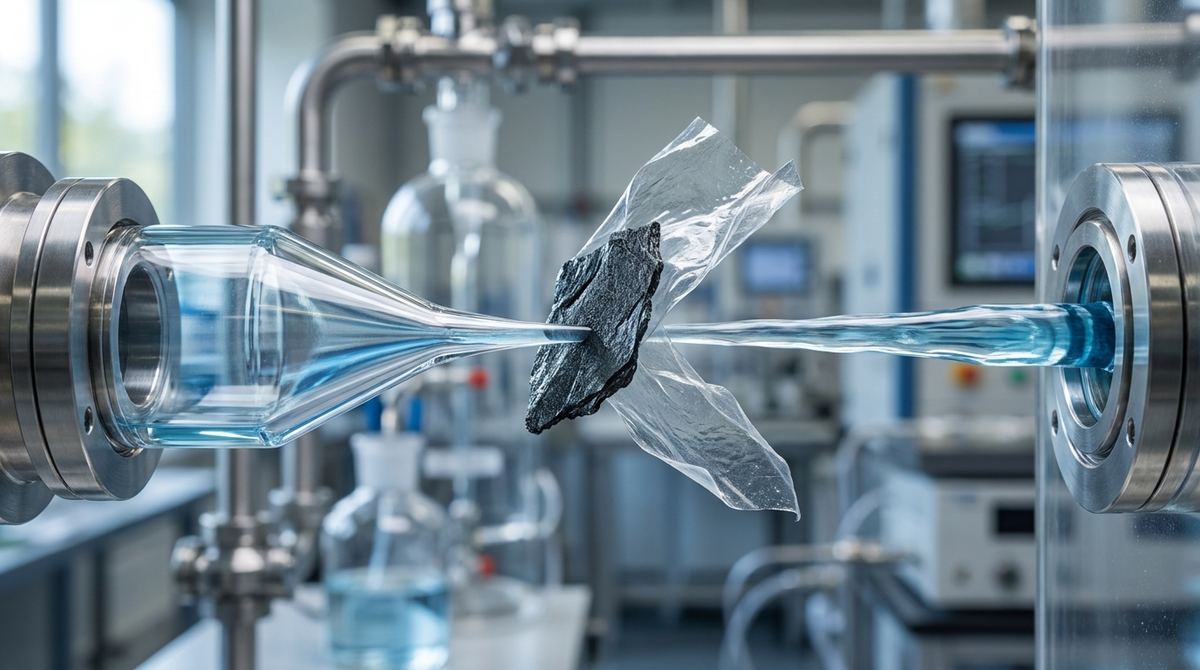
The researchers have turned to the world of fluid dynamics to solve this problem. Instead of simply stirring the graphite in a liquid, the team proposes using a method called transonic flow focusing. In simple terms, they use a specialized nozzle to accelerate a liquid to near-sonic speeds—the speed of sound within that liquid. When this high-speed fluid is forced through a narrow opening, it creates intense pressure changes and incredibly high shear forces.
Think of it like a high-pressure water jet used to cut stone, but tuned with extreme precision to act on a molecular level. By focusing this high-speed flow, the researchers can create an impulsive, or sudden, hydrodynamic force. This force acts like a microscopic wedge, driving itself between the layers of graphite and pushing them apart. The goal is to use the kinetic energy of the fluid to perform work on the graphite, effectively "popping" the layers apart into single sheets before the force becomes strong enough to tear the sheets themselves.
How the Graphene-Based System Works
To understand how this system works, we have to look at the interplay between fluid mechanics and solid-state physics. The process relies on the principles of transonic flow. When a fluid moves through a converging-diverging nozzle, it can reach speeds approaching the speed of sound in that specific medium. At these transonic speeds, the fluid behavior changes significantly, and the pressure gradients become much more acute.
When the graphite particles enter this focused, high-speed flow, they experience intense shear stress. Shear stress is the force that acts parallel to the surface of the graphite flake. Because the fluid is moving so fast and is so concentrated, this stress is not distributed evenly. Instead, it creates a massive pressure differential between the edges of the graphite flakes and their flat surfaces. This pressure difference generates a torque or a lifting force that penetrates between the layers.
This is where the physics of the "impulsive" nature of the action becomes critical. Rather than a constant, steady pressure, the flow provides a sudden, high-energy impact. This rapid transfer of momentum allows the fluid to wedge itself between the layers. Once the water or solvent has entered the space between the layers, it acts as a lubricant and a physical wedge, driving the layers apart. The efficiency of this process depends heavily on the geometry of the flow focusing, which determines how the energy is concentrated, and the fluid's properties, which dictate how much energy can be transferred to the graphite without causing excessive turbulence.
What the Researchers Found
In their investigation, A. Ponce-Torres, A. Rubio-González, J. M. Montanero, M. A. Herrada, and F. J. Galindo-Rosales demonstrated that transonic flow focusing is a viable and effective method for the production of both monolayer graphene and small nanofragments. By precisely controlling the fluid dynamics within the system, they were able to achieve a high degree of delamination.
The study showed that by tuning the flow, they could influence the thickness of the resulting material. This is a crucial finding because it suggests that the process is controllable. While much of the output was monolayer graphene, they also observed the production of nanofragments. These are much smaller pieces of graphene, which are still useful but represent a different class of material than large, continuous sheets. The research highlighted that the kinetic energy provided by the transonic flow is sufficient to overcome the inter-planar energy barriers that typically keep graphite in its bulk form. The ability to produce monolayers through a purely hydrodynamic process, without the need for harsh chemical reagents or extreme temperatures, marks a significant technical achievement in the field of carbon nanotechnology.
Why the Result Matters
The implications of this research are vast, particularly regarding the economic and practical aspects of graphene production. One of the biggest hurdles to the widespread adoption of graphene is the cost of high-quality material. If we can produce single-layer graphene using high-speed fluid flow—a process that is inherently scalable and uses relatively inexpensive equipment—the cost of graphene could drop significantly.
Furthermore, the quality of graphene is determined by its structural integrity. When graphene is produced via harsh chemical means, it often ends up with many "defects," which are essentially holes or misaligned atoms in the lattice. These defects act as obstacles for electrons, increasing electrical resistance and decreasing performance. The hydrodynamic method described here is a physical process, meaning it can potentially produce graphene with fewer chemical impurities and fewer structural defects. High-purity, high-quality graphene is essential for the next generation of electronics, where even a single misplaced atom can ruin the performance of a transistor.
Limitations and What Still Needs Testing
While the results are promising, it is important to distinguish between a successful laboratory demonstration and an industrial reality. The research, as presented, does not yet claim that this method is ready for commercial mass production. There are several critical areas that require further investigation.
First is the issue of yield and selectivity. While the researchers successfully produced monolayer graphene, they also produced nanofragments. In many industrial applications, the size of the graphene flake is just as important as its thickness. A large, continuous sheet is much more valuable for making conductive films than a collection of tiny fragments. Optimizing the flow to maximize monolayer yield while minimizing fragmentation is a major engineering challenge.
Second is the scalability of the hydrodynamic system. Moving from a controlled laboratory setup to a continuous industrial process requires managing high-speed fluids and high pressures over long periods. This introduces mechanical wear and energy consumption concerns. Finally, the researchers must investigate the long-term stability of the graphene dispersion. Once the graphene is exfoliated, it tends to clump back together (re-aggregate) unless it is properly stabilized in a solvent. Developing the right chemical or physical stabilization to accompany this hydrodynamic process is the next logical step for the technology.
Real-World Applications
The potential real-world applications for the graphene produced through transonic flow focusing are enormous. In the energy sector, graphene is a game-changer for battery technology. By adding graphene to battery electrodes, we can increase the surface area available for ion exchange. This leads to faster charging times and higher power densities. Because the hydrodynamic method produces thin, high-surface-area sheets, it is particularly well-suited for creating the highly conductive additives needed for next-generation lithium-ion and solid-state batteries.
In the field of electronics, the ability to produce high-quality monolayers could lead to faster, smaller, and more efficient transistors. Graphene's high electron mobility allows for extremely high-speed switching. If this method can produce large-area, defect-free sheets, it could pave the way for graphene-based sensors, flexible displays, and even advanced optical components.
Additionally, the composite materials industry stands to benefit. Graphene can be used as a reinforcement agent in polymers to create materials that are incredibly strong yet extremely lightweight. By using a liquid-based exfoliation method, it is much easier to mix the graphene into liquid resins or plastics, ensuring a uniform distribution that improves the overall mechanical properties of the final product.
If You Remember One Thing
If you take away only one piece of information from this research, let it be this: we are moving away from using "brute force" chemistry to create graphene and moving toward using the "precision" of fluid physics to peel it apart.
FAQ
What is the difference between graphite and graphene?
Graphite is a naturally occurring form of carbon that consists of many layers of carbon atoms stacked on top of each other. Graphene is a single, individual layer of those carbon atoms. While graphite is a common material used in pencils, graphene is a revolutionary nanomaterial with extraordinary electrical and mechanical properties.
Why can't we just use a regular stirrer to make graphene?
A regular stirrer provides a relatively uniform and low-intensity force throughout the liquid. To separate the layers of graphite, you need a force that is intense enough to penetrate between the layers but specific enough not to break the layers themselves. Standard stirring often lacks the localized, high-energy impact required to efficiently peel the sheets apart.
What does transonic mean in this context?
In fluid dynamics, transonic refers to a flow that is moving at speeds approaching the speed of sound within the medium (the liquid). At these speeds, the fluid behaves in complex ways, creating very sharp pressure changes and high-velocity impacts that are much more effective at separating materials than slower, steady flows.
Is this method going to make graphene cheap immediately?
Not quite yet. While the method uses relatively simple fluid-based principles, moving from a successful laboratory experiment to a large-scale factory requires significant engineering. We still need to figure out how to maximize the amount of single-layer graphene produced and minimize the amount of tiny, broken fragments.
How does graphene help improve electronics?
Graphene is an excellent conductor of electricity because its electrons can move through its hexagonal lattice with very little resistance. By using graphene in electronic components, we can create devices that are faster, smaller, and use less power than traditional silicon-based electronics.
Conclusion
This research points toward a practical lesson: graphene-based materials are most powerful when their nanoscale properties are connected to a clear engineering problem. The result is not a finished commercial product by itself, but it gives researchers and manufacturers a better map for designing lighter, more sensitive, or more durable systems. Future work still needs testing under real operating conditions, but the direction is promising because it joins materials science with application-driven design.