Imagine trying to measure the heartbeat of a hummingbird. If you use a stopwatch meant for a human, the bird's heart will seem like a continuous, blurry vibration rather than a series of distinct beats. In the world of nano-electronics, the same problem exists. As we move toward devices that operate at gigahertz frequencies—billions of cycles per second—the traditional tools used by engineers to measure electrical properties become too slow and too noisy. We need a way to listen to the ultra-fast electronic oscillations of single layers of atoms without disrupting them. This is where the cutting-edge intersection of superconductivity and two-dimensional materials comes into play.
The Problem This Research Is Solving
The push toward higher computing speeds and more sensitive quantum sensors requires materials that can switch and respond at incredibly high frequencies. Traditional electronic characterization typically relies on direct current (DC) measurements or low-frequency alternating current (AC) methods. While these are excellent for measuring the steady-state properties of a material, they have a fundamental speed limit. This limit is dictated by the RC time constant, which is a product of a material's resistance and its capacitance. As devices get smaller and more complex, the resistance and capacitance change in ways that require much faster measurement techniques to capture accurately.
Furthermore, standard measurement setups often introduce significant electrical noise and parasitic capacitance. When you attach physical wires to a tiny, one-atom-thick sheet of graphene, the wires themselves act like tiny capacitors and resistors that can drown out the signal you actually want to see. This makes it extremely difficult to determine the intrinsic electronic properties of the material, such as its capacitance or its tunable bandgap, without the measurement setup itself interfering with the results. This gap in measurement capability prevents us from fully understanding how bilayer graphene will behave in a high-speed circuit or a quantum computer.
The Key Idea in Plain English
The solution involves a technique called RF reflectometry, which uses radio-frequency signals instead of standard direct current. Instead of trying to push a steady stream of electrons through the material, researchers send a very high-speed wave toward the sample. By observing how much of that wave bounces back—a phenomenon known as reflection—they can infer the electrical state of the material. If the material's capacitance changes even slightly, the way the wave reflects changes in a measurable way.
To make this measurement incredibly sensitive, the researchers use superconducting materials. Superconductors are materials that allow electricity to flow with zero resistance when cooled to very low temperatures. By integrating a superconducting resonator on the same chip as the graphene, the measurement system becomes incredibly efficient. The resonator acts like a highly tuned musical string that only vibrates at a specific frequency. When the graphene's properties change, it slightly detunes that string, allowing the researchers to detect even the tiniest fluctuations in the material's electrical charge.
How the Graphene-Based System Works
To understand this system, we must first understand the specific material being studied: bilayer graphene. Unlike monolayer graphene, which is a single layer of carbon atoms, bilayer graphene consists of two such layers stacked on top of each other. This stacking is crucial because it introduces a new capability. By applying an electric field perpendicular to the layers, researchers can break the symmetry between the two sheets. This breaking of symmetry creates a bandgap, meaning the material can be switched from a conductor to an insulator. This ability to tune the bandgap is the holy grail for making graphene-based transistors.
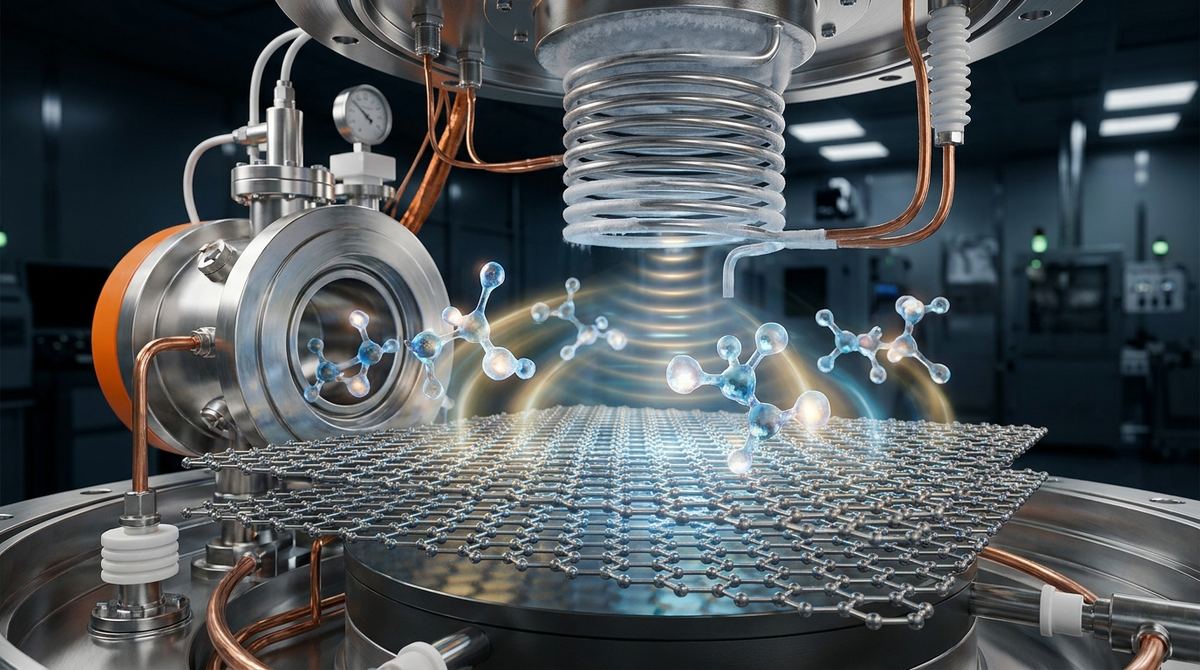
The experimental setup described by Sung Jin An, Minseo Cho, Minjun Park, Dohun Kim, HyeonJeong An, Seung-Bo Shim, Hakseong Kim, Sunghun Lee, Myoung-Jae Lee, Kenji Watanabe, Takashi Taniguchi, Jungpil Seo, et al. involves placing this bilayer graphene into a sophisticated microwave environment. The core component is a superconducting resonator, likely made from a material like niobium, which is patterned directly onto the chip. This resonator is designed to operate in the gigahertz range.
When a microwave signal is sent toward the resonator, it enters a transmission line. The signal's interaction with the graphene is determined by the capacitance between the graphene and a nearby gate electrode. This capacitance is directly linked to the density of states—essentially, how many electronic states are available for electrons to occupy—within the graphene. As the gate voltage changes, the density of charge in the graphene changes, which in turn changes the capacitance. This change in capacitance shifts the resonance frequency of the superconducting resonator. Because the resonator has a very high quality factor, or Q-factor, even a minuscule change in capacitance causes a significant, detectable shift in the reflected signal's phase or amplitude.
What the Researchers Found
The researchers successfully demonstrated that this on-chip RF reflectometry technique can accurately map the capacitance response of bilayer graphene at extremely high frequencies. By using the superconducting resonator, they were able to achieve a level of sensitivity that is far superior to traditional methods. This allowed them to observe the electronic response of the bilayer graphene as it transitioned through different states, such as when the bandgap is being opened or closed by an external voltage.
One of the key findings is the ability to perform these measurements without the massive interference typically caused by external measurement probes. Because the resonator is integrated directly on-chip, the "signal-to-noise ratio" is greatly improved. The study proves that high-frequency reflectometry can resolve the complex capacitance of the material, providing a high-resolution look at how charge carriers are distributed and how they respond to rapid electromagnetic stimuli. This provides a direct way to verify the theoretical models of bilayer graphene's electronic structure in a real-world, high-speed context.
Why the Result Matters
This research is a vital step toward the practical application of two-dimensional materials in high-frequency electronics. As the semiconductor industry looks beyond silicon, materials like bilayer graphene offer the promise of devices that are much faster and more energy-efficient. However, we cannot build what we cannot measure. This research provides the "microscope" needed to see how these materials will perform in actual high-speed environments.
For the field of quantum computing, this is equally significant. Many quantum bits, or qubits, rely on the ability to control the charge or spin of electrons with extreme precision. The ability to characterize the capacitance of a material at gigahertz frequencies allows scientists to design better interfaces between quantum materials and the microwave control signals used to operate quantum processors. By understanding the capacitance response, engineers can better manage the "decoherence" that often plagues quantum systems, potentially leading to more stable and scalable quantum computers.
Limitations and What Still Needs Testing
While this research represents a significant technical achievement, it is important to recognize its current scope. The work is a laboratory-scale demonstration performed under highly controlled conditions, typically involving cryogenic temperatures to maintain the superconducting state. In a commercial manufacturing environment, maintaining such extreme cold and the precision required for on-chip superconducting resonators adds significant complexity and cost.
Furthermore, while the technique is highly sensitive, the transition from a laboratory setting to a mass-produced microchip is a massive engineering hurdle. The process of fabricating high-quality, defect-free bilayer graphene on top of superconducting circuits requires advanced materials science techniques that are not yet standard in commercial chip factories. Future research will need to focus on whether these high-speed measurements can be performed at higher temperatures or using more scalable fabrication methods that are compatible with current semiconductor industry standards.
Real-World Applications
The implications of this research reach into several high-tech sectors. In the realm of telecommunications, this technology could lead to the development of next-generation RF transistors that operate at much higher frequencies than current silicon-based components, supporting the increasing demands of 6G networks and beyond.
In the medical field, ultra-sensitive RF sensors based on graphene could potentially lead to highly precise diagnostic tools. Because these sensors can detect incredibly small changes in electrical properties, they could be used in highly sensitive biosensors that detect the presence of specific molecules or proteins in a sample at extremely high speeds.
Additionally, in the field of high-speed data processing, the ability to characterize and utilize graphene's high-frequency capacitance could lead to much faster signal processing units for data centers and high-performance computing clusters, helping to manage the massive influx of data generated by modern digital infrastructure.
If You Remember One Thing
If you remember only one thing from this research, let it be this: to build the ultra-fast electronics of the future, we first need the tools to measure them at those same speeds, and superconducting RF reflectometry provides a way to probe the atomic-scale properties of graphene with unprecedented precision.
FAQ
What is the difference between monolayer and bilayer graphene?
Monolayer graphene is a single layer of carbon atoms arranged in a hexagonal lattice. It is a zero-gap semiconductor, meaning it always conducts electricity. Bilayer graphene, however, consists of two layers. When an electric field is applied across these two layers, it can create a bandgap, allowing the material to act like a semiconductor that can be turned on or off.
Why is the frequency of measurement so important?
As electronic devices become smaller and faster, they operate at much higher frequencies. Traditional measurement methods are too slow to capture the rapid changes in electrical charge that occur at these speeds. High-frequency measurements allow us to see how a material behaves in the actual environment where the device will operate, ensuring that it can keep up with high-speed signals.
Why are superconductors used in this research?
Superconductors have zero electrical resistance when cooled to very low temperatures. In a measurement system, resistance causes energy loss and generates heat, which can distort the signal. By using a superconducting resonator, researchers can create a very high-quality signal that is extremely sensitive to even the smallest changes in the graphene's capacitance, providing much cleaner data.
What is capacitance, and why does it matter for graphene?
Capacitance is the ability of a system to store an electrical charge. In bilayer graphene, the capacitance depends on how many electrons are available to move and how the layers are structured. By measuring capacitance, researchers can understand the electronic density and the bandgap of the graphene, which are the most important factors in determining how a transistor will function.
Is this technology ready to be used in smartphones?
Not yet. This research is currently in the fundamental science and laboratory testing phase. While the results are very promising for the future of electronics, the current methods require extremely cold temperatures and very specialized manufacturing processes that are not yet suitable for the mass production of consumer electronics like smartphones.
Conclusion
The work conducted by Sung Jin An, Minseo Cho, Minjun Park, and their colleagues marks a significant milestone in the characterization of two-dimensional materials. By successfully implementing on-chip superconducting GHz RF reflectometry, they have provided a powerful new lens through which we can observe the dynamic electronic properties of bilayer graphene. This capability is essential for the development of the next generation of high-frequency transistors, ultra-sensitive sensors, and quantum computing components. As we continue to push the boundaries of how fast and small electronics can be, the ability to probe the atomic pulse of materials like graphene will be a cornerstone of technological progress.