Introduction to Graphene NEMS Nonlinearity
In traditional signal processing, generating frequency combs or high-order harmonics usually requires complex optical setups or large-scale electronic circuits. However, recent research into Nanoelectromechanical Systems (NEMS) has opened a new door: using the mechanical vibrations of a single layer of graphene to perform these tasks.
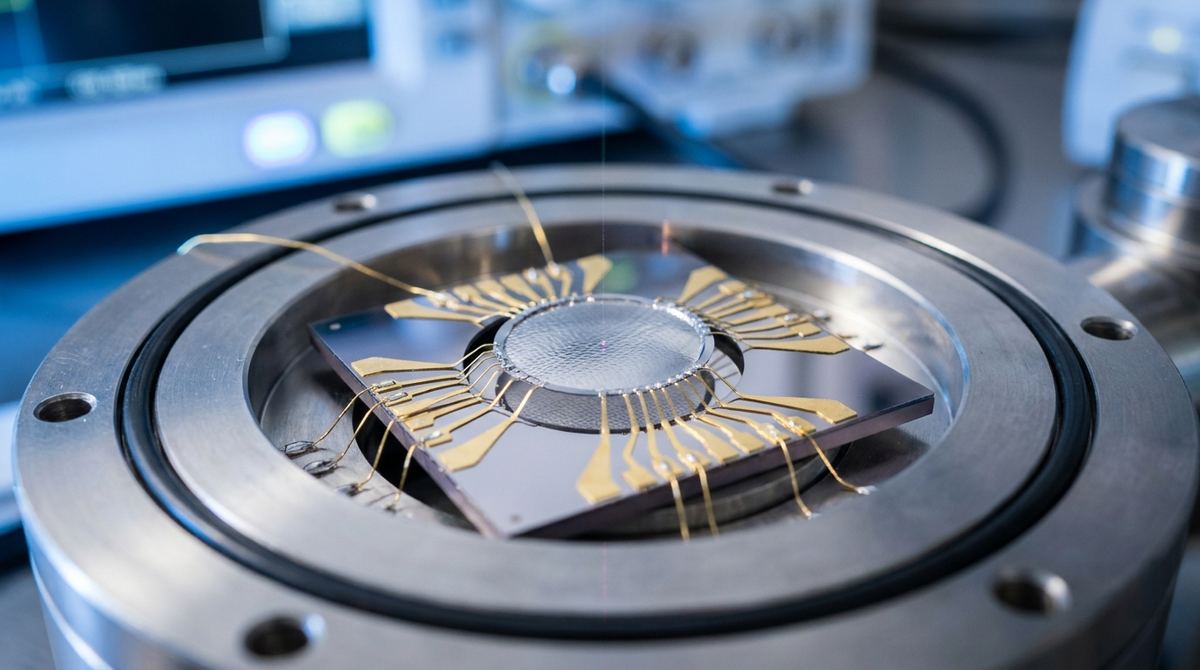
A graphene NEMS device is essentially a tiny, ultra-lightweight drum. Because graphene is incredibly thin and strong, it can vibrate at very high frequencies. When you drive this drum with an electrical signal, it vibrates. If the device is designed correctly, these vibrations become nonlinear. This nonlinearity allows a single input frequency to generate multiple output frequencies, creating what is known as a frequency comb.
This guide focuses on building a prototype of a tunable graphene drum capable of generating these combs. This device can act as a frequency multiplier, a broadband comb source, or even a chaotic signal generator, depending on how you tune the electrical gate voltage.
The Application: On-Demand Phononic Frequency Combs
The primary application for this device is phononic signal processing. A frequency comb is a series of discrete, equally spaced spectral lines. In the phononic (mechanical) domain, these lines represent specific vibration frequencies.
By using a graphene drum, you can create a device that provides a "tunable nonlinear landscape." This means you can change the behavior of the device—switching it from a simple frequency multiplier to a complex comb generator—just by adjusting the DC gate voltage. This is highly useful for:
1. High-precision timing and clock generation in micro-scale systems.
2. Ultra-wideband signal generation for communications.
3. High-sensitivity sensing, where the nonlinear response can be used to detect minute changes in mass or force.
Hardware Requirements and Materials
Building a graphene NEMS device requires a cleanroom environment and specialized microfabrication equipment. You cannot build this on a standard workbench.
1. Substrate: A silicon wafer with a thick thermally grown silicon dioxide (SiO2) layer, typically 200nm to 300nm. This layer acts as the dielectric for your gate.
2. Active Element: Monolayer graphene. This must be high-quality, typically grown via Chemical Vapor Deposition (CVD) on copper foil and then transferred to the substrate.
3. Electrodes: Gold (Au) or Titanium/Gold (Ti/Au) for both the driving electrodes and the gate electrodes.
4. Environment: A vacuum chamber capable of reaching at least 10^-3 Torr. High Q-factors (low energy loss) are essential for observing nonlinear effects, and air damping will kill the signal.
5. Instrumentation: A Vector Network Analyzer (VNA) or a high-frequency signal generator paired with a high-speed oscilloscope for FFT analysis.
Prototype Construction Steps
The fabrication process is complex and requires precision lithography.
1. Substrate Preparation: Clean the Si/SiO2 substrate using standard RCA cleaning procedures to remove organic contaminants.
2. Electrode Patterning: Use electron-beam lithography (EBL) to define the patterns for your gate and drive electrodes. A common design involves a central gate electrode underneath the graphene and peripheral electrodes for driving the membrane.
3. Graphene Transfer: Use a polymer-assisted (PMMA) wet transfer method to move the CVD graphene from the copper foil onto the patterned substrate. This is the most delicate step; any dust or bubbles will cause the graphene to tear or fail.
4. Membrane Suspension: This is the critical step to create the "drum." You must perform a dry etch (Reactive Ion Etching) to remove the SiO2 layer in the area between your electrodes. This leaves the graphene suspended over a hollow cavity, creating the membrane.
5. Contact Formation: Use EBL and metal evaporation to create electrical contacts that connect your graphene membrane to the external world.
Tuning the Nonlinear Landscape
The "magic" of this device happens when you apply a DC gate voltage. According to the research by Rathi et al., the gate voltage breaks the out-of-plane symmetry of the graphene membrane.
In a perfectly symmetric drum, the vibrations are linear. By applying a gate voltage, you introduce a quadratic coupling between different vibration modes. Specifically, you want to tune the device to a 1:2 internal resonance. This is when the frequency of the fundamental vibration mode is exactly half of a higher-order mode.
Once you hit this 1:2 resonance, a single drive tone will trigger integer high-harmonic generation. As you increase the drive power, the harmonics will begin to fill in the gaps, creating a dense frequency comb. If you increase the drive even further, you may observe a reverse period-doubling transition, where the spacing of the comb lines actually changes.
Testing and Characterization Plan
To verify your prototype, follow this testing sequence:
1. Fundamental Mode Characterization: Apply a small AC drive signal and use the VNA to find the resonance frequency of the fundamental mode.
2. Symmetry Breaking Test: Gradually increase the DC gate voltage and monitor the frequency of the higher-order modes. You are looking for the point where the fundamental frequency is exactly half of the second mode.
3. Harmonic Generation Test: Once at the 1:2 resonance, increase the AC drive amplitude. Use a Fast Fourier Transform (FFT) on your output signal to look for integer harmonics (2f, 3f, 4f, etc.).
4. Comb Verification: Increase the drive power until the discrete harmonics merge into a continuous comb of frequencies.
5. Nonlinear Coefficient Measurement: By analyzing the spectra, you can calculate the quadratic (ζ) and cubic (β) nonlinear coefficients of your specific graphene membrane.
Engineering Assumptions and Parameters
Since this is a prototype guide, we must work with estimated values. The following are cautious starting ranges for a lab-scale implementation:
1. Drum Diameter: Assume a suspended area of 5 to 10 micrometers in diameter. Smaller drums provide higher frequencies but are harder to fabricate without tearing.
2. Gate Voltage: Start with a range of 0V to -10V DC. The specific voltage required to reach the 1:2 resonance is highly dependent on the membrane tension and thickness.
3. Drive Frequency: Expect fundamental modes in the 10 MHz to 100 MHz range, with higher harmonics extending into the GHz range.
4. Vacuum Pressure: Aim for < 1 mTorr. At higher pressures, the mechanical Q-factor will be too low to sustain the nonlinear oscillations required for frequency combs.
Risk Assessment and Mitigation
1. Membrane Tearing: The most common failure is the graphene tearing during the transfer or etching process. Mitigation: Use high-quality PMMA and perform all steps in a Class 100 cleanroom.
2. Stiction: During the drying phase of the etching process, the graphene membrane might stick to the substrate due to capillary forces. Mitigation: Use supercritical CO2 drying to minimize surface tension.
3. Electrical Breakdown: High gate voltages can cause dielectric breakdown of the SiO2 layer. Mitigation: Use a thicker SiO2 layer (300nm+) for the first prototype and test at low voltages.
4. Thermal Noise: At room temperature, thermal fluctuations can mask the nonlinear signal. Mitigation: If possible, perform testing in a cryostat at liquid nitrogen temperatures to increase the Q-factor.
Source Basis
This guide is based on the research findings presented in "Tunable Nonlinear Landscapes in Graphene Nanoelectromechanical Systems" by Rathi, Singh, Mondal, Sarkar, Nicholl, Bolotin, and Ghosh (2026). The concepts of 1:2 internal resonance, integer high-harmonic generation, and the use of gate voltage for symmetry breaking are derived directly from their experimental observations.