The quest for the ultimate computer has led humanity to the edge of the quantum frontier, a realm where the rules of classical physics no longer apply. In this microscopic world, information is not stored as simple zeros and ones, but as qubits, which can exist in multiple states simultaneously. This capability allows quantum computers to perform calculations at speeds that would leave even the most powerful modern supercomputers in the dust. However, these qubits are notoriously temperamental. They are so sensitive to their surroundings that even a tiny thermal vibration or a stray magnetic field can cause them to lose their quantum state, a process known as decoherence. If we want to build practical, large-scale quantum computers, we must find a way to shield these qubits or find environments where they are naturally more stable. This research seeks to solve that exact puzzle by looking into the mysterious and complex landscape of superconducting materials.
The Problem This Research Is Solving
At the heart of the quantum computing challenge lies the problem of environmental noise. For a spin qubit—which uses the magnetic orientation of an electron to store data—the primary enemy is any interaction that causes the electron's spin to flip or drift. In many advanced quantum architectures, these spin qubits are integrated into superconducting circuits. Superconductivity is a state where electricity flows with zero resistance, but the transition into this state is not always a simple, clean process. In many high-temperature superconductors, there exists a mysterious intermediate phase known as the pseudogap.
The pseudogap phase is characterized by a partial gap in the energy spectrum of the material, occurring even before the material reaches a fully superconducting state. During this phase, the electronic environment is incredibly chaotic and fluctuating. These fluctuations create "noise" in the form of varying electric and magnetic fields. For a researcher trying to maintain a stable qubit, the pseudogap is like trying to perform delicate surgery in the middle of a thunderstorm. The unpredictable nature of the electronic density and the fluctuating magnetic moments in the pseudogap regime can lead to rapid decoherence, making the spin qubit lose its information almost instantly. Without a way to map how these fluctuations affect the spin, engineers are essentially flying blind, unable to predict which materials or temperatures will yield a stable quantum processor.
The Key Idea in Plain English
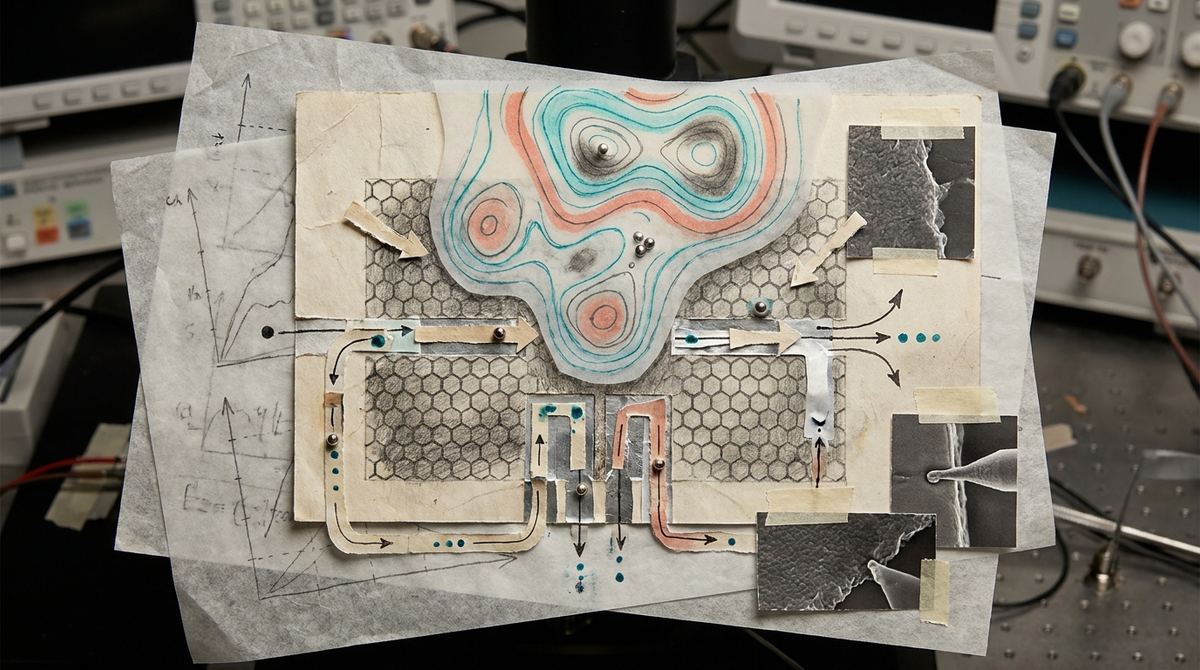
The core concept explored in this research is the creation of a stability map. Rather than simply trying to avoid the pseudogap phase, the researchers aim to understand the specific conditions under which the pseudogap behaves in a way that is compatible with spin qubits. By mapping the stability of these qubits across different energy levels and physical parameters, we can identify "islands of stability" within the chaotic electronic landscape. Imagine navigating a stormy sea; instead of just hoping for calm water, you use a detailed map to find the specific currents and pockets of calm that allow a ship to travel safely. By understanding how the pseudogap affects the spin, we can design quantum hardware that operates in these optimal zones, effectively turning a chaotic environment into a controlled and useful tool for quantum information processing.
How the Graphene-Based System Works
To study these complex interactions, scientists often turn to advanced two-dimensional (2D) architectures. In these systems, graphene and other 2D materials act as the foundational platform. Graphene is a single layer of carbon atoms arranged in a hexagonal lattice, and it possesses extraordinary electrical conductivity and a highly tunable electronic structure. When a layer of graphene is placed in close contact with a superconducting material, a phenomenon known as the proximity effect occurs. Through this effect, the superconducting properties of the host material are "leaked" into the graphene layer, creating a hybrid system where the electrons in the graphene begin to behave as if they were part of the superconductor.
In a graphene-based quantum system, the graphene acts as a highly controllable channel for electrons. Because the conductivity of graphene can be precisely tuned by applying an external voltage, researchers can manipulate the density of charge carriers within the material. This tunability is vital when studying the pseudogap. By changing the carrier density, researchers can move the system in and out of different electronic phases, effectively "scanning" the energy landscape. The interface between the graphene and the superconducting material is critical; the atomic-scale smoothness of the graphene provides an incredibly clean environment that minimizes defects. These defects would otherwise act as additional sources of noise, further complicating the study of the pseudogap. The synergy between the high-mobility electrons in graphene and the complex electronic landscape of the superconducting pseudogap provides the perfect laboratory to test how spin qubits respond to complex electronic environments.
What the Researchers Found
In this study, Chen-How Huang and Miguel A. Cazalilla utilized advanced theoretical modeling to map the stability landscape of spin qubits within these superconducting pseudogap systems. Their work focused on how the specific energy characteristics of the pseudogap phase influence the coherence time of a spin qubit. The researchers investigated how the fluctuations in the electronic density of states—the number of available energy levels for electrons—interact with the magnetic moment of the qubit.
The findings suggest that the stability of a spin qubit is not uniformly distributed across the pseudogap phase. Instead, there are specific energy regimes where the fluctuations are minimized, or where the electronic environment becomes more predictable. The researchers discovered that the interaction between the spin of the electron and the fluctuating magnetic fields in the pseudogap is highly dependent on the local electronic density. By mapping these relationships, the research provides a theoretical framework that describes how the "noise" of the pseudogap phase correlates with the rate of decoherence. This mapping provides a crucial piece of the puzzle, showing that the pseudogap does not have to be a source of pure chaos; rather, it possesses an underlying structure that can be understood and, potentially, exploited to maintain qubit stability.
Why the Result Matters
This research is significant because it shifts the focus from merely avoiding decoherence to understanding and navigating the fundamental physics that causes it. For the field of quantum computing, the ability to map the stability of qubits in complex environments is a prerequisite for scaling up. Currently, most quantum experiments are performed in highly idealized, simplified environments to avoid noise. However, as we move toward more integrated and powerful quantum chips, these simplified environments will become insufficient.
By understanding the relationship between the pseudogap and spin stability, engineers can design more robust hardware. If we know exactly which energy levels or temperatures provide the most stability, we can tailor our quantum processors to operate within those specific parameters. This could lead to a new class of "environment-aware" quantum computers that are specifically tuned to the materials they are built from. Furthermore, this research bridges the gap between fundamental condensed matter physics and practical quantum engineering, providing a theoretical roadmap that experimentalists can use to design new 2D heterostructures that are optimized for spin-based quantum information processing.
Limitations and What Still Needs Testing
While these findings offer a groundbreaking theoretical framework, it is important to note that this work is primarily computational and theoretical in nature. The mapping provided by Huang and Cazalilla describes the behavior of these systems through mathematical modeling, which is a vital step but not a final proof of performance. Moving from a theoretical map to a physical quantum chip is a massive engineering challenge.
Several critical areas still require intensive experimental testing. First, the actual fabrication of 2D heterostructures with the level of precision required to match these theoretical models is extremely difficult. Any microscopic impurity or slight misalignment in the layers could create noise that overshadows the effects being studied. Second, the scale of the mapping needs to be tested in real-world devices to ensure that the "islands of stability" identified in theory actually exist in physical hardware. Finally, the study focuses on how the pseudogap affects the spin, but in a real quantum computer, many other noise sources—such as cosmic rays, thermal radiation, and electromagnetic interference from control electronics—will be present. Understanding how the pseudogap-induced noise interacts with these other factors is the next essential frontier for the field.
Real-World Applications
The implications of mastering spin qubits in superconducting systems extend far beyond the laboratory. The most immediate application is the development of scalable quantum computers. Such machines will revolutionize industries by enabling the simulation of complex molecular structures for drug discovery, allowing pharmaceutical companies to design new medicines with unprecedented precision. This could drastically reduce the time and cost of bringing life-saving drugs to market.
In the field of materials science, quantum computers powered by stable qubits could be used to discover new superconductors or even new types of high-performance batteries by simulating quantum-level interactions that are impossible for classical computers to model. Additionally, the ability to control spin states in complex electronic environments has profound implications for the development of next-generation sensors. These sensors could be used in medical imaging, deep-space exploration, or highly sensitive geological surveys, where detecting minute magnetic fluctuations is essential. The intersection of 2D materials, superconductivity, and quantum information science is poised to drive a technological revolution across multiple industrial sectors.
If You Remember One Thing
If you remember only one thing from this research, let it be that stability is the most critical factor in the race for quantum computing. The ability to map and navigate the complex, noisy environments of superconducting materials is the key to transforming fragile quantum bits into the reliable components of a powerful, large-scale quantum computer.
FAQ
What exactly is a spin qubit? A spin qubit is a type of quantum bit that uses the intrinsic magnetic properties of an electron—specifically its spin—to represent information. Unlike a classical bit, which is either a zero or a one, a spin qubit can exist in a superposition of states, allowing it to process complex information much more efficiently.
Why is the pseudogap phase considered a problem for quantum computers? The pseudogap phase is a state in certain superconductors where the electronic environment is highly unpredictable and full of fluctuations. These fluctuations act as noise that can interfere with a qubit, causing it to lose its quantum information through a process called decoherence.
How does graphene help in studying these systems? Graphene acts as a highly tunable and extremely clean platform. Because its electrical properties can be precisely adjusted with voltage, researchers can use it to "scan" through different electronic states, allowing them to observe how the superconducting pseudogap affects the stability of a qubit.
What is the "proximity effect" mentioned in the text? The proximity effect occurs when a non-superconducting material, like graphene, is placed in contact with a superconductor. The superconducting properties "leak" into the other material, allowing scientists to study how superconductivity interacts with other unique electronic properties.
Is a quantum computer using these systems available for purchase today? No, quantum computers are currently in the experimental and development stages. The research described here is fundamental science meant to guide the design of future hardware, providing the theoretical groundwork needed before practical, large-scale machines can be manufactured.
Conclusion
The research conducted by Chen-How Huang and Miguel A. Cazalilla represents a vital step forward in our understanding of the quantum landscape. By mapping the stability of spin qubits within the complex and often chaotic superconducting pseudogap phase, they have provided a roadmap for navigating one of the most difficult environments in condensed matter physics. As we continue to integrate 2D materials like graphene into these sophisticated architectures, our ability to control and stabilize quantum information will only grow. The journey from theoretical stability maps to functional, large-scale quantum processors is complex, but with these kinds of fundamental insights, the dream of a quantum-powered future becomes increasingly tangible.