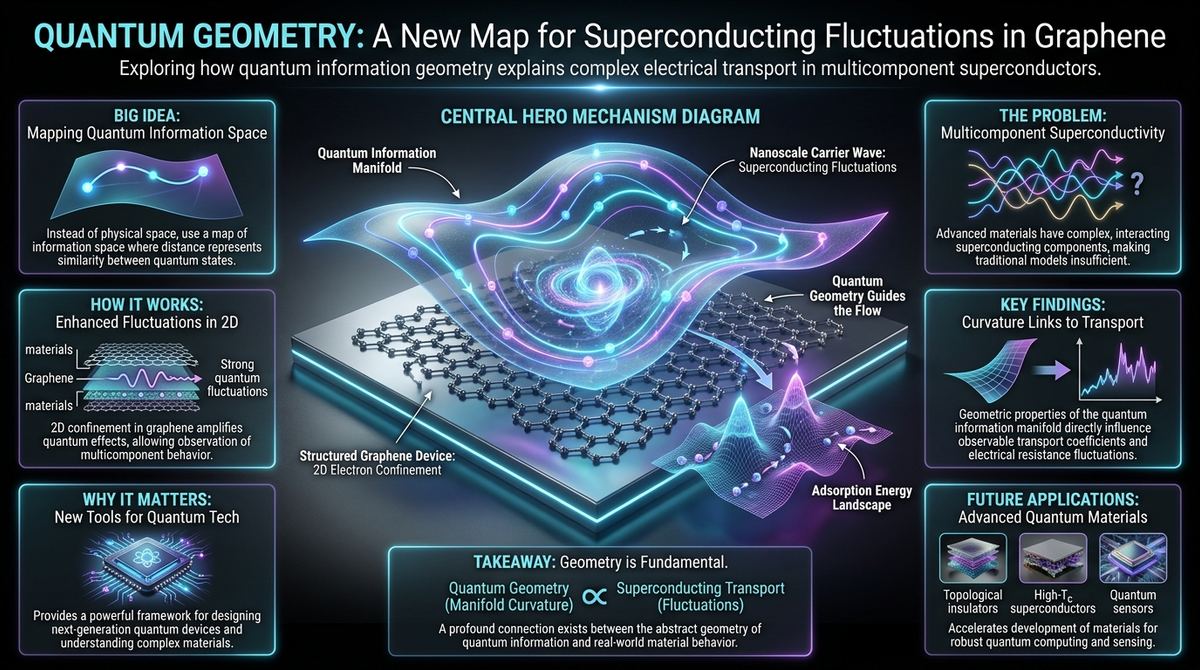
Imagine you are trying to navigate a vast, unfamiliar ocean. Instead of using a standard paper map that shows landmarks like islands or mountains, you are given a map that shows the density of the water and the way the waves change. This map doesn't tell you where you are physically, but it tells you how much the environment around you is changing. In the microscopic world of quantum physics, scientists are discovering that a similar kind of map can explain how electricity flows through complex materials. By treating the different possible states of a material as points on a curved surface, researchers can predict how electrical resistance fluctuates, even before the material becomes a superconductor. This approach uses the mathematics of information geometry to turn abstract quantum data into a practical guide for understanding the behavior of advanced electronics.
The Problem This Research Is Solving
To understand why this research is necessary, we must first look at the inherent complexity of modern quantum materials. Traditionally, superconductivity is understood through the lens of a single order parameter, which is essentially a mathematical description of how electrons pair up to move without resistance. In a simple superconductor, all the electron pairs behave in a unified, singular way. However, as we move toward more advanced materials, such as the layered 2D structures and multi-band materials that are at the forefront of semiconductor technology, this simplicity disappears. We encounter multicomponent superconductors.
In these materials, the electrons have multiple ways to organize themselves. They might have different spin orientations, or they might exist in different valleys within the energy landscape of the material. This creates a situation where there isn't just one way for the material to be superconducting, but several competing or cooperating ways. This complexity makes it incredibly difficult to predict how the material will behave as it approaches the transition from a normal conductor to a superconductor.
When these materials are near the transition temperature, they experience what scientists call fluctuations. Even if the material is not yet a full superconductor, tiny, short-lived droplets of superconductivity appear and disappear due to thermal energy. These fluctuations create a measurable signal in the electrical resistance of the material. In a multicomponent system, these fluctuations are not simple; they are a chaotic dance of different types of order parameters interacting with one another. Standard equations often fail to capture the full picture because they struggle to account for how these different components influence each other through the lens of quantum information. The challenge is to find a unified mathematical framework that can translate these complex, multi-layered quantum fluctuations into something we can measure with a standard voltmeter.
The Key Idea in Plain English
The breakthrough concept introduced by Zi-Ting Sun, Ying-Ming Xie, and Naoto Nagaosa is the application of quantum information geometry to these electrical transport problems. To grasp this, you have to step away from thinking about physical space and start thinking about information space. In quantum mechanics, a system is described by a state, and that state is essentially a collection of probabilities. Information geometry is a branch of mathematics that treats these probabilities as coordinates on a curved surface, known as a manifold.
Think of it this way: if two quantum states are very similar, they are close together on this curved surface. If they are vastly different, they are far apart. The way the surface curves—what mathematicians call curvature—tells us how sensitive the state of the material is to changes in its environment. If the curvature is very sharp, a tiny change in temperature or magnetic field will cause a massive shift in the quantum state.
The researchers realized that the fluctuations we see in electrical transport are not just random noise. Instead, they are a direct reflection of the geometry of this information manifold. By calculating the curvature of the information space, we can determine how the different components of the superconductivity interact and how they influence the movement of charge. This turns the problem from a messy calculation of many moving parts into a geometric problem of measuring the shape of a surface. It provides a deep, fundamental connection between the abstract information contained in a quantum state and the physical electrical signals measured in a laboratory.
How the Graphene-Based System Works
While the theoretical framework applies to a wide range of materials, it is particularly relevant to the study of 2D materials and heterostructures, such as those involving graphene. In these advanced systems, the material is essentially a single layer of atoms. Because the electrons are confined to a two-dimensional plane, their interactions are much more pronounced than in bulk three-dimensional materials. This confinement amplifies the effects of quantum fluctuations and makes it much easier to observe the multicomponent behavior discussed in the research.
In a graphene-based or 2D heterostructure system, we can engineer the environment of the electrons with extreme precision. By stacking different layers of materials or applying specific electric fields, we can create situations where different electronic components—such as spin and valley degrees of freedom—become active. This is where the multicomponent nature arises. For example, one component might represent the spin of the electron, while another represents its orbital state.
As the temperature of such a system is lowered, the electrons begin to form Cooper pairs, the fundamental units of superconductivity. However, because the system is two-dimensional and multicomponent, these pairs can fluctuate in several different ways simultaneously. One type of fluctuation might involve the spin of the pair flipping, while another might involve the orbital movement of the pair changing. These fluctuations disrupt the standard flow of electricity. The interaction between these different modes of fluctuation is what dictates the electrical resistance. The geometry of the quantum information manifold provides the mathematical landscape that maps these complex interactions, allowing us to see how the "distance" between different superconducting modes affects the total conductivity of the 2D layer.
What the Researchers Found
Through their rigorous mathematical analysis, Sun, Xie, and Nagaosa demonstrated that there is a profound and direct relationship between the geometric properties of the quantum information manifold and the observable transport coefficients in multicomponent superconductors. Specifically, they showed that the fluctuations in electrical conductivity are not merely accidental but are fundamentally tied to the curvature of the information space.
The researchers discovered that the way the different components of the superconducting order parameters interact can be fully captured by the metric of the information manifold. This means that if we know the geometric structure of the quantum states, we can predict how the material will conduct electricity during its transition into a superconducting state. This is a significant step forward because it provides a way to bridge the gap between high-level quantum information theory and practical condensed matter physics.
One of the most important aspects of their finding is that it provides a way to distinguish between different types of superconducting behavior that might look identical under traditional measurement techniques. By looking at the geometric signatures in the transport data, scientists can determine whether the fluctuations are being driven by a single component or by the complex interplay of multiple components. This effectively gives researchers a high-resolution lens through which they can observe the internal, hidden dynamics of quantum materials.
Why the Result Matters
This research is vital because it provides a new toolset for the development of next-generation quantum technologies. As we move toward more complex quantum computers, we require materials that can maintain their quantum states reliably and predictably. Understanding how different components of a quantum state interact is essential for controlling these states. If we can predict how fluctuations will affect a material's electrical properties, we can design materials that are more stable and less prone to noise.
Furthermore, the ability to map electrical transport to information geometry simplifies the design of quantum sensors. Sensors that rely on superconductivity are extremely sensitive to external changes, such as magnetic fields. By understanding the geometric nature of these fluctuations, engineers can design sensors that are optimized to detect specific types of quantum shifts, leading to much higher precision in measurements.
This research also has profound implications for the theoretical understanding of phase transitions. A phase transition, like water turning into ice, is a major shift in the state of matter. In quantum materials, these transitions can be incredibly complex. This work provides a way to treat these transitions as geometric events, offering a more unified way to understand how matter changes its fundamental properties at the quantum level.
Limitations and What Still Needs Testing
Despite the significance of these findings, it is important to recognize that this research is primarily theoretical and mathematical. The researchers have provided a powerful framework and a new way to look at the problem, but this has not yet been fully translated into a practical, industrial application. The equations and geometric models described are highly complex and require significant computational power to apply to real-world materials.
There is also the challenge of material realization. While we know that multicomponent superconductors exist, creating them with the level of perfection required to test these geometric theories is a massive engineering hurdle. Defects in the crystal lattice, impurities in the 2D layers, and thermal noise can all obscure the subtle geometric signatures that the researchers are describing.
Future testing will need to focus on high-precision transport measurements in extremely clean, ultra-low temperature environments. Scientists will need to use advanced techniques like scanning tunneling microscopy or specialized nano-electronics to see if the predicted geometric signatures match the actual electrical signals in real, fabricated devices. Only then can we confirm if this mathematical map accurately describes the physical reality of these complex materials.
Real-World Applications
The implications of this research extend into several high-tech industries. In the realm of quantum computing, this work could lead to the development of new types of qubits—the basic units of quantum information. By understanding the information geometry of superconducting fluctuations, we might be able to design qubits that are more resilient to the noise that currently plagues the field.
In the field of ultra-sensitive sensing, this research could revolutionize how we detect tiny magnetic or electric fields. This has direct applications in medical imaging technologies, such as more sensitive versions of Magnetoencephalography (MEG), which can map brain activity with unprecedented detail.
Additionally, the pursuit of lossless power transmission and more efficient electronic components could benefit from these insights. As we attempt to create circuits that operate at much higher speeds and lower power levels, the ability to manage and predict quantum fluctuations becomes essential for the design of the next generation of microchips and power regulators.
If You Remember One Thing
If you take away only one piece of information from this research, let it be this: the complex, chaotic fluctuations of electricity in advanced quantum materials are not random noise, but are actually a structured reflection of the underlying geometry of quantum information.
FAQ
How does information geometry work in physics?
Information geometry treats the different possible states of a quantum system as points on a curved surface. Instead of measuring the physical distance between these points, scientists measure the "distance" based on how much information is required to distinguish one state from another. This distance, known as the Fisher information metric, reveals the fundamental structure of the system's state space.
What is a multicomponent superconductor?
In a standard superconductor, all the electrons behave as a single, uniform group. In a multicomponent superconductor, the electrons have multiple different ways they can organize themselves, such as having different spins or different orbital paths. This makes the material's behavior much more complex and harder to predict than a simple superconductor.
Why are fluctuations important in superconductivity?
Fluctuations are transient, short-lived states where parts of the material act like a superconductor even before the whole material reaches a superconducting state. These fluctuations cause measurable changes in electrical resistance. Understanding them is crucial because they represent the transition phase where a material moves from being a normal conductor to a perfect one.
Is this research useful for making better computer chips?
Indirectly, yes. While this research is quite fundamental, the insights it provides about how quantum fluctuations affect electrical flow are essential for designing the next generation of ultra-fast, low-power electronic components and quantum computers. It provides a mathematical roadmap for managing the quantum noise that currently limits chip performance.
What is the difference between theoretical and experimental research?
Theoretical research, like this paper, uses mathematical models and logic to describe how the world works. Experimental research involves physically building devices and measuring them in a lab to see if the theory holds true. This research is theoretical, meaning it provides the map, but we still need experimentalists to confirm that the terrain matches the map.
Conclusion
The work of Zi-Ting Sun, Ying-Ming Xie, and Naoto Nagaosa marks a significant conceptual shift in how we study the movement of charge in complex quantum systems. By moving beyond traditional electrical measurements and adopting the tools of information geometry, they have provided a way to decode the intricate dance of multicomponent superconducting fluctuations. While much work remains to bridge the gap between these elegant mathematical theories and practical, industrial applications, this research provides a vital new lens through which we can view the future of quantum materials and the technology they will inevitably power.