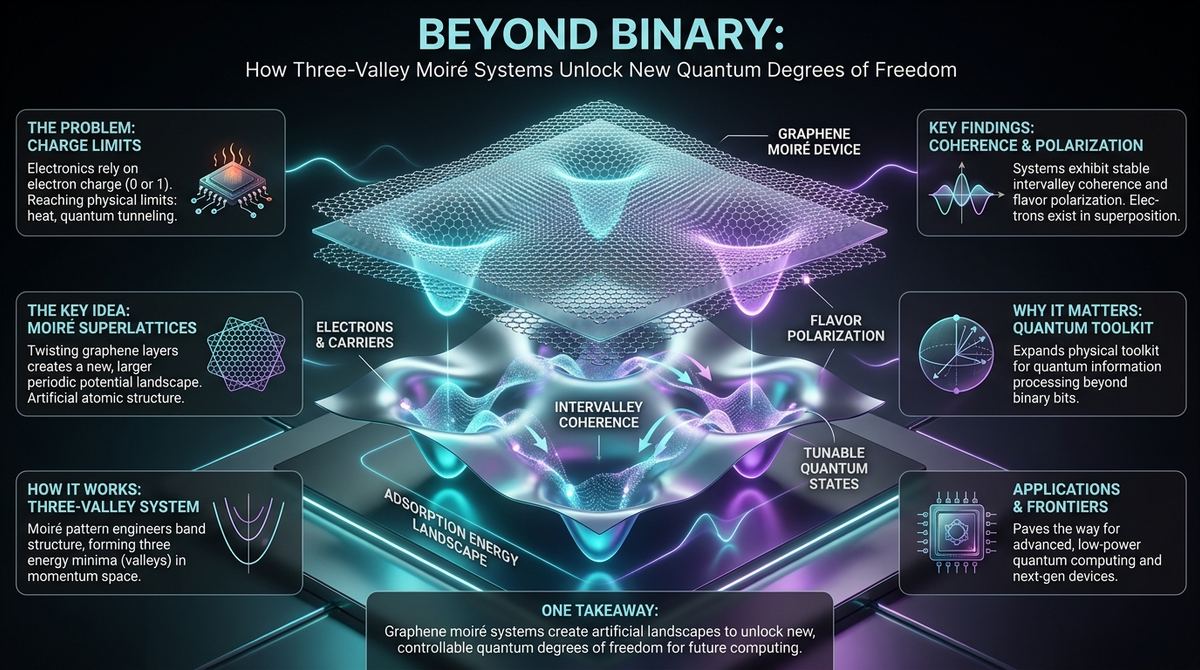
Imagine a world where the fundamental building block of computing is no longer a simple switch that is either on or off. Instead of a single bit representing zero or one, imagine a particle that can exist in three different states simultaneously, or even a state that is a perfect, coherent blend of all three. This is not the stuff of science fiction; it is the frontier of quantum materials science. By precisely twisting layers of carbon atoms, researchers are creating artificial landscapes that allow electrons to behave in ways that nature rarely permits. This research explores a specialized quantum environment where electrons possess more "flavors" than previously available, offering a much richer toolkit for the next generation of quantum technologies.
The Problem This Research Is Solving
For decades, the electronics industry has relied on the movement of electron charge to process information. This is the basis of every modern computer. However, we are reaching the physical limits of this approach. As transistors become smaller, the electrical charge becomes harder to control, leading to heat dissipation issues and quantum tunneling, where electrons leak where they should not go. To move past these limits, scientists are looking for new ways to encode information using other properties of the electron.
One such property is spin, which leads to the field of spintronics. Another is the valley degree of freedom. In certain materials like graphene, electrons do not move through a simple, uniform space. Instead, their momentum is concentrated in specific regions of the energy landscape called valleys. In standard graphene, there are two such valleys. While this provides more than just charge, it is still a relatively limited system. Engineers need more ways to store and manipulate information to achieve true high-density quantum computing.
The core problem is how to create a material that allows us to control these valleys with extreme precision. If we can force electrons to choose one valley over another, or to exist in a quantum superposition between valleys, we can create a new kind of logic. The difficulty lies in the fact that natural materials have fixed symmetries. To break these symmetries and create a system with three valleys instead of two, we cannot rely on the natural arrangement of atoms; we must engineer it through a process known as moiré pattern engineering.
The Key Idea in Plain English
The fundamental concept at play here is the moiré pattern. You have likely seen a moiré pattern in everyday life, such as when you look through two fine window screens held at a slight angle to one another. The overlapping patterns create larger, moving wavy lines. On an atomic scale, when we take two sheets of graphene and rotate one slightly against the other, we create a moiré superlattice. This new, much larger pattern of atoms acts as a giant periodic landscape for the electrons.
This artificial landscape changes how electrons move. Instead of just seeing the individual carbon atoms, the electrons now see the large-scale pattern created by the twist. This can change the number of "valleys" available to the electrons. This research focuses on a specific configuration that creates three distinct valleys.
In this three-valley system, the electron gains a new "flavor." In quantum physics, flavor is a term used to describe the different internal states an electron can occupy. By having three valleys, the electron has three possible states. This allows for something called flavor polarization, where the electrons all decide to occupy one specific valley, breaking the natural balance. Even more exciting is intervalley coherence, where an electron exists in a quantum superposition of these valleys, effectively being in multiple states at thes simultaneously.
How the Graphene-Based System Works
To understand how this works, we must look at how the moiré pattern alters the electronic band structure. In a single layer of graphene, the electrons behave like massless particles, moving through two specific energy minima in momentum space. When we introduce the moiré superlattice through twisting, we create a new periodic potential. This potential acts as a force that reshapes the energy landscape.
The researchers, Jeyong Park, Laura Classen, and Mathias S. Scheurer, investigated how these moiré patterns can be tuned to create a three-valley system. This usually involves specific stacking orders or twist angles that create a three-fold rotational symmetry in the superlattice. This symmetry is crucial because it dictates how the electron's wavefunction is distributed.
When the symmetry is high, the three valleys are "degenerate," meaning they all have the same energy level. This is the ideal starting point for quantum effects. When an electron is in this state, it can move between these valleys through quantum mechanical tunneling. This movement is what creates intervalley coherence.
The system is also highly sensitive to electron density and external electric fields. By adding or removing electrons (doping) or applying a voltage, researchers can change the interactions between the electrons. When the electrons start to repel each other strongly due to their charge, they undergo a phase transition. Instead of being distributed randomly among the three valleys, they might all decide to occupy the same valley to minimize their energy or to maximize their interaction benefits. This is the "flavor polarization" mentioned in the study. The "flavor" here is essentially a label for which valley the electron occupies, and polarization refers to the collective ordering of these labels across the material.
What the Researchers Found
The study by Park, Classen, and Scheurer provides a deep dive into the quantum mechanics of these three-valley systems. They found that these systems exhibit complex behaviors that are not possible in standard two-valley materials. Specifically, the research identifies the conditions under which intervalley coherence and flavor polarization emerge.
The researchers demonstrated that the interplay between the electronic kinetic energy and the electron-electron interactions determines the final state of the system. In the three-valley landscape, the electrons can enter a state where they are not just in one valley or another, but are in a coherent superposition of the three. This is a highly delicate state of matter.
Furthermore, the research shows that the system can undergo spontaneous symmetry breaking. This means that even without an external force telling the electrons which valley to pick, the electrons will collectively choose a "flavor" to minimize their total energy. This polarization is a signature of a highly correlated electronic state, where every electron is "aware" of the position and state of every other electron. This collective behavior is what makes these materials so interesting for studying new phases of matter that do not exist in simpler materials.
Why the Result Matters
The implications of finding stable, controllable intervalley coherence and flavor polarization in three-valley systems are profound. First, it expands the mathematical and physical toolkit available to quantum scientists. Moving from a two-state (SU(2) symmetry) to a three-state (SU(3) symmetry) system opens up a much wider array of quantum states that can be used for computation.
In a quantum computer, the goal is to create qubits that are robust and easy to manipulate. A three-valley system offers a new type of "qutrit"—a three-state quantum bit. Qutrits can theoretically pack more information into a single particle and allow for more efficient quantum algorithms than standard qubits.
Beyond computing, this research contributes to the field of condensed matter physics by providing a new playground for testing theories of highly correlated electrons. Most of our understanding of quantum materials comes from systems with simple symmetries. By engineering complex, three-fold symmetric moiré lattices, we can simulate exotic physics that might occur in much heavier, more complex materials, but in a much more controlled environment. This makes these graphene-based moiré systems a "quantum simulator" for the rest of the universe.
Limitations and What Still Needs Testing
While these findings are groundbreaking, it is important to distinguish between a fundamental discovery and a ready-to-use technology. The research conducted by Park, Classen, and Scheurer is a theoretical and experimental exploration of quantum phases, not a blueprint for a commercial processor.
Currently, these moiré systems must be operated at extremely low temperatures, often near absolute zero, to prevent thermal energy from destroying the delicate quantum coherence. At higher temperatures, the "noise" from heat would cause the electrons to jump randomly between valleys, destroying the flavor polarization and the intervalley coherence.
Additionally, the fabrication of these materials requires extreme precision. The "twist angle" must be controlled with incredible accuracy. Even a tiny deviation in the angle between the graphene layers can completely change the moiré pattern and destroy the three-valley symmetry. Scaling this up from a single, tiny flake of graphene in a laboratory to a large-scale, reliable manufacturing process is a massive engineering challenge that has yet to be solved.
Real-World Applications
If the challenges of temperature and fabrication are overcome, the real-world applications could be transformative. In the realm of ultra-high-density storage, flavor polarization could lead to a new type of non-volatile memory. Instead of storing charge, we could store information in the "valley state" of an electron, which is much more resilient to certain types of interference.
In the field of sensing, the extreme sensitivity of these quantum states to external fields could lead to the development of next-generation sensors. A device that relies on the coherence between three valleys would be incredibly responsive to tiny magnetic or electric perturbations, potentially allowing us to detect biological or chemical signals at a much higher resolution than currently possible.
Finally, in the realm of communications, the ability to manipulate multiple degrees of freedom in a single electron could lead to "multi-level" signal processing, increasing the bandwidth and efficiency of data transmission at the microscopic level.
If You Remember One Thing
If you remember only one thing from this research, let it be this: by twisting layers of atoms, we can create artificial "flavors" for electrons, turning a simple sheet of carbon into a complex quantum playground that could redefine how we process information.
FAQ
How do moiré patterns actually affect electrons? When two layers of a crystal are slightly misaligned, they create a new, much larger periodic pattern that the electrons feel as a new force. This force can change how many energy minima, or valleys, are available to the electron, effectively rewriting the rules of how the material behaves.
What is the difference between spin and valley? Spin is an inherent property of an electron that makes it act like a tiny magnet with two possible directions. A valley is a property of the crystal's structure where the electron's momentum is concentrated, and in these new materials, we can engineer them to have three valleys instead of the usual two.
What does "flavor polarization" actually mean? It refers to a situation where electrons, which would normally be spread out across all available valleys, all decide to occupy the same valley. This collective decision breaks the symmetry of the material and creates a new, ordered state of matter.
Why is "intervalley coherence" important for quantum computing? In quantum computing, we want particles to exist in multiple states at once, a phenomenon called superposition. Intervalley coherence is exactly that—it is a state where an electron is in a quantum superposition of being in different valleys simultaneously.
Is this technology ready for use in my smartphone? Not yet. While the physics is solid, these materials currently require extremely cold temperatures and incredibly precise manufacturing that is only possible in highly specialized research laboratories. We are still many years away from seeing these quantum effects in consumer electronics.
Conclusion
The research by Jeyong Park, Laura Classen, and Mathias S. Scheurer represents a significant step forward in our ability to engineer the quantum world. By moving beyond the standard two-valley graphene model and exploring the complexities of three-valley moiré systems, they have opened a new door into the study of intervalley coherence and flavor polarization. While the path from a laboratory discovery to a commercial quantum chip is filled with engineering hurdles, the ability to control the "flavor" of an electron provides a glimpse into a future of unprecedented computational power and sensing capabilities. As we continue to master the art of the twist, the possibilities for what we can achieve with carbon-based quantum materials are virtually limitless.