
Practical Guide: Engineering Magnetic Quantum Dots in WSe2 for Valleytronic Logic
Learn how to overcome Klein tunneling in 2D materials by using WSe2 and localized magnetic fields to create stable quantum dots for next-generation spin-valleytronics.
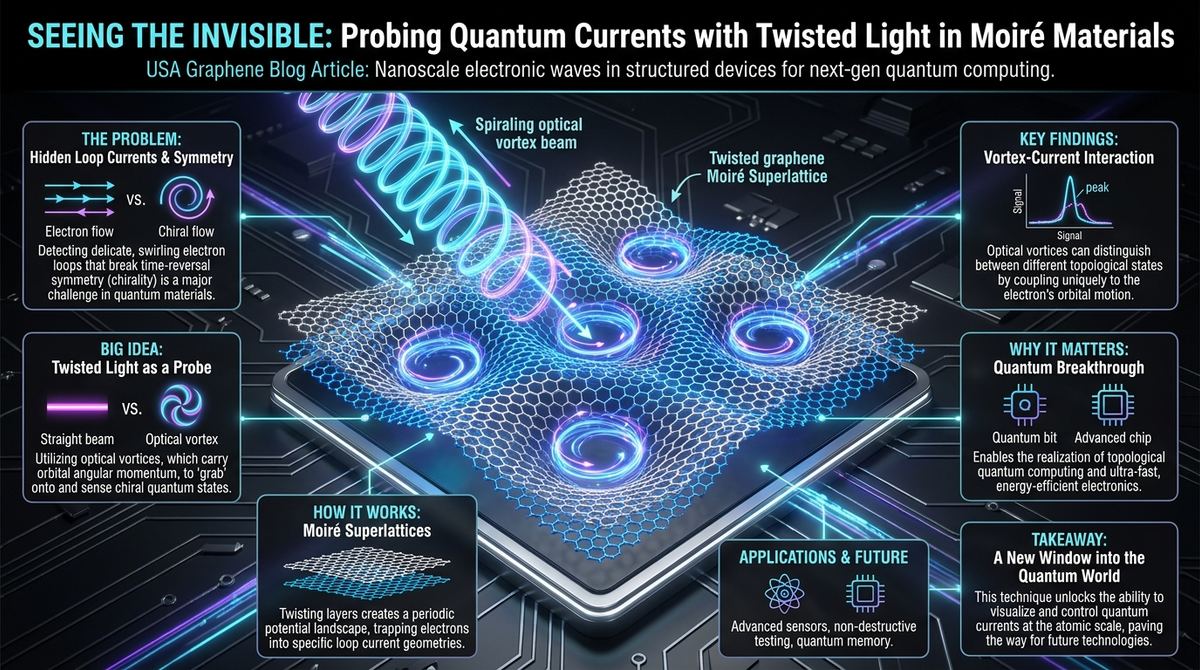
Imagine an invisible dance occurring on a stage no larger than a few atoms wide. In this microscopic ballroom, electrons are not just flying through space; they are performing intricate, swirling patterns, spinning in tiny, microscopic circles that never end. These tiny loops of current are incredibly difficult to see because they are too small for traditional microscopes and too delicate to touch with standard electrical probes. If we want to use these swirling electron patterns to build the next generation of quantum computers or ultra-fast electronics, we first need a way to watch them without disrupting their delicate rhythm. This is precisely the challenge that Nobuhiko Yokoshi and Akihito Kato are addressing in their groundbreaking research into the optical properties of moiré materials. By using light that itself carries a twist, they have developed a way to sense the handedness of these electron currents, opening a new window into the quantum world of twisted two-dimensional materials.
The central challenge in modern condensed matter physics is the detection of broken time-reversal symmetry in two-dimensional materials. In most standard materials, if you were to film the movement of electrons and then play the video in reverse, the physics would look exactly the same. This is known as time-reversal symmetry. However, certain exotic states of matter break this symmetry, meaning the electrons exhibit a preferred direction of motion, such as swirling in a clockwise or counter-clockwise direction. When this happens, the material develops a property known as chirality, or handedness.
Detecting this chirality is notoriously difficult for several reasons. First, these loop currents are often purely electronic and do not produce a significant magnetic field that can be easily measured by traditional sensors. Second, the materials used to host these states, known as moiré superlattices, are incredibly sensitive to their environment. Traditional measurement techniques often involve attaching physical wires or electrical contacts to the material to pass a current through it. However, the very act of attaching these contacts can introduce impurities or electrical interference that destroys the fragile quantum state the researchers are trying to study.
Furthermore, standard optical measurements often lack the resolution to distinguish between different types of quantum order. While we can see that a material is absorbing light, it is much harder to determine whether that absorption is being driven by the specific, swirling motion of electrons in a particular direction. Without a way to probe the chirality—the specific twist of the electronic movement—scientists remain blind to the underlying physics that makes these moiré materials so promising for future technologies.
The researchers, Nobuhiko Yokoshi and Akihito Kato, propose a solution that utilizes the fascinating properties of light itself. Instead of using a standard, straight beam of light, they use an optical vortex. An optical vortex is a special type of light beam that carries orbital angular momentum. If a standard laser beam is like a straight arrow flying through space, an optical vortex is like a corkscrew or a spinning drill bit. The light doesn't just travel forward; it rotates around its own axis as it moves.
This rotation creates a unique mathematical property known as a phase singularity at the center of the beam. Because the light is "twisted," it has a specific handedness—it is either left-handed or right-handed. When this twisted light beam interacts with a material that has its own electronic "twist" (the loop currents), the two twists interact with one another.
By observing how the twisted light changes when it passes through the moiré material, scientists can determine the direction of the electronic currents. It is a method of sensing through symmetry. If the light's twist matches the electron's twist, the interaction will look different than if they are mismatched. This allows for a non-invasive probe, meaning we can observe the delicate quantum dance without ever having to touch the material with an electrical wire.
To understand how this works, we must first look at the structure of the moiré materials being studied. Moiré materials are created by taking two layers of a crystal, such as graphene, and stacking them with a very slight twist angle. This twist creates a new, much larger periodic pattern called a moiré superlattice. This superlattice acts like a landscape of hills and valleys for the electrons. Instead of moving freely across the sheet, the electrons become trapped in these periodic potential wells created by the interference of the two layers.
In these specific moiré systems, the geometry of the lattice forces the electrons into localized, circular orbits. These are the loop currents mentioned earlier. Because these electrons are moving in circles, they break time-reversal symmetry locally, creating a chiral electronic environment. The structure of the graphene lattice, specifically the way the atoms are arranged and how the electron orbitals overlap, determines the specific direction and strength of these currents.
When an optical vortex beam is directed at this moiré lattice, a phenomenon called light-matter coupling occurs. The orbital angular momentum of the photons interacts with the orbital motion of the electrons. This interaction is governed by selection rules, which are essentially the "rules of engagement" for how light and matter can exchange energy and momentum. Specifically, the photon's angular momentum can be transferred to the electronic state, or the electronic state can shift the phase of the light.
Because the electron loops have a specific chirality, they interact differently with a left-handed optical vortex than they do with a right-handed one. This difference is measurable. The interaction changes the way the light is absorbed or how its phase is shifted. By carefully measuring these subtle changes in the light's properties, the research demonstrates that we can map out the chiral landscape of the material with high precision.
The research by Yokoshi and Kato provides a theoretical and methodological framework for using optical vortices to identify loop-current chirality. While the paper focuses on the capability of the probe, the implication is that the technique can successfully distinguish between different topological states that would otherwise look identical under standard observation.
The study indicates that the orbital angular momentum of light provides a unique "handle" to grab onto the orbital motion of electrons. This is a significant advancement because it moves beyond simply measuring the presence of a current to measuring the specific geometry and direction of that current. The research highlights that the interaction is most pronounced when the spatial scale of the optical vortex matches the characteristic scale of the moiré superlattice.
Crucially, the work confirms that optical vortex probing can bypass the limitations of traditional transport measurements. Because the probe is purely optical, it does not require the application of an external voltage that might drive the system out of its ground state. This allows for the study of "pure" quantum phases, where the loop currents exist naturally due to the material's inherent structure rather than being forced by an external electrical source.
The ability to probe chirality in moiré materials is a fundamental leap forward for the field of quantum materials. One of the biggest goals in condensed matter physics is the realization of topological quantum computing. In such a computer, information is stored in the "twists" and "knots" of electronic states rather than the simple presence or absence of an electron. These topological states are incredibly robust against noise and interference, which is the primary reason why current quantum computers are so difficult to scale.
If we can accurately identify and control these chiral loop currents, we can develop qubits (quantum bits) that are protected by the very geometry of the material. This would represent a massive shift in how we approach information processing. Furthermore, this research has direct implications for the field of spintronics and orbitronics. While spintronics uses the "spin" of an electron to carry information, orbitronics uses the "orbital motion" of the electron.
The ability to detect and manipulate these orbital currents using light could lead to the development of ultra-fast, light-driven electronic components. Imagine a device where information is processed not by moving electrons from one side of a chip to another, but by switching the direction of tiny, localized swirls of current. Such devices would be significantly more energy-efficient and operate at much higher frequencies than current silicon-based technology.
Despite the promise of this research, several significant hurdles remain before this can be translated into practical technology. First, the sensitivity of the probe is a major factor. The changes in the light's properties caused by these microscopic currents are extremely subtle. Detecting them requires highly stable laser systems and extremely sensitive detectors, making the current setup complex and difficult to replicate outside of a controlled laboratory environment.
Second, the "moiré" effect is highly sensitive to the twist angle. Even a fraction of a degree of deviation in how the layers are stacked can completely change the electronic landscape. Creating large-scale, perfectly consistent moiré materials is a significant engineering challenge in materials science. If the material is not perfect, the loop currents may be disordered or non-existent, rendering the optical probe ineffective.
Third, there is the issue of thermal noise. These delicate quantum states often only exist at extremely low temperatures, close to absolute zero. At higher temperatures, the thermal vibrations of the atoms in the lattice can disrupt the electron loops and the light-matter interaction. For this technology to be useful in real-world applications, researchers must find ways to stabilize these chiral states at higher temperatures or develop even more sensitive optical probes that can cut through the thermal noise.
While the research is currently in the fundamental science stage, the potential real-world applications are vast. In the realm of quantum computing, this method could be used to characterize the quality of topological qubits, ensuring they are properly formed before being used in calculations. This would be a vital step in the industrialization of quantum hardware.
In the field of sensing, the ability to detect tiny changes in chirality could lead to a new class of ultra-sensitive chemical or biological sensors. Many molecules have a specific "handedness" (chirality), and a device based on optical vortex probes could potentially detect the presence of specific chiral molecules in a sample with unprecedented accuracy.
Additionally, we may see the rise of "photonic-electronic" hybrid devices. These would be microchips where light and electricity are seamlessly integrated. In these devices, light could be used to "write" or "erase" the direction of electron loops, effectively acting as an optical switch that controls the flow of information at the quantum level. This could revolutionize high-speed telecommunications and data storage.
If there is one takeaway from this research, it is that light is more than just a way to see; it is a tool that can interact with the very geometry of quantum matter. By using the "twist" of light, we can finally begin to see and measure the "twist" of electrons in the next generation of quantum materials.
How does light "twist"?
Light can carry different types of angular momentum. While most light travels in a straight line without rotation, certain specialized beams, known as Laguerre-Gaussian beams, have a wavefront that spirals around the direction of travel. This means the phase of the light changes depending on its position around the center of the beam, creating a corkscrew-like structure.
What is a moiré material?
A moiré material is created when two layers of a material, like graphene, are stacked on top of each other with a slight twist. This creates a new, much larger pattern of interference between the two layers, similar to the pattern you see when you look through two window screens at an angle. This new pattern changes how electrons move through the material.
Why is chirality important in these materials?
Chirality refers to a property of asymmetry, like how your left and right hands are mirror images but cannot be perfectly overlapped. In quantum materials, if electrons move in a preferred swirling direction, the material becomes chiral. This property is a key indicator of new, exotic states of matter that could be used for advanced computing.
Why can't we just use electrical wires to measure these currents?
Electrical wires are "invasive." To measure a current, you have to attach a connection, which introduces defects and electrical noise. In very delicate quantum systems, this noise can destroy the very phenomenon you are trying to study. Light, however, can pass through the material without physically touching it, allowing for "non-invasive" observation.
Could this lead to faster computers?
Yes, potentially. If we can use light to control and detect the orbital motion of electrons (orbitronics), we could create electronic components that are much faster and use much less energy than the silicon transistors used in today's computers. This would be a fundamental shift in how we design and build electronic devices.
The research conducted by Nobuhiko Yokoshi and Akihito Kato marks a significant milestone in our ability to probe the quantum world. By bridging the gap between advanced optics and condensed matter physics, they have provided a way to observe the subtle, swirling currents that define the next frontier of material science. While the path from a laboratory curiosity to a commercial technology is filled with challenges—ranging from material precision to thermal stability—the fundamental concept of using twisted light to sense quantum chirality offers a profound new capability. As we continue to master the art of twisting both light and matter, the promise of topological quantum computing and ultra-efficient electronics moves one step closer to reality.
Serious about B2B integration? Test our premium Pulsed Electrical Resistive Carbon Heating turbostratic graphene in your lab. 100g sample packs available now.
Explore More
Learn how to overcome Klein tunneling in 2D materials by using WSe2 and localized magnetic fields to create stable quantum dots for next-generation spin-valleytronics.

A deep dive into how subtle structural variations in twisted bilayer graphene prevent scientists from observing the BKT transition and determining the true symmetry of the superconducting state.

Exploring how operator ordering in twisted bilayer graphene creates emergent gauge fields and unique spectral signatures at the magic angle.