
Emergent Gauge Fields in Twisted Bilayer Graphene: A New Quantum Perspective
Exploring how operator ordering in twisted bilayer graphene creates emergent gauge fields and unique spectral signatures at the magic angle.
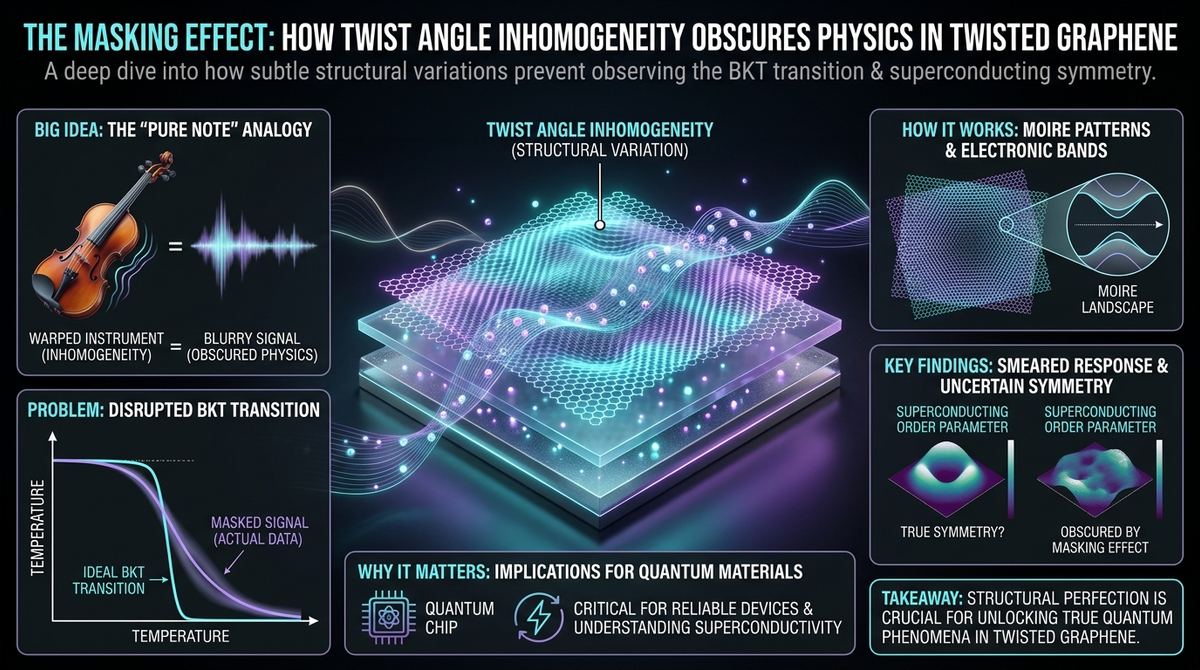
Imagine you are trying to listen to a single, pure musical note played by a violin. If that violin is perfectly constructed, the note is clear, sharp, and tells you everything about the quality of the wood and the tension of the strings. But if the violin is slightly warped, or if the strings are unevenly tightened in different spots, the note becomes a blurry, vibrating mess. You can tell a sound is being made, but you can no longer hear the true essence of the note. In the cutting-edge world of quantum materials, scientists are facing this exact problem. They are trying to hear the "pure note" of superconductivity in twisted bilayer graphene, but the material itself is often slightly warped, creating a chaotic landscape that hides the fundamental physics they are desperate to understand.
The quest to understand superconductivity is one of the most significant challenges in modern condensed matter physics. Superconductivity is the phenomenon where electricity flows through a material with zero resistance, a property that could revolutionize how we move energy and process information. Recently, a new playground for this phenomenon has emerged: twisted bilayer graphene. By taking two sheets of carbon atoms and rotating them at a very specific, "magic" angle, scientists can create a material with extraordinary electronic properties. However, there is a massive hurdle.
In a perfect laboratory setting, every part of that twisted graphene sheet would have the exact same angle. In reality, the process of stacking these two layers is incredibly difficult. As the sheets are laid down, the angle varies slightly from one nanometer to the next. This variation is known as twist angle inhomogeneity. The problem is that the electronic properties of graphene are extremely sensitive to this angle. If the angle changes even slightly, the way electrons behave changes completely. This means that instead of having a single, uniform superconducting state, the material becomes a patchwork of many different electronic environments. This structural chaos makes it nearly impossible for researchers to observe the BKT transition—the hallmark of two-dimensional superconductivity—and to determine the symmetry of the order parameter, which describes the fundamental nature of the superconducting state.
To understand why this is such a headache for scientists, we have to look at what they are looking for. In standard three-dimensional superconductors, electricity flows through a dense, unified sea of electron pairs. But in two-dimensional materials like graphene, the rules change. Instead of a simple transition, these materials undergo a process called the Berezinskii-Kosterlitz-Thouless, or BKT, transition. This involves the behavior of tiny "whirlpools" of electricity, known as vortices. At a certain temperature, these vortices pair up and become stable, allowing for a type of superconductivity.
When the twist angle is uniform, we expect to see a very specific, sharp change in how the material conducts electricity as it cools down. This is the BKT transition. However, because the twist angle is actually inconsistent across the sample, different regions of the graphene reach this transition at different temperatures. One patch might be superconducting while the patch next to it is not. When a scientist measures the whole piece of graphene, they don't see a sharp transition; they see a smeared, blurry mess. This masking effect hides the true physics, making it difficult to tell if the superconductivity is behaving in a way that could be used for advanced technology or if it is just a local anomaly.
To understand why a tiny change in angle has such a massive effect, we have to look at the atomic structure. Graphene is a single layer of carbon atoms arranged in a hexagonal lattice. When you stack two of these layers and twist them, you create a new pattern called a moire pattern. This moire pattern is a much larger, repeating geometric shape that emerges from the interference of the two overlapping lattices.
The size and shape of this moire pattern are entirely determined by the twist angle. This moire pattern acts as a new landscape for the electrons. At the "magic angle," the electronic bands become "flat." In a normal conductor, electrons move very quickly through the lattice. But in these flat bands, the electrons slow down significantly. They start to feel the presence of every other electron much more strongly. This intense interaction, known as strong correlation, is what leads to exotic states like superconductivity and insulating behavior.
The cause-and-effect relationship is direct: the twist angle dictates the moire periodicity, the moire periodicity dictates the bandwidth of the electrons, and the bandwidth dictates how strongly the electrons interact. If the angle is inconsistent, the bandwidth is inconsistent. This creates a landscape where the electronic "speed limit" varies from point to point, leading to the inhomogeneity that complicates everything.
In this research, Ilaria Maccari, Louk Rademaker, and Giulia Venditti investigated exactly how this inhomogeneity interferes with our ability to read the material's properties. By analyzing the effects of twist angle variations, they demonstrated that the local fluctuations essentially act as a veil. This veil masks the BKT transition by spreading out the temperature at which the transition appears to occur. Instead of a clear signal, the data shows a gradual, smeared-out response that can be easily misinterpreted.
More importantly, the researchers found that this masking effect extends to the order parameter symmetry. The order parameter is a mathematical description of the superconducting state—it tells us how the electron pairs are arranged and how they respond to external forces. Understanding this symmetry is vital because different symmetries lead to different types of quantum technologies. If the symmetry is "s-wave," it behaves one way; if it is "d-wave," it behaves quite differently. Because the inhomogeneity creates a patchwork of different electronic environments, the macroscopic measurement provides an average that doesn't represent any single, real physical state. The researchers have shown that what we see in many experiments might not be the true fundamental physics of the material, but rather an averaged-out version caused by structural imperfections.
This discovery is a wake-up call for the community of materials scientists and quantum engineers. It suggests that many of the "groundbreaking" observations in twisted bilayer graphene might be obscured by the very nature of how the materials are made. If we cannot distinguish between a true BKT transition and a smeared transition caused by inhomogeneity, we cannot accurately map out the phase diagram of these materials.
Furthermore, the inability to determine the order parameter symmetry is a major roadblock. To build a quantum computer based on topological superconductivity, we need to know exactly what kind of symmetry we are working with. If our material is messy, we cannot rely on its properties for stable quantum computation. This research provides a crucial framework for understanding why experimental results in the field have been so inconsistent and provides a roadmap for what researchers must account for in future studies.
While this research provides profound insights into the challenges of studying twisted graphene, it is important to recognize its current scope. The findings highlight a fundamental limitation in how we interpret current experimental data. It does not, however, provide an immediate solution to how to fix the material. The study focuses on the theoretical and observational consequences of inhomogeneity rather than a manufacturing technique to eliminate it.
More testing is required to determine the exact threshold at which inhomogeneity becomes fatal to observing certain quantum effects. We also need more advanced, localized measurement techniques—such as scanning tunneling microscopy—that can look at the material at the atomic scale rather than measuring the whole flake at once. Until we can bridge the gap between macroscopic measurements and local atomic reality, our understanding of the true physics in these materials will remain partially obscured.
Although this research focuses on fundamental physics, the implications for real-world technology are massive. The ultimate goal of studying these materials is to harness their unique properties for practical use.
In the realm of quantum computing, understanding the symmetry of superconducting states is essential for developing "topological qubits." These would be much more stable than current quantum bits, potentially leading to computers that can perform massive calculations without the errors caused by environmental noise.
In the field of power electronics, the ability to control superconductivity through structural manipulation could lead to ultra-efficient energy transmission. If we can master the twist angle and eliminate inhomogeneity, we could create materials that function as perfect conductors at much higher temperatures than currently possible.
Additionally, the extreme sensitivity of these materials to their environment makes them potential candidates for ultra-sensitive sensors, capable of detecting minute magnetic or electrical fields, which could revolutionize medical imaging and geological surveying.
If you take away only one idea from this research, let it be this: in the world of quantum materials, perfection is everything. The tiniest variation in the way two layers of atoms are twisted can completely hide the most interesting physics, meaning that the future of quantum technology depends as much on the precision of manufacturing as it does on the laws of physics themselves.
What is twisted bilayer graphene?
Twisted bilayer graphene is a material made by stacking two single layers of carbon atoms on top of each other and rotating them by a specific angle. This rotation creates a pattern of interference called a moire pattern, which changes how electrons move and interact within the material.
Why does the angle matter so much?
The angle determines the electronic landscape. At a specific angle, known as the magic angle, the electrons slow down and interact very strongly with one another. This interaction is what leads to exotic behaviors like superconductivity, which does not happen in regular graphene.
What is the BKT transition?
The Berezinskii-Kosterlitz-Thouless transition is a specific way that materials in two dimensions become superconducting. Instead of the whole material changing at once, it involves the pairing of tiny electrical whirlpools called vortices.
How does inhomogeneity mask the transition?
Inhomogeneity means the twist angle is not the same everywhere in the sample. Because the transition temperature depends on the angle, different parts of the sample want to become superconducting at different times. This makes the transition look gradual and blurry instead of sharp and clear.
Can we fix this problem?
Scientists are working on it. Improving the precision of how we stack these layers is a major area of research. Using more advanced microscopy and better fabrication techniques like chemical vapor deposition may eventually allow us to create the "perfect" twisted graphene needed for quantum technology.
The research by Ilaria Maccari, Louk Rademaker, and Giulia Venditti highlights a critical tension in modern condensed matter physics. As we push toward the limits of material science, the structural imperfections of our samples—specifically the twist angle inhomogeneity in bilayer graphene—act as a veil that hides the true nature of the BKT transition and the symmetry of the superconducting state. By understanding how these flaws mask the underlying physics, we are better equipped to tackle the challenges of material fabrication, moving us one step closer to a future defined by quantum-enabled technologies and highly efficient superconductors.
Serious about B2B integration? Test our premium Pulsed Electrical Resistive Carbon Heating turbostratic graphene in your lab. 100g sample packs available now.
Explore More
Exploring how operator ordering in twisted bilayer graphene creates emergent gauge fields and unique spectral signatures at the magic angle.

A technical guide for prototyping hydrogen storage materials using calcium-decorated carbon nanotubes to achieve the optimal -0.2 to -0.4 eV binding energy window.

Researchers have discovered that the inherent randomness in graphene can be harnessed to create Josephson diodes, offering a new path toward scalable, low-power superconducting electronics and quantum computing components.