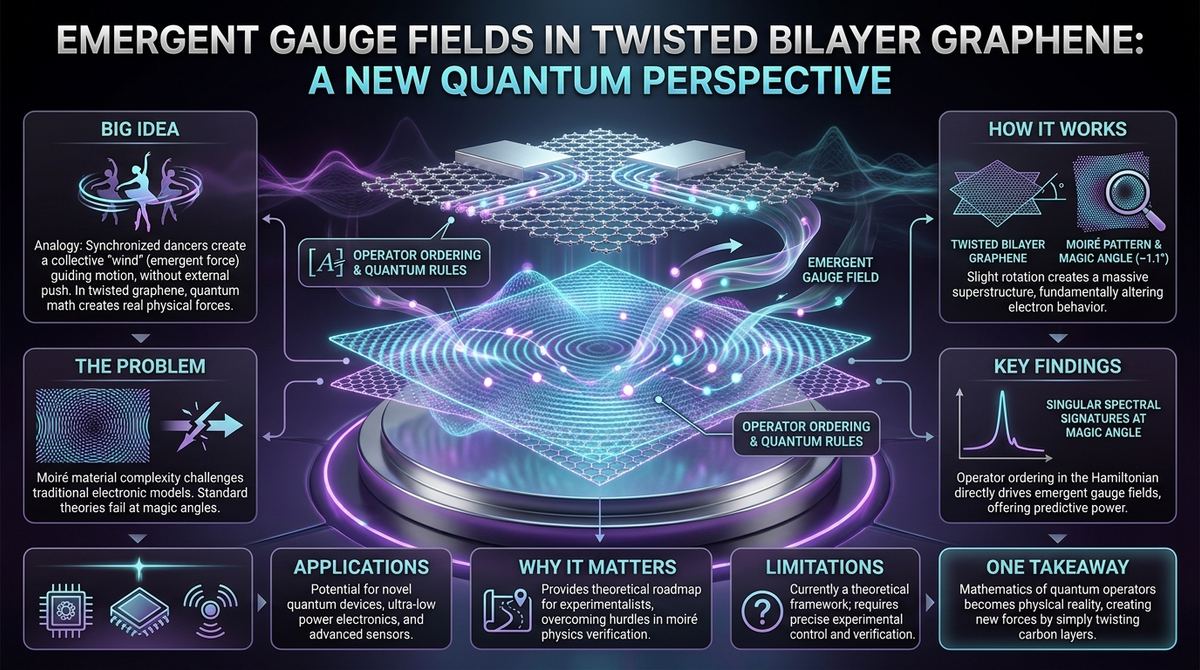
Imagine trying to walk through a crowded ballroom where the dancers are moving in such a precise, synchronized way that their collective movement creates a swirling wind. You aren't being pushed by any single person, and there are no electric fans in the room, yet you feel a persistent force guiding your path. This is the essence of what is happening at the quantum level in twisted bilayer graphene. By simply rotating two sheets of carbon atoms by a specific, tiny angle, scientists can create entirely new physical forces that do not exist in the individual layers. This research explores how the very mathematical rules we use to describe these electrons reveal the existence of these hidden forces, providing a new way to understand and eventually control the next generation of quantum technologies.
The Problem This Research Is Solving
The field of condensed matter physics is currently grappling with the immense complexity of moiré materials. When two layers of a material like graphene are stacked with a slight angular misalignment, they create a moiré pattern—a massive, repeating superstructure that is much larger than the original atomic lattice. This new pattern fundamentally changes how electrons move through the material. Traditional models of electronic behavior, which work perfectly for single layers of graphene or standard metals, begin to fail when they encounter these complex, twisted landscapes.
The core challenge lies in the fact that the electrons in twisted bilayer graphene do not behave like independent particles. Instead, they become deeply interconnected, governed by the geometry of the twist. Scientists have struggled to develop a mathematical framework that accurately predicts the behavior of these electrons without relying on overwhelming computational power or making overly simplistic assumptions. Specifically, there is a disconnect between the geometric structure of the twist and the mathematical way we calculate quantum states. Without a precise way to model these interactions, we cannot reliably predict when a material will become a superconductor or a topological insulator, which are the specific states needed for advanced electronics.
The Key Idea in Plain English
To understand the breakthrough presented by C. A. S. Almeida, we must look at a concept known as operator ordering. In the world of classical physics, it doesn't matter if you multiply two numbers in a certain order; the result is the same. However, in the quantum world, the order in which you perform mathematical operations—like measuring position and then momentum—can change the final outcome. This is because quantum particles possess properties that are fundamentally linked in non-commutative ways.
The research suggests that in twisted bilayer graphene, the specific way these quantum operations must be ordered to describe the electrons effectively creates an emergent gauge field. A gauge field is essentially a mathematical way of describing a force, much like how electromagnetism is described by the way electric and magnetic fields interact with particles. In this case, the force isn't coming from an external magnet, but rather from the mathematical necessity of the electron's movement through the twisted lattice. This emergent field acts like a phantom magnetic field, dictating how electrons swirl and interact, and it leaves behind a unique "fingerprint" or spectral signature that scientists can detect.
How the Graphene-Based System Works
The magic of this system begins with the structure of graphene itself. Graphene is a single layer of carbon atoms arranged in a perfect hexagonal honeycomb lattice. When you take two of these sheets and stack them, they usually align perfectly. But if you rotate one sheet relative to the other, the hexagons no longer line up. This misalignment creates a moiré pattern, a secondary, much larger lattice that emerges from the interference of the two original patterns.
As the twist angle approaches a very specific value, known as the magic angle—roughly 1.1 degrees—the electronic properties of the material undergo a radical transformation. At this angle, the electrons' kinetic energy is significantly reduced, causing the electronic bands to become "flat." In a standard conductor, electrons move quickly and have high kinetic energy. In a flat band, they essentially slow down, making them extremely sensitive to the interactions they have with one another.
Because the electrons are moving through a moiré landscape that is much larger than the atomic scale, they experience the geometry of the twist as a continuous field. The rotation creates a periodic modulation of the potential energy that the electrons feel. This periodic modulation, combined with the quantum mechanical requirement of operator ordering, results in the emergence of the gauge field. The electrons are no longer just moving through a crystal; they are moving through a landscape where the very rules of their motion are defined by the twist of the layers.
What the Researchers Found
The work conducted by C. A. S. Almeida provides a deep theoretical connection between the mathematics of quantum operators and the physical reality of twisted bilayer graphene. The research identifies that the operator ordering required to describe the system’s Hamiltonian—the mathematical equation representing its total energy—is directly responsible for the emergence of these gauge fields. This is a profound realization because it moves the concept of emergent forces from a purely descriptive role to a predictive one.
Crucially, the researcher identified singular spectral signatures that occur at the magic angle. In spectroscopy, scientists use light or other forms of energy to probe a material, and the way the material absorbs or emits that energy provides a "spectrum" or a signature of its internal state. Almeida found that at the magic angle, the emergent gauge field creates very specific, predictable spikes and patterns in this spectrum. These signatures are the physical manifestation of the mathematical operator ordering. Essentially, the math is telling us exactly what the material should look like when it is probed, and the research suggests that these signatures are the key to verifying that a material has reached the highly sought-after magic angle state.
Why the Result Matters
This finding is significant because it provides a theoretical roadmap for the experimentalists who work with these materials. One of the biggest hurdles in moiré physics is the difficulty of verifying that a sample is actually in the "magic" state. Because the magic angle is so narrow and the effects are so sensitive to tiny variations in pressure, temperature, or twist angle, it is hard to know if a laboratory result is due to the intended quantum effect or just a defect in the sample.
By identifying the singular spectral signatures associated with emergent gauge fields, this research gives scientists a definitive way to "see" the magic. If a researcher observes these specific spectral patterns, they have direct evidence that the emergent gauge field is present and that the electrons are behaving according to the predicted quantum rules. This reduces the guesswork in the lab and allows for much faster development of new quantum materials. Furthermore, by understanding how operator ordering dictates these fields, physicists can begin to engineer different types of gauge fields by precisely controlling the twist and the stacking order, opening up a whole new dimension of material design.
Limitations and What Still Needs Testing
While this research provides a significant leap in theoretical understanding, it is important to distinguish between these mathematical insights and a commercially ready product. The study is primarily a theoretical exploration of the mathematical foundations of twisted bilayer graphene. It does not present a device, such as a transistor or a sensor, that can be sold or used in industry today.
There are several areas that still require extensive testing. First, the precision required to achieve and maintain the magic angle in a real-world device is incredibly high. Currently, most of these experiments are performed in highly controlled laboratory environments at extremely low temperatures. Second, the presence of structural defects, such as wrinkles in the graphene or impurities in the substrate, can mask or destroy the emergent gauge fields. Finally, while the spectral signatures have been identified theoretically, experimentalists still need to develop the high-resolution spectroscopic techniques required to capture these signals with enough clarity to make them useful for routine manufacturing.
Real-World Applications
The implications for future technology are vast, particularly in the realm of quantum information science. If we can master the ability to create and control emergent gauge fields through twisting, we could create new types of qubits for quantum computing. Unlike traditional qubits, which are often fragile and prone to error, qubits based on the topological properties of twisted bilayer graphene might be much more robust, as their information is protected by the very geometry of the lattice.
Beyond quantum computing, these materials could revolutionize sensing technology. The extreme sensitivity of the electronic state at the magic angle to external perturbations makes twisted bilayer graphene an ideal candidate for ultra-sensitive magnetic and electrical sensors. This could lead to new medical imaging tools, more precise navigation systems, or highly advanced detectors for fundamental physics experiments. Additionally, the ability to tune the electronic properties of a material simply by changing its twist angle suggests a future where we can "program" the conductivity and magnetism of a device through structural engineering rather than chemical doping.
If You Remember One Thing
If you take only one concept from this research, let it be this: the geometry of how we stack atoms can create entirely new laws of physics. By simply twisting two layers of carbon, we create a landscape where the mathematical order of quantum operations generates a new force—an emergent gauge field—which leaves a unique fingerprint in the material's energy spectrum.
FAQ
What is twisted bilayer graphene?
Twisted bilayer graphene is a material made by stacking two single layers of carbon atoms on top of each other and rotating one layer slightly relative to the other. This rotation creates a moiré pattern, a large-scale interference pattern that changes how electrons move through the material, allowing us to observe quantum effects that are not present in a single layer.
What is the magic angle?
The magic angle is a very specific angle of rotation, approximately 1.1 degrees, at which the electronic properties of the bilayer graphene change dramatically. At this angle, the electrons' kinetic energy is minimized, causing them to interact much more strongly with each other and creating unique states like superconductivity.
What is an emergent gauge field?
An emergent gauge field is a force that arises from the collective behavior or the mathematical rules governing a system, rather than from an external source like a magnet. In twisted bilayer graphene, the geometry of the twist and the rules of quantum mechanics combine to create a field that acts on electrons much like a magnetic field does.
Why does the order of quantum operations matter?
In quantum mechanics, certain properties, like position and momentum, are non-commutative, meaning that performing one measurement before another can change the outcome. This mathematical necessity, known as operator ordering, can manifest as real physical effects, such as the emergent gauge fields described in this research.
How can this research be used in the future?
This research provides a theoretical framework that helps scientists predict and identify the unique quantum states in twisted bilayer graphene. By knowing the specific "spectral signatures" to look for, researchers can more accurately verify their materials, paving the way for new technologies in quantum computing, ultra-sensitive sensors, and advanced electronics.
Conclusion
The research by C. A. S. Almeida represents a significant step forward in our ability to understand the intersection of geometry and quantum mechanics. By linking the mathematical necessity of operator ordering to the physical emergence of gauge fields, this work provides a vital tool for the study of moiré materials. As we move toward an era where materials are engineered through structural precision rather than just chemical composition, understanding these emergent phenomena will be essential for unlocking the full potential of the quantum world.