The Hydrogen Storage Challenge
Hydrogen is a cornerstone of the transition to a low-carbon economy, yet its practical deployment in mobile applications is severely limited by storage technology. Current industry standards rely on high-pressure carbon fiber tanks. While effective for volume, these systems are inefficient because they store hydrogen as a compressed gas rather than through molecular adsorption. This leads to significant energy loss during compression and decompression cycles.
To make hydrogen-powered vehicles viable, we need a material that can adsorb hydrogen molecules (H2) at ambient temperatures and pressures. The goal is to achieve a specific binding energy window of -0.2 to -0.4 eV per H2 molecule. If the binding is too weak (physisorption), the hydrogen will not stay in the material at room temperature. If it is too strong (chemisorption), the energy required to release the hydrogen for fuel cell use becomes prohibitively high.
Recent research has identified calcium (Ca) as a prime candidate for decorating carbon structures to reach this target. However, a major engineering hurdle exists: when calcium is placed on flat graphene, it tends to react with hydrogen to form calcium hydride (CaH2), which is thermodynamically stable and ruins the reversible storage capability. To solve this, we must move from 2D graphene to 1D carbon nanotubes (CNTs) to anchor the calcium atoms and prevent them from clustering or reacting uncontrollably.
The Engineering Objective: Achieving the Binding Energy Window
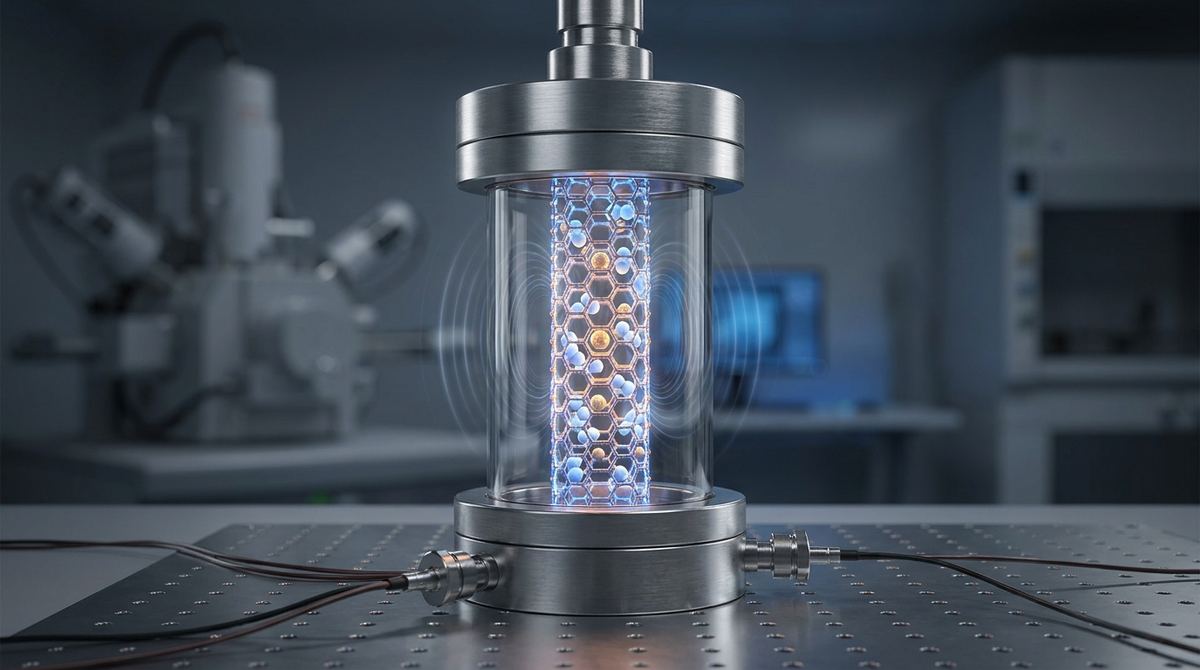
The objective of this prototype is to create a material consisting of single-walled carbon nanotubes (SWCNTs) decorated with calcium atoms that are physically anchored within the nanotube structure. By confining the calcium inside the CNT, we aim to reach the target binding energy of -0.2 to -0.4 eV, as predicted by recent quantum Monte Carlo simulations.
This specific energy range is the sweet spot for mobile hydrogen storage. It allows for high-density storage at manageable pressures while ensuring that the hydrogen can be released efficiently by a small temperature change or pressure drop in the fuel cell system.
Materials and Equipment
To build a laboratory-scale prototype of this material, the following materials and equipment are required:
1. Single-Walled Carbon Nanotubes (SWCNTs): High purity, ideally with a narrow diameter distribution (e.g., 1.2 to 1.5 nm) to ensure the calcium atoms can fit within the tube cavity.
2. Calcium Metal: High-purity calcium (99.9% or higher) for the decoration process.
3. Inert Gas: High-purity Argon (Ar) for glovebox environments and Nitrogen (N2) for purging.
4. Substrate: Silicon wafers with a thin layer of SiO2 or a conductive substrate if electrochemical testing is required.
5. Physical Vapor Deposition (PVD) System: A thermal evaporation or sputtering system capable of operating in high vacuum (10^-6 Torr or better).
6. Vacuum Annealing Furnace: A furnace capable of controlled heating in an inert atmosphere.
7. Characterization Tools:
- Thermogravimetric Analysis (TGA) or Differential Scanning Calorimetry (DSC) for mass change and thermal stability.
- Thermal Desorption Spectroscopy (TDS) to measure the hydrogen release temperature and calculate binding energy.
- Transmission Electron Microscopy (TEM) to verify calcium placement inside the tubes.
Prototype Fabrication Process
The following steps outline the fabrication of the Ca-decorated CNT material. Note that these steps are engineering assumptions based on standard metal-decoration protocols for carbon nanomaterials.
1. Substrate Preparation and CNT Deposition:
Clean the silicon/SiO2 substrate using standard RCA cleaning procedures. Deposit a thin, uniform film of SWCNTs onto the substrate using a vacuum filtration method or spin-coating. The film should be thin enough to allow for accurate mass measurement during TGA but dense enough to provide a significant surface area for adsorption.
2. Calcium Deposition via PVD:
Place the CNT-coated substrate into the PVD chamber. Evaporate a controlled amount of calcium metal onto the substrate. The amount of calcium should be calculated to achieve a low atomic ratio relative to the carbon to prevent the formation of large, bulk calcium clusters. The deposition should occur in a high-vacuum environment to prevent premature oxidation.
3. Thermal Annealing (The Anchoring Step):
This is the most critical step. The Ca-decorated substrate must be annealed in a vacuum or an inert Argon atmosphere. The purpose of annealing is to provide enough thermal energy for the calcium atoms to migrate from the exterior of the nanotubes into the interior cavities.
Assumption: Based on similar metal-carbon systems, an annealing temperature range of 500K to 700K is proposed. Excessive heat may cause the nanotubes to collapse or the calcium to aggregate into large, non-functional clumps.
4. Hydrogen Loading and Desorption Testing:
Once the material is stabilized, expose it to a controlled H2 environment at varying pressures. Use Thermal Desorption Spectroscopy (TDS) to observe the temperature at which the hydrogen is released.
Testing and Validation Protocol
To confirm the prototype meets the engineering requirements, the following tests must be performed:
1. Binding Energy Calculation:
Use the temperature of maximum desorption (Tm) from the TDS data and the Clausius-Clapeyron equation to calculate the isosteric heat of adsorption. The result must fall within the -0.2 to -0.4 eV window.
2. Structural Integrity Check:
Use High-Resolution TEM to visually confirm that the calcium atoms are located inside the nanotubes rather than sitting on the surface. This confirms that the anchoring strategy was successful.
3. Reversibility Test:
Perform multiple cycles of hydrogen adsorption and desorption. A successful prototype should show minimal loss in storage capacity over 50 to 100 cycles.
4. Stability Analysis:
Use TGA to ensure the material does not undergo a phase change into calcium hydride (CaH2) under the operating conditions. If CaH2 is detected, the annealing temperature or the calcium concentration must be adjusted.
Critical Engineering Risks and Mitigation
1. Calcium Oxidation:
Calcium is extremely reactive with oxygen and moisture. Any exposure to air during fabrication will result in calcium oxide (CaO) or calcium hydroxide (Ca(OH)2), which will not bind hydrogen effectively.
Mitigation: All handling must occur in a high-purity Argon glovebox, and all vacuum systems must be checked for leaks.
2. Formation of Calcium Hydride (CaH2):
As noted in the research, calcium on flat surfaces tends to form stable hydrides. If the calcium is not properly anchored inside the CNT, the storage will be irreversible.
Mitigation: Precise control of the calcium deposition rate and the use of CNTs with specific diameters to ensure confinement-driven stabilization.
3. Nanotube Damage:
The thermal energy required for annealing or the energy from the PVD process could damage the hexagonal lattice of the carbon nanotubes.
Mitigation: Use low-energy deposition methods and monitor the structural integrity via Raman spectroscopy after fabrication.
Source Basis and Theoretical Foundation
This guide is based on the theoretical findings presented by Al-Hamdani, Alfè, and Zen (2026) in their research regarding hydrogen storage in Ca-decorated low-dimensional materials. The study utilized fixed-node diffusion Monte Carlo (DMC) simulations to provide high-accuracy benchmarks for binding energies.
The research specifically highlights that while calcium on graphene is unstable due to hydride formation, the use of boron-doped graphene or the confinement of calcium inside carbon nanotubes provides a stable environment that boosts H2 adsorption energy into the viable storage window. The engineering steps and assumptions provided here are intended to translate these quantum-level insights into a physical prototyping workflow for material scientists and engineers.