Imagine a high-speed highway where the lanes are perfectly designed to allow cars to flow smoothly in one direction, but if a car tries to travel the other way, it encounters an unexpected, heavy resistance. In the world of conventional electronics, we use components called diodes to act as these one-way valves, allowing current to flow in only one direction. This is the foundation of almost everything from power adapters to the chips in your smartphone. However, as we push toward the limits of computing power and enter the realm of quantum mechanics, standard silicon-based diodes face insurmountable hurdles, particularly with heat and energy efficiency. Scientists are now looking toward a new frontier: superconductivity. In a superconducting state, electricity flows with zero resistance, meaning no heat is generated. The goal is to create a superconducting version of the diode, known as a Josephson diode. This research, led by Ivan Villani, Luca Chirolli, Matteo Carrega, Alessandro Crippa, Elia Strambini, Francesco Giazotto, Vaidotas Miseikis, Camilla Coletti, Fabio Beltram, Kenji Watanabe, Takashi Taniguchi, Stefan Heun, and their collaborators, suggests that we might not need to engineer perfect, symmetric devices to achieve this. Instead, the natural, messy disorder already present in graphene might be exactly what we need to build the next generation of ultra-efficient electronics.
The Problem This Research Is Solving
The primary challenge in superconducting electronics is the need for non-reciprocity. In a standard superconducting circuit, the current flows equally well in both directions if the circuit is perfectly symmetric. To create a diode, which is essentially a device that breaks this symmetry, researchers usually have to perform incredibly complex engineering. This typically involves applying external magnetic fields or using very specific, highly asymmetric geometric shapes to force the current to favor one direction over the other.
There are two major problems with this traditional approach. First, the engineering required is extremely difficult to scale. Creating perfectly controlled asymmetries in microscopic devices is a manufacturing nightmare, and as devices get smaller, maintaining that precise control becomes nearly impossible. Second, relying on external magnetic fields to break symmetry requires additional power and control circuitry, which defeats the purpose of creating ultra-low-power, highly efficient superconducting systems. We need a way to break symmetry that is "built-in" to the material itself, rather than something we have to impose on it from the outside.
The Key Idea in Plain English
The researchers took a radical approach by looking at the flaws in the material. In most engineering contexts, disorder—the random arrangement of impurities, structural defects, or unevenness in a material—is something to be eliminated. It is seen as a source of noise or a hindrance to performance. However, this research explores the idea that this inherent disorder might actually be a useful tool.
If the disorder in a material like graphene is distributed in an asymmetric way, it can naturally break the symmetry of the electronic environment. Instead of fighting the randomness, the researchers suggest we can exploit it. By using the natural, uneven landscape of electric charges and atomic imperfections within a graphene sheet, they can create a device where current flows more easily in one direction than the other. This turns the concept of "messiness" on its head, transforming it from a manufacturing defect into a functional feature of the device.
How the Graphene-Based System Works
To understand how this works, we must look at the unique properties of graphene and the physics of superconductivity. Graphene is a single layer of carbon atoms arranged in a hexagonal lattice. Because it is only one atom thick, the electrons in graphene are extremely sensitive to their surroundings. They behave as massless particles, often referred to as Dirac fermions, which allows them to move with incredible speed and minimal scattering under the right conditions.
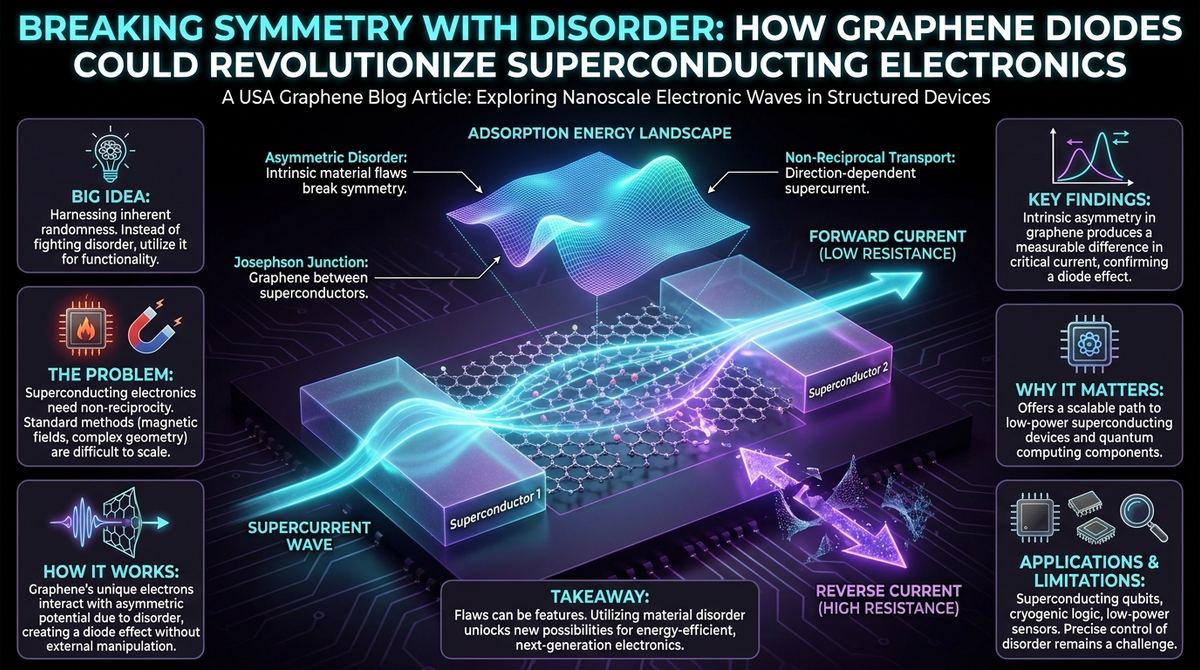
When we place a layer of graphene between two superconductors, we create a device known as a Josephson junction. In this setup, the two superconductors are separated by the thin graphene barrier. Instead of individual electrons flowing through the barrier, the charge carriers are Cooper pairs. These are pairs of electrons that have coupled together due to specific interactions, allowing them to move through a material without any resistance. This movement is governed by the quantum mechanical phase of the superconductors.
In a perfectly symmetric Josephson junction, the current-phase relationship—which describes how the current depends on the difference in the quantum phase between the two superconductors—is a symmetric sine wave. This means that if you reverse the direction of the current, the system behaves exactly the same way. To create a diode, we must break this symmetry.
The researchers found that the inherent disorder in the graphene lattice—caused by small variations in the local electrostatic potential or the presence of random impurities—creates an asymmetric landscape. This landscape creates a gradient in the chemical potential across the graphene channel. Essentially, the electrons experience a slightly different environment when traveling from left to right than they do when traveling from right to left. This spatial asymmetry in the electrochemical potential breaks the inversion symmetry of the junction. Consequently, the relationship between the current and the phase becomes non-reciprocal. This means the superconducting current is no longer a simple, symmetric function, and the device begins to act like a diode, rectifying the flow of Cooper pairs.
What the Researchers Found
The study demonstrated that this inherent asymmetry is sufficient to produce a measurable diode effect. The researchers observed that the critical current—the maximum amount of electricity that can flow through the junction without any resistance—was different depending on the direction of the flow. This is a profound finding because it proves that non-reciprocal transport can be achieved through the natural properties of the material rather than through external intervention.
By measuring the voltage and current characteristics of the graphene-based Josephson junction, the team confirmed that the disorder-induced asymmetry effectively creates a one-way street for Cooper pairs. This was not achieved by applying complex magnetic fields or building intricate, asymmetric geometries. Instead, the "messiness" of the graphene, which is often seen as a limitation in high-performance electronics, was the very driver behind the diode effect. This discovery validates the idea that controlled disorder can be a powerful design tool in the burgeoning field of quantum and superconducting electronics.
Why the Result Matters
This research is significant because it offers a potential solution to the scalability problem in superconducting technology. If we can create Josephson diodes using the inherent properties of the material, we can bypass the need for the extreme precision currently required to engineer asymmetric devices. This would make the manufacturing of superconducting components much more robust and scalable, as the system becomes less dependent on perfect, symmetrical fabrication.
Furthermore, this approach opens up new possibilities for low-power, high-speed computing. Traditional semiconductor-based electronics generate heat due to resistance, which limits how densely we can pack components together. Superconducting electronics, which operate without resistance, promise much higher speeds and significantly lower power consumption. The ability to create efficient, integrated diodes within these superconducting circuits could pave the way for a new class of ultra-fast, energy-efficient processors that could operate at the limits of quantum physics.
Limitations and What Still Needs Testing
While these results are groundbreaking, it is important to note that this research is currently at a fundamental level and is not yet ready for commercial mass production. There are several critical hurdles that remain. First, the nature of the "disorder" used in this study must be understood and controlled more deeply. While the research shows that disorder can be useful, it must be a predictable, reproducible form of disorder. If the disorder is too random or too extreme, it could degrade the performance of the device or prevent the superconductivity from occurring altogether.
Second, these devices currently require extremely low temperatures—typically near absolute zero—to maintain the superconducting state. While this is standard for current superconducting research, it remains a significant barrier for widespread consumer application. Finally, the signal-to-noise ratio of these devices needs to be optimized. In a real-world computing environment, the electrical signals must be clear and distinct; if the inherent disorder creates too much electrical noise, the advantages of the diode effect might be lost.
Real-World Applications
The potential applications for graphene-based Josephson diodes are vast, particularly in the fields of quantum computing and advanced sensing. In quantum computing, many proposed architectures rely on superconducting circuits. The ability to create highly efficient, small-scale components like diodes could allow for more complex and stable quantum bits, or qubits, which are the building blocks of quantum computers.
Beyond quantum computing, these devices could find use in Rapid Single Flux Quantum (RSFQ) logic. This is a type of superconducting digital electronics that could potentially outperform modern silicon-based processors in terms of speed and energy efficiency. Additionally, the high sensitivity of graphene to its electronic environment makes it an ideal candidate for ultra-sensitive sensors. A Josephson diode could be integrated into a sensing array to create highly precise detectors for a variety of scientific and industrial applications, ranging from medical imaging to mineral exploration.
If You Remember One Thing
If you take away only one concept from this research, let it be this: in the future of high-performance computing, we may stop trying to make materials perfect and instead learn how to use their natural imperfections to drive quantum-scale technology.
FAQ
What is a Josephson junction and why is it important?
A Josephson junction is a quantum device consisting of two superconductors separated by a very thin barrier, such as a layer of graphene. It is the fundamental component of superconducting electronics because it allows electric current to flow without resistance through a phenomenon called the Josephson effect. This allows for the creation of incredibly fast and energy-efficient electronic circuits.
Why is graphene used in this research instead of other materials?
Graphene is uniquely suited for this because it is only one atom thick, making its electronic properties extremely sensitive to the environment. This sensitivity allows even small amounts of asymmetry or disorder in the material to have a significant effect on the flow of Cooper pairs, making it an ideal candidate for creating quantum-scale diodes.
What exactly is "asymmetric disorder"?
In most contexts, disorder refers to random defects or impurities in a material. Asymmetric disorder occurs when these defects or impurities are not distributed evenly. This unevenness creates a gradient in the electrical potential across the material, which breaks the symmetry of the system and allows current to flow more easily in one direction than the other.
Does this mean we can replace silicon with graphene in our computers?
Not immediately. While graphene has incredible properties, silicon is currently much easier and cheaper to manufacture at a massive scale. The application of graphene in this context is more likely to be seen in specialized, high-performance fields like quantum computing or ultra-fast superconducting logic, rather than in everyday consumer electronics like your laptop or phone in the near future.
Will these devices work at room temperature?
No, the current research relies on superconductivity, which requires extremely cold temperatures, close to absolute zero, to function. This is because the Cooper pairs that carry the current without resistance are sensitive to heat, which can break them apart. Achieving room-temperature superconductivity is one of the "holy grails" of physics and remains a separate, ongoing area of research.
Conclusion
The research conducted by Ivan Villani and his colleagues represents a fundamental shift in how we approach the design of quantum-scale components. By demonstrating that inherent disorder in graphene can be harnessed to create a Josephson diode, the team has shown that the "flaws" in a material can be transformed into functional advantages. This discovery provides a new roadmap for developing scalable, energy-efficient superconducting electronics, bringing us one step closer to a future of ultra-fast quantum computing and a new era of high-performance, low-power technology.