
Graphene-Silicon Modulator Unlocks High-Speed Data at New Wavelengths
Explore a breakthrough graphene-silicon slot-waveguide modulator. This high-speed device operates at both 1.5 μm and 2 μm, promising next-gen optical networks.
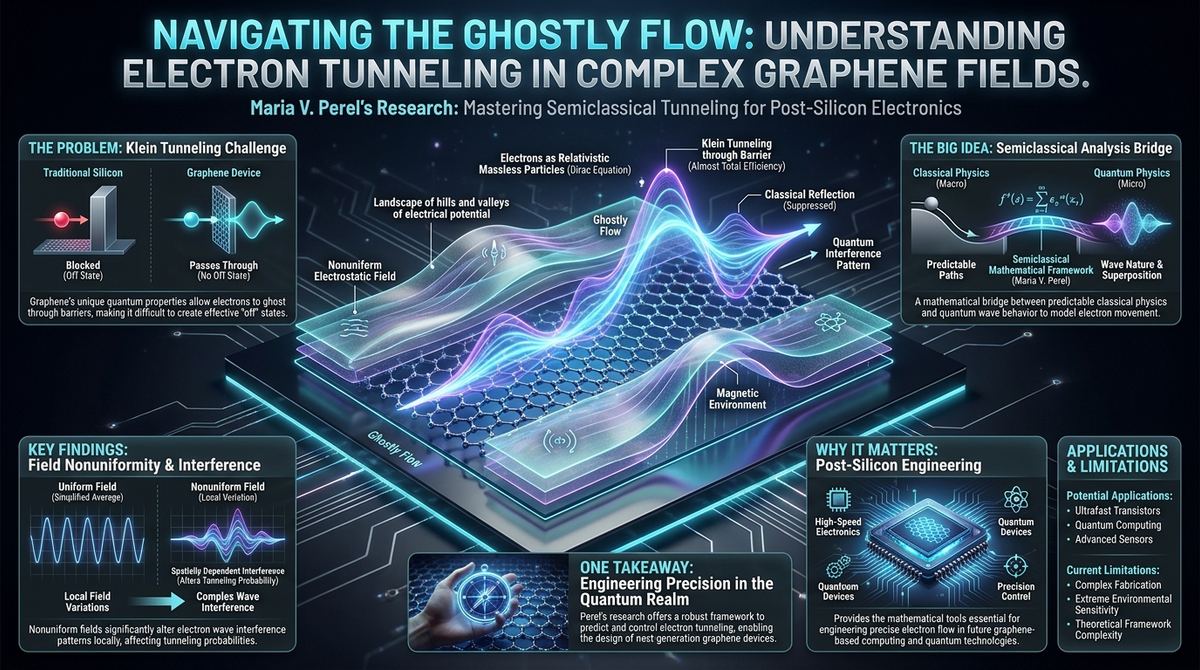
Imagine you are trying to build a high-speed train track, but instead of solid steel rails, the tracks are made of shadows, and the train itself is a ghost that can pass through solid walls. This sounds like a nightmare for an engineer, but it is exactly the situation scientists face when they try to control electricity in graphene. Graphene, a single layer of carbon atoms, is one of the most conductive materials known to man, but it has a strange quirk: its electrons are incredibly good at tunneling, or "ghosting," through barriers that should stop them. This makes it incredibly fast, but it also makes it incredibly difficult to turn off. To master this material for the next generation of supercomputers, we need to understand exactly how these "ghostly" electrons behave when they encounter uneven electrical and magnetic fields.
The primary challenge in graphene-based electronics is the phenomenon known as Klein tunneling. In traditional silicon-based semiconductors, we control the flow of electricity by creating energy barriers. When we apply a voltage, we can raise the barrier high enough that electrons no longer have the energy to cross it, effectively turning the device "off." In graphene, however, the electrons behave more like relativistic particles than standard electrons. Because of their unique quantum properties, they can pass through energy barriers with almost total efficiency, regardless of how high those barriers are. This makes it nearly impossible to create a traditional transistor that can be switched completely off.
Beyond the tunneling problem, there is the issue of nonuniformity. In a perfectly controlled laboratory environment, engineers might attempt to apply a perfectly uniform electric or magnetic field across a graphene sheet. However, in real-world devices, the fields are never truly uniform. There are variations in the voltage applied across the surface, and magnetic fields fluctuate due to the geometry of the device or local impurities. Currently, many models used to predict how graphene behaves assume these fields are constant across the entire material. While these simplified models are useful for basic theory, they fail to capture the messy, complex reality of actual semiconductor manufacturing. Without a mathematical way to predict how electrons move through these uneven landscapes, we cannot reliably design the next generation of graphene-based microchips or quantum sensors.
Maria V. Perel addresses this gap by using a method called semiclassical analysis. To understand this, we have to look at the two different ways we describe the world: classical physics and quantum physics. Classical physics is the world of everyday objects—a ball rolling down a hill follows a predictable, smooth path. Quantum physics is the world of the ultra-small, where particles behave like waves and can exist in multiple places at once or pass through solid objects.
Semiclassical analysis is a mathematical bridge between these two worlds. It allows scientists to use the predictable, smooth paths of classical physics to approximate the much more complex and chaotic behavior of quantum waves. By treating the electron as having a somewhat predictable trajectory while still accounting for its wave-like nature, researchers can solve incredibly difficult equations that would otherwise be impossible. Perel's work specifically applies this "bridge" to graphene, looking at how an electron's wave-like tunneling behavior is influenced when the electric and magnetic forces acting upon it are not steady, but are instead changing depending on where the electron is located in the material.
To understand how this works, we must look at the specific physics of the graphene lattice. In graphene, electrons do not follow the standard Schrödinger equation used for regular semiconductors. Instead, they follow the Dirac equation, which is usually used to describe particles moving near the speed of light. This is why they exhibit Klein tunneling; they behave like massless particles that are essentially "immune" to standard barriers.
When we introduce an electrostatic field, we are essentially creating a landscape of hills and valleys of electrical potential. In a nonuniform electrostatic field, these hills and valleys are shaped irregularly. As an electron travels through the graphene, it encounters these varying heights. Simultaneously, we introduce magnetic fields. A magnetic field exerts a Lorentz force on a moving charge, causing it to curve. In a nonuniform magnetic field, this curvature is not constant. The electron might curve sharply in one area and slowly in another, creating a complex, winding path.
The interaction between these two nonuniform forces—the shifting electrical heights and the shifting magnetic curves—determines the probability that an electron will successfully tunnel through a barrier. The semiclassical approach allows us to calculate how the phase of the electron's wave function changes as it moves along these complex, curving paths. By tracking how the phase shifts as the electron encounters different field strengths, we can determine the final probability of the electron appearing on the other side of the barrier.
The research conducted by Maria V. Perel provides a robust mathematical framework for predicting these tunneling probabilities in complex environments. The core finding is that the nonuniformity of the fields significantly alters the interference patterns of the electron waves. In quantum mechanics, tunneling is often the result of constructive or destructive interference of waves. When the fields are nonuniform, the "shape" of this interference changes in a spatially dependent way.
The study demonstrates that you cannot simply average out the field strengths to predict the result. Instead, the local variations in the electrostatic and magnetic fields create unique "trajectories" for the electron waves. This means that the tunneling current—the actual amount of electricity that leaks through—is highly sensitive to the specific shape and pattern of the nonuniformity. Perel's mathematical analysis provides the tools to map these sensitivities, allowing for a much more precise prediction of electron behavior than was previously possible with simplified, uniform models. This moves the field of graphene physics from qualitative descriptions (saying that tunneling happens) to quantitative precision (calculating exactly how much tunneling occurs in a messy, real-world field).
This research is vital because it provides a roadmap for engineering precision in the post-silicon era. As the semiconductor industry looks toward graphene to replace or augment silicon, the ability to control electron flow is the most important requirement. If we cannot predict how much electricity will leak through a transistor because of nonuniform fields, we cannot design reliable digital logic.
The ability to calculate tunneling in nonuniform fields means that engineers can begin to design "compensation" mechanisms. If we know exactly how a specific nonuniform magnetic field will affect electron tunneling, we can design the device's geometry or its electrical inputs to counteract that effect. This is the difference between a material that is a scientific curiosity and a material that can be used to build a smartphone or a supercomputer. Furthermore, this research has implications for the development of highly sensitive quantum sensors. If we know exactly how an electron's tunneling probability changes in response to small, nonuniform magnetic fields, we can use that sensitivity to create sensors capable of detecting incredibly faint magnetic signals, which could revolutionize medical imaging or geological surveying.
While these mathematical findings are a significant step forward, it is important to recognize that this is a theoretical and semiclassical model. Semiclassical analysis, by its very nature, is an approximation. It works best when the variations in the fields occur over distances much larger than the electron's wavelength. In extremely small, nanoscale devices where the fields might change abruptly over a distance of just a few atoms, the semiclassical approximation may break down, and full quantum mechanical simulations would be required.
Additionally, this model focuses on the interaction between the electron and the external fields. In a real-world graphene device, there are other complex factors at play. These include impurities within the graphene lattice itself, interactions with the substrate upon which the graphene sits, and thermal fluctuations caused by heat. A theoretical model that perfectly accounts for every single defect and every single vibrating atom in a real-world device is currently beyond our computational reach. Therefore, while Perel's work provides the mathematical foundation, experimentalists will still need to conduct extensive testing to see how well these semiclassical predictions hold up in physical, imperfect devices.
The implications of mastering electron tunneling in graphene extend across several high-tech industries. In the field of electronics, the most immediate application is the development of "Graphene Field-Effect Transistors" (GFETs) that can actually function in digital logic. By using these mathematical models, engineers can design devices that minimize leakage and maximize switching speed, paving the way for computers that are significantly faster and more energy-efficient than today's silicon-based machines.
In the realm of quantum computing, graphene is being investigated as a platform for qubits. Controlling the movement and tunneling of electrons is essential for manipulating quantum information. Precise knowledge of how nonuniform fields affect electron waves could allow for more stable and controllable quantum gates. Additionally, in the field of sensing, the high sensitivity of tunneling to magnetic field variations could lead to a new class of ultra-sensitive magnetometers. These could be used in non-invasive medical diagnostics, such as mapping brain activity with unprecedented resolution, or in industrial settings to detect microscopic cracks in materials by observing how they distort local magnetic fields.
If there is one takeaway from this research, it is that the "messiness" of real-world conditions—the nonuniformity of electric and magnetic fields—is not just a hurdle to be ignored, but a complex physical variable that can be mathematically mastered to unlock the true potential of graphene.
What is graphene and why is it special? Graphene is a single, one-atom-thick layer of carbon atoms arranged in a hexagonal pattern. It is special because its electrons behave like massless particles, allowing them to move at extremely high speeds and exhibit unique quantum properties like Klein tunneling.
Why is electron tunneling a problem for electronics? In digital electronics, a transistor needs to act like a switch that can be turned completely off to represent a zero. Because graphene electrons can tunnel through barriers, they tend to "leak" through even when the switch is off, making it difficult to maintain a clear distinction between an on and off state.
What does "nonuniform" mean in this context? In physics, a uniform field is one that is the same everywhere in a given area. A nonuniform field is one that changes in strength or direction depending on where you are. In a real device, the voltage and magnetic field are rarely the same at every single point on the graphene sheet.
How does semiclassical analysis help scientists? Quantum mechanics is incredibly difficult to solve for complex, real-world situations. Semiclassical analysis allows scientists to use the simpler rules of classical physics to approximate the behavior of quantum waves, making it possible to calculate how electrons behave in complicated, uneven environments.
How will this research affect future technology? This research provides the mathematical tools needed to design graphene-based devices that actually work in the real world. By understanding how nonuniform fields affect electron flow, engineers can design more reliable transistors, faster computers, and more sensitive quantum sensors.
This research points toward a practical lesson: graphene-based materials are most powerful when their nanoscale properties are connected to a clear engineering problem. The result is not a finished commercial product by itself, but it gives researchers and manufacturers a better map for designing lighter, more sensitive, or more durable systems. Future work still needs testing under real operating conditions, but the direction is promising because it joins materials science with application-driven design.
Serious about B2B integration? Test our premium Pulsed Electrical Resistive Carbon Heating turbostratic graphene in your lab. 100g sample packs available now.
Explore More
Explore a breakthrough graphene-silicon slot-waveguide modulator. This high-speed device operates at both 1.5 μm and 2 μm, promising next-gen optical networks.

New research reveals that mechanical strain doesn't just reduce but fundamentally reshapes heat flow in graphene, a critical insight for flexible...

Learn to build a gate reflectometry sensor using bilayer graphene. This practical guide details a non-contact method for material characterization.