
An Exact Solution for Electron Transport and Resistivity in the Hubbard Model
Researchers derived the first exact formula for resistivity in the 1D infinite-U Hubbard model, providing a crucial benchmark for understanding strongly...
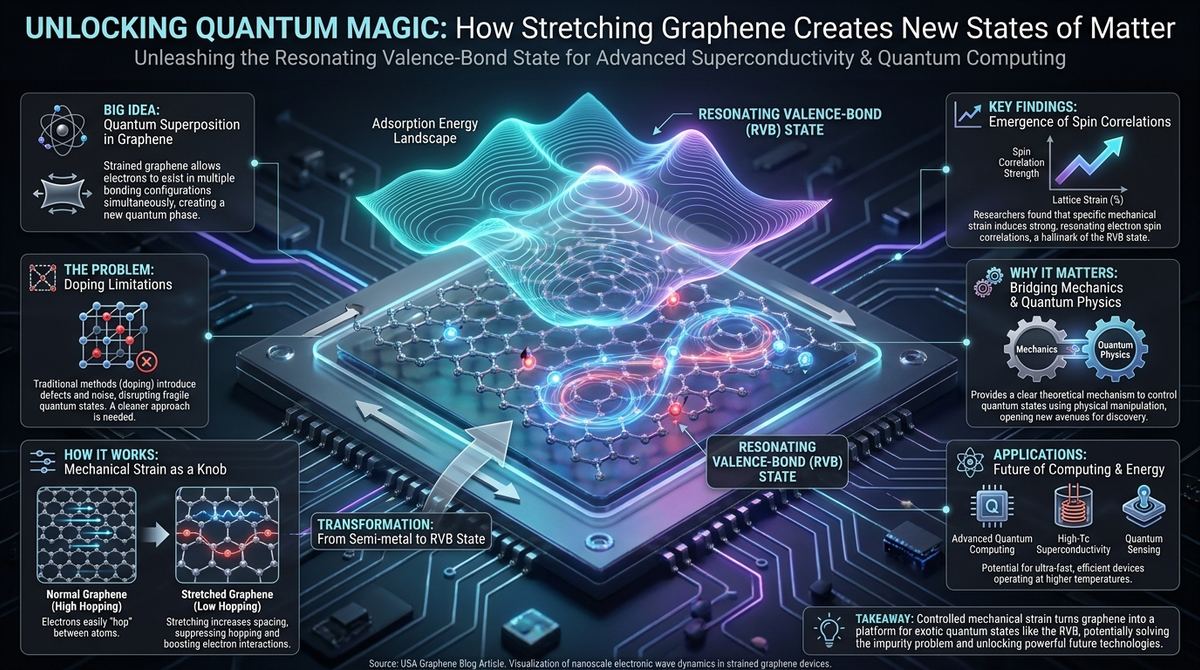
TITLE: Unlocking Quantum Magic: How Stretching Graphene Creates New States of Matter
EXCERPT: New research explores how mechanical strain can transform graphene into a Resonating Valence-Bond state, potentially opening doors to advanced superconductivity and quantum computing.
IMAGE_PROMPT: A high-end 16:9 scientific cover image showing a hexagonal carbon lattice being pulled apart by invisible forces, with glowing blue and red electron wavefunctions resonating between the atoms in a quantum superposition. Cinematic lighting, macro photography style, deep scientific aesthetic.
Imagine having a material that you could change just by pulling on it. Imagine if you could take a simple sheet of carbon and, by stretching it slightly, transform it from a simple conductor into a playground for exotic quantum particles that could power the computers of the future. This is the promise of mechanical strain engineering, a field where we use physical force to rewrite the rules of physics at the atomic level. A groundbreaking study by Sam Azadi, A. Principi, T. D. Kühne, and M. S. Bahramy suggests that we are on the verge of unlocking a highly coveted state of matter known as the Resonating Valence-Bond or RVB state within graphene. By understanding how stretching this single layer of atoms influences the dance of electrons, scientists are finding a new way to engineer the next generation of quantum technologies.
In the search for new materials, scientists often hit a wall known as the chemical impurity problem. Traditionally, if we want to change the properties of a material—for instance, to make it a superconductor or a magnetic insulator—we have to "dope" it. Doping involves adding foreign atoms or chemical elements into the crystal structure to change how electrons behave. While effective, doping is a blunt instrument. It introduces "noise" into the system because the foreign atoms are often distributed unevenly, creating defects and scattering sites that disrupt the very quantum effects we are trying to observe.
Furthermore, the most interesting states of matter, such as high-temperature superconductors, are notoriously difficult to understand and control. For decades, physicists have been searching for a "clean" way to tune a material through a quantum phase transition—a moment where the material's fundamental identity changes due to a single parameter. Graphene, with its perfect, flawless hexagonal lattice, is the ideal candidate for this study, but standard graphene is a semi-metal with very specific, stable electronic properties. To force graphene out of its comfortable, predictable state and into something more exotic, we need a way to tune it without adding chemical clutter. This is where mechanical strain enters the picture. The problem is determining whether and how the physical act of stretching the lattice can trigger these complex, highly sought-after quantum correlations.
To understand the concept of a Resonating Valence-Bond state, we must first understand how electrons behave in a normal material. Usually, electrons are like commuters on a highway, moving from one point to another to carry an electric current. In some materials, electrons form "singlets," which are essentially pairs of electrons that are magnetically neutralized because their spins point in opposite directions. In a standard crystal, these pairs might be fixed and static.
The Resonating Valence-Bond (RVB) state is much more exotic. Instead of being stuck in one configuration, the electron pairs are in a state of quantum superposition. They are "resonating" between many different possible configurations simultaneously. Think of it like a series of dancers on a floor. In a standard state, a dancer is paired with one specific partner and stays with them. In an RVB state, the dancers are constantly switching partners in a rhythmic, synchronized dance that covers the entire floor. This "resonance" creates a highly entangled quantum environment. This state is a prime candidate for explaining high-temperature superconductivity and the behavior of quantum spin liquids, which are states of matter where magnetism is "liquid" rather than solid.
The mechanism behind this transformation is a delicate tug-of-war between two competing forces in the graphene lattice: the kinetic energy of the electrons and the repulsion between them. In its natural state, graphene is a honeycomb lattice where carbon atoms are spaced at a very specific distance. In this configuration, the electrons have a high "hopping" probability. This means they can easily jump from one atom to the next, making graphene an excellent conductor. In physics terms, we say the "hopping integral" is large.
When you stretch graphene, you physically increase the distance between these carbon atoms. This change in geometry has a profound effect on the electron orbitals. As the atoms move further apart, the overlap between their electron clouds decreases. This reduction in overlap directly lowers the hopping probability. As the electrons find it harder to move from site to site, their kinetic energy decreases.
As the kinetic energy drops, the "on-site repulsion" becomes the dominant force. This is the energy cost that occurs when two electrons try to occupy the same atom at the same time. When the cost of moving (hopping) is much higher than the energy gained by moving, the electrons become "localized." They become stuck, one per atom. However, because they are quantum particles, they don't just sit still like statues. Even when stuck, their spins (their intrinsic magnetic properties) interact with one another. As the stretching continues and the electrons become more localized, the interaction between these spins leads to the formation of the valence bonds. Because the graphene lattice is so highly symmetrical, these bonds don't settle into a single pattern; instead, they begin to resonate, creating the RVB state described by Azadi, Principi, Kühne, and Bahramy.
The research conducted by Sam Azadi, A. Principi, T. D. Kühne, and M. S. Bahramy provides a theoretical roadmap for identifying this transition. Their findings indicate that by applying specific amounts of mechanical strain, the electronic system in graphene undergoes a fundamental shift. The researchers demonstrated that as the hopping energy is suppressed through lattice expansion, the system moves away from being a simple semi-metal and enters a regime characterized by strong spin correlations.
Specifically, the study highlights the emergence of these resonating correlations, meaning the electrons begin to form the "dancing" pairs mentioned earlier. This is a significant finding because it proves that the RVB state is not just a mathematical curiosity for specific, rare materials, but a state that can be "engineered" into a well-known material like graphene through physical deformation. The researchers showed that the symmetry of the graphene lattice is crucial; it is this very symmetry that allows the resonance to occur rather than the system falling into a standard, static magnetic order. This suggests that strain is not just a way to distort a material, but a precise "tuning knob" to access entirely new phases of quantum matter.
This research is significant because it bridges the gap between two massive fields: mechanics and quantum physics. For years, the "holy grail" of condensed matter physics has been to find a clear, theoretical mechanism for high-temperature superconductivity. Many scientists believe that the RVB state is the key to understanding why certain materials can conduct electricity with zero resistance at much higher temperatures than previously thought possible.
By showing that graphene can be driven into an RVB state via strain, this research provides a "clean" platform for studying these effects. If we can observe these correlations in a controlled, laboratory setting using graphene, we can learn the fundamental rules of high-temperature superconductivity without the interference of chemical impurities. This could lead to a "design manual" for new materials. Instead of discovering new superconductors by accident through trial and error, we might learn how to "strain-engineer" them into existence. Furthermore, the ability to tune a material's state through mechanical force opens up a new dimension of control for semiconductor technology and quantum device architecture.
It is important to note that this research, as presented in the arXiv preprint, is a theoretical and computational study. While the math and the models provide a compelling argument for the emergence of RVB correlations, the work has not yet been translated into a physical, commercial device. There are several significant hurdles that remain before this can be applied in industry.
First, there is the challenge of "strain uniformity." In a laboratory setting, stretching a single layer of carbon atoms uniformly across a large area without causing cracks or irregular distortions is an immense engineering feat. If the strain is uneven, the RVB state might only exist in tiny, disconnected patches, making it useless for practical applications. Second, the temperature factor is critical. Many of these quantum effects are extremely fragile and can only be observed at temperatures near absolute zero. For this to have a real-world impact, researchers will need to determine if these strain-induced correlations can survive at higher, more manageable temperatures. Finally, the transition from a theoretical model to a scalable fabrication process is a long journey that involves much more than just stretching a sheet of carbon.
If the theoretical predictions of Azadi and colleagues can be realized in physical devices, the implications for technology are staggering. One of the most direct applications is in the field of quantum computing. Current quantum computers are limited by "decoherence," where the delicate quantum state of a qubit is destroyed by environmental noise. Materials that exhibit RVB correlations and topological properties could potentially host "topologically protected" qubits. These would be much more stable and resistant to errors, potentially leading to a new era of scalable, fault-tolerant quantum computers.
Another application lies in ultra-sensitive sensors. Since the electronic state of stretched graphene is so sensitive to the amount of strain applied, we could develop sensors that can detect infinitesimal movements or pressures by measuring changes in the quantum phase of the material. This could revolutionize everything from medical imaging to earthquake detection. Finally, the ultimate goal remains the development of high-temperature superconductors. If we can master the art of strain-engineering RVB correlations, we might create power grids that lose zero energy during transmission, revolutionizing how we distribute electricity across the planet.
If you take away only one concept from this research, let it be this: mechanical force can change the fundamental identity of a material. By stretching graphene, we are not just changing its shape; we are changing how its electrons interact, potentially unlocking exotic quantum states like the Resonating Valence-Bond state that could redefine the future of computing and energy.
Question: What exactly is graphene?
Answer: Graphene is a single layer of carbon atoms arranged in a hexagonal, honeycomb-like lattice. It is famous for being incredibly strong, thin, and highly conductive, making it a superstar in the world of materials science.
Question: Why does stretching graphene change its electrical properties?
Answer: When you stretch graphene, you increase the distance between the carbon atoms. This makes it harder for electrons to "hop" from one atom to another, which changes how the electrons interact with each other and can fundamentally change the material's electronic phase.
Question: What is a Resonating Valence-Bond (RVB) state?
Answer: An RVB state is a quantum state where electrons form pairs that are not fixed in place. Instead, these pairs are in a "superposition," meaning they are constantly shifting and resonating between different configurations, creating a highly entangled and complex quantum environment.
Question: Is this research ready for commercial use?
Answer: No, this is currently a theoretical research paper. While the findings are very exciting and provide a roadmap for future studies, it will take many years of experimental testing and engineering to turn these theoretical ideas into real-world products.
Question: How does this relate to superconductivity?
Answer: Many scientists believe that the RVB state is a key ingredient in high-temperature superconductivity. If we can master the conditions that create this state, we might be able to create materials that conduct electricity with zero resistance at much higher temperatures.
This research points toward a practical lesson: graphene-based materials are most powerful when their nanoscale properties are connected to a clear engineering problem. The result is not a finished commercial product by itself, but it gives researchers and manufacturers a better map for designing lighter, more sensitive, or more durable systems. Future work still needs testing under real operating conditions, but the direction is promising because it joins materials science with application-driven design.
Serious about B2B integration? Test our premium Pulsed Electrical Resistive Carbon Heating turbostratic graphene in your lab. 100g sample packs available now.
Explore More
Researchers derived the first exact formula for resistivity in the 1D infinite-U Hubbard model, providing a crucial benchmark for understanding strongly...

Learn how to utilize bipartite-lattice symmetry to generate pure spin shift currents in graphene nanoribbons for advanced spintronic device prototyping.

Researchers propose a novel method to detect spin- and valley-polarized states in van der Waals materials, a key step for next-gen spintronics and...