
Practical Guide: Engineering Pure Spin Current Generators with Ferromagnetic GNRs
Learn how to utilize bipartite-lattice symmetry to generate pure spin shift currents in graphene nanoribbons for advanced spintronic device prototyping.
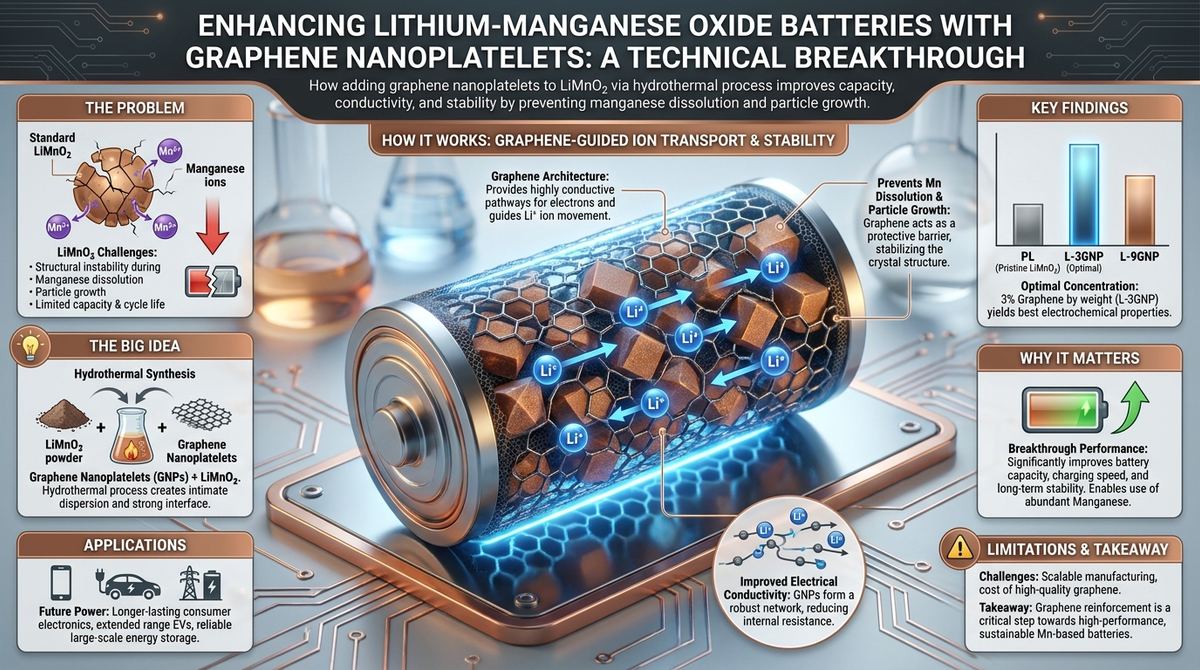
Imagine a smartphone that stays charged for a week or an electric vehicle that travels much further on a single charge without the battery degrading after just a few years of use. The bottleneck for this future is not just energy density, but the fundamental chemistry inside the battery itself. As we push for more powerful devices, the materials used in our batteries often struggle to keep up, breaking down or losing their ability to hold a charge as they work. Recent scientific advancements are tackling this head-on by using a super-material known as graphene to reinforce the chemistry inside our batteries. This research represents a significant step toward making next-generation energy storage more durable and efficient.
The quest for better batteries often focuses on lithium manganese oxide, specifically the orthorhombic form known as LiMnO2. This material is highly attractive for large-scale energy storage and consumer electronics because manganese is relatively abundant and inexpensive compared to cobalt, which is much more volatile in price and ethically complex to mine. However, LiMnO2 faces several critical chemical hurdles that prevent it from reaching its full potential.
One major issue is the structural instability that occurs during the charging and discharging cycles. As lithium ions move in and out of the crystal structure, the material undergoes physical stress. Over time, this stress causes the primary particles of the LiMnO2 to grow or aggregate. When these particles grow too large, the surface area available for lithium ions to interact with decreases, which directly leads to a drop in the battery's capacity. This is a fundamental degradation mechanism that shortens the lifespan of the battery.
Another significant problem is the phenomenon known as manganese dissolution. During the electrochemical process, manganese ions can sometimes escape the crystal structure and dissolve into the liquid electrolyte. Once manganese is lost from the electrode structure, the battery loses its ability to hold a charge, and the dissolved manganese can migrate to other parts of the battery, causing even more damage and reducing overall efficiency. This chemical leakage is a primary reason why many lithium-ion batteries lose capacity over hundreds of cycles. Finally, pure LiMnO2 suffers from relatively low electrical conductivity, meaning it is difficult for electrons to move quickly through the material, which limits how fast the battery can be charged or discharged.
To solve these problems, a team of researchers including Ngoc Binh Duong, Van Thang Pham, Tuan Hung Hoang, Van Duong Dao, Hong Thang Le, and Duc huy Tran looked toward a solution involving graphene nanoplatelets, or GNPs. Graphene is a single layer of carbon atoms arranged in a hexagonal lattice, known for being incredibly strong and exceptionally conductive. By creating a composite material that mixes LiMnO2 with these graphene platelets, the researchers aimed to create a reinforced structure.
Instead of just mixing the two powders together like salt and pepper, the researchers used a specialized technique called a hydrothermal process. This process happens in a pressurized, heated water environment, which allows the LiMnO2 and the graphene to grow together in a highly integrated, in-situ composite. The idea is to use the graphene to create a protective and conductive scaffolding. This scaffolding should act like a cage to prevent the LiMnO2 particles from growing too large, a shield to keep the manganese from dissolving, and a high-speed highway to help electricity move more freely through the electrode.
To understand why this composite works so well, we have to look at the interaction between the graphene and the lithium manganese oxide at the molecular level. The hydrothermal synthesis is the critical first step. Because the reaction occurs under high temperature and pressure in an aqueous solution, the graphene nanoplatelets become intimately dispersed throughout the LiMnO2 matrix. This creates a massive amount of interface, or contact points, between the carbon and the metal oxide.
The first major benefit is the improvement in electrical conductivity. In a standard battery electrode, electrons must travel through the crystal lattice of the oxide material. Lithium manganese oxide is not a perfect conductor, which creates resistance. When graphene is integrated into the structure, it provides a continuous, highly conductive network. This network allows electrons to bypass the more resistive parts of the oxide, significantly lowering the charge-transfer resistance. Lower resistance means that the battery can handle higher currents with less heat generation and better efficiency.
The second mechanism is the physical limitation of particle growth. During the hydrothermal process, the graphene nanoplatelets act as physical barriers between the growing crystals of LiMnO2. As the particles attempt to coalesce and grow larger, the thin sheets of graphene sit between them, preventing them from merging. This keeps the primary particles small and well-distributed. Smaller particles mean a much higher surface-area-to-volume ratio, which provides more active sites for lithium ions to enter and exit the material, thereby increasing the capacity for charge storage.
The third mechanism addresses the chemical stability of the manganese. By coating the LiMnO2 particles with a layer of graphene, the researchers created a protective barrier that suppresses the dissolution of manganese ions. This barrier makes it much harder for Mn3+ ions to escape the crystal lattice and enter the electrolyte. Additionally, the graphene helps manage the volume changes that occur during the electrochemical reaction. As ions move in and out, the electrode physically expands and contracts. The flexible, incredibly strong nature of the graphene nanoplatelets helps absorb these mechanical stresses, reducing the risk of the electrode cracking or losing structural integrity over time.
The research team tested several different concentrations of graphene to find the optimal balance for performance. They synthesized a series of composites labeled L-xGNP, where x represented the weight percentage of graphene nanoplatelets, ranging from 1 percent to 9 percent. The study compared these composites against a pristine sample of LiMnO2, referred to as PL.
The results showed that the addition of graphene significantly improved the electrochemical properties, but more graphene is not always better. The researchers discovered that the L-3GNP sample, which contained exactly 3 percent graphene by weight, was the optimal configuration. This specific concentration provided the best balance of structural protection and electrical performance.
At a slow discharge rate of 0.1 C, the L-3GNP composite achieved a discharge capacity of 151.90 mAh/g. When the rate was increased to 1 C, which is a much faster discharge, the capacity remained robust at 98.46 mAh/g. This is a remarkable result because it shows the material can maintain high performance even when the battery is being pushed harder. Furthermore, the L-3GNP sample demonstrated incredible longevity. After 90 full charge and discharge cycles, it retained over 94 percent of its original capacity.
The technical measurements also confirmed the structural benefits. The L-3GNP composite exhibited the lowest charge-transfer resistance at 72.007 ohms. It also showed a significantly higher electrical conductivity of 4.95 times 10 to the negative 5 S/cm. These numbers prove that the graphene successfully created the conductive pathways and reduced the internal resistance necessary for high-performance energy storage.
These findings are significant because they address the core issues that have historically limited the use of manganese-based cathodes. By proving that a 3 percent addition of graphene can stabilize LiMnO2, the researchers have provided a blueprint for creating batteries that are both cheap and durable. The ability to maintain 94 percent capacity after 90 cycles is a strong indicator that the suppression of manganese dissolution and particle growth is working effectively.
For the energy industry, this is a vital step toward making lithium-ion batteries more sustainable. As the world shifts toward renewable energy, we need large-scale storage solutions that can last for years without needing replacement. Manganese-based materials are perfect for this, provided they can be made stable. This research shows that graphene-based composites can bridge that gap, offering a path toward high-capacity, long-cycle-life electrodes that do not rely on expensive or scarce metals like cobalt.
While the results are highly promising, it is important to view them within the context of a laboratory environment. This study focused on the fundamental electrochemical performance over 90 cycles. While 90 cycles is a significant achievement for a new material, it is only a tiny fraction of the lifespan required for commercial applications. For example, an electric vehicle battery is expected to survive thousands of cycles. Further testing is required to see if the graphene protection remains effective over hundreds or thousands of cycles.
Additionally, the hydrothermal synthesis process, while effective for creating high-quality composites, is a complex method to scale up for mass manufacturing. Translating a laboratory-scale hydrothermal process into a continuous, high-throughput industrial process presents significant engineering challenges. There is also the question of the electrolyte interaction; while the graphene suppresses manganese dissolution, the long-term chemical compatibility between the graphene, the oxide, and the specific electrolytes used in commercial batteries needs deeper investigation.
The implications for real-world technology are vast. In the consumer electronics sector, this technology could lead to smartphones and laptops that charge faster and maintain their battery health for years longer than current models. The improved conductivity means faster charging, which is a primary requirement for modern mobile devices.
In the realm of electric vehicles, the stability provided by the graphene-LiMnO2 composite could lead to more affordable EV battery packs. By reducing the reliance on cobalt and increasing the cycle life of manganese-based cathodes, manufacturers could significantly lower the cost of electric cars, making them accessible to a much wider population.
Furthermore, this research is highly relevant to grid-scale energy storage. As we transition to wind and solar power, we need massive battery systems to store energy when the sun is not shining or the wind is not blowing. These systems require materials that are extremely stable and can operate reliably for many years. A highly stable, manganese-based composite could provide the cost-effective, long-duration storage necessary to stabilize a green energy grid.
If you take away only one detail from this research, let it be that adding a tiny amount of graphene—specifically 3 percent—to lithium manganese oxide creates a powerful synergy that prevents the battery from degrading, making it more conductive, more stable, and much more efficient.
What exactly is graphene and why is it so special for batteries?
Graphene is a single layer of carbon atoms arranged in a hexagonal lattice. It is incredibly thin, yet it is one of the strongest materials known and possesses extraordinary electrical conductivity. In a battery, it acts as a conductive highway for electrons and a physical support structure that keeps the other battery materials from breaking down.
Why is manganese dissolution a problem for battery life?
Manganese dissolution occurs when the metal ions within the cathode escape into the liquid electrolyte during the charging and discharging process. When these ions leave the cathode, the chemical structure of the battery electrode is physically damaged and permanently loses its ability to store lithium ions, which causes the battery capacity to drop rapidly.
How does the hydrothermal process help create a better composite?
The hydrothermal process uses high temperature and pressure in a water-based environment to facilitate a chemical reaction. This allows the graphene and the lithium manganese oxide to grow together in a highly integrated way. This in-situ growth is much more effective than simply mixing two powders, as it ensures the graphene is perfectly positioned to protect and conduct electricity through the oxide.
What does a 0.1 C discharge rate mean?
The C-rate refers to the speed at which a battery is charged or discharged. A 1 C rate means the battery is being discharged at a rate that would empty the entire battery in one hour. A 0.1 C rate is much slower, meaning the battery is being discharged at a rate that would take ten hours to fully empty. Testing at different C-rates helps scientists understand how a battery performs under both slow and heavy use.
Why was 3 percent the optimal amount of graphene?
The researchers found that while adding graphene improved performance, adding too much can be counterproductive. If there is too much graphene, it can increase the overall weight of the electrode without providing enough additional benefit, or it could potentially block the pathways that lithium ions need to travel through. The 3 percent mark represents the "sweet spot" where the benefits of conductivity and structural protection are maximized without excessive weight or interference.
The research conducted by Ngoc Binh Duong and the team provides a compelling case for the use of graphene nanoplatelets to revolutionize lithium manganese oxide cathodes. By utilizing a one-step hydrothermal process, they successfully engineered a composite that solves three major problems: particle growth, manganese dissolution, and low electrical conductivity. The L-3GNP composite, with its 151.90 mAh/g capacity and exceptional stability, marks a significant milestone in the development of high-performance, cost-effective energy storage. While further testing is needed to scale this technology for commercial use, the potential for more durable, faster-charging, and more affordable batteries is clearer than ever.
Serious about B2B integration? Test our premium Pulsed Electrical Resistive Carbon Heating turbostratic graphene in your lab. 100g sample packs available now.
Explore More
Learn how to utilize bipartite-lattice symmetry to generate pure spin shift currents in graphene nanoribbons for advanced spintronic device prototyping.

Researchers propose a novel method to detect spin- and valley-polarized states in van der Waals materials, a key step for next-gen spintronics and...

Researchers developed the CARBON-2D Topological Descriptor (C2DTD), an interpretable, physics-informed method to rapidly predict the properties of new 2D...