
Generalized Beth-Uhlenbeck Model for Graphene Electronics
Researchers use the Generalized Beth-Uhlenbeck approach to model electron interactions in 2D materials, offering a new way to predict graphene's behavior.
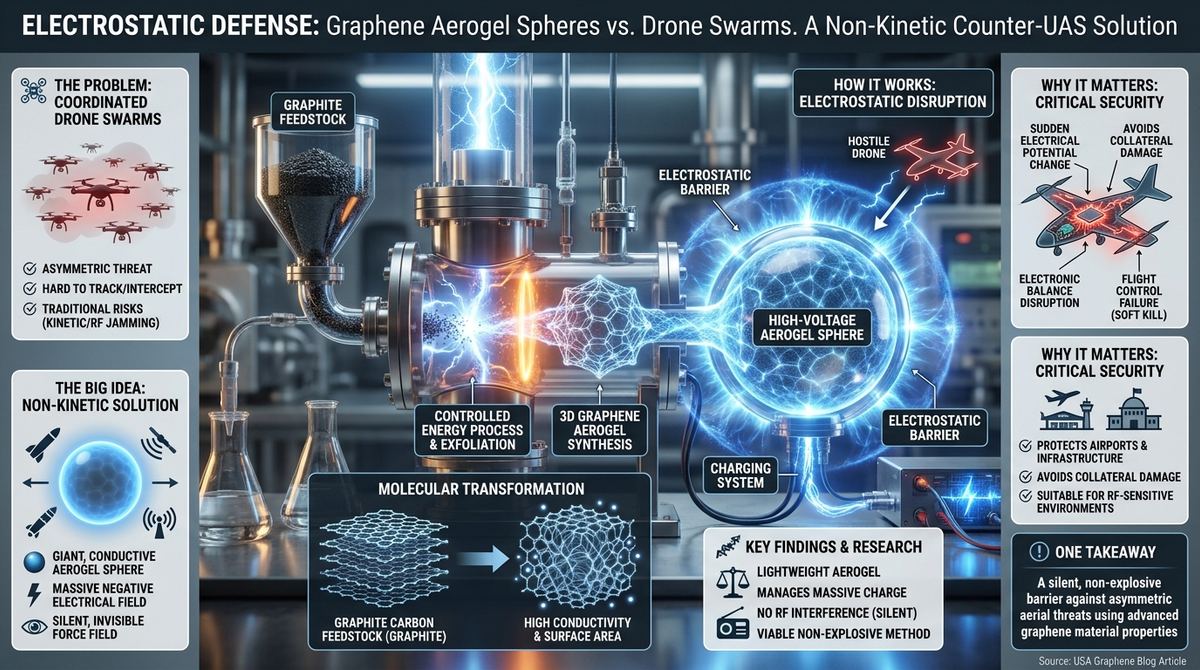
Imagine a world where the threat of a coordinated drone swarm—a cloud of hundreds of small, cheap, and highly maneuverable aircraft—could be neutralized not by missiles or bullets, but by a silent, invisible force field. Traditional defense methods often rely on kinetic projectiles that create dangerous debris or radio frequency jamming that can disrupt civilian communications. However, a new paradigm in airspace protection is emerging through the innovative work of Alaa Mohammed Hammouda, who has proposed a method that uses the unique electrical properties of graphene to create a massive electrostatic barrier. This approach offers a way to protect critical infrastructure from unmanned aerial vehicles (UAVs) using nothing more than high-voltage physics and advanced material science.
The rise of unmanned aerial systems has fundamentally changed the landscape of security. While drones offer immense benefits for delivery, photography, and agriculture, they also present a significant asymmetric threat. A single operator can deploy a swarm of drones that are difficult to track and even harder to intercept using traditional means. Current counter-UAS technologies generally fall into three categories: kinetic, electronic, and directed energy. Kinetic solutions, such as interceptor drones or anti-aircraft guns, are expensive and produce fragmentation that can pose a risk to the very assets they are trying to protect. Electronic solutions, such as RF jamming, work by flooding the frequency bands used by the drone to disrupt its link to the operator. However, modern drones are increasingly equipped with autonomous navigation systems that do not rely on constant RF signals, rendering jamming less effective. Directed energy systems, like high-powered lasers, are effective but require massive amounts of power and can be difficult to deploy in varied environments.
The core challenge is to find a method that is clean, scalable, and capable of addressing autonomous drones that do not rely on traditional communication signals. There is a critical need for a non-kinetic, non-explosive, and non-RF-emissive system that can protect sensitive areas like airports, power plants, and government buildings without causing collateral electronic damage to civilian infrastructure. The current security landscape lacks a "clean" method of neutralization—one that can disable a drone by targeting its fundamental physical operating principles rather than its communication or propulsion systems.
The solution proposed is as elegant as it is startling: a giant, lightweight, highly conductive sphere. Instead of shooting something at the drone or broadcasting radio waves, this system creates a massive electrical field around a large sphere made of graphene aerogel. This sphere is charged to a very high negative voltage. When a drone flies into this massive electric field, the sudden change in electrical potential disrupts the delicate electronic balance inside the drone. The drone essentially experiences an unexpected electrical surge or a disruption in its electrical environment that causes its flight controllers or motors to fail. Because the sphere is made of graphene aerogel, it can be enormous in size while remaining light enough to be managed, providing a wide area of protection through a silent, invisible, and non-destructive electrostatic barrier.
To understand why this system is effective, we must look at the molecular architecture of the materials involved. Graphene is a single layer of carbon atoms arranged in a hexagonal lattice. This structure is famous for its extraordinary electrical conductivity, which arises from the delocalized electrons that can move freely across the surface with very little resistance. When graphene is converted into an aerogel, it retains much of this conductivity but gains a highly porous, three-dimensional structure. This aerogel is almost entirely air, consisting of a skeletal network of graphene that provides immense surface area and structural integrity while maintaining an incredibly low density.
The system utilizes a 40-meter sphere of this graphene aerogel. By charging this sphere to -100 kV, a massive electrostatic field is generated. The effectiveness of this field is driven by several physical mechanisms. First, the high conductivity of the graphene ensures that the charge is distributed uniformly across the entire surface of the sphere. This prevents "hot spots" and ensures that the electric field is stable and predictable. Second, the system can utilize ion injection to enhance its reach. By injecting ions into the air surrounding the sphere, the system can effectively increase the conductivity of the surrounding atmosphere, effectively expanding the sphere's "zone of influence" through a localized plasma or ionized air layer.
When a drone enters this field, the interaction is governed by the principles of electrostatic induction and capacitive coupling. As the drone approaches the -100 kV sphere, the intense electric field induces a redistribution of charges on the drone's outer shell and within its internal circuitry. This creates a potential difference between different components of the drone. Because the drone’s flight controller and sensors operate on very low voltages, even a minor electrostatic discharge or a significant shift in the local electric field can cause a catastrophic failure in the drone's microelectronics. This is not a "jamming" of a signal, but a physical disruption of the electrical equilibrium required for the drone to function. The capacitive coupling between the sphere and the drone acts like a giant, invisible capacitor, where the drone becomes a part of the electrical circuit, leading to the neutralization of its propulsion or control systems.
The research indicates that the combination of graphene aerogel and high-voltage electrostatic fields presents a viable, non-kinetic method for UAV neutralization. The theoretical framework suggests that the high surface-to-volume ratio of the aerogel is the key to managing such massive charges without the prohibitive weight of a solid metal sphere. The findings emphasize that the system can operate without the need for RF-based jamming, making it uniquely suited for environments where electromagnetic silence is mandatory. Furthermore, the proposed use of open-source licensing highlights a shift in defense research, moving toward a model where security technologies can be collaboratively improved by a global community of engineers and researchers to ensure widespread civilian protection.
The implications of this research are profound for both military and civilian security. For airports, it offers a way to protect runways from low-flying drone threats without the risk of radio interference that could disrupt pilot communications or air traffic control systems. For critical infrastructure like power grids or water treatment plants, it provides a "clean" defense that does not involve the kinetic impact of missiles or the permanent destruction of the drone's parts, which could lead to falling debris. Furthermore, because the system is non-kinetic and does not rely on radio waves, it is much harder for an adversary to detect or counter through traditional electronic warfare tactics. It effectively moves the battlefield from the frequency spectrum to the realm of fundamental electrostatics, a domain where autonomous, AI-driven drones have no inherent advantage.
While the theoretical foundation is strong, several significant engineering challenges remain. Scaling a graphene aerogel structure to a 40-meter diameter is a massive undertaking. Maintaining the structural integrity of such a large, lightweight, and porous material against wind, gravity, and environmental stressors is a major hurdle. Additionally, the power requirements for maintaining a consistent -100 kV charge on such a large surface area are substantial and would require advanced, stable power management systems.
Safety is another critical area that requires rigorous testing. A 40-meter sphere charged to -100 kV creates a massive electrical hazard. The design must include strict safety protocols and physical barriers to prevent accidental contact by humans or large animals. Furthermore, the impact of environmental factors, such as humidity and precipitation, must be thoroughly studied. Since water is conductive, the behavior of the electrostatic field in rain or fog could significantly alter its effectiveness or safety profile. Finally, the specific threshold at which a drone's flight controller fails under these conditions needs to be quantified through extensive laboratory and field testing.
The potential applications for this technology are diverse. In high-security correctional facilities, it could prevent unauthorized drone deliveries of contraband. In border security, it could serve as a non-damaging way to intercept surveillance drones used by smuggling organizations. In urban environments, it could be integrated into the architecture of smart cities to protect busy intersections or public gatherings from rogue drone activity. The ability to deploy a non-kinetic, non-RF-emissive defense system makes it an ideal candidate for any environment where traditional electronic warfare would be too disruptive to the local population.
If you remember only one thing from this research, let it be this: the future of defense may lie not in more powerful explosives or more complex radio signals, but in the masterful application of fundamental physics using advanced materials like graphene to create silent, non-kinetic barriers.
What is the primary mechanism that disables a drone in this system? The system works by creating a powerful electrostatic field that induces electrical currents and charge imbalances within the drone's sensitive electronic components. This disrupts the flight controller or the motor controllers, causing the drone to lose stability and fail without the need for physical impact or radio interference.
Why is graphene aerogel used instead of a traditional metal sphere? Graphene aerogel provides the necessary electrical conductivity to maintain a high voltage while being extremely lightweight and porous. A solid metal sphere of that size would be incredibly heavy and difficult to deploy, whereas the aerogel structure allows for a massive, lightweight, and scalable solution.
How does this system differ from traditional radio frequency jamming? Traditional jamming works by broadcasting radio signals that drown out the communication between the drone and its operator. This graphene system does not use radio waves at all; instead, it uses high-voltage electrostatics to physically disrupt the drone's internal electronics, meaning it cannot be bypassed by autonomous drones that do not rely on radio signals.
Is it safe for people to be near this high-voltage sphere? The research indicates that the system would require rigorous safety testing and strict operational protocols to prevent accidental contact. Because the field is extremely powerful, it would likely be used in controlled zones with physical and electronic safety measures to ensure that only the intended targets enter the field's influence.
Can this technology be used for commercial purposes? This specific research is released under an open-source, non-commercial license known as CC BY-NC-SA. This means that while researchers and engineers are encouraged to improve and build upon the design, it is strictly prohibited from being sold or commercialized for profit by any private entity, ensuring the technology remains a public good for global security.
The proposal of a graphene-based electrostatic neutralization system represents a significant shift in how we approach airspace defense. By moving away from the limitations of kinetic and radio-frequency-based countermeasures, this method offers a way to neutralize drone swarms through the fundamental principles of electrostatics. While significant engineering challenges regarding scale, power, and safety must be addressed, the potential for a clean, non-destructive, and highly effective defense mechanism is immense. As drone technology continues to evolve, so too must our methods for securing the skies, and the intersection of graphene science and high-voltage physics may provide the answer.
Serious about B2B integration? Test our premium Pulsed Electrical Resistive Carbon Heating turbostratic graphene in your lab. 100g sample packs available now.
Explore More
Researchers use the Generalized Beth-Uhlenbeck approach to model electron interactions in 2D materials, offering a new way to predict graphene's behavior.

Researchers derived the first exact formula for resistivity in the 1D infinite-U Hubbard model, providing a crucial benchmark for understanding strongly...

Learn how to utilize bipartite-lattice symmetry to generate pure spin shift currents in graphene nanoribbons for advanced spintronic device prototyping.