
Detection of spin- and valley-polarized states in van der Waals materials via
Researchers propose a novel method to detect spin- and valley-polarized states in van der Waals materials, a key step for next-gen spintronics and...
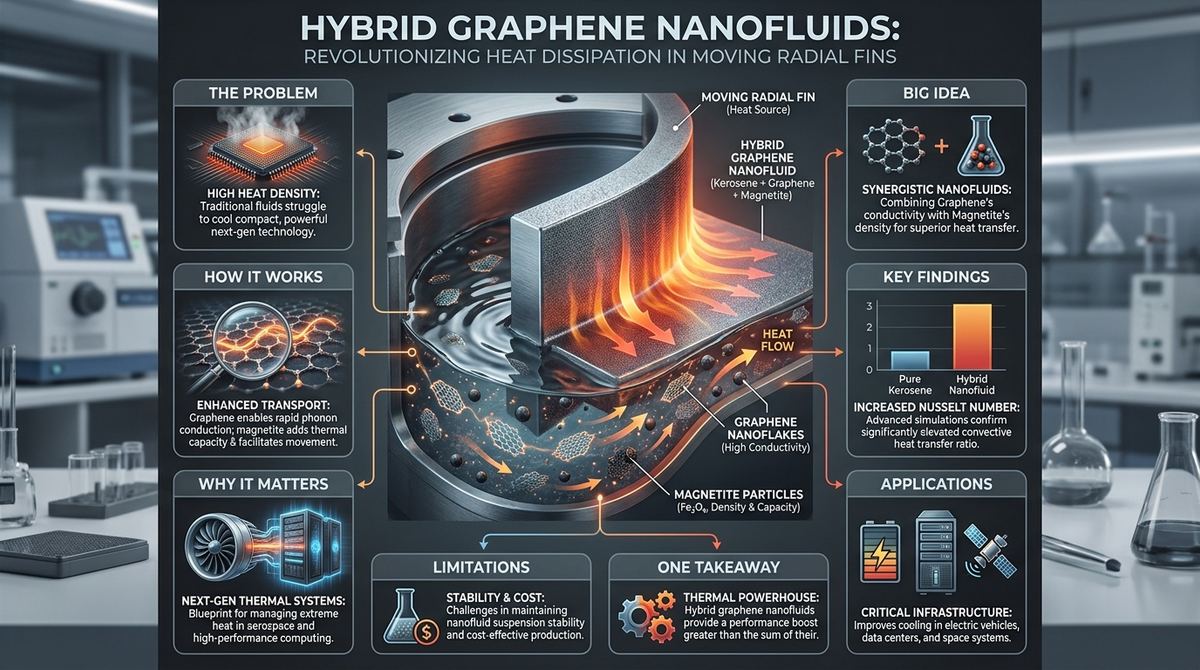
Imagine a high-performance jet engine or a cutting-edge supercomputer that generates so much heat it threatens to melt its own components. Traditional cooling liquids, like water or standard oils, often struggle to move that heat away fast enough to keep the system stable. To solve this, engineers are looking toward the microscopic world, mixing incredibly thin sheets of carbon, known as graphene, and magnetic iron oxide into cooling fluids to create a thermal powerhouse. This breakthrough approach to heat management is being explored through the advanced mathematical simulations provided by researchers Madhura K. R, Prapthi R Kashyap, Apoorva. D, and Bhanushree. K. L. Their work uses a sophisticated method to predict exactly how these hybrid fluids behave when they are pushed through moving cooling structures.
As modern technology becomes more compact and powerful, the density of heat generation increases exponentially. In industries ranging from aerospace to high-performance computing, the primary bottleneck is no longer how fast we can move electrons, but how fast we can remove the heat they produce. Standard cooling fluids, often called single-phase fluids, consist of a single liquid or gas. While reliable, these fluids have inherent thermal conductivity limits. They simply cannot absorb and transport energy at the rates required by next-generation hardware.
Furthermore, many cooling systems do not involve static surfaces. In many high-speed applications, the cooling surfaces, such as fins, are in constant motion. When a fin moves through a fluid, the physics becomes significantly more complicated. You are no longer just dealing with simple conduction through a solid; you are dealing with the interaction between the moving surface, the fluid's momentum, and the complex ways heat moves through a liquid. Additionally, at higher operating temperatures, heat transfer is not just about contact between a solid and a liquid; it is also driven by radiation, where heat travels through electromagnetic waves. Predicting how a moving fin, a complex fluid, and radiation all interact simultaneously is a mathematical nightmare that standard equations cannot easily solve.
The solution lies in the creation of a hybrid nanofluid. Instead of using just one type of tiny particle to enhance a liquid, scientists are combining two different types of nanomaterials to create a synergistic effect. In this specific research, graphene and magnetite (Fe3O4) are suspended in kerosene. Graphene is a superstar of heat conduction due to its unique atomic structure, while magnetite adds density and extra thermal capacity.
To understand why this matters, think of a standard fluid like a slow-moving crowd of people trying to carry heat away. If you add a few high-speed runners (the graphene) into that crowd, the heat moves much faster. If you also add a group of people with much larger carrying capacity (the magnetite), the entire group becomes much more efficient at moving large amounts of energy. The researchers use a mathematical tool called the Hybrid Residual Power Series Method, or HRPSM, to act as a high-powered simulator. This method allows them to predict the temperature patterns and heat flow of this complex mixture without needing to build an expensive, physical prototype every time they want to test a new variable.
To truly understand why this system works, we have to look at the molecular level. The base fluid in this study is kerosene, which is a stable hydrocarbon. While kerosene is a good lubricant, its thermal conductivity is relatively low. When we introduce graphene, we are introducing a material with a massive surface-to-volume ratio. Graphene is essentially a single layer of carbon atoms arranged in a hexagonal lattice. This structure allows phonons, which are essentially vibrations of the atoms, to travel through the material with almost zero resistance. These phonons are the primary carriers of heat in non-metallic materials.
When graphene flakes are suspended in kerosene, they create a network of highly conductive pathways. Even at very low concentrations, these flakes disrupt the way heat moves through the liquid. Instead of the heat having to slowly diffuse through the kerosene molecules, it can "jump" along the high-speed graphene pathways. This significantly increases the effective thermal conductivity of the entire fluid.
However, graphene alone has limitations, particularly regarding the fluid's viscosity and stability. This is where the magnetite (Fe3O4) comes in. Magnetite is a magnetic iron oxide that is much denser than kerosene. By adding magnetite, we increase the overall volumetric heat capacity of the fluid. This means the fluid can hold more thermal energy per unit of volume. The combination of the two creates a hybrid effect where the graphene provides the high-speed "tracks" for heat, and the magnetite provides the "capacity" to carry more heat.
The research also accounts for the nonlinear nature of heat transfer. In these systems, the rate of heat transfer is not a simple linear relationship. For example, radiative heat transfer follows the Stefan-Boltzmann law, where the heat emitted is proportional to the fourth power of the temperature. This means that as the fin gets hotter, the amount of heat moving through radiation increases at an accelerating rate. The movement of the radial fin adds another layer of complexity. As the fin moves, it creates a velocity gradient in the fluid, which affects the thickness of the thermal boundary layer. A thinner boundary layer allows for much more efficient convective heat transfer. The HRPSM method is specifically designed to handle these nonlinearities, solving the differential equations by expressing the temperature and velocity as power series, which allows for a highly accurate approximation of how the heat spreads.
By applying the HRPSM approach, the researchers were able to quantify exactly how much the hybrid nanofluid improves performance compared to pure kerosene. The results demonstrate that the presence of the Fe3O4 and graphene particles significantly elevates the Nusselt number, which is a dimensionless number used in fluid mechanics to describe the ratio of convective to conductive heat transfer. A higher Nusselt number indicates a more efficient cooling process.
The simulations showed that the combination of the two nanoparticles provides a performance boost that is greater than the sum of its parts. This is the essence of the hybrid effect. They also found that the radial geometry of the fin, combined with its motion, creates a complex temperature profile along the length of the fin. The mathematical model allowed them to see how the convective and radiative components of heat transfer compete and cooperate. In many scenarios, the radiation becomes a significant contributor to the total heat dissipation, especially as the temperature of the fin increases. The HRPSM method proved to be a robust and reliable tool for mapping these complex interactions, providing a mathematical "map" that engineers can use to design more efficient cooling systems.
This research is vital because it provides a blueprint for the next generation of thermal management systems. We are moving toward an era where electronic components are packed so tightly that traditional cooling is no longer an option. By understanding the mathematical relationship between particle concentration, fin motion, and heat transfer, engineers can optimize the design of heat sinks and cooling channels.
For example, in an electric vehicle (EV) battery cooling system, being able to move heat away from the cells rapidly and efficiently is crucial for safety and longevity. If we can use hybrid nanofluids to prevent "hot spots" in a battery pack, we can increase the lifespan and performance of the vehicle. Similarly, in high-performance computing centers that power modern artificial intelligence, the ability to manage heat through moving, nano-enhanced fluids could lead to much higher processing speeds and lower energy consumption.
While the mathematical results are highly promising, it is important to recognize that this is a computational study. The research provides a theoretical model of how these systems should behave under specific conditions. It does not account for several real-world engineering challenges that must be addressed before this can be used in a commercial product.
One major challenge is the stability of the nanofluid over time. In a real-world engine or computer, the fluid will be circulating for thousands of hours. There is a risk that the graphene and magnetite particles might begin to clump together, a process known as agglomeration. If the particles clump, they can settle at the bottom of the system due to gravity, a process called sedimentation, which destroys the "hybrid" effect and can even clog the cooling channels. Additionally, the abrasive nature of solid particles in a liquid can lead to wear and tear on the moving parts of the cooling system. Future research will need to focus on the long-term stability and the mechanical impact of these hybrid fluids in physical, moving hardware.
The implications of this research extend into several high-tech industries. In the aerospace sector, heat exchangers used in jet engines or spacecraft could utilize these hybrid fluids to manage the extreme temperatures encountered during flight or reentry. The ability to use moving radial fins with high-efficiency fluids could allow for smaller, lighter, and more efficient engine designs.
In the realm of renewable energy, specifically solar thermal power plants, these nanofluids could be used to transport heat from collectors to turbines more efficiently, increasing the overall energy yield of the plant. Finally, in the consumer electronics market, as devices like smartphones and laptops become thinner and more powerful, the ability to integrate micro-scale cooling systems using these advanced fluids could be a game-changer for device performance and durability.
If you take only one concept away from this research, let it be this: the synergy of hybrid nanofluids. By combining different nanomaterials like graphene and magnetite, we can create a cooling medium that is significantly more powerful than any single-component fluid, enabling us to solve the growing problem of heat in our increasingly high-powered world.
What exactly is a nanofluid? A nanofluid is a specialized liquid that has been enhanced by adding extremely small particles, typically in the nanometer range. These particles are so small that they do not settle out of the liquid easily and can fundamentally change the fluid's thermal and physical properties, making it much better at conducting heat than the base liquid alone.
Why is graphene so important for cooling? Graphene is a single layer of carbon atoms that is incredibly thin and incredibly strong. Most importantly for this research, it has an extraordinary ability to conduct heat due to its atomic structure. When added to a fluid, it acts like a high-speed highway for heat, allowing thermal energy to move through the liquid much more quickly than it would through a standard liquid.
What is the difference between convection and radiation? Convection is the process of heat transfer through the physical movement of a fluid, such as liquid or gas, over a surface. Radiation is the transfer of heat through electromagnetic waves and does not require a physical medium to travel through. In high-temperature systems, both processes happen simultaneously and must be accounted for to ensure effective cooling.
How does the HRPSM method help engineers? The Hybrid Residual Power Series Method is a complex mathematical technique used to solve non-linear differential equations. In heat transfer, many relationships are not straight lines; they are curves that change rapidly. HRPSM allows scientists to create highly accurate mathematical models that predict how temperature and fluid flow will behave, saving time and money on physical testing.
Why use kerosene as a base fluid in this research? Kerosene is often used in thermal studies because it is a stable hydrocarbon with predictable properties. It serves as a reliable baseline to demonstrate how much the addition of graphene and magnetite improves the fluid's performance. It provides a practical context for understanding how these advanced materials might work in real-world industrial cooling applications.
The integration of graphene and magnetite into a kerosene-based hybrid nanofluid represents a significant frontier in thermal engineering. Through the rigorous mathematical modeling provided by the HRPSM method, researchers like Madhura K. R, Prapthi R Kashyap, Apoorva. D, and Bhanushree. K. L. have demonstrated how we can move beyond the limits of traditional cooling. While challenges regarding particle stability and mechanical wear remain, the ability to supercharge heat transfer via hybrid nanoparticles offers a clear path toward more efficient, more powerful, and more reliable technology.
Serious about B2B integration? Test our premium Pulsed Electrical Resistive Carbon Heating turbostratic graphene in your lab. 100g sample packs available now.
Explore More
Researchers propose a novel method to detect spin- and valley-polarized states in van der Waals materials, a key step for next-gen spintronics and...

Researchers developed the CARBON-2D Topological Descriptor (C2DTD), an interpretable, physics-informed method to rapidly predict the properties of new 2D...

Learn how to create p-n junctions in graphene by selectively oxidizing the underlying germanium substrate. This guide covers a practical method for...