
An Exact Solution for Electron Transport and Resistivity in the Hubbard Model
Researchers derived the first exact formula for resistivity in the 1D infinite-U Hubbard model, providing a crucial benchmark for understanding strongly...
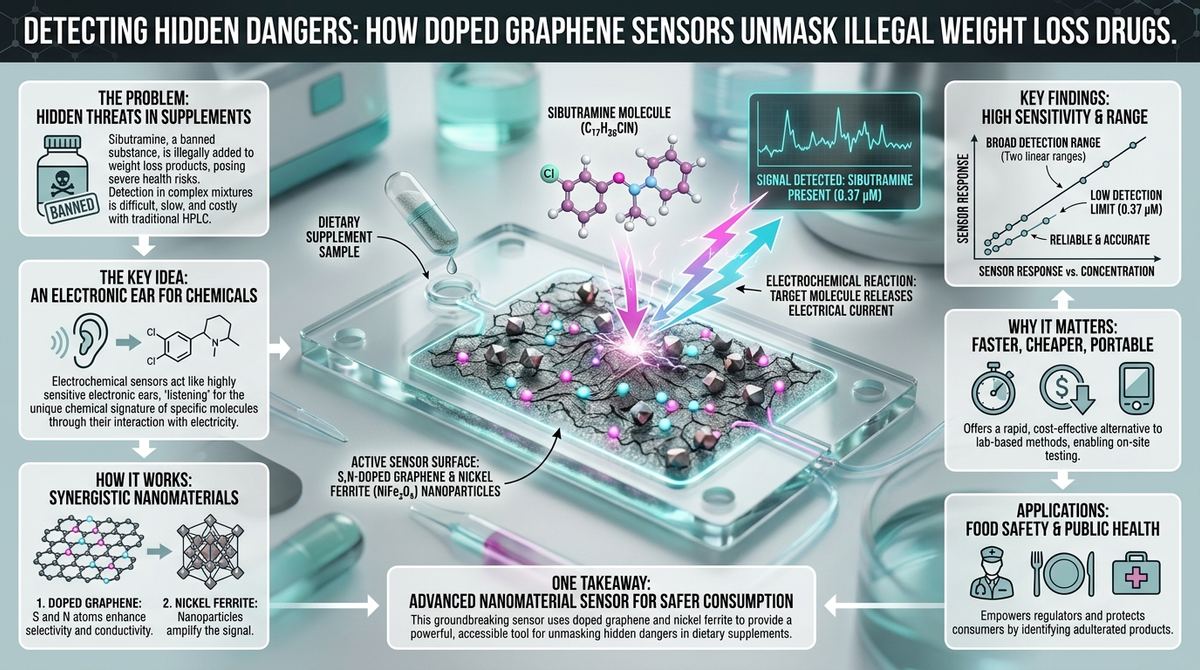
Imagine walking into a health food store and picking up a supplement promised to revolutionize your weight loss journey. Many consumers trust these products, but some are secretly laced with sibutramine, a potent drug that was banned in many parts of the world because it significantly increases the risk of heart attack and stroke. Detecting this substance in a complex mixture of vitamins and herbs is a monumental challenge for food safety regulators. Traditional laboratory methods are highly accurate but are often slow, expensive, and require specialized equipment that is not available in every testing facility. This is where the intersection of advanced materials science and electrochemistry provides a critical solution. Recent pioneering work conducted by Ngo Thi Thanh Xuan, Le Thi Thanh Nhi, Nguyễn Quang Mẫn, Vo Thi Khanh Ly, Le Thi Hong Phong, Nguyễn Hải Phong, Phạm Khắc Liệu, Lê Lâm Sơn, and Đinh Quang Khiếu has introduced a new way to identify these hidden dangers using a sophisticated sensor based on modified graphene.
The primary challenge in food safety today is the detection of banned pharmaceutical substances that are intentionally or accidentally included in dietary supplements. Sibutramine is a primary target for regulators because it is often used to boost the perceived efficacy of weight loss products. However, because supplements contain a massive variety of organic and inorganic ingredients, finding a single molecule of sibutramine is like finding a needle in a haystack. The current gold standard for this detection is High-Performance Liquid Chromatography (HPLC), which provides excellent precision but is not a rapid-response tool. It requires significant time for sample preparation, expensive solvents, and highly trained technicians to operate.
Furthermore, the regulatory environment requires a testing method that is not just accurate, but also incredibly sensitive. Even a tiny amount of sibutramine can pose a health risk, meaning the detection limit must be extremely low. There is an urgent need for a tool that can provide quick, reliable, and cost-effective results to ensure that the supplements hitting the market are safe for public consumption. This research addresses this exact gap by proposing a sensor that utilizes the unique electronic properties of graphene to catch these illicit substances.
To understand this research, you must first understand the concept of an electrochemical sensor. Think of an electrochemical sensor as a highly sensitive electronic ear that listens for a specific chemical signature. Every chemical has a unique way of interacting with electricity—some molecules can easily give up electrons, while others are more stubborn. When a target molecule, like sibutramine, comes into contact with a specially designed electrode, it undergoes a chemical reaction that releases a small electrical current. By measuring this current, we can determine exactly how much of the substance is present.
The researchers' key innovation lies in the "ear" they have designed. Instead of a plain metal surface, they created a complex, high-performance material made of nickel ferrite crystals and graphene that has been chemically modified with sulfur and nitrogen. This modification turns the surface into a highly active landscape of "docking stations." These stations are specifically tuned to attract and interact with sibutramine, making the electrical signal much stronger and easier to detect. This makes the sensor both faster and more sensitive than many traditional methods.
The efficiency of this sensor is rooted in the synergistic relationship between the nickel ferrite (NiFe2O4) and the sulfur and nitrogen-doped graphene oxide (S,N-GO). Graphene is a single layer of carbon atoms arranged in a hexagonal lattice. While pure graphene is an excellent conductor of electricity, it is not always selective; it might react with many different things at once. To fix this, the researchers used a process called doping, where they replaced some of the carbon atoms with sulfur and nitrogen.
The addition of nitrogen and sulfur fundamentally changes the electronic environment of the graphene. Nitrogen atoms introduce extra electrons into the structure, while sulfur atoms, being larger than carbon, create physical distortions or defects in the lattice. These defects are not flaws; they are features. They create highly reactive sites that act as energetic landing pads for the sibutramine molecule. When the sibutramine molecule approaches the electrode, these specialized sites facilitate a much faster transfer of electrons from the molecule to the sensor. This rapid electron transfer is the cause of the sensor's high sensitivity.
To further enhance this effect, the researchers integrated nanocrystalline nickel ferrite into the graphene sheets. This metal oxide serves two purposes. First, the nanocrystalline structure significantly increases the total surface area of the electrode. A higher surface area means there are more available spaces for sibutramine to land, which directly increases the signal strength. Second, nickel ferrite provides additional electrocatalytic activity. Catalysis is the process of lowering the energy required for a chemical reaction to occur. In this case, the nickel ferrite lowers the energy barrier required for the oxidation of sibutramine, making the electrochemical response much more vigorous.
The researchers confirmed the success of this synthesis using several advanced scientific techniques. They used X-ray diffraction (XRD) to ensure the nickel ferrite had the correct crystal structure. They employed Raman spectroscopy to confirm that the sulfur and nitrogen were successfully integrated into the graphene lattice. Scanning electron microscopy (SEM) allowed them to visualize the morphology of the material, confirming that the nickel ferrite particles were uniformly dispersed on the graphene sheets rather than clumped together. This uniform dispersion is vital because any large clumps would reduce the available surface area and decrease the sensor's efficiency. Finally, they used vibrating sample magnetometry (VSM) to study the magnetic properties of the material, which is an important characteristic of ferrite-based composites.
The results of the study were highly impressive. Using a technique called differential pulse voltammetry (DPV), which is a highly sensitive way of measuring electrical current, the researchers were able to map out exactly how the sensor responded to different concentrations of sibutramine. The study revealed that the sensor was capable of detecting the drug across two distinct linear ranges. This is a significant finding because it means the sensor is reliable at both very low concentrations and relatively higher concentrations.
The detection limit was found to be 0.37 µM, which is remarkably low and indicates a high level of sensitivity. This means that even trace amounts of the drug, which might be missed by lesser sensors, can be identified by this NiF/GrO(S,N) composite. When the researchers tested the sensor against common interfering substances—such as other vitamins, minerals, and organic compounds found in supplements—the sensor remained highly selective for sibutramine. This means the sensor does not get "confused" by the other ingredients in a complex supplement.
To ensure the sensor was reliable for real-world use, the researchers compared its performance to the industrial standard, High-Performance Liquid Chromatography (HPLC). They tested the sensor on seven different commercial dietary supplement samples that were suspected of containing sibutramine. The results showed that the sensor was extremely accurate, with recovery rates ranging from 96.38% to 104.83%. In science, a recovery rate close to 100% indicates that the testing method is providing a true measurement of what is actually in the sample. The researchers found no statistically significant difference between the results produced by their new sensor and those produced by the expensive HPLC method, proving that this new technology is just as accurate as the industry standard.
This research is a significant step forward for public health and food safety enforcement. By providing a method that is as accurate as HPLC but much faster and cheaper, this research offers a blueprint for more frequent and widespread testing of dietary supplements. If regulatory agencies can implement these types of electrochemical sensors, they can perform rapid screening of products before they ever reach the shelves, effectively stopping dangerous substances from entering the consumer market.
Moreover, the success of this composite material demonstrates the power of "heterostructure engineering." By combining a highly conductive material (doped graphene) with a catalytic material (nickel ferrite), scientists can create new tools that were previously impossible. This approach opens the door for creating sensors for many other dangerous substances, such as pesticides, heavy metals, or other prohibited pharmaceutical drugs. The ability to tune the properties of graphene through doping provides a universal toolkit for the next generation of chemical detection technology.
While the results are highly promising, it is important to recognize that this research is currently in the laboratory phase. The synthesis of sulfur and nitrogen-doped graphene is a precise chemical process that requires controlled conditions. For this sensor to be used in a real-world testing facility, the manufacturing process must be scaled up to produce large quantities of the composite material without losing its specialized properties. Consistency in the size and distribution of the nickel ferrite nanocrystals is essential for maintaining the sensor's sensitivity.
Additionally, while the sensor was tested against common interferences, real-world dietary supplements can be incredibly complex, containing hundreds of different plant extracts and synthetic ingredients. Further testing is required to ensure that the sensor remains robust and reliable when faced with even more complex and unpredictable sample matrices. The current study focused on seven samples, and while these were representative, a much wider array of diverse commercial products would need to be tested to fully validate the sensor for global regulatory use.
The most immediate application for this technology is in the field of food safety and regulatory compliance. Customs officials and food inspectors could use portable versions of these sensors to quickly screen shipments of supplements at ports of entry. This would allow for rapid decision-making and prevent illegal substances from being distributed.
Beyond food safety, this sensor technology has potential applications in environmental monitoring. The ability to detect trace amounts of organic molecules with high selectivity could be adapted to monitor water quality or soil contamination. Furthermore, the modular nature of electrochemical sensors means they could eventually be integrated into handheld devices for use by field researchers, providing real-time data in remote locations where laboratory equipment is unavailable.
If you remember only one thing from this research, let it be this: the combination of doped graphene and metal oxides creates a highly sensitive "electronic ear" capable of detecting trace amounts of dangerous drugs like sibutramine in complex mixtures, providing a faster and more affordable alternative to traditional laboratory testing.
What is sibutramine and why is it dangerous? Sibutramine is a drug once used for weight loss that has been banned in many countries because it significantly increases the risk of cardiovascular events, such as heart attacks and strokes. Because it is often hidden in tainted dietary supplements, it poses a major risk to unsuspecting consumers.
How does doping graphene make it a better sensor? Graphene is a single layer of carbon atoms that conducts electricity very well. When we "dope" it with nitrogen or sulfur, we are essentially adding different types of atoms that disrupt the smooth surface of the carbon. These disruptions create highly reactive sites that act like docking stations, making it easier for the target molecule to interact with the sensor and produce an electrical signal.
Why was nickel ferrite added to the graphene? Nickel ferrite is a material that can speed up chemical reactions, a process known as electrocatalysis. By adding nanocrystalline nickel ferrite to the graphene, the researchers increased the surface area of the sensor and lowered the energy required for the target molecule to react. This makes the sensor much more sensitive to very low concentrations of the drug.
Is this sensor better than the current standard method? The current standard is HPLC, which is extremely accurate but very slow and expensive. This new graphene-based sensor provides nearly the same level of accuracy but is much faster and more cost-effective, making it a highly promising tool for rapid testing.
Is this technology ready for use in stores? Currently, this research is at the laboratory stage. While it has proven to be highly effective in controlled tests, more work is needed to scale up the manufacturing process and ensure it can reliably handle the extreme complexity of all types of commercial supplements before it can be used for widespread regulatory enforcement.
The development of a NiFe2O4/(S,N)-doped graphene oxide composite represents a significant achievement in the field of electrochemical sensing. By expertly manipulating the atomic structure of graphene and utilizing the catalytic power of nickel ferrite, researchers have created a tool that can identify sibutramine with incredible precision and speed. This work not only addresses a critical need in consumer safety but also demonstrates the immense potential of advanced nanomaterials to solve real-world challenges. As this technology moves from the laboratory toward practical application, it promises to enhance our ability to protect public health and ensure the integrity of the global supplement market.
Serious about B2B integration? Test our premium Pulsed Electrical Resistive Carbon Heating turbostratic graphene in your lab. 100g sample packs available now.
Explore More
Researchers derived the first exact formula for resistivity in the 1D infinite-U Hubbard model, providing a crucial benchmark for understanding strongly...

Learn how to utilize bipartite-lattice symmetry to generate pure spin shift currents in graphene nanoribbons for advanced spintronic device prototyping.

Researchers propose a novel method to detect spin- and valley-polarized states in van der Waals materials, a key step for next-gen spintronics and...