
Practical Guide: Engineering Pure Spin Current Generators with Ferromagnetic GNRs
Learn how to utilize bipartite-lattice symmetry to generate pure spin shift currents in graphene nanoribbons for advanced spintronic device prototyping.
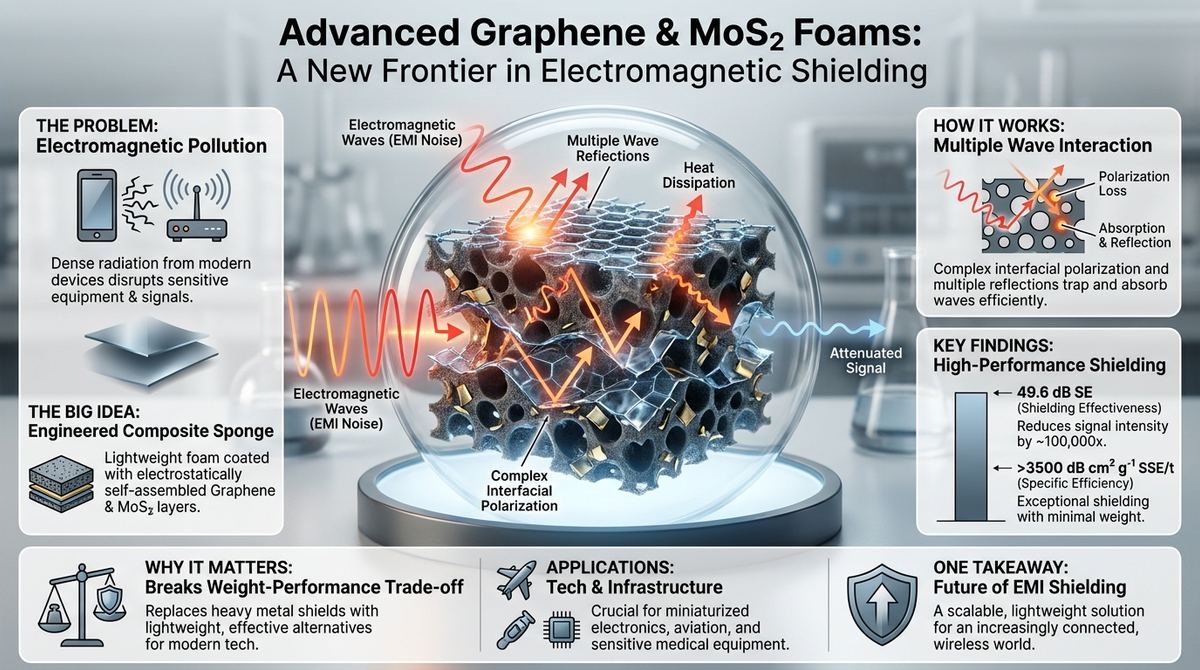
Every time you power up a smartphone, connect to a wireless charger, or walk past a high-powered microwave, you are participating in a massive, invisible dance of electromagnetic waves. While these waves are essential for modern communication, they also create a form of electronic noise known as electromagnetic pollution. If left unchecked, this noise can interfere with sensitive medical equipment, disrupt aviation communications, and cause errors in microelectronics. The challenge for modern scientists is to find ways to block this invisible interference without adding significant weight or bulk to our devices. Recent breakthroughs in nanostructure engineering are providing the answer by creating lightweight, ultra-strong foams that can effectively trap and neutralize these problematic waves.
The rapid proliferation of mobile communication technology and the miniaturization of electronic components have significantly increased the density of electromagnetic radiation in our immediate environment. This phenomenon, often referred to as electromagnetic interference (EMI), is a critical concern for the stability of modern infrastructure. As devices become smaller and more powerful, the electromagnetic fields they generate can bleed into neighboring components, leading to signal degradation or complete device failure.
Historically, shielding these devices required heavy, bulky metal enclosures. While metal is an excellent conductor and can block electromagnetic waves, it presents significant challenges for the next generation of technology. In the worlds of aerospace, portable electronics, and electric vehicles, every gram of weight matters. A heavy metal shield adds unnecessary mass, reduces battery life, and consumes valuable physical space. Furthermore, as we move toward more integrated systems, we need materials that can provide shielding while also offering structural integrity and thermal stability. We need a material that acts like a sponge—absorbing and diffusing energy rather than just reflecting it into the surrounding environment.
The researchers have addressed this problem by creating a specialized "sponge" made of a lightweight foam that is coated with a complex layer of ultra-thin materials. This sponge is not made of simple plastic or metal, but rather a carefully engineered cocktail of graphene and molybdenum disulfide. To make sure these tiny particles do not simply clump together into useless lumps, the team used a chemical process called electrostatic self-assembly, which uses electrical charges to glue the layers together perfectly.
The magic of this material lies in how it handles electromagnetic waves. Instead of just bouncing the waves away like a mirror, which can actually cause more interference elsewhere, this material forces the waves to go on a long, difficult journey. The waves enter the porous structure of the foam and bounce around between the layers of graphene and molybdenum disulfide. Every time the wave hits a layer, it loses some of its energy. By the time the wave has traveled through the labyrinth of the foam, it has been converted into a tiny, harmless amount of heat, effectively neutralizing the interference.
To understand the success of this material, we must look at the sophisticated chemistry and physics employed by Shansu Li, Xin Ye, Yingbo Guan, Rui Han, Yuan Liu, and Qi Wang. The creation of this composite begins with a melamine-formaldehyde (MF) foam, which serves as the structural skeleton. This foam provides a three-dimensional porous architecture, creating the vast internal surface area necessary for effective wave interaction.
The researchers utilized a process of electrostatic self-assembly to decorate this skeleton with modified molybdenum disulfide (C-MoS2) and graphene (GP). In this process, the nanomaterials are given specific electrical charges that cause them to attract one another and the foam structure. To ensure these nanosheets remain permanently anchored and do not aggregate into large, ineffective chunks, the team employed a cross-linking technique using sodium alginate and calcium chloride. This chemical bridge creates a stable, interconnected network that preserves the high surface area of the individual nanosheets.
The actual destruction of the electromagnetic wave occurs through three distinct physical mechanisms. The first is conduction loss. Graphene is a superb conductor of electricity. When an electromagnetic wave hits the continuous network of graphene within the foam, it induces a flow of electrons. As these electrons move through the carbon lattice, the energy from the electromagnetic wave is converted into thermal energy through resistance, a process known as conduction loss.
The second mechanism is interfacial polarization. This occurs at the "heterogeneous interfaces"—the boundaries where a graphene sheet meets a molybdenum disulfide sheet. Because these two materials have different electrical properties, charges tend to accumulate at their junctions when an electromagnetic field is applied. This buildup of charge creates dipoles that oscillate in response to the wave, absorbing energy from the field. This is often referred to as the Maxwell-Wagner-Sillars effect, where the internal boundaries of a composite material act as tiny energy traps.
The third mechanism is multiple reflections and scattering. Because the graphene and molybdenum disulfide are arranged in a multilayered structure within the pores of the foam, the electromagnetic wave cannot travel in a straight line. Instead, it is forced to bounce off the various interfaces. Each reflection and scattering event increases the distance the wave must travel through the material, providing more opportunities for the first two mechanisms—conduction loss and interfacial polarization—to drain the wave of its energy.
The results of this research demonstrate a massive leap in shielding performance. The composite foam achieved an electromagnetic interference shielding effectiveness (SE) of 49.6 dB. To put this in perspective, the decibel scale is logarithmic; an increase of 10 dB represents a tenfold decrease in signal intensity. Therefore, a shielding effectiveness of nearly 50 dB means the material can reduce the intensity of the interfering signal by a factor of approximately 100,000.
Perhaps even more impressive for the tech industry is the specific shielding efficiency (SSE/t), which exceeded 3500 dB cm2 g–1. This metric measures how much shielding is provided per unit of mass. A high value here is crucial because it proves that the material provides immense protection without being heavy. In the context of portable electronics and drones, this high efficiency means we can achieve elite-level protection while barely adding any weight to the device. Finally, the study confirmed that these foams possess excellent compressive strength and thermal stability, meaning they can be squeezed or exposed to heat without losing their structural shape or their ability to block interference.
This research is significant because it breaks the traditional trade-off between weight and performance. For decades, engineers have had to choose between a heavy, effective metal shield and a lightweight, less effective plastic shield. This new composite offers a third way: a lightweight, porous structure that is actually more effective at absorbing and dissipating energy than solid metal.
The ability to achieve high shielding effectiveness through absorption rather than just reflection is a game-changer for electromagnetic compatibility. When a metal shield reflects waves, those waves can sometimes bounce back into the device itself or scatter into other nearby electronics, potentially causing new problems. Because this graphene-molybdenum disulfide foam focuses on absorption through conduction and polarization, it essentially "eats" the interference, making it a much cleaner solution for sensitive electronic environments.
While these results are groundbreaking, it is important to note that the material is not yet ready for mass-market consumer products. The synthesis process involves complex electrostatic self-assembly and chemical cross-linking, which can be difficult and expensive to scale up to industrial levels. Moving from laboratory-scale samples to large-scale manufacturing rolls is a significant engineering hurdle.
Furthermore, while the material shows excellent thermal stability and compressive strength, its long-term durability in extreme environments remains to be fully understood. We do not yet know how the material will perform after years of exposure to moisture, salt spray, or extreme temperature fluctuations found in aerospace or automotive applications. Future research will need to focus on the long-term aging of the organic MF foam and the chemical stability of the alginate cross-links under stress.
The potential applications for this material are vast and span several high-tech industries. In the aerospace and satellite sectors, where every milligram of weight is scrutinized, this lightweight foam could be used to protect sensitive guidance systems and communication arrays from electromagnetic interference.
In the automotive industry, particularly with the rise of electric vehicles (EVs), electromagnetic compatibility is a major concern. EVs are packed with high-power cables and electronic controllers that generate significant electromagnetic noise. Using graphene-based foams to shield the vehicle's communication and sensor systems could improve reliability and safety.
For the consumer electronics market, this material could be integrated into the casings of smartphones, tablets, and wearable technology. As we move toward 5G and 6G networks, which utilize higher frequencies, the need for highly efficient, lightweight, and thin shielding materials like this will only increase. Even in the medical field, these foams could provide a way to shield delicate diagnostic equipment from the interference generated by other hospital electronics.
If you take away only one concept from this research, let it be this: the most effective way to stop electromagnetic interference is not to bounce the waves away, but to create a complex, layered labyrinth that forces the waves to lose their energy through heat.
What is electromagnetic interference?
Electromagnetic interference, often called EMI, is the disruption caused by an external source of electromagnetic radiation. You can think of it like a loud person shouting in a room where two people are trying to have a quiet conversation; the "shouting" (the interference) makes it difficult for the listeners to hear each other. This can happen with radio waves, microwaves, or even the electricity running through a wire.
Why is graphene used in this research?
Graphene is used because it is one of the best conductors of electricity known to science. In an electromagnetic shielding material, graphene acts as a highway for electrons. When the electromagnetic wave hits the graphene, the movement of electrons through the material converts the wave's energy into a small amount of heat, effectively destroying the interference.
What role does molybdenum disulfide play?
Molybdenum disulfide serves as a partner to graphene to create what scientists call a heterogeneous interface. Because molybdenum disulfide has different electrical properties than graphene, it creates boundaries where charges can accumulate. This phenomenon, known as interfacial polarization, is a highly effective way to absorb electromagnetic energy.
Why is a foam structure better than a solid metal sheet?
A solid metal sheet primarily works by reflecting waves, which can sometimes cause the waves to bounce around and cause new problems elsewhere. A foam structure is porous and lightweight. Its complex internal geometry provides a massive surface area and a "winding path" that forces waves to bounce multiple times, maximizing the chances that they will be absorbed and neutralized.
What does a shielding effectiveness of 49.6 dB actually mean?
Decibels are used on a logarithmic scale to describe how much a signal is reduced. A value of 49.6 dB is extremely high. It means that the material reduces the power of the incoming electromagnetic interference by a factor of nearly 100,000. This level of protection is essential for shielding highly sensitive electronic components.
This research points toward a practical lesson: graphene-based materials are most powerful when their nanoscale properties are connected to a clear engineering problem. The result is not a finished commercial product by itself, but it gives researchers and manufacturers a better map for designing lighter, more sensitive, or more durable systems. Future work still needs testing under real operating conditions, but the direction is promising because it joins materials science with application-driven design.
Serious about B2B integration? Test our premium Pulsed Electrical Resistive Carbon Heating turbostratic graphene in your lab. 100g sample packs available now.
Explore More
Learn how to utilize bipartite-lattice symmetry to generate pure spin shift currents in graphene nanoribbons for advanced spintronic device prototyping.

Researchers propose a novel method to detect spin- and valley-polarized states in van der Waals materials, a key step for next-gen spintronics and...

Researchers developed the CARBON-2D Topological Descriptor (C2DTD), an interpretable, physics-informed method to rapidly predict the properties of new 2D...