
An Exact Solution for Electron Transport and Resistivity in the Hubbard Model
Researchers derived the first exact formula for resistivity in the 1D infinite-U Hubbard model, providing a crucial benchmark for understanding strongly...
Corrosion is one of the most expensive and destructive forces in industrial engineering, leading to catastrophic failures in infrastructure, maritime vessels, and automotive components. While graphene has long been touted as a miracle material for barrier coatings due to its impermeability, most experimental applications fail to reach their theoretical potential. The reason is often not the amount of graphene used, but how the graphene is positioned within the polymer matrix.
Recent research, specifically the 2026 study by Shaker et al., has quantified a critical variable that engineers have long suspected but struggled to model: the orientation of graphene sheets. The study demonstrates that the angle at which graphene flakes sit relative to the substrate is the primary driver of corrosion protection. When graphene sheets are aligned perpendicular to the substrate, they offer minimal resistance to corrosive ions. However, when they are aligned nearly parallel to the substrate, they create a massive, winding path—often called a tortuous path—that forces water, oxygen, and chloride ions to travel a much longer distance to reach the metal.
The research indicates that a mismatch angle of just 10 degrees between the graphene sheets and the substrate can delay the onset of corrosion by approximately 65 times compared to a coating where the graphene is oriented perpendicularly. This guide provides a practical framework for a small lab or startup to prototype and test this orientation-dependent protection.
The goal is to fabricate a 100-micron thick epoxy/graphene composite coating where the graphene nanoplatelets (GNPs) are oriented horizontally (parallel to the substrate) to maximize the diffusion barrier effect.
Because the research focuses on a 100-micron thickness, your prototype must prioritize thickness control and shear-induced alignment.
1. Substrate: Polished carbon steel or aluminum coupons. The surface must be chemically clean.
2. Matrix: A high-quality, low-viscosity epoxy resin (e.g., a standard two-part industrial epoxy).
3. Reinforcement: Graphene Nanoplatelets (GNPs). For this prototype, we assume a particle size of 5 to 25 micrometers in lateral dimension to ensure they can be effectively aligned by shear forces.
4. Dispersion Equipment: An ultrasonic probe (sonicator) for breaking up graphene agglomerates.
5. Application Tool: A precision doctor blade or a spin coater. The doctor blade is preferred for inducing the shear necessary for alignment.
6. Curing Equipment: A temperature-controlled oven for controlled thermal curing.
7. Measurement Tools: An Electrochemical Impedance Spectroscopy (EIS) setup or a standard Salt Spray Chamber (ASTM B117).
The following steps assume a standard laboratory environment. Note that the exact concentration of graphene is not specified in the source study, so we will use a cautious starting range of 0.5 wt% to 1.0 wt% of graphene relative to the total resin weight.
1. Substrate Preparation: Clean the metal coupons using an ultrasonic bath in acetone, followed by isopropyl alcohol. Ensure the surface is free of oils, oxides, or fingerprints. A slight mechanical abrasion (sandblasting or fine grit sandpaper) may be required to improve mechanical interlocking, but it must be consistent across all samples.
2. Graphene Dispersion: This is the most critical step for preventing agglomeration. Mix the GNPs into the epoxy resin at the target concentration. Use a probe sonicator for 15 to 30 minutes in an ice bath to prevent the resin from overheating. The goal is a uniform, dark-tinted suspension without visible clumps.
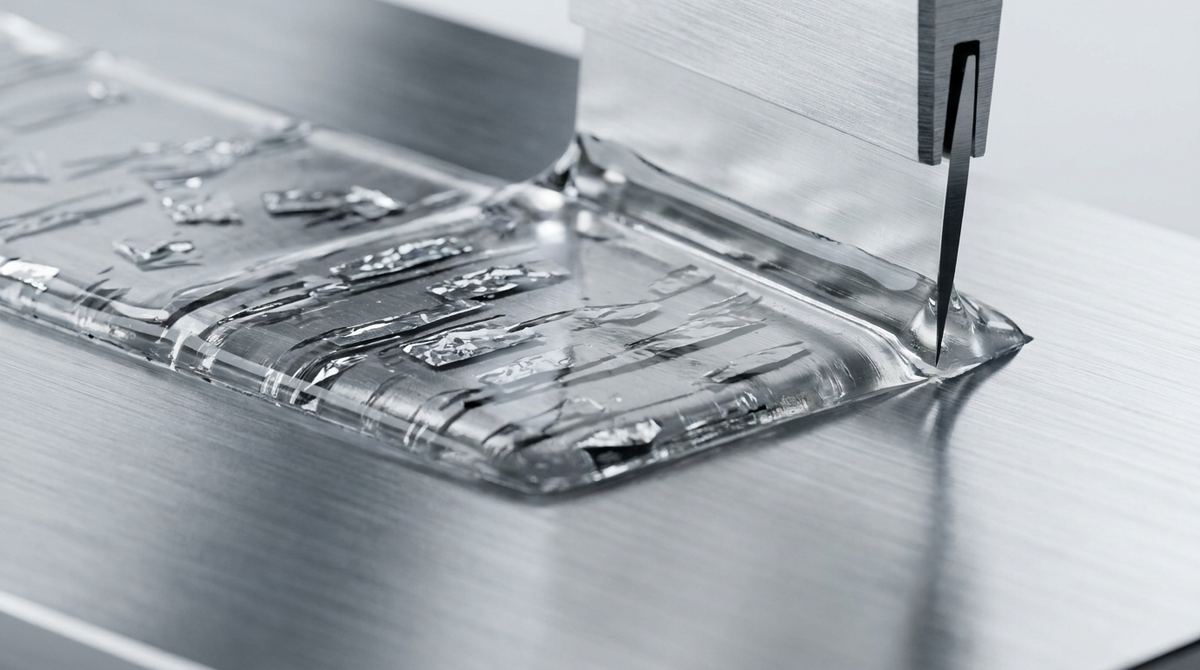
3. Controlled Application (The Alignment Phase): To achieve the high-performance orientation described in the research, you must apply shear force during application.
- Use a doctor blade setup.
- Set the blade gap to exactly 100 microns.
- Apply the epoxy/graphene mixture to the substrate and pull the blade at a constant velocity.
- The shear force generated by the blade moving through the viscous resin will tend to flatten the graphene flakes and align them parallel to the substrate surface.
4. Controlled Curing: Place the coated samples in a temperature-controlled oven. Follow the manufacturer's curing schedule for the epoxy, but ensure the temperature ramp is gradual to prevent internal stresses that might cause the graphene to re-orient or the coating to crack.
To verify if your orientation-controlled coating actually performs as the research predicts, you must move beyond simple visual inspection.
1. Electrochemical Impedance Spectroscopy (EIS): This is the most effective way to simulate long-term corrosion. By measuring the impedance of the coating over time while submerged in an electrolyte, you can calculate the pore resistance and the coating capacitance. A high-performance, well-aligned coating will show a significantly higher impedance (resistance to ion flow) over several weeks compared to a poorly aligned control sample.
2. Salt Spray Testing (ASTM B117): For a more traditional industrial validation, subject the samples to a continuous salt spray environment. Monitor the time to the first sign of visible corrosion (pitting or blistering) at the scribe line.
3. Cross-Sectional Microscopy: Use Scanning Electron Microscopy (SEM) on a polished cross-section of the coating to visually confirm the orientation of the graphene flakes. This allows you to verify if your application method actually achieved the desired parallel alignment.
It is important to distinguish between the findings of the research and the assumptions made for this practical guide.
- Concentration Assumption: The research focuses on the effect of orientation, not the optimal concentration. We have assumed a range of 0.5% to 1.0% wt% for the prototype. Exceeding this may lead to agglomeration, which creates "short-circuits" for corrosive ions.
- Thickness Assumption: The research specifically highlights a 100-micron thickness. Results may vary significantly if the coating is much thinner (where the flakes might bridge the entire thickness) or much thicker.
- Orientation Assumption: We assume that a doctor blade provides sufficient shear to achieve the 10-degree alignment. In a production environment, this would require rigorous calibration of blade speed and resin viscosity.
- Risk of Agglomeration: If the graphene is not perfectly dispersed via ultrasonication, the flakes will clump. These clumps act as defects rather than barriers, potentially accelerating corrosion rather than delaying it.
- Risk of Delamination: High graphene loading can sometimes increase the internal stress of the epoxy, leading to the coating peeling away from the substrate.
This guide is built upon the mathematical modeling of Fick's laws of diffusion applied to composite coatings, as presented by Shaker et al. (2026). The core takeaway for any engineer is that the geometric arrangement of the graphene is just as important as the chemical composition of the coating. By treating the graphene orientation as a controllable design parameter, you can move from "adding graphene to see what happens" to "engineering a specific barrier architecture."
Serious about B2B integration? Test our premium Pulsed Electrical Resistive Carbon Heating turbostratic graphene in your lab. 100g sample packs available now.
Explore More
Researchers derived the first exact formula for resistivity in the 1D infinite-U Hubbard model, providing a crucial benchmark for understanding strongly...

Learn how to utilize bipartite-lattice symmetry to generate pure spin shift currents in graphene nanoribbons for advanced spintronic device prototyping.

Researchers propose a novel method to detect spin- and valley-polarized states in van der Waals materials, a key step for next-gen spintronics and...