
Generalized Beth-Uhlenbeck Model for Graphene Electronics
Researchers use the Generalized Beth-Uhlenbeck approach to model electron interactions in 2D materials, offering a new way to predict graphene's behavior.
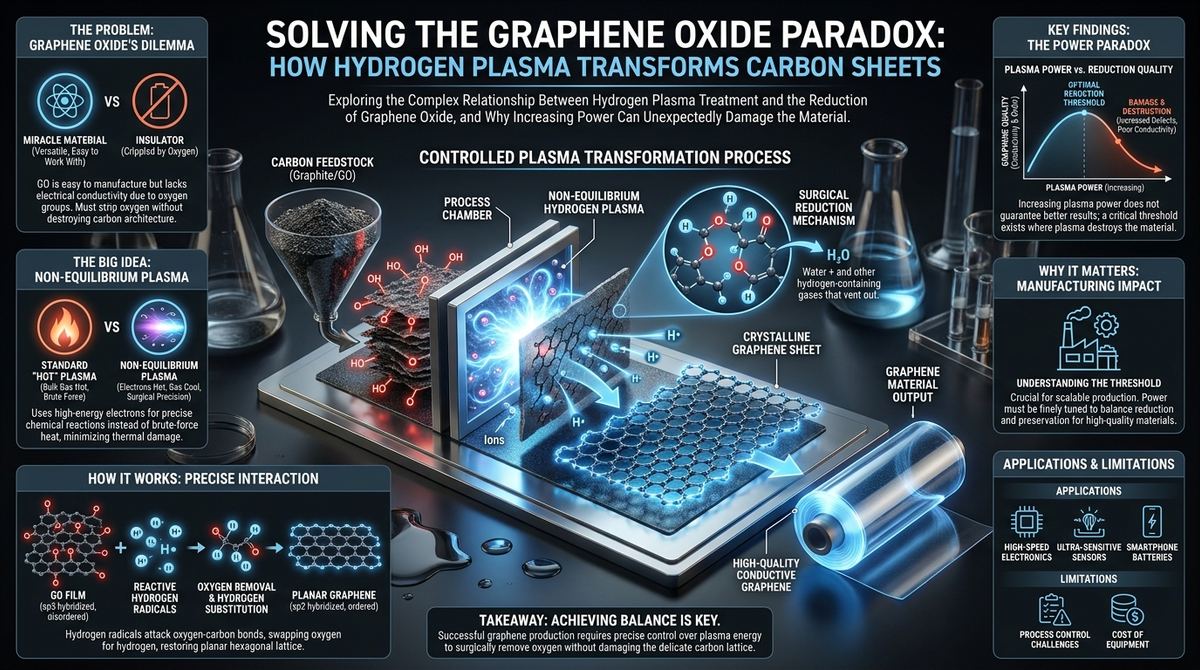
Imagine a material that has the potential to revolutionize everything from smartphone batteries to ultra-sensitive medical sensors, yet it is fundamentally sabotaged by its own chemical composition. This is the dilemma of graphene oxide. On paper, it is a miracle material: a single layer of carbon atoms that is easy to work with and highly versatile. But in reality, it is often an electrical insulator, crippled by the very oxygen atoms that make it so easy to manufacture. To make it useful for the high-speed electronics of the future, we have to strip away those oxygen atoms without destroying the delicate carbon architecture in the process. It is a microscopic balancing act that researchers are currently struggling to master.
To understand why this research is so vital, we must look at the fundamental chemistry of carbon. Pure graphene is a single layer of carbon atoms arranged in a perfect hexagonal lattice. Because of this structure, electrons can flow through it with almost zero resistance. However, making pure graphene is difficult and expensive. Instead, scientists often use graphene oxide (GO) as a starting point. Graphene oxide is produced by adding oxygen-containing functional groups—such as hydroxyl, epoxy, and carboxyl groups—onto the carbon sheets. While these groups make the material much easier to dissolve in liquids and manipulate for various applications, they create a massive problem for conductivity.
The presence of these oxygen groups causes two primary issues. First, they disrupt the electronic structure. In pure graphene, the carbon atoms are in an sp2 hybridization state, meaning they form a flat, continuous network of overlapping electron clouds. When oxygen attaches to the carbon, it forces the atoms into a tetrahedral, sp3-like hybridization. This creates a "bump" in the sheet and, more importantly, breaks the continuous path that electrons need to travel. Without that path, the material becomes an insulator rather than a conductor. Second, these oxygen groups make the sheets physically bulky and difficult to stack into the dense, highly conductive films required for high-performance devices.
Current methods to fix this involve thermal reduction, where the material is heated to very high temperatures in a controlled atmosphere. The goal is to drive off the oxygen as gases like carbon monoxide or carbon dioxide. However, this method is a double-edged sword. As the oxygen atoms leave the sheet, they do so as gas molecules that must escape the structure. This sudden escape creates intense localized pressure and structural defects. The result is often a collapsed or highly disordered film where the sheets are no longer flat or properly stacked. This structural degradation can offset any gains in electrical conductivity, leaving the researcher with a material that is neither a good insulator nor a good conductor.
In a comprehensive review that addresses these critical chemical bottlenecks, researchers such as František Zelenák, Richard Krumpolec, Dušan Kováčik, Rok Zaplotnik, Alenka Vesel, Gregor Primc, and Miran Mozetič have investigated how we can transition from the oxygen-rich state to a highly conductive state using advanced plasma technologies.
The solution being explored is the use of non-equilibrium hydrogen plasma. To understand this, we must distinguish between a standard "hot" plasma and a "non-equilibrium" plasma. In a standard plasma, such as the one found in a lightning bolt, the gas itself is incredibly hot. In a non-equilibrium plasma, however, the energy is concentrated in the electrons rather than the bulk gas. This means that while the gas stays relatively cool, the individual electrons and the ions they create carry immense energy.
Instead of using brute-force heat to shake the oxygen off the carbon, we use this plasma to perform a surgical strike. The hydrogen in the plasma is broken down into highly reactive hydrogen radicals. These radicals are small, energetic, and extremely efficient at seeking out oxygen atoms. When these radicals hit the graphene oxide, they chemically react with the oxygen groups, turning them into water or other volatile gases that can be easily removed. Because the overall temperature of the material remains low, the carbon lattice is not subjected to the violent thermal stress that causes the sheets to buckle or collapse during traditional heating.
The effectiveness of this system relies on the precise interaction between the plasma species and the chemical bonds of the graphene oxide. When the hydrogen plasma is applied to the GO film, the reactive hydrogen radicals penetrate the layers and attack the oxygen-carbon bonds. The chemical reaction essentially swaps the heavy oxygen atoms for light hydrogen atoms, which then leave the surface as hydrogen-containing gases. This process is known as reduction.
As the oxygen is removed, the carbon atoms undergo a structural transformation. They transition from the distorted sp3 hybridization back to the planar sp2 hybridization. This is the most critical step in the process. As the carbon atoms return to their flat, hexagonal arrangement, the electron clouds begin to overlap again. This restoration of the pi-electron network is what allows electricity to flow through the material. The goal is to create a "reduced graphene oxide" (rGO) that mimics the electronic properties of pure graphene while maintaining the structural benefits of the original oxide precursor.
The non-equilibrium nature of the plasma is the key to maintaining the integrity of the system. By decoupling the chemical energy (provided by the high-energy electrons and ions) from the thermal energy (the temperature of the gas), the researcher can drive the chemical reduction forward without providing the kinetic energy required to melt or physically shatter the carbon sheets. This allows for the creation of dense, highly conductive films that retain a high degree of surface area, which is essential for many electrochemical applications.
Despite the theoretical elegance of plasma reduction, the actual results revealed a fascinating and frustrating paradox. The researchers observed that simply increasing the power of the plasma discharge does not necessarily lead to better results. In fact, larger discharge powers often lead to worse outcomes, characterized by both higher remaining oxygen concentrations and significantly poorer electrical conductivity.
This paradox suggests that there is a critical threshold beyond which the plasma ceases to be a tool for reduction and begins to act as a tool for destruction. The researchers propose that this is caused by radiation damage. A plasma discharge does not just produce reactive radicals; it also produces high-energy UV photons and high-velocity ions. While the radicals are working to remove oxygen, the UV radiation and energetic ion bombardment are simultaneously attacking the carbon-carbon bonds that form the backbone of the material.
When the power is too high, the rate of structural damage begins to outpace the rate of chemical reduction. Instead of just removing the oxygen, the plasma starts to strip away carbon atoms themselves, creating holes and cracks in the sheets. This physical fragmentation increases the electrical resistance of the material and prevents the formation of a continuous conductive network. Therefore, the reduction efficiency is not a simple linear relationship with power; rather, it is a complex optimization problem where the researcher must find the "sweet spot" where oxygen removal is maximized but structural damage is minimized.
Understanding this paradox is vital because it changes how we approach the manufacturing of graphene-based materials. If the relationship between power and reduction were linear, the solution would be simple: just turn up the power until the oxygen is gone. Because the relationship is non-linear and involves a trade-off, scientists must develop much more sophisticated control mechanisms.
This research provides a roadmap for optimizing the production of reduced graphene oxide. By understanding the exact point at which radiation damage begins to dominate, manufacturers can fine-tune plasma parameters—such as pressure, gas composition, and power—to produce high-quality, highly conductive films. This is essential for creating materials that are consistent and reliable. In the world of advanced manufacturing, a material that is 90% conductive one day and 40% conductive the next is useless. These findings allow for the precision engineering of the electronic properties of the carbon sheets.
While plasma reduction is a tremendously promising niche, it is not yet a magic bullet. One of the primary limitations is the complexity of the plasma environment. Controlling the exact density and energy of ions, radicals, and photons simultaneously is an immense technical challenge. Current models struggle to predict exactly how much damage will be caused by a specific power setting because the interaction between UV radiation and the carbon lattice is highly complex.
Furthermore, there is the question of scalability. While plasma treatment works exceptionally well on small, laboratory-scale samples, scaling this up to produce kilometers of graphene-based films for industrial use will require significant engineering breakthroughs. We also need a deeper understanding of how the reduction process affects the interlayer spacing of stacked sheets. If the sheets are reduced too unevenly, the resulting film might have inconsistent conductivity across its surface, which would be catastrophic for sensitive electronic sensors.
The successful optimization of plasma-reduced graphene oxide will have immediate impacts on several high-tech industries. One of the most prominent areas is the development of supercapacitors. These devices store energy through the accumulation of ions on the surface of an electrode. To maximize energy storage, you need a massive surface area. However, to maximize power delivery (how fast you can discharge that energy), you need high electrical conductivity. Plasma reduction offers a way to achieve this delicate balance, creating electrodes that are both incredibly porous and highly conductive.
Another major application is in the field of electrochemical sensors. Many modern sensors rely on the ability of a material to change its electrical resistance when a specific molecule binds to its surface. By using plasma to precisely control the amount of oxygen left on the graphene sheets, scientists can "tune" the sensitivity and selectivity of the sensor. This could lead to new types of breathalyzers, environmental pollutants detectors, or even glucose monitors.
Finally, the process is highly relevant to the semiconductor and flexible electronics industries. As we move toward wearable technology, we need conductive materials that are incredibly thin and mechanically robust. Plasma-reduced graphene oxide films can be deposited on flexible substrates, providing a conductive pathway that can bend and stretch without losing its electrical properties, thanks to the preservation of the structural integrity of the carbon sheets.
The key takeaway from this research is that reducing graphene oxide is not just about removing oxygen; it is about managing the delicate balance between chemical reduction and structural destruction. Success depends on finding the precise energy level where oxygen is removed but the carbon lattice remains intact.
What is the difference between graphene and graphene oxide?
Graphene is a single layer of carbon atoms arranged in a perfect, highly conductive hexagonal lattice. Graphene oxide is a derivative of graphene that has been chemically modified with oxygen-containing groups. While graphene is an excellent conductor of electricity, graphene oxide is largely an insulator due to these oxygen groups and is much easier to process in liquid solutions.
Why is plasma used instead of heat to reduce graphene oxide?
Thermal reduction using heat can be too violent for the delicate carbon sheets, often causing them to buckle, collapse, or develop permanent holes as gases escape. Non-equilibrium plasma allows for chemical reduction using highly reactive hydrogen radicals while keeping the overall temperature of the material low, which helps preserve the structural integrity of the carbon lattice.
Why does increasing the plasma power sometimes make the material worse?
Increasing the power of the plasma increases the number of reactive species, but it also increases the amount of high-energy UV radiation and high-velocity ion bombardment. If the power is too high, these energetic particles begin to break the carbon-carbon bonds that make up the sheet itself, causing structural damage and reducing the material's overall conductivity.
How does oxygen affect the electrical conductivity of the material?
Oxygen atoms bonded to the carbon sheets change the hybridization of the carbon from sp2 to sp3. This change alters the shape of the atoms from a flat plane to a three-dimensional tetrahedral shape, which breaks the continuous network of electron clouds. Without this continuous network, electrons cannot flow freely, which turns the conductive graphene into an insulating material.
Can plasma-reduced graphene be used in everyday electronics?
While research is ongoing, the goal is to use these optimized materials in supercapacitors, sensors, and flexible electronics. Currently, the process is being refined to ensure it is scalable and consistent enough for industrial applications, which would allow for better batteries, more sensitive medical devices, and more durable wearable technology.
The quest to perfect the reduction of graphene oxide via hydrogen plasma represents a critical frontier in materials science. By moving away from destructive thermal methods and toward controlled, non-equilibrium plasma treatments, we are opening the door to a new class of high-performance carbon materials. The paradox of power—where more energy can lead to more damage—serves as a vital reminder of the complexity of nanoscale engineering. As we learn to master this balance, the transition from the oxygen-rich precursor to the highly conductive, structured graphene sheet will move from a laboratory challenge to an industrial reality, powering the next generation of electronic and energy-storage technologies.
Serious about B2B integration? Test our premium Pulsed Electrical Resistive Carbon Heating turbostratic graphene in your lab. 100g sample packs available now.
Explore More
Researchers use the Generalized Beth-Uhlenbeck approach to model electron interactions in 2D materials, offering a new way to predict graphene's behavior.

Researchers derived the first exact formula for resistivity in the 1D infinite-U Hubbard model, providing a crucial benchmark for understanding strongly...

Learn how to utilize bipartite-lattice symmetry to generate pure spin shift currents in graphene nanoribbons for advanced spintronic device prototyping.