
An Exact Solution for Electron Transport and Resistivity in the Hubbard Model
Researchers derived the first exact formula for resistivity in the 1D infinite-U Hubbard model, providing a crucial benchmark for understanding strongly...
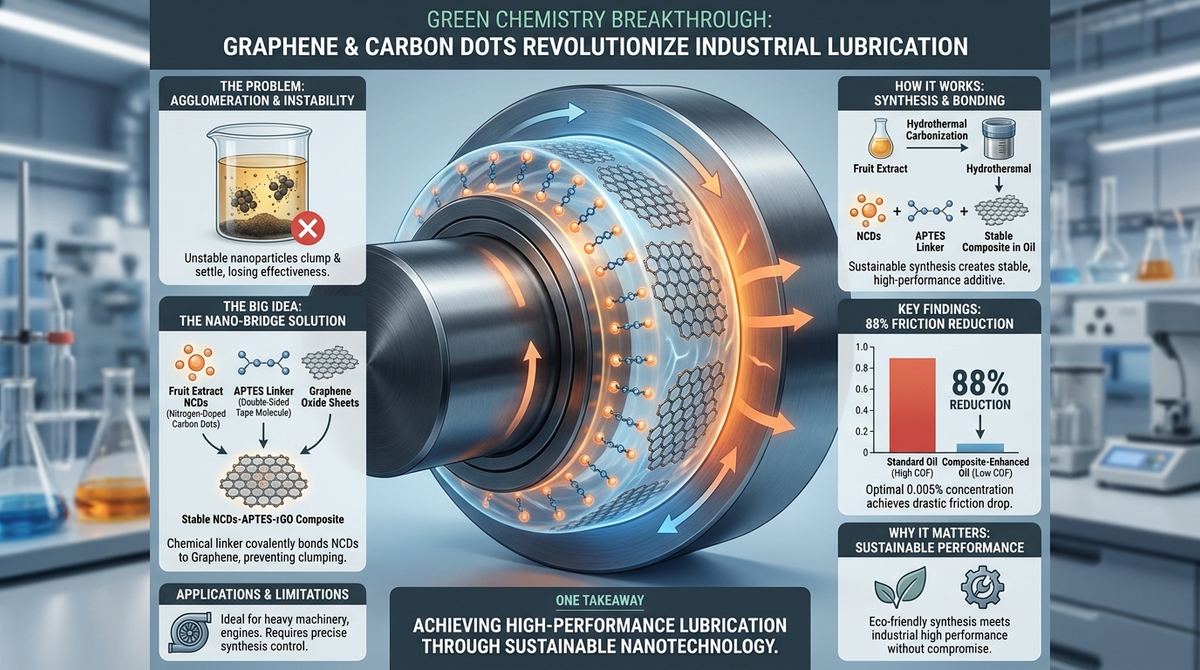
Imagine a massive industrial turbine or a high-performance car engine running at thousands of revolutions per minute. Every second, the metal components inside are screaming against each other under immense pressure. This friction creates heat, which leads to wear, which eventually leads to catastrophic mechanical failure. For decades, the quest for the perfect lubricant—one that stays stable, doesn't clump, and forms a indestructible protective layer—has been the holy grail of mechanical engineering. In a breakthrough that merges green chemistry with advanced nanotechnology, a team of researchers including Satypal Prajapati, Muskan Sahu, S. N. Singh, Murli Dhar Mitra, Jiya Lal Maurya, Dhanesh Tiwary, and Dinesh K. Verma has engineered a new type of additive that uses the power of graphene and carbon dots to fight friction more effectively than ever before.
The primary challenge in modern lubrication is the instability of nanoadditives. While it is well-known that adding tiny particles like carbon nanotubes or graphene to oil can reduce friction, these nanoparticles possess incredibly high surface energy. This high energy makes them inherently unstable; they naturally want to stick to one another rather than remaining suspended in the oil. This phenomenon, known as agglomeration, causes the particles to clump together and eventually settle at the bottom of the oil reservoir as sediment. Once they clump, they lose their effectiveness and can actually act as abrasive grit that increases wear rather than reducing it.
Furthermore, traditional chemical additives often rely on harsh, non-environmentally friendly synthetic processes. As industrial standards shift toward sustainability, there is an urgent need for additives that are not only highly efficient but also "green" in their synthesis and non-toxic to the environment. The research addresses both the physical problem of particle instability and the chemical problem of environmental impact by finding a way to keep these tiny, powerful lubricants working together in a stable, unified structure.
The researchers decided to tackle this problem by building a "nano-bridge." Instead of just throwing carbon dots and graphene into a tank of oil and hoping they mix well, they used a specialized chemical linker to physically and covalently bond them together. They started by making the carbon dots from a natural source—fruit extract—which makes the whole process much more eco-friendly.
To prevent the carbon dots from clumping, they used a molecule that acts like a double-sided piece of tape. One side of this molecule sticks firmly to the carbon dots, and the other side sticks to the graphene sheets. This creates a sophisticated hybrid material where the carbon dots are securely anchored to the graphene. When this mixture is added to oil, the graphene sheets act as large, protective carriers that distribute the carbon dots evenly throughout the liquid, preventing sedimentation and ensuring that every drop of oil contains active, high-performance particles.
The synthesis begins with a process called hydrothermal carbonization. By using Phyllanthus emblica fruit extract under high temperature and pressure, the researchers were able to create nitrogen-doped carbon dots (NCDs). The nitrogen is crucial here because it alters the electronic structure of the carbon dots, enhancing their ability to interact with metal surfaces. However, as previously mentioned, these NCDs are prone to clumping.
To fix this, the team introduced (3-aminopropyl) triethoxysilane, commonly known as APTES. APTES is a bifunctional molecule, meaning it has two distinct chemical ends that act differently. The silane end of the APTES molecule reacts with the functional groups on the surface of the carbon dots to form a strong covalent bond. This effectively "decorates" the carbon dots with amino groups. These amino-terminated NCDs are then reacted with graphene oxide (GO). The amino groups on the carbon dots bond covalently to the oxygen-containing groups on the graphene oxide.
The resulting composite, NCDs-APTES-rGO, works through a mechanism known as the formation of an in situ tribofilm. When the lubricant is under the intense pressure of two moving metal parts, the graphene sheets and the carbon dots are forced into the contact zone. As the surfaces rub together, a chemical reaction occurs between the additives and the metal surface, creating a robust, thin, and highly stable film. This film is composed of silica (SiO2) from the silane linker, iron oxides (Fe2O3) from the metal surface, and graphitic carbon. This tribofilm acts as a physical and chemical barrier that prevents the metal surfaces from ever actually touching, effectively absorbing the load and sliding smoothly.
The study used a rigorous battery of tests, including X-ray diffraction (p-XRD) and Scanning Electron Microscopy (SEM), to confirm that the chemical structures were exactly what the researchers intended. The most impressive results came from the tribological evaluations using a four-ball tester. By testing different concentrations, the researchers identified that a tiny amount—just 0.005% by volume—of the NCDs-APTES-rGO composite was the optimal concentration.
At this specific concentration, the additive achieved an incredible 88% reduction in the average coefficient of friction (COF). This means the surfaces slid against each other with much less resistance. Additionally, the mean wear scar diameter (MWD), which is a measurement of how much metal was actually scraped away during the test, was reduced by 58%.
The researchers also discovered a clear hierarchy in performance. When comparing different additives, the order of effectiveness was: Polyethylene glycol (PEG) followed by pure Graphene Oxide, then Carbon Dots, then NCDs, then NCDs-APTES, and finally the optimized NCDs-APTES-rGO. This progression demonstrates that the more effectively the components are covalently linked, the better the lubricant performs. The covalent grafting is the key driver of this superior performance, as it ensures the synergy between the zero-dimensional carbon dots and the two-dimensional graphene sheets is maximized.
This research is significant because it proves that we do not have to choose between high performance and environmental responsibility. By using fruit extracts for synthesis and ensuring the resulting material is biocompatible, this method provides a pathway for "green" industrial lubrication. This is vital for industries like automotive manufacturing and heavy machinery, where lubricant leaks can have significant environmental consequences.
Furthermore, the extreme efficiency of the additive—requiring only 0.005% w/v to achieve massive results—means that industrial users can achieve much higher levels of machine protection with very little material. This leads to longer machine lifespans, reduced maintenance costs, and significantly lower energy consumption because the engines and machines are operating with much less internal resistance.
While these results are highly promising, it is important to recognize that this research is currently in the advanced laboratory testing phase. The experiments were conducted using a four-ball tester, which is a standardized way to measure friction, but it does not fully replicate the incredibly complex, high-speed, and multi-directional stresses found in a real-world internal combustion engine or a high-speed turbine.
Future testing is required to see how these nanocomposites perform in actual engines over long periods of time. We need to know if the tribofilm remains stable after thousands of hours of operation or if the NCDs-APTES-rGO breaks down under the extreme oxidative environments found in high-temperature industrial settings. Additionally, while the synthesis uses green precursors, the scalability of the hydrothermal carbonization process for mass industrial production remains an area that requires further economic and chemical investigation.
The potential applications for NCDs-APTES-rGO are vast and span multiple sectors. In the automotive industry, this additive could be integrated into engine oils to reduce fuel consumption and extend the life of critical components like pistons and crankshafts. The reduction in friction directly translates to better fuel efficiency, which is a major goal for both commercial fleets and individual consumers.
In the realm of heavy industry, this material could be used in massive gearboxes, hydraulic systems, and mining equipment where the loads are immense and the cost of downtime due to mechanical failure is extremely high. Moreover, because the material is non-toxic and biocompatible, it could eventually find applications in specialized lubricants for industries where environmental contamination is a strict concern, such as food processing or marine engineering.
If you take away only one fact from this research, let it be this: by using a "molecular bridge" to covalently link carbon dots to graphene, scientists have created a super-lubricant that is both incredibly efficient at reducing friction and environmentally sustainable through the use of green synthesis.
What are carbon quantum dots and why are they useful?
Carbon quantum dots are essentially tiny specks of carbon, often only a few nanometers in size. They are useful because their incredibly small size and unique surface chemistry allow them to interact with surfaces at the atomic level, providing lubrication and protection that larger particles cannot achieve.
Why is it better to bond graphene and carbon dots covalently rather than just mixing them?
Mixing them relies on weak physical forces that can easily be broken by the intense movement and heat inside a machine, leading to the particles clumping together. Covalent bonding creates a permanent, strong chemical connection that ensures the particles stay well-dispersed and work together as a single, powerful unit.
What does the term "green chemistry" mean in this context?
In this research, green chemistry refers to the use of natural, sustainable materials—like fruit extracts—to create advanced nanomaterials. This avoids the use of toxic, harsh chemicals traditionally used in chemical synthesis, making the entire process safer for the environment.
How does the additive actually stop metal from wearing down?
The additive works by creating a tribofilm, which is a microscopic protective layer that forms on the metal surfaces. This film acts like a physical shield, preventing the two metal surfaces from ever making direct contact, which significantly reduces the amount of metal that gets scraped away during operation.
Is this new lubricant safe for the environment?
The researchers conducted hemolysis assays to check the biocompatibility of the nanomaterials. The results showed that the materials were non-toxic and did not cause cell damage, meaning they are safe and pose a very low risk to biological systems and the environment.
The work performed by Prajapati and the research team represents a significant leap forward in the field of nanotechnology-enhanced lubrication. By solving the fundamental problem of nanoparticle agglomeration through smart, covalent functionalization, they have unlocked a way to create highly stable, high-performance, and eco-friendly additives. As we move toward a future of more efficient and sustainable industrial processes, such "green" nano-solutions will be essential in keeping our machines running smoothly, efficiently, and safely.
Serious about B2B integration? Test our premium Pulsed Electrical Resistive Carbon Heating turbostratic graphene in your lab. 100g sample packs available now.
Explore More
Researchers derived the first exact formula for resistivity in the 1D infinite-U Hubbard model, providing a crucial benchmark for understanding strongly...

Learn how to utilize bipartite-lattice symmetry to generate pure spin shift currents in graphene nanoribbons for advanced spintronic device prototyping.

Researchers propose a novel method to detect spin- and valley-polarized states in van der Waals materials, a key step for next-gen spintronics and...