
Practical Guide: Engineering Pure Spin Current Generators with Ferromagnetic GNRs
Learn how to utilize bipartite-lattice symmetry to generate pure spin shift currents in graphene nanoribbons for advanced spintronic device prototyping.
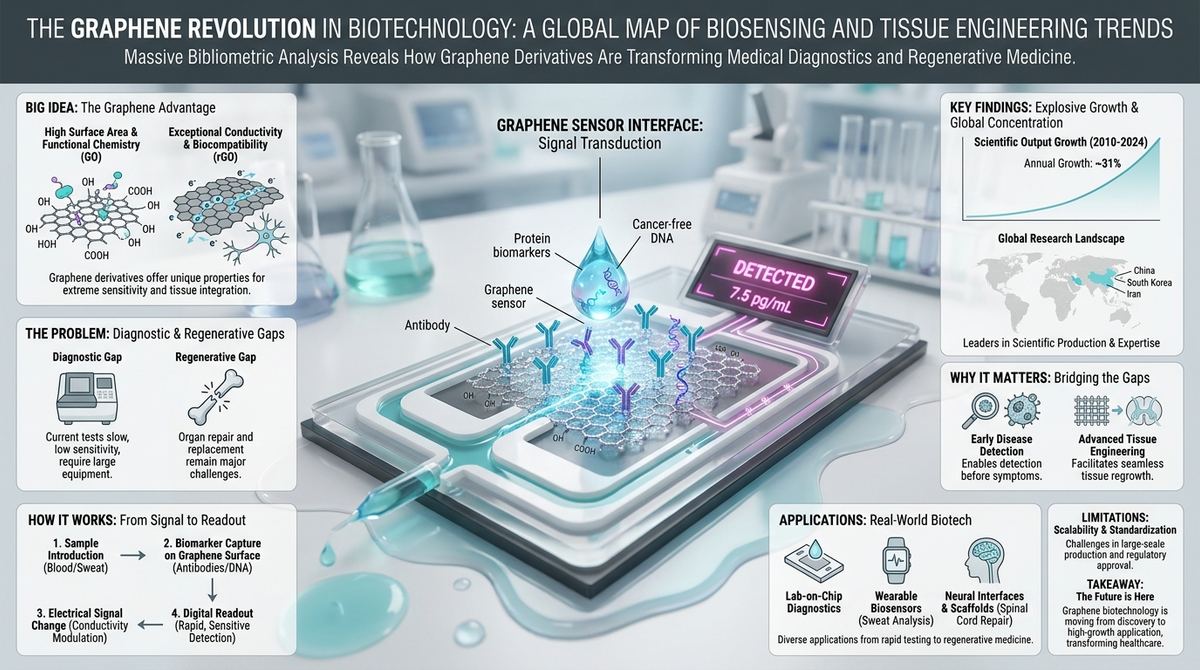
Imagine a medical world where a single drop of sweat can detect a disease long before symptoms appear, or where a synthetic scaffold can seamlessly integrate into your body to regrow a damaged spinal cord. This future is being built today, not with traditional metals or plastics, but with a single layer of carbon atoms known as graphene. While graphene has been a scientific superstar for years, the question has shifted from whether it can be used to how it can be perfected for life-saving medical applications. By mapping thousands of scientific studies, researchers are now uncovering the blueprint for the next generation of healthcare technology.
Modern medicine faces two massive hurdles: the diagnostic gap and the regenerative gap. The diagnostic gap refers to the limitations of current medical testing, which often relies on large-scale laboratory equipment, slow turnaround times, and relatively low sensitivity for early-stage detection. Many current electrochemical sensors lack the extreme sensitivity required to detect minute concentrations of biomarkers, such as specific proteins or cancer-free DNA, in a complex biological fluid like blood.
The regenerative gap is a separate but equally daunting challenge. When human tissue is damaged—whether it is bone, cardiac muscle, or nerve tissue—the body often replaces it with non-functional scar tissue rather than healthy, working cells. Current synthetic scaffolds used in tissue engineering often fail because they lack the necessary mechanical strength to support the weight of developing tissue or the electrical conductivity required to communicate with active cells like neurons or heart cells. Without a way to provide both structural support and biological communication, true tissue regeneration remains a elusive goal in clinical medicine.
To understand the future of biotechnology, we must look at the work of Gustavo Vaca, Ignacio Isa-Vargas, Andrea Castañeda, Naomi Becerra, and Matt Abad. These researchers conducted a massive, high-level evaluation of over three thousand scientific documents to see exactly how graphene derivatives are bridging these diagnostic and regenerative gaps. Instead of looking at a single experiment, they looked at the entire global scientific landscape from 2010 to 2024 to identify which trends are actually working and which technologies are ready for the real world.
Their research shows that graphene is not just a single material but a versatile family of derivatives. By chemically modifying graphene, scientists can change its properties—making it more soluble, more conductive, or more biologically compatible. This study provides a roadmap for where the industry is headed, highlighting a massive move toward hybrid materials that combine the best of graphene with existing biomaterials like collagen or chitosan to create "super-materials" for the medical field.
To understand why graphene is so transformative, we must look at the relationship between its atomic structure and its functional performance. Graphene derivatives, specifically Graphene Oxide (GO) and Reduced Graphene Oxide (rGO), offer two distinct advantages that solve the problems mentioned earlier.
In the world of biosensors, the magic lies in the surface area and the chemistry of Graphene Oxide. GO is covered in oxygen-containing functional groups, such as hydroxyl and carboxyl groups. These groups act as chemical handles, allowing scientists to "tether" specific biological molecules, like antibodies or DNA strands, directly onto the graphene surface. Because graphene has an incredibly high surface area-to-volume ratio, a tiny amount of material provides millions of these attachment sites. When a target molecule from a patient's sample binds to these handles, it causes a measurable change in the electrical resistance of the graphene sheet. This is known as field-effect transduction, and because the graphene layer is so thin, even a single binding event can significantly disrupt the flow of electrons, leading to ultra-sensitive detection.
In the field of tissue engineering, the mechanism shifts toward mechanical and electrical integration. While GO is excellent for chemical bonding, Reduced Graphene Oxide (rGO) is prized for its restored electrical conductivity. When rGO is integrated into a polymer scaffold, such as chitosan or collagen, it creates a hybrid network. This network serves two purposes. First, the high mechanical modulus of graphene increases the structural integrity of the scaffold, preventing it from collapsing under physiological stress. Second, the electrical conductivity of the rGO allows the scaffold to transmit electrical signals. This is vital for neural and cardiac regeneration, as these cells rely on electrical impulses to function correctly. The graphene essentially acts as a bridge, allowing electrical signals to jump across the synthetic scaffold, guiding the cells to grow and behave as they would in natural tissue.
The bibliometric analysis conducted by the research team reveals a field that is not just growing, but exploding. Between 2010 and 2024, the scientific output regarding graphene in biotechnology has maintained an annual growth rate of nearly 31 percent. This suggests that the field has moved past the initial "discovery" phase and has entered a high-growth "application" phase.
The data shows that the global research landscape is highly concentrated, with China, South Korea, and Iran leading the world in scientific production. This geographic distribution highlights where the specialized expertise and industrial investment are currently focused. Furthermore, the study identified a clear evolution in research themes. Early research focused on the basic properties of graphene, but recent studies have shifted toward sophisticated multifunctional hybrid materials and 3D bioprinting. We are seeing a transition from simply making graphene to designing complex, 3D-printed biological structures that incorporate graphene to mimic the intricate architecture of human organs.
This research matters because it provides a reality check for the biotech industry. By identifying the current trends, the study tells investors, clinicians, and engineers where the most significant breakthroughs are occurring. The shift toward portable, non-invasive diagnostics means we are moving closer to a world where healthcare is decentralized—moving from large hospitals to a small, handheld device in a patient's home.
Moreover, the identification of 3D bioprinting as a major trend suggests that the future of medicine will involve "printing" personalized tissue scaffolds that match a specific patient's anatomy. This level of precision was previously impossible with traditional materials. By understanding the synergy between graphene and existing biomaterials like hydroxyapatite or collagen, researchers can design more effective treatments for bone defects and nerve injuries, significantly reducing the recovery time and improving the long-term success of regenerative procedures.
Despite the immense potential, the research highlights significant hurdles that prevent these technologies from being immediately available in every hospital. One of the primary challenges is the lack of synthesis standardization. Because graphene can be produced through many different chemical and physical methods, no two batches of graphene are exactly the same. This variability in oxygen content, defect density, and sheet size makes it difficult for regulatory bodies like the FDA to approve graphene-based products, as the performance may change from one batch to another.
Furthermore, large-scale production remains a significant economic and technical barrier. Creating high-quality, defect-free graphene at a massive scale while maintaining the specific functional groups needed for biotechnology is incredibly difficult and expensive. Finally, there is the critical issue of clinical validation. While the performance of graphene in a laboratory setting is often spectacular, moving from a controlled petri dish to the complex, unpredictable environment of the human body requires years of rigorous, long-term safety testing to ensure that the material does not cause inflammation or toxicity over time.
The implications of these findings extend into several practical domains. In clinical diagnostics, we can expect the rise of point-of-care devices that use graphene-based electrochemical sensors to detect infectious diseases or metabolic imbalances in seconds, using only a tiny drop of blood or saliva. These devices could be as simple as a smartphone attachment, democratizing access to high-end medical testing.
In the realm of regenerative medicine, graphene-enhanced scaffolds are being developed to treat complex bone fractures and spinal cord injuries. By combining graphene with hydroxyapatite—the primary mineral found in bone—engineers are creating scaffolds that not only provide a physical template for bone growth but also use electrical stimulation to accelerate the healing process. Additionally, the emergence of 3D bioprinting with graphene-based bio-inks opens the door to printing complex, vascularized tissues that can eventually lead to the creation of entire replacement organs, fundamentally changing how we approach organ transplantation.
If you take away only one concept from this research, let it be this: graphene is evolving from a scientific curiosity into a versatile "functional toolkit" that allows us to bridge the gap between electronic sensing and biological life.
What are graphene derivatives and why are they important?
Graphene derivatives are materials created by chemically modifying pure graphene to change how it behaves. While pure graphene is an excellent conductor, it is difficult to work with in biological settings because it does not easily dissolve in water or bond with biological molecules. By creating derivatives like Graphene Oxide, scientists can add oxygen-containing groups that allow the material to be more soluble and chemically reactive, making it much more useful for medical applications.
How does graphene actually detect a disease in a sensor?
Graphene-based sensors work through a process called electrical transduction. Because graphene is an incredibly thin sheet of carbon, its electrical conductivity is extremely sensitive to any changes on its surface. When we attach specific biological "catchers," like antibodies, to the graphene, and a target molecule like a virus or a cancer protein binds to them, it creates a disturbance in the electrical flow. This change in resistance is measured instantly, providing a signal that indicates the presence and concentration of the disease.
Why is graphene used in tissue engineering?
Graphene is used in tissue engineering because it provides two essential components that most traditional materials lack: mechanical strength and electrical conductivity. Many biological tissues, such as bone and nerve, are both physically tough and electrically active. By adding graphene to a biodegradable polymer, we create a scaffold that can support the weight of growing tissue while also providing the electrical pathways necessary for cells like neurons to communicate with each other.
Which countries are leading the research in this field?
Based on the bibliometric analysis of thousands of documents, China, South Korea, and Iran are currently the global leaders in research output regarding graphene in biotechnology. This indicates that these nations are investing heavily in the fundamental science and applied engineering necessary to move graphene from the laboratory into practical, commercial medical applications.
Is graphene technology ready for widespread medical use right now?
While the research shows incredible progress and a massive growth in scientific interest, graphene-based medical technologies are not yet ready for widespread clinical use. The field still faces significant challenges regarding the standardization of how graphene is manufactured, the difficulty of scaling up production, and the need for long-term clinical trials to ensure that these materials are safe and effective for human use in a variety of medical scenarios.
The landscape of biotechnology is undergoing a profound shift, driven by the incredible versatility of graphene derivatives. From highly sensitive biosensors that could revolutionize diagnostics to advanced scaffolds that facilitate tissue regeneration, the potential applications are nearly limitless. While significant challenges in standardization and clinical validation remain, the rapid growth and emerging trends identified in this research suggest that graphene is not just a passing trend, but a foundational pillar of the future of medical science.
Serious about B2B integration? Test our premium Pulsed Electrical Resistive Carbon Heating turbostratic graphene in your lab. 100g sample packs available now.
Explore More
Learn how to utilize bipartite-lattice symmetry to generate pure spin shift currents in graphene nanoribbons for advanced spintronic device prototyping.

Researchers propose a novel method to detect spin- and valley-polarized states in van der Waals materials, a key step for next-gen spintronics and...

Researchers developed the CARBON-2D Topological Descriptor (C2DTD), an interpretable, physics-informed method to rapidly predict the properties of new 2D...