
An Exact Solution for Electron Transport and Resistivity in the Hubbard Model
Researchers derived the first exact formula for resistivity in the 1D infinite-U Hubbard model, providing a crucial benchmark for understanding strongly...
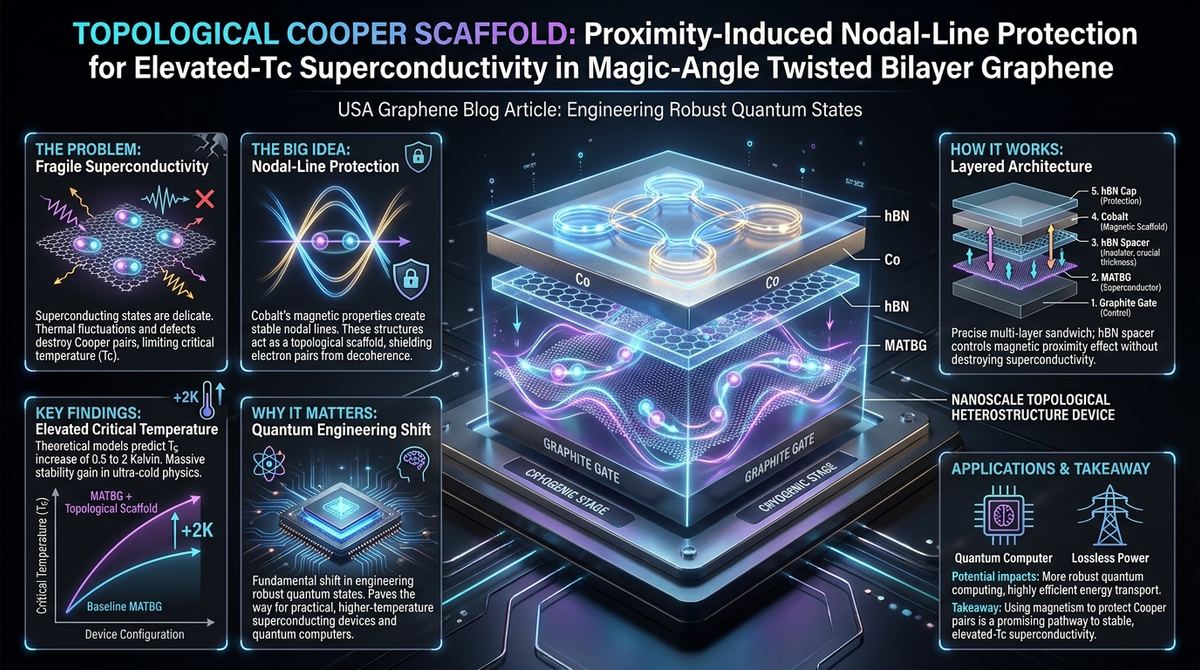
Imagine a world where electricity flows through wires without losing a single drop of energy, and where quantum computers operate at temperatures much higher than the absolute zero required by today's machines. This is not science fiction; it is the holy grail of modern physics. Researchers are currently hunting for a way to make superconductivity more robust and easier to maintain. By using a clever trick involving the magnetic properties of cobalt and the unique structure of twisted graphene, scientists may have found a way to shield the delicate quantum states of electrons from the chaotic vibrations that usually destroy them.
The primary challenge in materials science today is the extreme fragility of the superconducting state. Superconductivity is a phenomenon where electrons form pairs, known as Cooper pairs, which move through a material without any electrical resistance. However, these pairs are incredibly delicate. In a material like magic-angle twisted bilayer graphene, or MATBG, superconductivity emerges when two sheets of graphene are twisted at a very specific angle, approximately 1.1 degrees. This precise twist creates flat electronic bands, which essentially slows down the electrons, allowing them to interact more strongly and form these essential Cooper pairs.
Despite this potential, the temperature at which MATBG becomes superconducting, known as the critical temperature or Tc, is extremely low, typically around 1.7 Kelvin. This requires specialized and expensive dilution refrigerators to maintain. The reason the temperature remains so low is due to a process called intervalley phonon scattering. In graphene, electrons exist in specific momentum states called valleys. For superconductivity to be stable, these electrons must remain in a coordinated state. However, thermal vibrations in the crystal lattice, called phonons, act like tiny hammers, knocking electrons from one valley to another. This scattering disrupts the coordination of the Cooper pairs, causing the superconductivity to vanish. To achieve higher temperatures, we must find a way to suppress this specific type of decoherence without introducing other disruptive forces that might destroy the superconductivity altogether.
The concept proposed by researchers, including Leon Sandler, is what they call the Topological Cooper Scaffold. This idea moves away from traditional methods of trying to stabilize superconductivity by changing the material's chemistry or temperature. Instead, it uses a concept inspired by topological physics. In certain materials, like elemental cobalt, the electronic structure contains special features called magnetic nodal lines. These are regions where the energy levels of the electrons cross in a very specific, stable way that is protected by the symmetry of the crystal.
The researchers propose using these stable magnetic features to create a protective environment for the electrons in the graphene. By placing an ultrathin layer of cobalt near the graphene, the unique magnetic spin texture from the cobalt can be transferred into the graphene's electronic structure. This is not done by allowing electricity to flow between the materials, but rather through a subtle quantum mechanical effect. This transferred texture acts as a scaffold, a structural framework that stabilizes the electronic environment. Much like how a stabilizer can prevent a camera from blurring during a shaky shot, this topological scaffold is designed to protect the Cooper pairs from the disruptive effects of lattice vibrations.
To achieve this effect without destroying the superconductivity, the researchers have designed a highly specific multi-layer sandwich. The proposed architecture consists of a graphite gate, a layer of magic-angle twisted bilayer graphene, a thin spacer made of hexagonal boron nitride (hBN), an ultrathin layer of cobalt, and a final protective cap of hBN. The use of hexagonal boron nitride is critical to the success of the mechanism. hBN is an excellent electrical insulator that is also atomically smooth, making it perfect for van der Waals assembly.
The thickness of the hBN spacer is the most sensitive variable in the system. By keeping the spacer to only one or two monolayers thick, the researchers can control the interaction between the cobalt and the graphene. At this extreme thinness, the electrical current remains trapped within the graphene, preventing the magnetic cobalt from "poisoning" the superconductivity through direct electrical contact. However, the spacer is thin enough to allow for exchange coupling. Exchange coupling is a short-range quantum interaction that allows the magnetic information, or the spin texture, to leak through the insulator.
Once this magnetic texture is transferred into the MATBG, it modifies the way electrons interact with phonons. Specifically, the topological nature of the cobalt's nodal lines changes the electronic symmetry in the graphene. This change is designed to make the electrons much less likely to undergo intervalley scattering. By suppressing the specific path through which thermal energy disrupts the Cooper pairs, the material can maintain its superconducting state even as the temperature rises. This approach essentially uses symmetry-based protection to decouple the superconducting state from the specific environmental noise that usually destroys it.
While this research is currently a theoretical and conceptual framework, the mathematical models provide highly encouraging predictions. Using the Bardeen-Cooper-Schrieffer (BCS) theory, which is the standard mathematical language for describing superconductivity, the researchers have calculated the expected outcomes of this heterostructure. They predict that the critical temperature of the MATBG could be elevated by 0.5 to 2 Kelvin above the current baseline. While a two-degree increase might seem small in everyday terms, in the physics of ultra-cold temperatures, it represents a massive increase in the stability and robustness of the superconducting state.
In addition to raising the critical temperature, the research predicts that this topological scaffold will enhance the upper critical field, known as Hc2. The upper critical field is the maximum magnetic field a material can withstand before it loses its superconductivity. By using a topological scaffold to protect the Cooper pairs, the researchers believe the material will be much more resilient to external magnetic fields, potentially exceeding the standard Pauli limit that usually restricts such materials. Furthermore, because the entire system is controlled by an external voltage through the graphite gate, the researchers predict that this enhancement is tunable. This means scientists could potentially turn the superconductivity boost on or off, or adjust its strength, simply by changing the electrical potential applied to the device.
The significance of this research extends far beyond the study of graphene; it represents a fundamental shift in how we might engineer quantum states. For decades, the pursuit of higher-temperature superconductivity has focused on finding new materials through trial and error or by increasing the pressure applied to existing ones. This new approach suggests a different design axis: symmetry-based decoherence suppression. Instead of changing the material's composition, we can change its topological environment.
This concept is closely related to the principle of isolation used in the development of the Thorium-229 nuclear clock. In that application, scientists achieve unprecedented precision by isolating the nuclear transition from environmental perturbations. The Topological Cooper Scaffold applies this same logic to the electronic scale. If we can prove that topological features can shield quantum states from thermal noise, it opens the door to a whole new class of materials where superconductivity is protected by design rather than by extreme cooling. This could fundamentally accelerate the search for ambient-pressure, higher-temperature superconductors, which would revolutionize everything from energy transmission to high-speed transportation.
It is important to note that this research remains a theoretical proposal and a conceptual framework. There are several significant experimental hurdles that must be overcome before this can be realized in a laboratory. The first is the extreme precision required in the fabrication of the heterostructure. The effectiveness of the topological scaffold depends entirely on the thickness of the hBN spacer. If the layer is too thick, the magnetic influence of the cobalt will not reach the graphene; if it is too thin, the cobalt will cause direct pair-breaking and destroy the superconductivity entirely.
Furthermore, verifying the mechanism will be difficult. Scientists will need to distinguish between the benefits provided by the topological scaffold and other potential artifacts, such as the mechanical strain caused by depositing the cobalt layer or the electrostatic effects of the different materials. The researchers have proposed five specific transport predictions to help isolate the mechanism, including "null controls" where the spacer thickness is varied to prove that the effect is purely due to the proximity-induced topological texture. Only through these rigorous experimental tests can the hypothesis of the Topological Cooper Scaffold be confirmed.
If the predictions of this research are validated, the real-world implications are vast. The most immediate application would be in the field of quantum computing. One of the biggest obstacles to scalable quantum computers is decoherence, where the quantum state of a qubit is lost due to environmental noise. A material that is topologically protected from such noise could serve as the foundation for much more stable and reliable qubits, allowing for more complex and powerful quantum processors.
Beyond computing, the ability to tune superconductivity and increase the upper critical field has profound implications for sensing technologies. Superconducting quantum interference devices (SQUIDs) are used to detect incredibly faint magnetic fields, such as those produced by the human brain. Enhancing the stability and field-tolerance of these materials could lead to a new generation of ultra-sensitive, portable medical imaging and geological sensors. In the long term, the development of more robust, higher-temperature superconductors is the key to ultra-efficient power grids and the widespread adoption of maglev transportation systems, which require powerful, stable magnetic fields.
If there is one core concept to take away from this research, it is that we can protect delicate quantum states not just by making them colder, but by using the geometry and symmetry of the material's electronic structure to shield them from the world around them.
What is magic-angle twisted bilayer graphene and why is it special?
Magic-angle twisted bilayer graphene is a material made by stacking two sheets of graphene and twisting them at a very specific angle, about 1.1 degrees. This twist causes the electrons to move much more slowly, creating "flat bands" where they can interact very strongly with one another. This intense interaction is what allows the material to become a superconductor, which is a state where electricity flows without any resistance.
Why does the researchers' use of cobalt help the superconductivity?
The cobalt is not used for its electrical properties, but for its unique magnetic structure, specifically its magnetic nodal lines. These lines provide a special topological texture that can be transferred into the graphene via a thin spacer. This texture acts as a "scaffold" that protects the electrons from being scattered by thermal vibrations, thereby helping the material stay superconducting at higher temperatures.
What is the role of the hexagonal boron nitride (hBN) layer in this design?
The hBN layer acts as a highly controlled barrier. Its job is to act as an insulator so that the electrical current stays within the graphene, preventing the cobalt from interfering with the superconductivity. However, it is kept extremely thin—only one or two layers thick—so that the quantum magnetic influence, known as exchange coupling, can still pass through to the graphene.
Does this research mean we will have room-temperature superconductors soon?
Not exactly. This research is a theoretical proposal that suggests a new way to boost the temperature at which these materials work. While the researchers predict an increase in the critical temperature, it is still measured in Kelvin, which is far below room temperature. However, it provides a new roadmap for how scientists might eventually reach much higher temperatures by using topological protection.
How can scientists prove that this specific mechanism is what is causing the change?
To prove that the topological scaffold is responsible for the improvement, scientists will perform a series of controlled experiments. They will vary the thickness of the hBN spacer to see if the effect disappears when the layers are too thick, and they will look for specific electrical signatures that match the theoretical predictions. This helps ensure that the results are caused by the magnetic texture and not by accidental factors like mechanical strain or simple electrical changes.
The proposal of the Topological Cooper Scaffold marks a significant conceptual leap in condensed matter physics. By moving beyond simple chemical doping and looking toward the topological protection of electronic states, researchers like Leon Sandler are offering a new way to approach the challenge of decoherence. If the predicted upward shift in critical temperature and the enhancement of the upper critical field can be experimentally demonstrated, it will confirm that symmetry-based design is a viable path toward more robust and higher-temperature superconductivity. This work could bridge the gap between the fragile quantum states observed in laboratories today and the stable, high-temperature superconductors required for the technological revolutions of tomorrow.
Serious about B2B integration? Test our premium Pulsed Electrical Resistive Carbon Heating turbostratic graphene in your lab. 100g sample packs available now.
Explore More
Researchers derived the first exact formula for resistivity in the 1D infinite-U Hubbard model, providing a crucial benchmark for understanding strongly...

Learn how to utilize bipartite-lattice symmetry to generate pure spin shift currents in graphene nanoribbons for advanced spintronic device prototyping.

Researchers propose a novel method to detect spin- and valley-polarized states in van der Waals materials, a key step for next-gen spintronics and...