
Detection of spin- and valley-polarized states in van der Waals materials via
Researchers propose a novel method to detect spin- and valley-polarized states in van der Waals materials, a key step for next-gen spintronics and...
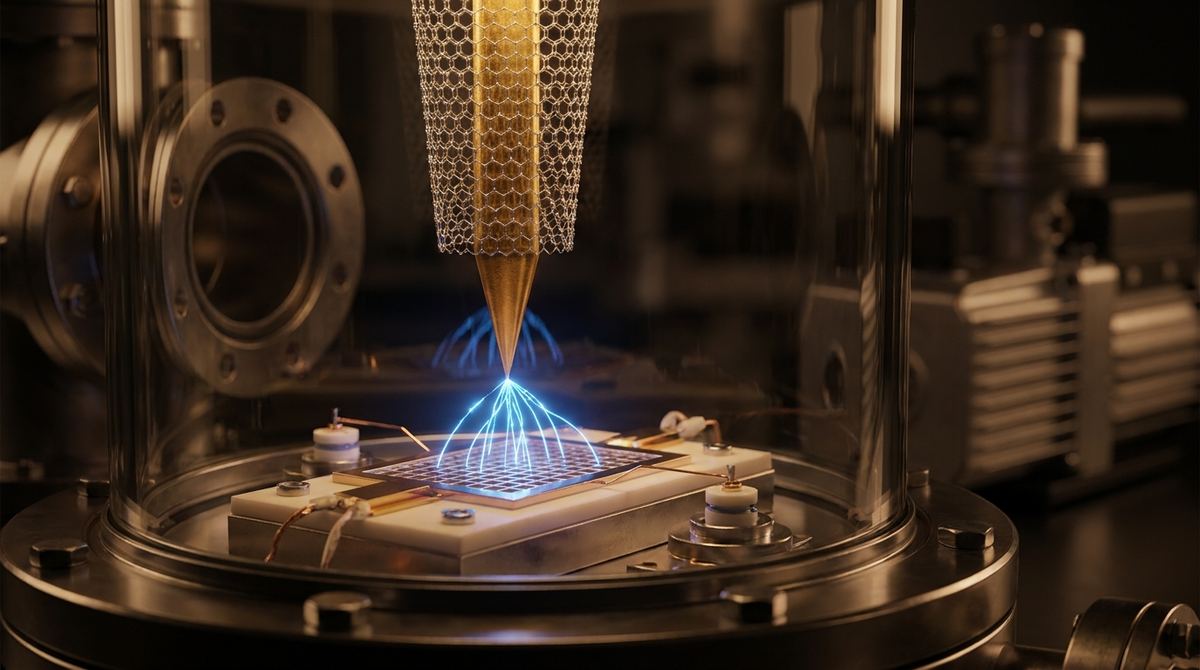
The evolution of vacuum electronics has moved from the macro-scale vacuum tubes of the early 20th century to the nanoscale vacuum electronics of the future. While traditional field-emission (FE) devices using pure metal tips are efficient, they suffer from a significant engineering limitation: they are difficult to tune. Once a metal emitter is fabricated, its electron transport characteristics are largely fixed by the material properties of the metal.
Recent theoretical work by Maxim Trushin has proposed a solution to this tunability problem. By coating noble metals with a single layer of graphene, we create a heterostructure that enables resonant tunneling. This allows for non-monotonic I-V (current-voltage) characteristics, meaning the electron flow can be controlled with much higher precision and sensitivity than standard metal emitters. For engineers working in high-frequency signal modulation, sensing, or next-generation vacuum nanoelectronics, this represents a significant leap in device control.
This guide outlines how to prototype a coplanar field-emission device using graphene-metal heterostructures.
In a standard field-emission device, electrons tunnel through a potential barrier created by an external electric field, following the Fowler-Nordheim law. This typically results in an exponential increase in current as voltage increases.
However, when a graphene layer is placed on a noble metal, the graphene's unique electronic states act as a filter. Because graphene is atomically thin and has weak electronic hybridization with metals like gold or silver, it allows for resonant tunneling. As you sweep the voltage, the Fermi level of the metal aligns with the discrete electronic states of the graphene. This creates peaks and valleys in the current-voltage curve. For a developer, this means you can design a device where the current response is not just a simple ramp, but a highly sensitive, tunable function of the applied field.
The most immediate practical application for this technology is the high-speed vacuum nano-modulator. In traditional semiconductor-based modulation, speed is limited by carrier mobility and capacitance. In a vacuum-channel device, the lack of mass and collisions allows for much higher operating frequencies.
By utilizing the non-monotonic I-V characteristics provided by the graphene-metal interface, you can create a device that acts as a high-speed switch or a highly sensitive amplitude modulator for RF signals. This is particularly useful in environments where radiation hardness or high-temperature stability is required, as vacuum-channel devices are inherently more robust than silicon-based components.
To build a prototype, we will focus on the coplanar configuration. This geometry uses two sharp electrodes on a single substrate, allowing for strong field enhancement at the tips and easier electrical gating.
Required Materials:
- Substrate: Silicon with a thick thermal oxide layer (SiO2) or a Quartz substrate for better insulation.
- Metal Emitter: Gold (Au) or Silver (Ag). Gold is preferred for its chemical stability and ease of processing.
- Graphene: High-quality CVD (Chemical Vapor Deposition) monolayer graphene.
- Resist: PMMA (Polymethyl methacrylate) for the transfer process.
- Etchant: Standard lithography chemicals (e.g., HF for oxide removal or specialized metal etchants).
Engineering Assumptions and Dimensions:
- Tip Radius: To achieve significant field enhancement, the electrode tips should have a radius of curvature between 50nm and 100nm. This is an assumption based on standard electron-beam lithography capabilities.
- Graphene Thickness: The device assumes a single monolayer of graphene.
- Vacuum Requirement: The device must operate in a high vacuum environment, ideally 10^-7 Torr or better, to prevent ion bombardment and gas-related noise.
The fabrication of a graphene-metal heterostructure requires precision to ensure the graphene layer is continuous and in intimate contact with the metal tip.
1. Substrate Preparation: Clean the silicon/quartz substrate using a Piranha etch or oxygen plasma to remove organic contaminants.
2. Electrode Patterning: Use Electron Beam Lithography (EBL) to define sharp, needle-like electrodes on the substrate. The geometry should be a coplanar setup where the tips are separated by a distance of 100nm to 500nm.
3. Metal Deposition: Deposit a thin layer of gold (approx. 50-100nm) using electron-beam evaporation. The evaporation angle should be controlled to ensure the formation of sharp, high-aspect-ratio tips.
4. Graphene Transfer: Use the PMMA-mediated wet transfer method to place the CVD graphene onto the metal electrodes. The graphene must be transferred such that it covers the sharp tips of the gold electrodes without significant wrinkling or tearing.
5. Post-Transfer Annealing: Perform a vacuum annealing step (approx. 200-300 degrees Celsius) to improve the contact between the graphene and the gold. This is critical for reducing contact resistance and ensuring the resonant tunneling effect is not dampened by interface defects.
6. Final Cleaning: Perform a gentle rinse to remove any remaining PMMA residue, followed by a final vacuum bake.
Once the prototype is fabricated, the goal is to verify the non-monotonic I-V characteristics.
1. Vacuum Integration: Place the device in a high-vacuum chamber equipped with electrical feedthroughs. Evacuate the chamber to at least 10^-7 Torr.
2. I-V Characterization: Use a high-sensitivity picoammeter (such as a Keithley 6450) and a precision DC voltage source. Sweep the voltage between 0V and 100V in small increments. Look for the non-monotonic current response—specifically, look for deviations from the standard Fowler-Nordheim exponential curve.
3. Frequency Response: To test the modulation capability, apply a small RF signal (GHz range) superimposed on the DC bias. Use a network analyzer to measure the transmission coefficient of the vacuum channel.
4. Stability Test: Run the device at a constant bias for several hours to ensure the graphene layer does not delaminate or degrade under the intense local electric field.
- Interface Contamination: The most significant risk is the presence of trapped hydrocarbons or moisture between the metal and the graphene. This will destroy the resonant tunneling effect. Mitigation: Use ultra-clean transfer techniques and rigorous post-transfer annealing.
- Graphene Delamination: The high electric field at the tip can create mechanical stress. Mitigation: Ensure the graphene is well-adhered through optimized annealing and consider using a thin adhesion layer of Chromium or Titanium, though this must be balanced against the risk of hybridization.
- Tip Degradation: Metal atoms can migrate under high field (electromigration). Mitigation: Keep the operating temperature low and the current density within the limits suggested by the non-monotonic peaks.
This guide is based on the theoretical framework established by Maxim Trushin in the paper Resonant field emission from noble-metal/graphene heterostructures (2026). The fabrication steps and testing protocols are engineering assumptions designed to translate the ab-initio and Schrödinger equation solutions provided in the research into a physical prototype.
Serious about B2B integration? Test our premium Pulsed Electrical Resistive Carbon Heating turbostratic graphene in your lab. 100g sample packs available now.
Explore More
Researchers propose a novel method to detect spin- and valley-polarized states in van der Waals materials, a key step for next-gen spintronics and...

Researchers developed the CARBON-2D Topological Descriptor (C2DTD), an interpretable, physics-informed method to rapidly predict the properties of new 2D...

Learn how to create p-n junctions in graphene by selectively oxidizing the underlying germanium substrate. This guide covers a practical method for...