
Unlocking Superconductivity in Twisted Graphene: A Gutzwiller Study Explained
Explore how theoretical physics unlocks the secrets of strongly correlated superconductivity in twisted bilayer graphene, a key step toward future quantum...
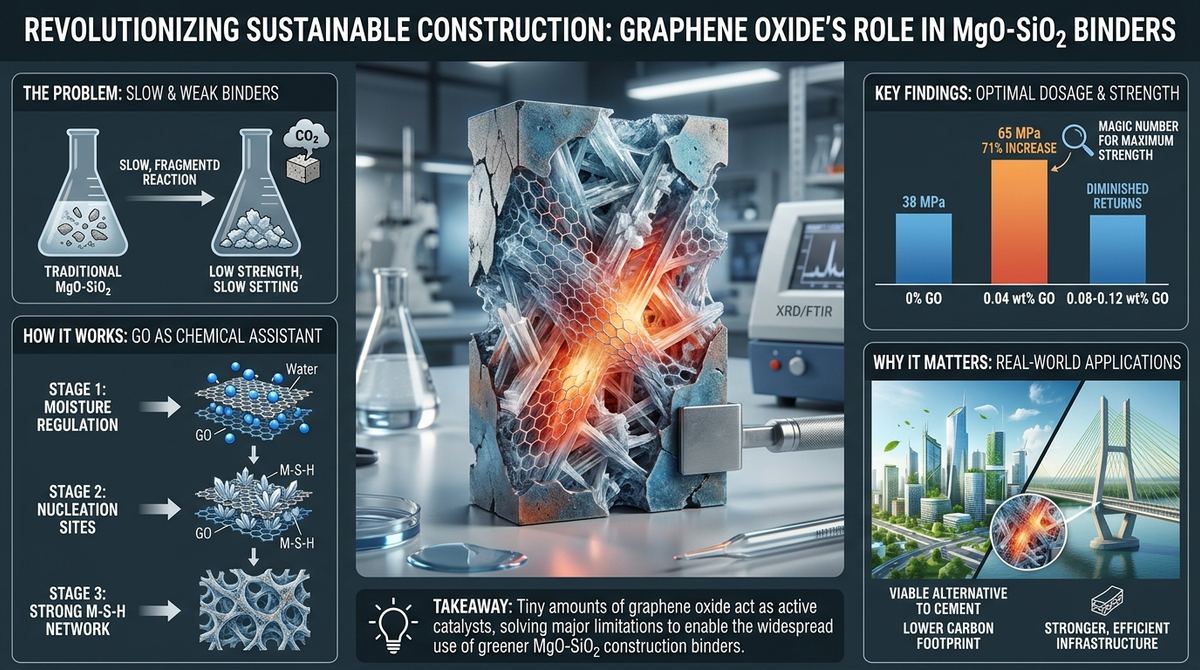
The global construction industry is currently facing a massive challenge: how to build the cities of tomorrow without destroying the climate of today. Traditional Portland cement, the most common binder in the world, is a significant source of carbon dioxide emissions due to the high-temperature chemical processes required for its production. As a result, scientists are looking toward alternative binders, such as magnesium-silicate systems, which offer a much lower carbon footprint. However, these alternatives have a notorious weakness. They often react too slowly to be practical on a construction site and fail to develop the immense structural strength that engineers require for large-scale infrastructure. Recent scientific investigations have begun to uncover a way to fix these flaws using a miracle material: graphene oxide.
The primary challenge in developing MgO-SiO2 (magnesium oxide-silica) binders lies in their complex and sluggish chemical kinetics. When magnesium oxide and silica are mixed with water, they do not immediately form the strong, dense structure known as Magnesium Silicate Hydrate (M-S-H), which is the chemical "glue" responsible for the strength of the material. Instead, the reaction often gets stuck in an intermediate stage.
During the early stages of hydration, the reaction tends to favor the formation of brucite, which is magnesium hydroxide. While brucite is a necessary step in the process, it is not the ultimate goal. If the reaction remains focused on brucite, the resulting material is often porous, weak, and slow to harden. For a construction material to be viable, the magnesium ions released during the initial phase must be successfully incorporated into the silicate network to create a dense, interlocking M-S-H matrix. Currently, the transition from the brucite phase to the M-S-H phase is inefficient, leading to binders that lack the mechanical integrity needed for heavy-duty applications. Researchers are essentially trying to find a way to speed up this transition and ensure that the chemical building blocks end up in the right place at the right time.
The solution proposed by Ziyan Hang, Thakur Bharati, Jianzheng Man, Chuang Feng, and Cise Unluer involves using graphene oxide, or GO, as a multi-purpose chemical assistant. Rather than just acting as a passive filler that sits inside the mixture, graphene oxide acts as a highly active participant in the chemical dance of hydration.
Think of the hydration process like a construction site where workers are trying to build a complex scaffolding. Without instructions or a central hub, the workers might build small, disconnected piles of bricks that do nothing to support the structure. Graphene oxide acts like a foreman and a structural template simultaneously. First, it holds onto water to ensure the workers have enough material to work with. Second, it provides a specialized surface that encourages the bricks to start sticking together much faster. Finally, it provides a massive, interconnected framework that ensures all the pieces are locked into a strong, unified web. By adding just a tiny, precise amount of this material, researchers found they could dramatically increase the strength and speed of the entire process.
To understand why graphene oxide is so effective, we must look at the three distinct stages of its interaction with the binder system. The researchers used advanced techniques like X-ray diffraction (XRD) and Fourier-transform infrared spectroscopy (FTIR) to observe these changes at a molecular level.
In the first stage, which occurs during the initial hours of hydration, the graphene oxide acts as a powerful moisture regulator and a nucleation site. Graphene oxide is covered in oxygen-containing functional groups, such as hydroxyl and carboxyl groups. These groups are hydrophilic, meaning they love water. By attracting and retaining water molecules, GO creates a localized environment with optimal moisture levels, which facilitates the rapid formation of brucite. Furthermore, the flat, two-dimensional surface of the GO sheets provides a perfect "landing pad" for the first crystals to form. This process, known as heterogeneous nucleation, significantly lowers the energy required for the chemical reaction to begin, allowing the brucite to form much more quickly than it would in a standard mixture.
In the second stage, the role of graphene oxide shifts toward chemical facilitation. As the reaction progresses, the brucite that was formed in the first stage must dissolve to release magnesium ions into the solution. These ions are essential for the formation of the magnesium silicate hydrate (M-S-H) phase. The researchers discovered that graphene oxide actually assists in this dissolution-reprecipitation process. By interacting with the brucite crystals, the GO helps release the magnesium ions more effectively, ensuring there is a steady supply of building blocks available to form the final, strong mineral phase.
In the third and final stage, the graphene oxide performs its most critical structural role. As the M-S-H begins to grow, it does not just form random clumps. Instead, the M-SH crystals grow along and around the graphene oxide sheets. The high surface area of the GO provides an expansive interfacial area, acting as a scaffolding or a template. This allows the M-S-H to develop into a highly interconnected and dense network. Instead of having isolated pockets of strength, the material develops a continuous, microscopic web of minerals that is physically reinforced by the presence of the graphene oxide sheets.
The results of the study were quite striking, particularly regarding the optimal dosage of the nanomaterial. The researchers tested various concentrations of graphene oxide to find the perfect balance. They discovered that the magic number was 0.04 wt%. At this specific concentration, the compressive strength of the MgO-SiO2 binder reached 65 MPa, which represents a staggering 71% improvement over the standard binder without graphene oxide.
However, more is not always better. The study found that as the concentration of graphene oxide increased to 0.08 wt% or 0.12 wt%, the effectiveness of the material actually began to decline. This phenomenon is caused by agglomeration. Because graphene oxide sheets are extremely thin and are subject to van der Waals forces, they have a natural tendency to stick to each other rather than spreading out through the mixture. When too much GO is added, the sheets clump together into large, thick bundles. These clumps act as structural defects rather than reinforcements, creating large voids and uneven distributions within the binder that actually weaken the material instead of strengthening it. This finding highlights the critical importance of precision when working with nanotechnology in construction materials.
This research is significant because it bridges the gap between experimental chemistry and practical engineering. For years, MgO-SiO2 binders have been viewed as interesting laboratory curiosities rather than real-world competitors to Portland cement. By solving the two biggest hurdles—reaction speed and mechanical strength—this research moves us closer to a future where sustainable, low-carbon concrete can be used in skyscrapers, bridges, and roads.
The ability to increase strength by 71% using a mere 0.04% addition of a nanomaterial is an incredible example of efficiency. It suggests that we do not need to overhaul the entire chemical composition of building materials to achieve massive performance gains; we simply need to introduce smart, highly active additives that optimize the existing chemistry. This approach could lead to the development of "smart binders" that are not only greener but are also more reliable and faster to install, reducing the time and cost of large-scale construction projects.
While these results are highly promising, it is important to recognize that this research is currently at the laboratory scale. Moving from a controlled scientific environment to a massive construction site involves many complexities that have not yet been fully addressed.
First, the sensitivity of the concentration is a potential hurdle. The fact that effectiveness drops significantly if the dosage is doubled means that industrial-scale mixing processes must be incredibly precise to avoid the agglomeration issues identified by the researchers. Second, the long-term durability of these graphene-enhanced binders is still unknown. While the 28-day strength is impressive, engineers need to know how these materials will behave after twenty or fifty years of exposure to weather, salt, and physical stress. Finally, the cost of graphene oxide, while decreasing, remains much higher than the cost of traditional cement additives. For this technology to become commercially dominant, the cost-to-performance ratio must be optimized so that the benefits of the increased strength and speed outweigh the cost of the graphene oxide.
The potential applications for this graphene-enhanced MgO-SiO2 binder are vast and span several sectors of the economy. In the realm of civil engineering, this could lead to the development of high-performance, low-carbon concrete for infrastructure projects like highway pavements and bridge supports, where high compressive strength and rapid curing are essential.
In specialized construction, such as precast concrete manufacturing, the ability to speed up the hardening process means that molds can be stripped and reused much faster. This increases the throughput of factories and significantly lowers the energy consumption of the manufacturing process. Additionally, as the construction industry faces increasing pressure to meet "net-zero" carbon targets, these binders could become the standard for green building certifications, providing a scientifically proven way to reduce the environmental impact of new developments without sacrificing structural safety.
If there is one key takeaway from this research, it is that graphene oxide acts as a multi-stage catalyst in MgO-SiO2 binders. It does not just strengthen the material at the end; it actively manages the entire chemical progression from the initial hydration of magnesium oxide to the final formation of a dense, interconnected magnesium silicate hydrate network.
Question: What exactly is graphene oxide and why is it used here?
Answer: Graphene oxide is a material derived from graphene that contains various oxygen-containing functional groups on its surface. In this research, it is used because these oxygen groups allow the material to interact chemically with the binder components, helping to manage water levels and acting as a physical template for crystal growth.
Question: Why can't we just add more graphene oxide to make it even stronger?
Answer: Adding too much graphene oxide leads to a problem called agglomeration, where the tiny sheets stick together in clumps. Instead of being spread out to reinforce the material, these clumps create weak spots and voids in the structure, which actually reduces the overall strength of the binder.
Question: What is the role of brucite in this process?
Answer: Brucite is an intermediate magnesium hydroxide that forms very early in the reaction. While it is not the final goal of the binder, it serves as a necessary stepping stone. The graphene oxide helps facilitate the transition from this brucite phase into the much stronger magnesium silicate hydrate phase.
Question: How does this research help the environment?
Answer: Traditional cement production is a major source of carbon dioxide. By improving the performance of MgO-SiO2 binders, this research makes it more feasible to use alternative, low-carbon materials in large-scale construction, which helps reduce the overall carbon footprint of the building industry.
Question: What is M-S-H and why is it important?
Answer: M-S-H stands for Magnesium Silicate Hydrate. It is the primary mineral phase that provides the structural strength and density to the binder. The goal of adding graphene oxide is to ensure that the chemical reaction produces as much of this high-strength mineral as possible in a very short amount of time.
The incorporation of graphene oxide into MgO-SiO2 binder systems represents a significant leap forward in material science. By understanding and leveraging the stage-dependent mechanisms of hydration—from nucleation and dissolution to the development of a complex mineral network—researchers have unlocked a way to make sustainable binders highly competitive with traditional cement. As we move toward a more carbon-conscious era of construction, the ability to use nano-scale additives to drive macro-scale performance will be a cornerstone of modern engineering.
Serious about B2B integration? Test our premium Pulsed Electrical Resistive Carbon Heating turbostratic graphene in your lab. 100g sample packs available now.
Explore More
Explore how theoretical physics unlocks the secrets of strongly correlated superconductivity in twisted bilayer graphene, a key step toward future quantum...

Explore how the intrinsic band geometry of 2D materials can induce valley polarization of chiral excitons, a key step toward next-gen valleytronics.

Explore a new class of pressure sensors using graphene to detect pressure-enhanced polarization in ferroelectric boron nitride, a novel slidetronic effect.