
Practical Guide: Patterning Graphene Doping on Germanium
Learn how to create p-n junctions in graphene by selectively oxidizing the underlying germanium substrate. This guide covers a practical method for...
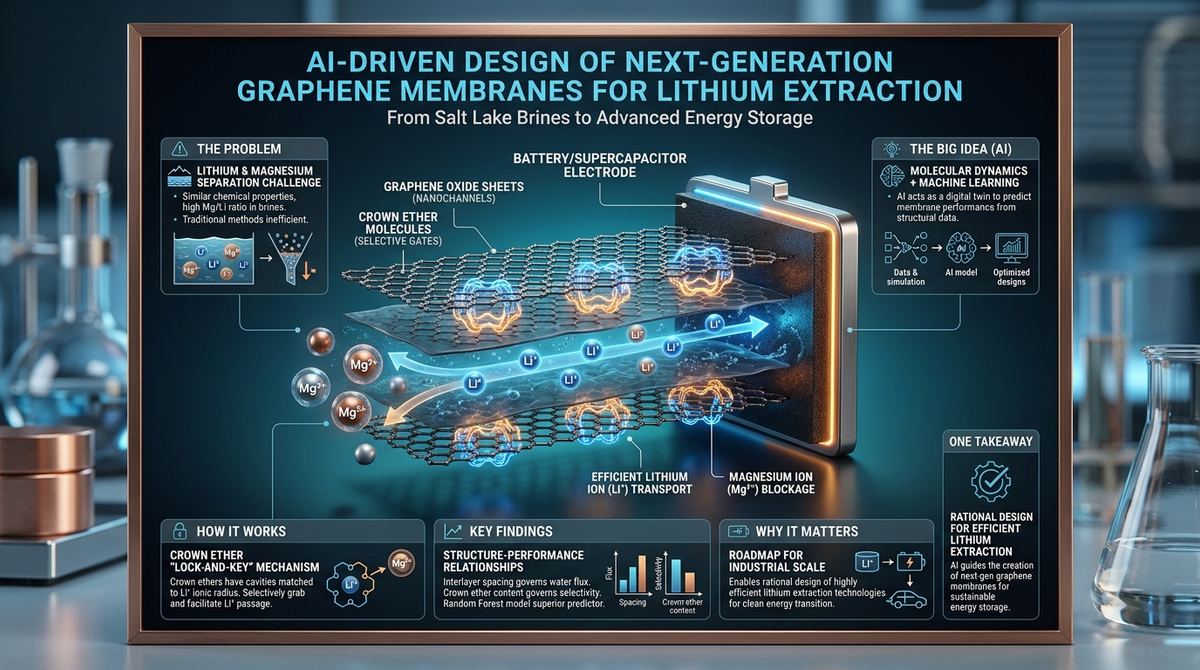
The global transition toward electric vehicles and renewable energy storage has triggered an unprecedented surge in demand for lithium. As the primary component in lithium-ion batteries, lithium is often referred to as white gold, yet its extraction remains a significant industrial challenge. Many of the world's largest lithium reserves are found in salt lake brines, where lithium is mixed with high concentrations of other ions, most notably magnesium. Because magnesium and lithium share similar chemical properties and are often found in much higher concentrations, separating them is an incredibly difficult task that current industrial processes struggle to perform efficiently and sustainably. To solve this, scientists are looking toward nanotechnology, specifically using graphene oxide membranes modified with specialized molecules called crown ethers. Recent breakthroughs by Chunlei Wei, Mengmeng Ge, Yi Song, Timing Fang, and Xiaomin Liu have introduced a way to use artificial intelligence to predict exactly how these membranes will perform, potentially bypassing years of expensive and slow laboratory experimentation.
The primary obstacle in lithium production is the chemical similarity between lithium ions and magnesium ions in brine. While lithium is a monovalent ion and magnesium is a divalent ion, their hydration shells—the layer of water molecules that surrounds them in solution—can make their effective sizes and behaviors quite similar when passing through a filter. In many salt lake brines, the ratio of magnesium to lithium is high, meaning the membrane must be incredibly selective to prevent magnesium from clogging the system or diluting the final lithium product. Traditional separation methods, such as chemical precipitation or solvent extraction, are often energy-intensive, require harsh chemicals, and produce significant waste.
A more elegant solution lies in using graphene oxide membranes. Graphene oxide consists of thin sheets of carbon that can be stacked to create tiny, nano-scale channels. However, even with graphene oxide, achieving the perfect balance between speed and selectivity is difficult. If the channels are too wide, magnesium passes through; if they are too narrow, the water flux—the speed at which the liquid flows through the membrane—becomes too slow for industrial use. Furthermore, optimizing these membranes typically requires molecular dynamics simulations. While these simulations are highly accurate, they are computationally expensive and time-consuming. Simulating a single membrane configuration can take weeks of supercomputer time, making it nearly impossible to test the millions of potential combinations of molecular structures needed to find the perfect membrane.
The researchers addressed this bottleneck by combining the physical accuracy of molecular dynamics with the predictive power of machine learning. Instead of trying every possible membrane design in a simulation, the team used a small set of highly accurate simulations to train an artificial intelligence model. This model acts as a proxy or a digital twin. Once the AI learns the relationship between a membrane's structure and its performance, it can predict the outcome for new, untested designs in a fraction of a second.
This approach allows scientists to treat membrane design like a mathematical optimization problem. By looking at four specific structural features—how many crown ethers are attached, how much space is between the graphene sheets, how the electrical charge is distributed, and the angle at which the sheets are tilted—the AI can pinpoint the exact configuration that maximizes lithium collection while minimizing magnesium contamination and maximizing water flow. This shifts the paradigm from trial-and-error experimentation to a data-driven design strategy.
To understand why these membranes work, one must look at the chemistry of the crown ether and the physics of the graphene nanochannels. A crown ether is a cyclic molecule that acts like a chemical lock and key. These molecules are specifically engineered to have a cavity size that matches the ionic radius of a target ion. In this research, the crown ethers are grafted onto the surface of the graphene oxide sheets. As ions flow through the membrane, the crown ethers use host-guest recognition to selectively grab lithium ions, facilitating their passage through the membrane while effectively ignoring or repelling other ions.
The graphene oxide itself provides the structural framework. The sheets are stacked in a way that creates nanochannels or interlayer spacings. These channels act as a physical sieve, but the mechanism is more complex than just size. The presence of functional groups on the graphene oxide creates an electrostatic environment. When the charge distribution on the membrane is non-uniform, it creates an asymmetric charge effect. This effect, combined with the Donnam effect—whereby the electrical charge of the membrane repels ions of the same charge—helps to block the divalent magnesium ions.
Furthermore, the inclination of the graphene sheets plays a critical role in the fluid dynamics within the membrane. If the sheets are perfectly parallel, the water flows straight through. However, if the sheets are slightly tilted or inclined, it changes the path the water must take, creating a more tortuous route. This inclination influences the water flux and the time the ions spend interacting with the crown ethers, which ultimately dictates how many lithium ions are successfully captured versus how many magnesium ions are rejected.
Using two different types of machine learning models, Random Forest and Extreme Gradient Boosting, the researchers analyzed how the structural descriptors affect performance. The Random Forest model proved to be the superior tool for this task, providing higher accuracy in predicting the complex, non-linear relationships between the membrane structure and its chemical performance.
The study revealed that different performance indicators are governed by different physical mechanisms. For instance, the water flux—the speed at which the brine moves through the membrane—is primarily determined by the interlayer spacing and the inclination of the graphene sheets. This makes sense, as these two factors directly control the geometry of the paths through which the liquid must travel. On the other hand, the permeability of lithium is a co-determined result of the interlayer spacing and the number of crown ether molecules grafted to the surface. This highlights the importance of the host-guest recognition mechanism; you need enough crown ethers to catch the lithium, but you also need enough space for the ions to move through.
One of the most significant findings was the discovery of interactive effects, which are interactions where the impact of one variable depends on the state of another. The researchers found that the number of crown ethers works in synergy with the interlayer spacing to enhance lithium permeability. Additionally, the crown ether density works in synergy with the asymmetric charge distribution to boost the retention of magnesium. This means that simply adding more crown ethers is not enough; they must be paired with a specific charge distribution to effectively block the magnesium ions. This discovery provides quantitative evidence for the synergy between the Donnan effect and specific host-guest recognition, proving that a multi-layered defense is necessary for high-performance separation.
This research is significant because it provides a roadmap for the rational design of industrial-scale separation technologies. By identifying the specific synergies between crown ether content, charge distribution, and sheet geometry, the study moves the field away from the "guess and check" method. Instead of producing many failed membrane prototypes in a lab, engineers can use these machine learning models to design the perfect membrane on a computer first.
The ability to achieve high selectivity (keeping magnesium out) while maintaining high flux (letting lithium in) is the holy grail of lithium extraction. Usually, there is a trade-off: if you make a membrane very selective, it becomes very slow. If you make it fast, it becomes less selective. This research provides the mathematical evidence needed to find the "sweet spot" where both performance metrics are optimized. This could significantly lower the cost of lithium production, making the entire electric vehicle supply chain more efficient and economically stable.
While this research represents a massive leap forward, it is important to note that the study is currently based on molecular dynamics simulations rather than physical, large-scale manufacturing. Simulations are excellent for understanding fundamental physics, but they cannot fully capture the complexities of a real-world industrial environment. For example, the study does not account for the long-term chemical stability of the crown ether-modified graphene in highly corrosive, real-world salt lake brines.
In a real factory, membranes are subject to fouling—where impurities like organic matter or silt clog the pores—and chemical degradation over months of continuous use. Furthermore, the transition from a computer-optimized model to a mass-produced, roll-to-roll manufactured membrane involves significant engineering challenges. The next critical step for this research will be the fabrication of these optimized membranes in a laboratory setting and testing them with actual brine samples to see if the AI's predictions hold true in the real world.
The implications of this research extend far beyond a single laboratory experiment. The most immediate application is in the lithium mining industry, specifically in the extraction of lithium from brine resources in regions like the Lithium Triangle in South America. As demand for battery-grade lithium grows, these optimized membranes could become a standard component of lithium processing plants.
Beyond lithium, this technology has broad potential in the field of water purification and resource recovery. The same principles of using crown ethers and graphene oxide could be applied to extract other valuable metals from industrial wastewater, such as cobalt, nickel, or rare earth elements. This could play a massive role in the circular economy, specifically in the recycling of spent lithium-ion batteries, where separating the components for reuse is essential for sustainability. Finally, the ability to control ion transport through nano-scale channels could lead to advancements in desalination and the purification of highly saline industrial effluents.
If there is one takeaway from this research, it is that the future of advanced materials lies in the fusion of physical science and artificial intelligence, allowing us to design complex molecular "locks and keys" that can solve the world's most pressing resource challenges.
Question: What is graphene oxide and why is it used here?
Graphene oxide is a derivative of graphene that contains oxygen-functional groups on its surface. In this research, it is used as a structural scaffold. Because it can be stacked into layers with tiny gaps between them, it creates nano-scale channels that act as filters for ions.
Question: Why is magnesium such a problem in lithium extraction?
Magnesium ions often exist in much higher concentrations than lithium ions in salt lake brines. Because they are chemically similar in certain ways, they can easily "sneak" through filters that are designed for lithium, which dilutes the lithium and makes the extraction process inefficient.
Question: How does a crown ether actually work?
A crown ether is a ring-shaped molecule that has a very specific size. This size allows it to selectively bind to a specific ion, like lithium, through a process called host-guest recognition. It acts like a specialized gateway that only lets certain ions pass through easily.
Question: What is the difference between Random Forest and XGBoost in this study?
Both are machine learning techniques used to make predictions. Random Forest works by creating many different "decision trees" and averaging their results to find a pattern. XGBoost is similar but uses a "boosting" method where each new tree tries to correct the errors made by the previous trees. In this study, Random Forest was more accurate.
Question: Will this mean we can get cheaper lithium batteries immediately?
Not immediately. While this research provides a way to design much better membranes, there is still work to do in manufacturing these membranes at scale and testing them in real-world conditions. However, it provides a vital blueprint for making that transition possible.
The intersection of nanotechnology and machine learning is opening new frontiers in material science. By using AI to decode the complex relationships between molecular structure and ion selectivity, researchers like Chunlei Wei and their team have provided a powerful tool for solving the lithium-magnesium separation problem. This data-driven approach not only accelerates the discovery of high-performance membranes but also paves the way for a more sustainable and efficient global supply chain for the materials that power our modern world.
Serious about B2B integration? Test our premium Pulsed Electrical Resistive Carbon Heating turbostratic graphene in your lab. 100g sample packs available now.
Explore More
Learn how to create p-n junctions in graphene by selectively oxidizing the underlying germanium substrate. This guide covers a practical method for...

Explore a breakthrough graphene-silicon slot-waveguide modulator. This high-speed device operates at both 1.5 μm and 2 μm, promising next-gen optical networks.

New research reveals that mechanical strain doesn't just reduce but fundamentally reshapes heat flow in graphene, a critical insight for flexible...