
Detection of spin- and valley-polarized states in van der Waals materials via
Researchers propose a novel method to detect spin- and valley-polarized states in van der Waals materials, a key step for next-gen spintronics and...
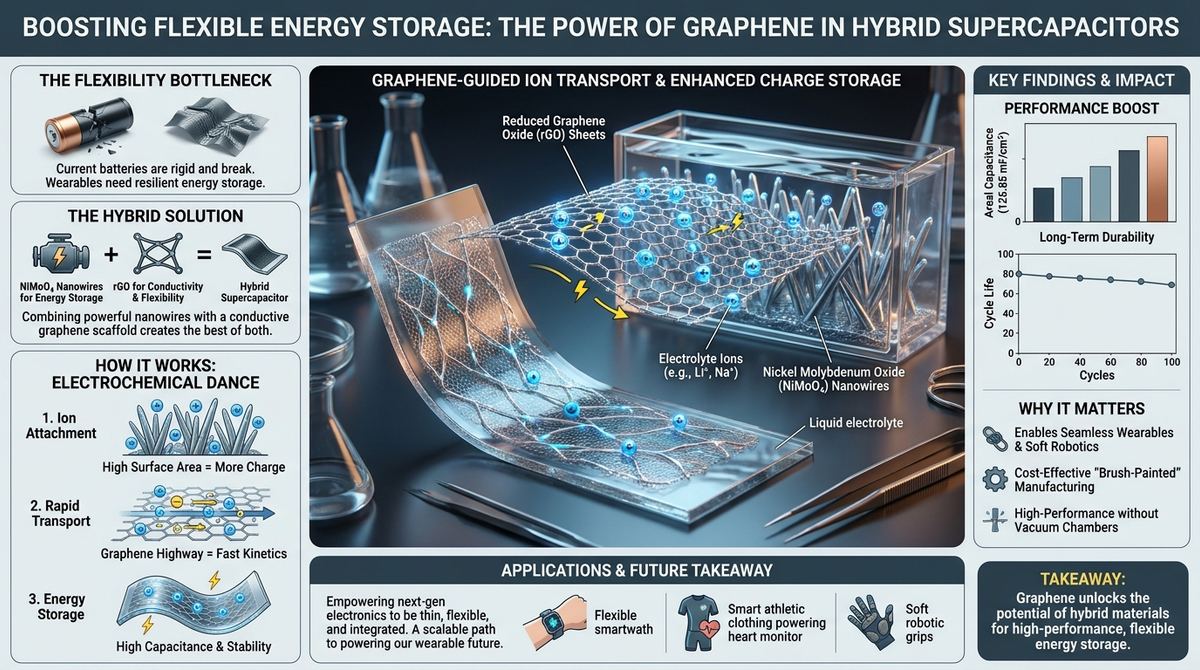
Imagine a future where your smartwatch is as thin as a piece of adhesive tape, or where your athletic clothing can power your heart monitor through the simple motion of your muscles. As we move toward a world of wearable technology and soft robotics, our current energy storage solutions are hitting a wall. Most of the batteries we use today, like the lithium-ion cells in your phone, are rigid, bulky, and prone to breaking if you bend them too much. To make the next generation of smart gadgets truly seamless, we need energy storage that is as flexible and resilient as the fabrics we wear. This is the challenge that a team of dedicated researchers, including Pei-Yi Yan, Lu-Hong Chen, Li-Da Chiu, Yi-Der Huang, I-Chun Cheng, and Jian-Zhang Chen, have set out to solve by developing a new kind of flexible supercapacitor that combines the best properties of multiple advanced materials.
The drive toward wearable electronics and soft integrated systems has created a significant engineering bottleneck. Current energy storage devices are generally designed for static, flat environments. While they are incredibly efficient at holding a charge, they lack mechanical adaptability. When you bend a standard battery, the internal chemical components can crack, the connections can fail, and the device can even become dangerous. This mechanical instability is a dealbreaker for the burgeoning field of "e-textiles," where electronics must be integrated into clothes that are washed, stretched, and folded.
Furthermore, there is a performance gap in energy density and power delivery. Traditional capacitors often struggle to hold enough energy to power complex sensors, while traditional batteries often cannot charge or discharge fast enough to meet sudden power demands. There is a desperate need for a device that bridges this gap—a device that offers high capacitance (the ability to store charge) and high conductivity (the ability to move that charge quickly) while remaining completely flexible. The core problem is how to combine different materials that have conflicting properties: some materials store a lot of energy but are poor conductors, while others are great conductors but cannot store much energy.
The solution proposed by the research team involves creating a "hybrid" material. Instead of relying on just one substance, they have cooked up a specialized recipe that mixes several different components to get the best of all worlds. Think of it like building a high-performance racing car. You wouldn't want an engine that is powerful but heavy, or a frame that is light but weak. Instead, you want a powerful engine, a lightweight frame, and high-quality tires that provide grip.
In this research, the researchers use nickel molybdenum oxide nanowires to act as the engine, providing a massive amount of energy storage through chemical reactions. They use polyaniline, a special type of conductive plastic, to add extra energy storage and help the flow of electricity. To keep everything together and flexible, they use chitosan, a natural substance derived from the shells of crustaceans. Finally, they add reduced graphene oxide, which acts like a high-speed highway system, allowing electricity to zip through the material without getting stuck. By brush-painting these materials together onto a surface, they create a single, flexible, and highly efficient energy storage layer.
To understand why this specific combination works, we have to look at the electrochemical dance happening at the microscopic level. The star of the show is the nickel molybdenum oxide (NiMoO4) nanowire structure. These nanowires are not just random shapes; they are engineered to provide a massive surface area. Because the electrochemical reactions that store energy happen on the surface of the material, having a "forest" of nanowires provides much more space for the ions in the electrolyte to attach and detach compared to a flat surface.
However, nanowires by themselves can be isolated from one another, making it difficult for electrons to travel across the whole electrode. This is where the reduced graphene oxide (rGO) becomes essential. Graphene is a single layer of carbon atoms arranged in a hexagonal lattice, and it is one of the best conductors of electricity known to science. When rGO is added to the mix, it fills the empty spaces between the nanowires and the polymer chains. This creates what scientists call a continuous percolation network. Effectively, the graphene creates a conductive scaffold that bridges the gaps between the active NiMoO4 nanowires, ensuring that an electron can travel from one end of the device to the other with minimal resistance.
The polyaniline (PANI) component adds another layer of complexity through a process called pseudocapacitance. Unlike traditional capacitors that store energy through simple physical movement of ions, pseudocapacitors store energy through fast, reversible chemical redox reactions. This allows for a much higher storage capacity. Finally, the chitosan acts as a structural binder. In many electrochemical devices, the active materials tend to expand and contract as they charge and discharge, which can cause the material to flake off the electrode. Chitosan provides a flexible, organic matrix that holds the nanowires and graphene in place, absorbing the mechanical stress of bending and the chemical stress of ion movement.
The results of this composite design were quite striking. By integrating the reduced graphene oxide, the researchers observed a significant boost in electrochemical performance. Specifically, the device achieved an areal capacitance of 125.85 mF/cm2 at a low scan rate. This measurement tells us how much charge the material can hold per unit of surface area, and for a flexible, brush-painted device, this is a very impressive figure.
One of the most critical metrics for any electronic component is how long it can last. Most batteries degrade over time as their internal chemistry shifts or their physical structure breaks down. However, this NiMoO4/PANI/Chitosan/rGO composite demonstrated incredible durability. After being subjected to 10,000 charge and discharge cycles, the device retained 94.5% of its original capacitance. This suggests that the synergistic effect of the graphene and the chitosan prevents the degradation that usually plagues high-performance materials. The graphene ensures the electrical pathways remain intact, while the chitosan ensures the physical structure remains stable.
Furthermore, the device operated stably within a voltage window of 0.8 V. While this might seem like a small number compared to a standard lithium battery, for a flexible supercapacitor, it represents a successful balance between operating voltage and material stability. The researchers also confirmed that the mechanical flexibility was robust, meaning the device could be bent repeatedly without a significant drop in its ability to store and release energy.
This research is a significant milestone because it demonstrates that we do not need incredibly complex, multi-million dollar vacuum chambers to create high-performance materials. The researchers used a "brush-painting" strategy. This is a low-cost, simple, and highly scalable fabrication method. If we want to produce flexible electronics for the mass market, we cannot rely on expensive, slow manufacturing processes. The ability to "paint" an electrode onto a substrate opens the door to industrial-scale production of flexible energy storage.
Furthermore, the study proves the power of hybrid materials. It shows that we don't have to choose between high power (how fast it can discharge) and high energy (how long it can last). By combining the pseudocapacitance of the metal oxide and the polymer with the electric double-layer capacitance of the graphene, the researchers created a material that performs well across multiple dimensions. This synergy is the blueprint for the next generation of energy storage design.
Despite these exciting results, it is important to maintain a realistic perspective on the current state of this technology. While the performance is high, the voltage window of 0.8 V is relatively narrow. In the world of energy storage, energy is proportional to the square of the voltage. This means that even a small increase in the voltage window could lead to a massive increase in total energy storage. Future research will need to focus on using electrolytes that can support higher voltages without breaking down chemically.
Additionally, while the brush-painting method is cost-effective and simple, it may face challenges in achieving perfect uniformity over very large areas or very complex, three-dimensional surfaces required for advanced soft robotics. There is also the question of long-term environmental stability. While the device can handle 10,000 cycles, we do not yet know how these organic components (chitosan and polyaniline) will react to extreme humidity, temperature fluctuations, or prolonged exposure to oxygen over several years. Moving from a lab-scale prototype to a consumer-ready product will require rigorous testing under real-world environmental stresses.
The implications for real-world technology are vast. The most immediate application is in wearable health monitors. Imagine a glucose monitor or a heart-rate sensor that is embedded directly into a smart bandage or a compression sleeve, powered by a flexible, thin-film supercapacitor that bends with your skin.
Beyond healthcare, this technology is vital for the smart textile industry. We are moving toward a world where clothing is not just a covering, but a digital interface. Flexible supercapacitors could power integrated sensors that track posture, temperature, or even muscle activity, all while being seamlessly integrated into the fabric of a shirt or pair of leggings.
Finally, in the realm of soft robotics, these devices could provide the power for artificial muscles and flexible sensors that allow robots to navigate uneven terrain or interact safely with humans. As the demand for portable, flexible, and durable electronics continues to skyrocket, materials like the one developed by Yan and her team will become the foundational building blocks of the digital age.
If you take away only one point from this research, let it be this: the marriage of graphene with metal oxides and organic polymers creates a "super-material" that solves the trade-off between conductivity and storage capacity, providing a scalable and flexible solution for the future of wearable electronics.
What is a supercapacitor and how does it differ from a standard battery?
A supercapacitor is an energy storage device that sits somewhere between a traditional capacitor and a chemical battery. While a battery relies on slow chemical reactions to store energy, a supercapacitor stores energy through the physical movement of ions or much faster electrochemical reactions. This allows supercapacitors to charge and discharge much more quickly than batteries, making them ideal for applications that require sudden bursts of power.
Why is graphene so important in this specific research?
Graphene acts as a high-speed electrical highway within the electrode. Because the active material, the NiMoO4 nanowires, is not a perfect conductor, electrons can sometimes get "trapped" or face high resistance. Graphene's incredible electrical conductivity provides a continuous network that allows electrons to move rapidly through the material, which increases the overall efficiency and power delivery of the device.
What role does chitosan play in a device that is meant to be flexible?
Chitosan serves as a structural binder or a "glue." Because the active materials in a supercapacitor can expand and contract as they charge and discharge, they have a tendency to crack or peel away from the electrode. Chitosan is a flexible, natural polymer that holds all the components together in a stable matrix, allowing the entire electrode to bend and stretch without falling apart.
Can this technology be used in the clothes we wear?
Yes, that is one of its primary goals. Because the fabrication method involves a simple brush-painting technique, it is possible to apply these materials to flexible substrates like fabrics or thin plastics. This makes it a prime candidate for "smart textiles," where the energy storage component is so thin and flexible that the wearer would not even notice it is there.
Is this technology ready to replace the battery in my smartphone?
Not quite yet. While these supercapacitors are excellent for flexibility and power, current smartphone batteries still hold much more total energy than these flexible devices can. Current research is focused on finding ways to increase the energy density so that these flexible materials can eventually power more complex electronics over longer periods of time.
The research conducted by Pei-Yi Yan, Lu-Hong Chen, Li-Da Chiu, Yi-Der Huang, I-Chun Cheng, and Jian-Zhang Chen represents a significant step forward in the quest for flexible, high-performance energy storage. By cleverly combining the high capacity of NiMoO4 nanowires and polyaniline with the superior conductivity of reduced graphene oxide and the structural stability of chitosan, they have created a composite that is both powerful and incredibly durable. While challenges remain in increasing the voltage window and ensuring long-term environmental stability, the use of a simple, scalable brush-painting method provides a clear path toward the mass production of the flexible power sources needed for the next generation of wearable and portable electronics.
Serious about B2B integration? Test our premium Pulsed Electrical Resistive Carbon Heating turbostratic graphene in your lab. 100g sample packs available now.
Explore More
Researchers propose a novel method to detect spin- and valley-polarized states in van der Waals materials, a key step for next-gen spintronics and...

Researchers developed the CARBON-2D Topological Descriptor (C2DTD), an interpretable, physics-informed method to rapidly predict the properties of new 2D...

Learn how to create p-n junctions in graphene by selectively oxidizing the underlying germanium substrate. This guide covers a practical method for...